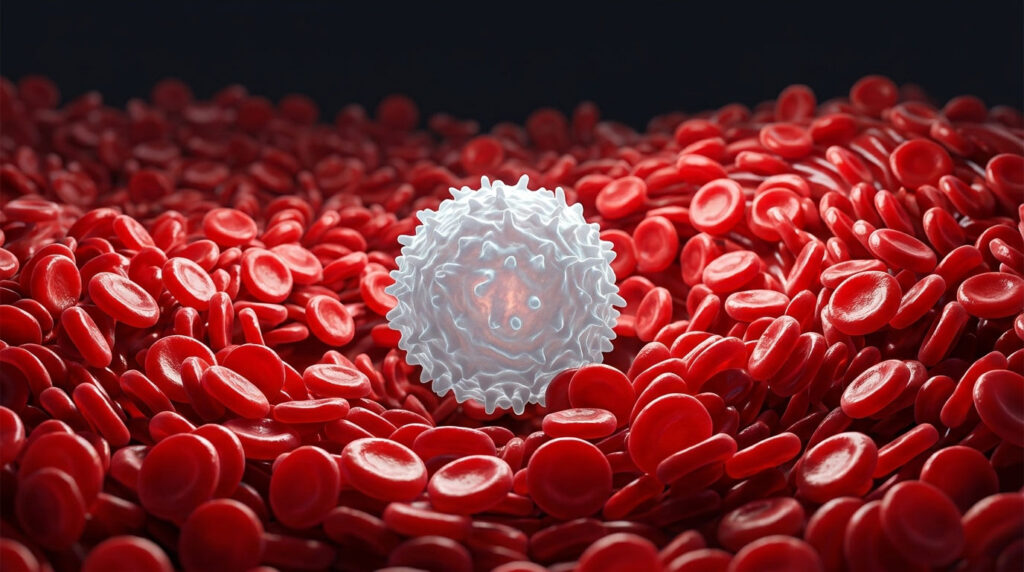
For every white blood cell in your body, you carry several hundred red ones. The red cells keep you breathing at the tissue level; the rare white cells keep a minor scratch from becoming a dangerous infection. Two cell types, two unrelated jobs, sharing the same bloodstream.
Table of Contents
If you’ve ever opened a blood test and wondered why RBC and WBC land on separate lines, this is the plain-English breakdown that connects the dots, including what your own numbers are telling you.
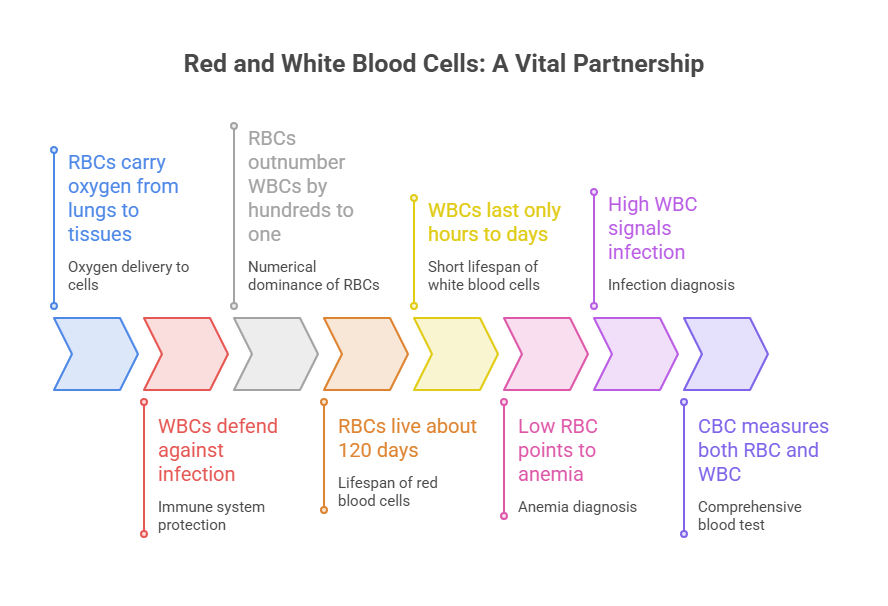
Quick answer: Red blood cells (RBCs) and white blood cells (WBCs) are the two main cell types in your blood. RBCs, or erythrocytes, carry oxygen from your lungs to your tissues and give blood its red color. WBCs, or leukocytes, defend you against infection. RBCs vastly outnumber WBCs, live about 120 days, and have no nucleus, while WBCs are larger, far fewer, and keep their nucleus. Both show up on a complete blood count.
At a glance
- RBCs carry oxygen; WBCs fight infection. That’s the core difference.
- RBCs (erythrocytes) outnumber WBCs (leukocytes) by hundreds to one.
- A normal adult WBC count runs about 4,500 to 11,000 cells per microliter.
- RBCs live about 120 days; most WBCs last only hours to days.
- Low RBC often points to anemia; high WBC often signals infection.
- One blood test, the CBC, measures both at the same time.
Red and White Blood Cells, Meet the Two Workhorses
Blood looks like one red liquid, but it’s a crowded mix of cells suspended in plasma. Two of those cell types do most of the talking on your lab report, and they could hardly be more different in what they do.
Taking each one on its own first makes the head-to-head comparison much easier to hold in your head.
What red blood cells (erythrocytes) are
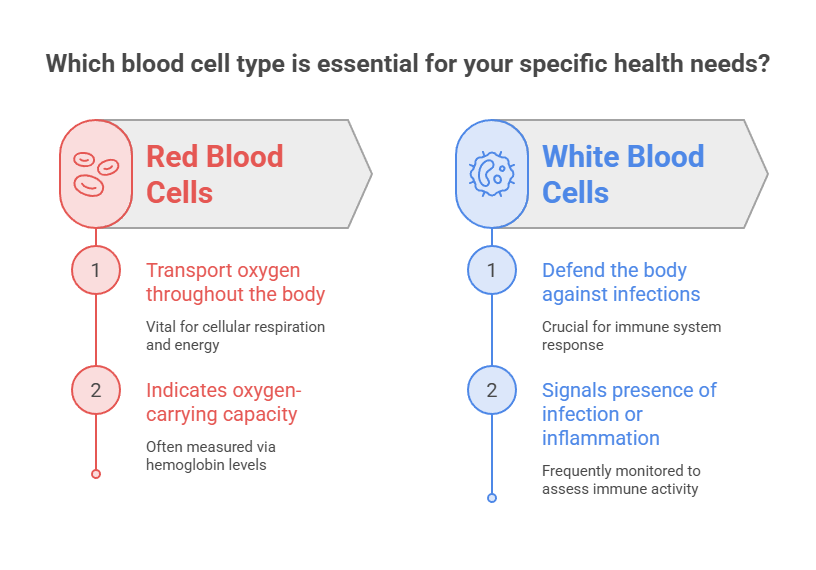
Red blood cells, known medically as erythrocytes, are your body’s oxygen couriers. Packed with hemoglobin, an iron-rich protein, they collect oxygen in your lungs and deliver it to every tissue, then ferry carbon dioxide back out.
That hemoglobin is also what makes them red, and because there are so many of them, it’s what makes your blood red. A mature red cell is a flexible, biconcave disc with no nucleus, a design that leaves more room for hemoglobin.
Each red cell is packed with around 270 million hemoglobin molecules, and the iron at the center of each one is what actually grips the oxygen. That’s why iron levels and red cell health are so closely linked.
What white blood cells (leukocytes) are
White blood cells, or leukocytes, are your immune system’s field agents. They patrol your bloodstream and tissues, hunting bacteria, viruses, and other invaders, and they coordinate the counterattack when something breaks through.
Unlike red cells, they keep their nucleus, come in several specialized types, and are colorless on their own. They’re badly outnumbered, yet they punch well above their weight.
They also don’t stay put. White cells spend much of their time outside the bloodstream, patrolling tissues and lymph nodes, then surge into circulation when an infection calls for backup.
Where both come from: the bone marrow
Here’s where the two finally agree. Both red and white blood cells are produced in your bone marrow, the spongy tissue inside your larger bones, from the same family of stem cells.
In CBC panels reviewed by our medical team, these two counts anchor almost every result we walk patients through, precisely because they mirror how that marrow is performing.
Your marrow runs this production line every second of the day. A healthy adult makes roughly two million red blood cells per second just to keep pace with the ones wearing out, alongside a steady supply of white cells and platelets.
RBC vs WBC: The Core Differences Side by Side
When patients ask us to sum up the difference fast, the table below is the shortcut. It lines up the traits that matter most, from job and color to size, count, and the conditions each cell is tied to.
| Feature | Red Blood Cells (RBC) | White Blood Cells (WBC) | Why It Matters |
| Also called | Erythrocytes | Leukocytes | Same cells, technical names |
| Main job | Carry oxygen, remove CO2 | Fight infection, immune defense | The single biggest difference |
| Color | Red (from hemoglobin) | Colorless or pale | Hemoglobin colors your blood |
| Nucleus | None when mature | Yes | Lets WBCs do complex tasks |
| Shape and size | Biconcave disc, about 6 to 8 microns | Larger, varies by type, about 10 to 20 microns | WBCs are noticeably bigger |
| Normal count | Men about 4.7 to 6.1 million/µL; women 4.2 to 5.4 million/µL | About 4,500 to 11,000 cells/µL | RBCs hugely outnumber WBCs |
| Lifespan | About 120 days | Hours to a few days (some live years) | RBCs are long-haul workers |
| Made in | Bone marrow | Bone marrow (some mature in lymph tissue) | Shared origin |
| Linked conditions | Anemia, polycythemia | Leukopenia, leukocytosis, leukemia | What an abnormal count may signal |
Structure and size, why shape follows function
A red blood cell’s biconcave shape isn’t an accident. That dimpled disc gives it a large surface area for swapping oxygen and enough flex to fold through your narrowest capillaries single-file.
White blood cells trade that streamlined shape for versatility. Many can change form to slip out of blood vessels and crawl into infected tissue, a move red cells simply can’t make.
The numbers gap: why RBCs vastly outnumber WBCs
The count difference is striking. A microliter of blood holds millions of red cells but only thousands of white cells, which is why several hundred red cells exist for every white one.
The logic holds up. Every cell in your body needs constant oxygen, while immune defenders sit in reserve and surge only when called. Our lab partners report that this lopsided ratio is one of the first things that surprises people reading a CBC.
A simple way to remember which is which
Here’s a memory trick. Red cells are about the red stuff, oxygen and hemoglobin, the fuel delivery. White cells are about defense, the body’s security team. Red equals routine transport; white equals warfare on germs.
Another anchor: there are far more delivery trucks (red cells) than security guards (white cells) on the road at any moment, because delivery happens constantly while security surges only when there’s a threat. That picture keeps the two roles straight.
What Each Cell Actually Does
The side-by-side view shows that they differ. This section shows how each one earns its place, because the jobs are where erythrocytes and leukocytes truly part ways.
Red blood cells: oxygen delivery and CO2 return
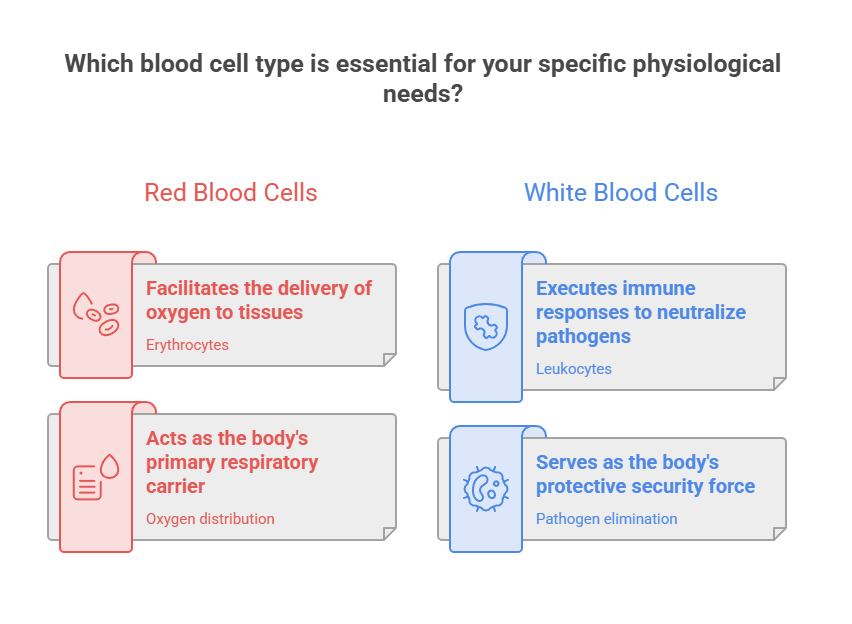
Red cells run a two-way shuttle. Hemoglobin grabs oxygen in the lungs, releases it where tissues need fuel, then binds carbon dioxide and carries it back to the lungs to be exhaled.
It’s nonstop work. Because mature red cells carry no nucleus and can’t repair themselves, they wear out after roughly 120 days and get recycled while fresh ones replace them. Anything that lowers their number or their hemoglobin chips away at how much oxygen reaches your tissues.
Production is tightly managed. When oxygen runs low, your kidneys release a hormone called erythropoietin (EPO) that signals the marrow to make more red cells, which is part of why conditions affecting the kidneys can also affect your red count.
White blood cells: the body’s defense team
White cells are less a single worker than a coordinated squad. Some swallow and destroy bacteria, some target virus-infected cells, some release chemicals that drive allergic and inflammatory responses, and some build long-term immune memory.
When you shake off a cold or a wound starts to heal, white cells are doing the work behind the scenes. Across the patients we serve, a rising white count is usually the body’s normal answer to an infection, not a sign of something rare.
Broadly, the defense splits into two arms. Innate immunity is the fast, general first response led by neutrophils and monocytes, while adaptive immunity is the slower, targeted response led by lymphocytes that also remembers a germ for next time.
The five types of white blood cells
White blood cells aren’t all alike. A standard test called the differential breaks the total into five types, each with a distinct role. The table below shows the usual proportions and what each one handles.
| White Cell Type | Normal Share of WBCs | Main Job |
| Neutrophils | 40 to 60% | First responders to bacterial infection |
| Lymphocytes | 20 to 40% | B and T cells; fight viruses, make antibodies, store memory |
| Monocytes | 2 to 8% | Become macrophages that engulf debris and germs |
| Eosinophils | 1 to 4% | Target parasites and drive allergic responses |
| Basophils | 0.5 to 1% | Release histamine in allergic and inflammatory reactions |
Neutrophils and lymphocytes do the bulk of the work, which is why a shift in either tells your doctor a lot. If you want the red-cell side in the same depth, our related guides on red cell indices and RDW break those numbers down.
Beyond RBC and WBC: Platelets and Plasma
Red and white cells get the spotlight, but they share the bloodstream with two other key players. Knowing where they fit makes your CBC easier to read as a whole.
Platelets: the clotting crew
Platelets, also called thrombocytes, are tiny cell fragments that rush to the site of a cut and clump together to stop bleeding. A normal count runs about 150,000 to 450,000 per microliter, and they appear right alongside RBC and WBC on your CBC.
A low platelet count can mean easy bruising or bleeding, while a high one can raise clotting risk. They’re neither red nor white, but they come from the same bone-marrow output as the other two.
Plasma: the liquid that carries it all
Plasma is the pale yellow fluid that makes up just over half your blood by volume. It carries red cells, white cells, and platelets, plus nutrients, hormones, antibodies, and waste products.
When you hear that pregnancy or dehydration changes blood concentration, plasma is usually the reason. More plasma dilutes the cells; less plasma concentrates them, which is why hydration alone can shift a reading.
How the three cell types compare
Put simply, red cells carry oxygen, white cells fight infection, and platelets stop bleeding. Three jobs, one bloodstream, all tracked by the same routine test. Patients we serve often find the CBC clicks once they picture these three roles together.
| Cell Type | Main Job | Normal Adult Range |
| Red blood cells (RBC) | Carry oxygen | About 4.2 to 6.1 million/µL |
| White blood cells (WBC) | Fight infection | About 4,500 to 11,000/µL |
| Platelets | Stop bleeding (clotting) | About 150,000 to 450,000/µL |
Normal RBC and WBC Counts (US Reference Ranges)
Numbers only mean something against a reference range, and ranges drift a little by sex, age, and lab. The values below pair commonly used US adult ranges with fresh national data, so you can see both what’s typical and how common abnormal counts actually are.
| Measure | Typical US Value or Statistic | Source |
| Normal RBC count (men) | 4.7 to 6.1 million/µL | Univ. of Rochester Medical Center |
| Normal RBC count (women) | 4.2 to 5.4 million/µL | Univ. of Rochester Medical Center |
| Normal WBC count (adults) | 4,500 to 11,000 cells/µL | StatPearls (NCBI) |
| US anemia prevalence (age 2+) | 9.3% overall; 13.0% women, 5.5% men | CDC NHANES |
| Estimated new US leukemia cases, 2026 | 67,790 | SEER / NCI |
| Normal platelet count (for context) | 150,000 to 450,000 cells/µL | StatPearls (NCBI) |
How to read your own CBC without panic
When results land, resist matching a single flagged value to the worst outcome you can picture. One number slightly outside the range is common and often harmless, especially right after illness, stress, or even a hard workout.
What your doctor reads is the full picture: which value is off, by how much, and whether the others form a pattern. Patients booking tests with us often ask which number matters more, and the honest answer is that context decides.
A handy habit is to check whether a value is flagged high or low, by how far, and whether you feel any symptoms. Those three cues, direction, distance from the range, and how you feel, are what guide whether a result needs action.
Why “normal” varies by sex, age, and lab
Reference ranges aren’t universal. Men typically run higher red cell counts than women, newborns and young children carry higher white counts than adults, and each lab sets its own limits based on its equipment and local population.
That’s why the range printed beside your result is the one that counts. According to StatPearls, commonly cited intervals are only a guide, and local laboratory values always apply.
Medical disclaimer: This article is for general educational purposes and reflects current US sources like the CDC, NIH, and the American Cancer Society. It isn’t a substitute for personalized medical advice. Reference ranges vary by lab, and a single abnormal result rarely tells the whole story. Always discuss your blood test results and any symptoms with your physician or healthcare provider before drawing conclusions or making changes.
When Counts Go Wrong: High and Low
An abnormal RBC or WBC count is a clue, not a verdict. Each direction, high or low, points toward a different short list of causes, and most are far more ordinary than people fear.
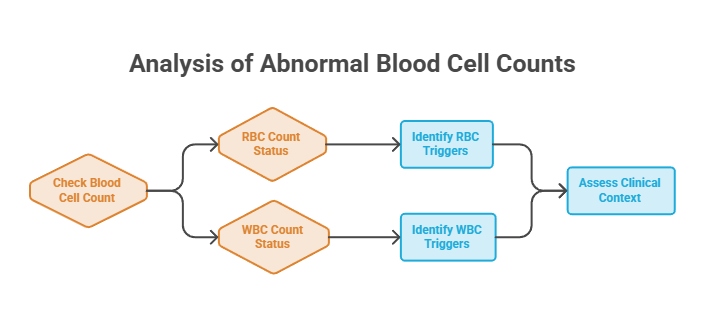
The two counts can also move on their own. You might have a low red count with a perfectly normal white count, or a high white count while your red cells sit right in range, since the two respond to different triggers.
Low RBC (anemia) and high RBC (polycythemia)
A low red blood cell count, or low hemoglobin, is anemia, the most common blood abnormality of all. Iron deficiency leads the causes, with symptoms like fatigue, pale skin, and breathlessness. Anemia affects about 9.3% of Americans age 2 and older, per CDC data.
A high red cell count, called polycythemia or erythrocytosis, is less common. It can come from dehydration, smoking, or living at altitude, or, rarely, from a bone marrow disorder that needs specialist care.
Symptoms of a genuinely high red cell count can include headaches, dizziness, flushed skin, or itching, though many people notice nothing at all. Because thicker blood can raise clot risk, a count that stays high is worth investigating rather than ignoring.
Low WBC (leukopenia) and high WBC (leukocytosis)
A high white blood cell count, leukocytosis, most often means your body is answering an infection, inflammation, or physical stress. It usually settles once the trigger resolves.
A low white count, leukopenia, can follow a viral illness, certain medications, or autoimmune conditions, and occasionally signals a marrow problem. Our medical reviewers note that a mildly low count after a recent virus is a frequent and usually temporary finding.
When an abnormal count points to something serious
Most abnormal counts are benign and short-lived. The exceptions matter, though. Persistently very high white counts, especially with many immature cells, can signal leukemia, a cancer of blood-forming tissue. An estimated 67,790 Americans will be diagnosed with leukemia in 2026, per the American Cancer Society and SEER.
Context is everything here. A one-time mildly abnormal value after an infection or a hard week rarely means cancer, while a count that drifts further across repeat tests, or comes with symptoms like easy bruising, deserves a closer look. Your provider weighs the number, the trend, and how you feel together.
The table below maps common CBC findings to what they may mean and a sensible next step.
| Result on Your CBC | What It May Suggest | Sensible Next Step |
| Low RBC or low hemoglobin | Anemia, often iron deficiency | Ask about iron studies and the underlying cause |
| High RBC or high hematocrit | Dehydration or polycythemia | Rehydrate; provider checks if it persists |
| High WBC (leukocytosis) | Infection, inflammation, or stress | Treat the cause; often a follow-up CBC |
| Low WBC (leukopenia) | Recent virus, medication, or marrow issue | Provider reviews meds and repeats testing |
| Both RBC and WBC low | Possible bone marrow problem | Prompt evaluation, likely a specialist referral |
| Very high or low counts with symptoms | A more urgent concern | Seek prompt medical care |
Call your doctor promptly if you notice: drenching night sweats with unexplained weight loss, easy bruising or bleeding, repeated infections, severe fatigue, or a fever that won’t break. These don’t always mean something serious, but paired with an abnormal count they’re worth a fast check rather than a wait.
How RBC and WBC Are Measured: The CBC
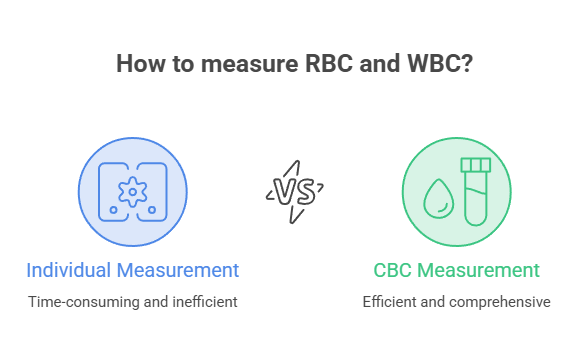
You don’t measure these cells one at a time. A single, routine test captures both, which is why your RBC and WBC results almost always arrive together.
What the complete blood count includes
The complete blood count, or CBC, is one of the most ordered tests in US medicine. It reports your red cell count, hemoglobin, and hematocrit, your white cell count, your platelet count, and a set of red cell indices like MCV and RDW.
Read together, those values sketch a fast portrait of your blood and bone marrow. In testing booked through HealthCareOnTime, the CBC is the panel patients meet first, often at a routine checkup.
What the WBC differential adds
Many CBCs include a differential, which splits the total white count into the five types covered earlier. That detail helps pinpoint why a white count is off.
A neutrophil-heavy rise points toward bacterial infection, while a lymphocyte shift leans viral. Per StatPearls, most modern analyzers generate this differential automatically.
What the red cell indices add
Your CBC also reports red cell indices: MCV (average red cell size), MCH and MCHC (how much hemoglobin each cell holds), and RDW (how much cell sizes vary). They explain the why behind a low red count.
Small, pale cells point to iron deficiency, while large cells suggest a B12 or folate gap. These details turn a single low number into a likely cause, which is why your doctor reads them alongside the RBC and WBC counts.
When doctors order it
A CBC turns up in many settings: annual physicals, pre-surgery workups, run-down spells, or monitoring a known condition. It’s quick, low-cost, and done from a single blood draw.
Because it screens red cells, white cells, and platelets at once, it’s an efficient first look whenever something seems off.
What can shift your counts day to day
Plenty of everyday factors nudge these numbers. Dehydration concentrates your blood and can raise counts, while recent exercise, stress, time of day, smoking, altitude, and pregnancy all move red or white values within or beyond the usual range.
Medications matter too. Steroids can raise white counts, and some drugs lower them. That’s why doctors look at trends and the full panel rather than reacting to one isolated result, and why a repeat test often clears things up.
Why Knowing the Difference Helps You
This isn’t just biology trivia. Understanding which cell does what changes how you read your own results and how you talk to your doctor.
It tells you what a flagged value might mean
When you know RBCs carry oxygen, a low red count paired with fatigue makes sense as possible anemia. When you know WBCs fight infection, a high white count during a cold reads as reassuring rather than scary. The label points you toward the right question.
It helps you ask better questions
Instead of “is my blood okay,” you can ask whether a low red count is from iron, or whether a high white count is just your recent infection. Patients booking tests with us tend to get more from their appointments when they frame questions this way.
It separates routine from urgent
Most abnormal counts are mild and temporary. Knowing the difference helps you tell a likely-harmless blip from the pattern of symptoms that genuinely warrants prompt care, so you neither panic over a small flag nor brush off a real warning sign.
In testing booked through HealthCareOnTime, that calm, informed read is exactly what we aim to give people: enough understanding to act when it counts and to relax when it doesn’t.
Frequently Asked Questions
What is the main difference between RBC and WBC?
Red blood cells carry oxygen from your lungs to your tissues and give blood its color. White blood cells defend your body against infection. That difference in job is the biggest distinction, and it drives nearly every other difference in shape, count, and lifespan.
Which is more important, RBC or WBC?
Neither, since they do different essential jobs. RBCs keep your tissues supplied with oxygen, while WBCs protect you from infection. You need both in healthy numbers, which is exactly why a CBC measures them together rather than treating one as primary.
What is a normal RBC and WBC count?
In US adults, red blood cell counts typically run about 4.7 to 6.1 million per microliter in men and 4.2 to 5.4 million in women. White blood cell counts usually fall between 4,500 and 11,000 cells per microliter. Ranges vary by lab, sex, and age.
Which is bigger, a red or white blood cell?
White blood cells are larger. A red blood cell measures about 6 to 8 microns across, while white cells range from roughly 10 to 20 microns depending on the type. Red cells make up for their smaller size with vastly greater numbers.
Why are there so many more RBCs than WBCs?
Every tissue in your body needs a steady oxygen supply, so red cells are produced in the millions. White cells stay in reserve and surge mainly when infection strikes, so far fewer are needed at any moment. That’s why several hundred red cells exist per white cell.
What does a high WBC count mean?
A high white count, called leukocytosis, most often means your body is fighting an infection or responding to inflammation or stress. It usually normalizes once the trigger clears. A persistently high count, especially with immature cells, warrants further testing to rule out other causes.
What does a low RBC count mean?
A low red cell count, or low hemoglobin, is anemia. Iron deficiency is the most common cause, and symptoms include fatigue, pale skin, and shortness of breath. Anemia affects about 9.3% of Americans age 2 and older and is usually treatable once the cause is found.
Can RBC and WBC both be low at once?
Yes, and that combination gets your doctor’s attention. When red cells, white cells, and often platelets are all low, it can point to a bone marrow problem, such as aplastic anemia or certain blood cancers. It usually prompts prompt evaluation and likely a specialist referral.
Do RBCs and WBCs have a nucleus?
Mature red blood cells have no nucleus, which frees up space for more hemoglobin and oxygen. White blood cells keep their nucleus, which helps them carry out the more complex tasks of recognizing and responding to threats. That difference is visible under a microscope.
How long do red and white blood cells live?
Red blood cells live about 120 days before they’re recycled and replaced. Most white blood cells last only hours to a few days, though some immune-memory cells survive for years. Your bone marrow continuously produces fresh cells to keep both supplies steady.
What are the five types of white blood cells?
The five types are neutrophils, lymphocytes, monocytes, eosinophils, and basophils. Neutrophils tackle bacteria, lymphocytes handle viruses and antibodies, monocytes clear debris, eosinophils target parasites and allergies, and basophils drive inflammatory responses. A test called the differential shows each one’s share.
Does a CBC measure both RBC and WBC?
Yes. The complete blood count measures red blood cells, white blood cells, and platelets in a single test, along with hemoglobin, hematocrit, and red cell indices. It’s one of the most common US lab tests and gives a fast overview of your blood from one draw.
References
- CDC NHANES: Anemia Prevalence, United States, August 2021 to August 2023
- StatPearls (NCBI): Normal and Abnormal Complete Blood Count With Differential
- University of Rochester Medical Center: Complete Blood Count Reference Ranges
- SEER / National Cancer Institute: Leukemia Cancer Stat Facts
- American Cancer Society: Key Statistics for Acute Myeloid Leukemia
- University of Iowa Health Care: Complete Blood Count (CBC) Reference Values