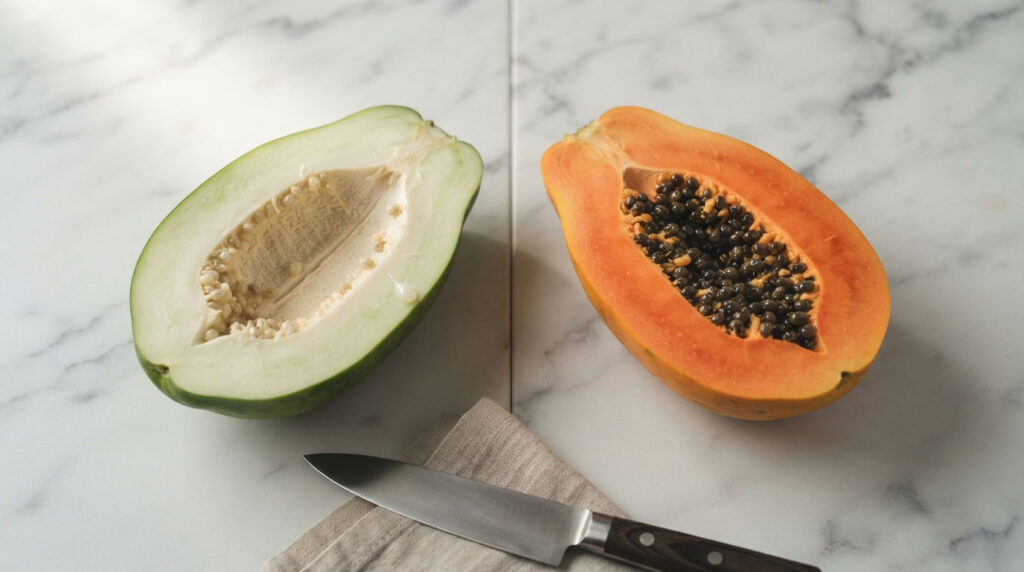
Slice a green papaya and a fully ripe one side by side, and only one of them weeps. Milky white sap runs from the unripe fruit, beads along the blade, and dries sticky on your fingers.
Table of Contents
That sap is not a defect. It is the whole story, and it explains why one form of this fruit carries a pregnancy warning while the other shows up on prenatal nutrition lists.
Quick Answer: Ripe papaya and raw green papaya are the same fruit at different stages, but they behave like two separate foods. Ripe papaya carries more vitamin C, lycopene, and beta-carotene at roughly 43 calories per 100 grams. Raw green papaya carries about a third of the sugar and far more papain enzyme, but its latex makes it unsafe during pregnancy. Ripe wins for daily eating. Raw wins for enzyme activity.
At a Glance
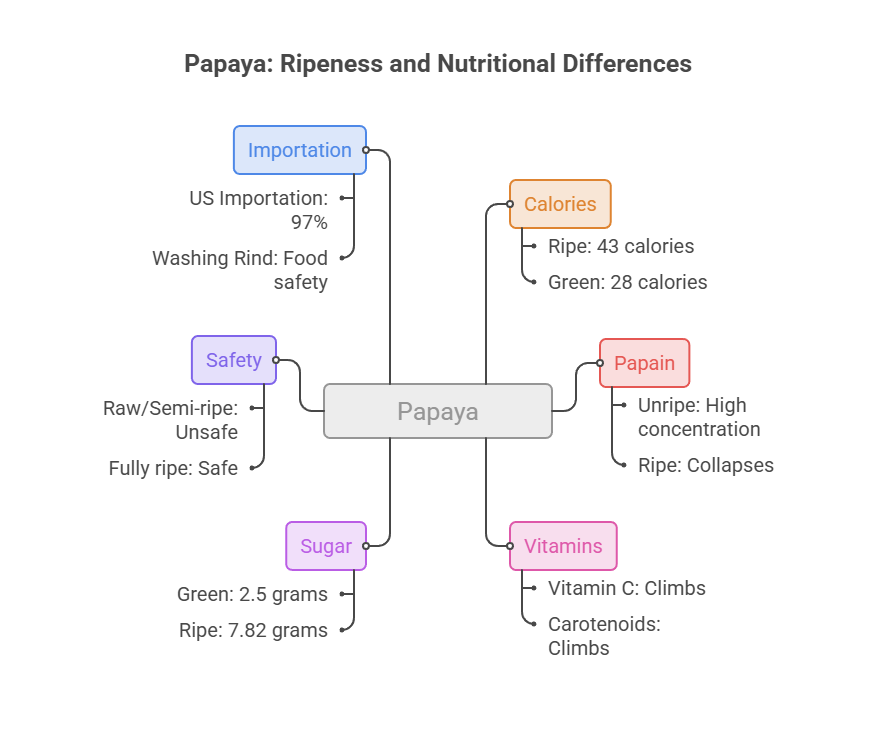
- Same fruit, two different foods: ripe papaya runs about 43 calories per 100 grams, green papaya closer to 28.
- Papain concentrates in the latex of unripe fruit and collapses as the papaya ripens.
- Vitamin C and carotenoids climb during ripening, which reverses the claim most articles make.
- Green papaya carries roughly 2.5 grams of sugar per 100 grams against 7.82 grams in ripe fruit.
- Cooking green papaya destroys the papain that most people bought it for.
- Raw and semi-ripe papaya are not safe in pregnancy. Fully ripe papaya is.
- About 97% of US papaya is imported, which makes washing the rind a real food-safety step.
What “Ripe” and “Raw” Actually Mean (and Why It Changes Everything)
Papaya is one of the few things in an American produce aisle you can buy as either a fruit or a vegetable, depending on when it was picked. Nothing about the plant changes. Only the clock does.
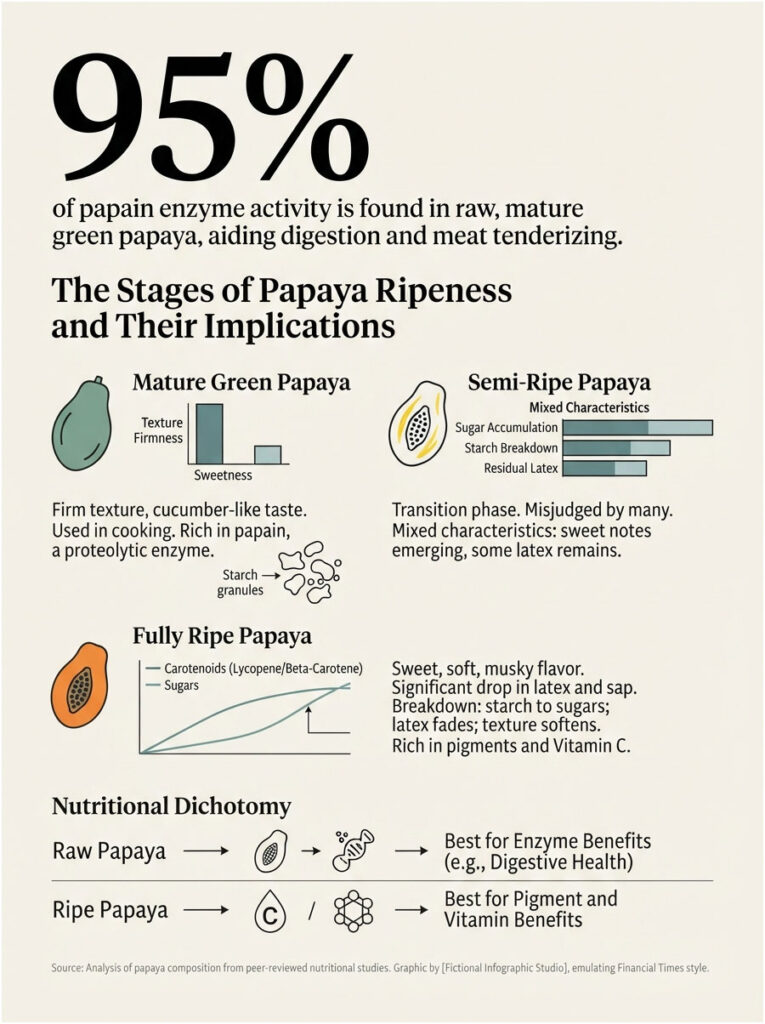
Patients booking tests with us often bring in a papaya they cannot classify, and the question is always the same: is this the good one? The answer depends entirely on what you want out of it.
The Three Stages on the American Shelf
Mature green. Skin fully green, flesh white to pale green, texture firm and snappy. It tastes closer to a cucumber than a fruit. Stores label it “green papaya” or “cooking papaya,” and it is the backbone of Thai som tam.
Semi-ripe. Yellow streaks creep across the skin. The flesh turns orange at the rim while the center stays pale and firm. This is the stage most people misjudge, and it causes the most trouble.
Fully ripe. Skin yellow to orange with little green left. Flesh uniformly orange or salmon, soft under gentle pressure, sweet and faintly musky. Cut it open and almost no sap appears.
The White Sap Is the Whole Story
That latex is a working defense system. It carries proteolytic enzymes, chiefly papain and chymopapain, along with alkaloids and other compounds the plant uses to deter insects.
Papain cuts protein chains into shorter fragments. It is the same compound packed into supermarket meat tenderizer, and it is the reason a green papaya marinade turns tough steak soft in under an hour.
As the fruit ripens, the plant no longer needs that defense. Latex production falls, papain activity drops steeply, and the sap you saw at the green stage nearly vanishes.
What Ripening Builds Up
Three things increase: sugar, aroma compounds, and carotenoid pigments. The orange color is not cosmetic. It is a visible readout of lycopene, beta-carotene, and beta-cryptoxanthin accumulating in the flesh.
Research on carotenoid biosynthesis during papaya ripening shows lycopene and beta-carotene rising sharply from the color-break stage through full maturity, driven by the fruit’s own gene expression, per work published in Horticulture Research.
What Ripening Breaks Down
Starch converts to simple sugars. Latex and papain fade. Certain phenolic compounds in the skin decline. The squeaky, almost crunchy texture of green papaya gives way to something you can eat with a spoon.
This single trade explains nearly every difference that follows. Raw papaya benefits run through enzymes. Ripe papaya benefits run through pigments and vitamin C. You cannot get both from one fruit at one moment.
Ripe vs Raw Papaya Nutrition, Side by Side
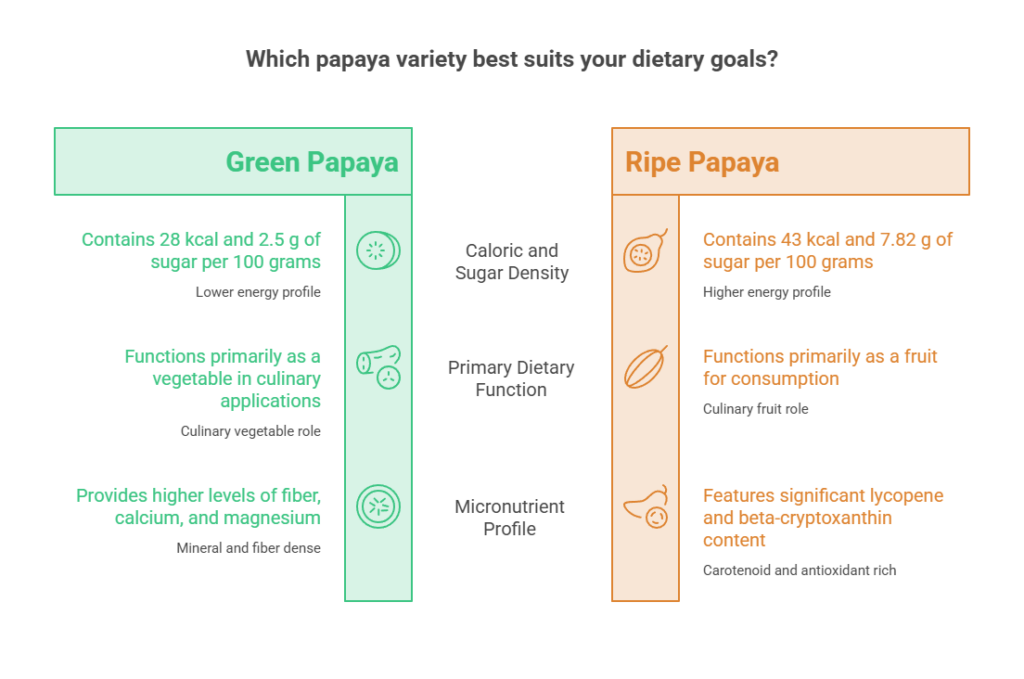
Here is the comparison with the marketing stripped out. Ripe values come from USDA FoodData Central entry #169926 for raw papaya. Green papaya values are drawn from published nutritional databases for unripe Carica papaya, since USDA maintains no separate standard entry for the green stage.
| Nutrient (per 100 g) | Raw Green Papaya | Fully Ripe Papaya | Winner | Why It Matters |
| Calories | ~28 kcal | 43 kcal | Green | Green runs about 35% lighter, useful for volume eating |
| Total sugar | ~2.5 g | 7.82 g | Green | Roughly one third the sugar load per serving |
| Dietary fiber | ~2.0 g | 1.7 g | Green | Slightly more bulk, though both are modest |
| Total carbohydrate | ~7 g | 10.8 g | Green | Lower carb density suits low-carb eating patterns |
| Vitamin C | ~40 to 75 mg (varies widely by variety and lab) | 60.9 mg (68% DV, USDA) | Ripe, within the same fruit | Vitamin C rises as a given papaya ripens; cross-variety numbers conflict |
| Lycopene | Trace | 1,828 mcg | Ripe | One of the few non-tomato fruits with meaningful lycopene |
| Beta-cryptoxanthin | Trace | 589 mcg | Ripe | A provitamin A carotenoid that is rare in common fruits |
| Beta-carotene | Low | 274 mcg | Ripe | Converts to vitamin A for vision and immune function |
| Papain activity | High | Very low | Green | The enzyme story lives almost entirely in the unripe fruit |
| Calcium | ~33 mg | 20 mg | Green | A small but real mineral edge |
| Magnesium | ~30 mg | 21 mg | Green | Same pattern as calcium |
| Water | ~90% | 88% | Tie | Both are hydrating, low energy density foods |
Calories and Sugar: Green Papaya Cuts Both Roughly in Half
Green papaya lands near 28 calories per 100 grams against 43 for ripe. The sugar gap is wider: about 2.5 grams versus 7.82 grams.
Scale that to a real serving. One cup of diced fruit (145 grams) delivers roughly 11.3 grams of sugar as ripe papaya and closer to 3.6 grams as green. Anyone counting carbs will feel that difference.
Ripe papaya still sits in reasonable company. Its 7.82 grams per 100 grams runs below mango (13.7 g), banana (12.2 g), and grapes (16.3 g). For the full calorie breakdown, see our USDA papaya nutrition guide.
Vitamin C: The Claim Most Articles Get Backwards
Search “green papaya benefits” and you will find page after page insisting the unripe fruit is richer in vitamin C. Within a single papaya, the peer-reviewed data says the opposite.
An HPLC analysis of Maradol papaya, the variety that fills most American supermarkets, tracked four ripeness stages and found vitamin C climbing from 25.07 to 58.59 mg per 100 grams dry weight as the fruit matured. That study appeared in Food Research International.
Our medical reviewers flag this as the most repeated papaya myth in circulation. Ripe papaya at 60.9 mg per 100 grams delivers more vitamin C per gram than an orange, according to USDA figures and the NIH Office of Dietary Supplements.
Carotenoids: Where Ripe Papaya Runs Away With It
This is not a close contest. Ripe papaya carries 1,828 mcg of lycopene, 589 mcg of beta-cryptoxanthin, and 274 mcg of beta-carotene per 100 grams. Green papaya carries almost none of the three.
Beta-cryptoxanthin deserves attention because so few common fruits contain it in useful amounts. Alongside beta-carotene, it converts to vitamin A, which supports vision and immune defense.
The same Maradol analysis measured lycopene rising from 0.36 to 3.40 mg per 100 grams dry weight during ripening, close to a tenfold jump. If antioxidant pigments are the goal, waiting for the fruit to turn orange is the entire strategy.
Fiber, Minerals, and Water
Green papaya edges ahead on calcium, magnesium, iron, and fiber. None of these gaps are dramatic on their own.
Stacked with the sugar advantage, they explain why green papaya functions like a vegetable in a meal plan while ripe papaya functions like a fruit. Both run near 90% water, which is why neither is calorie dense.
How to Read These Numbers Honestly
Nutrient values for papaya swing more than most fruits. Variety, soil, climate, harvest timing, and laboratory method all move the figures, and green papaya has no standardized USDA entry to anchor against.
Treat the ripe column as solid and the green column as a reasonable estimate. The directional conclusions (green is lower in sugar, ripe is higher in carotenoids, green has far more papain) hold across every dataset we reviewed. The decimal points do not.
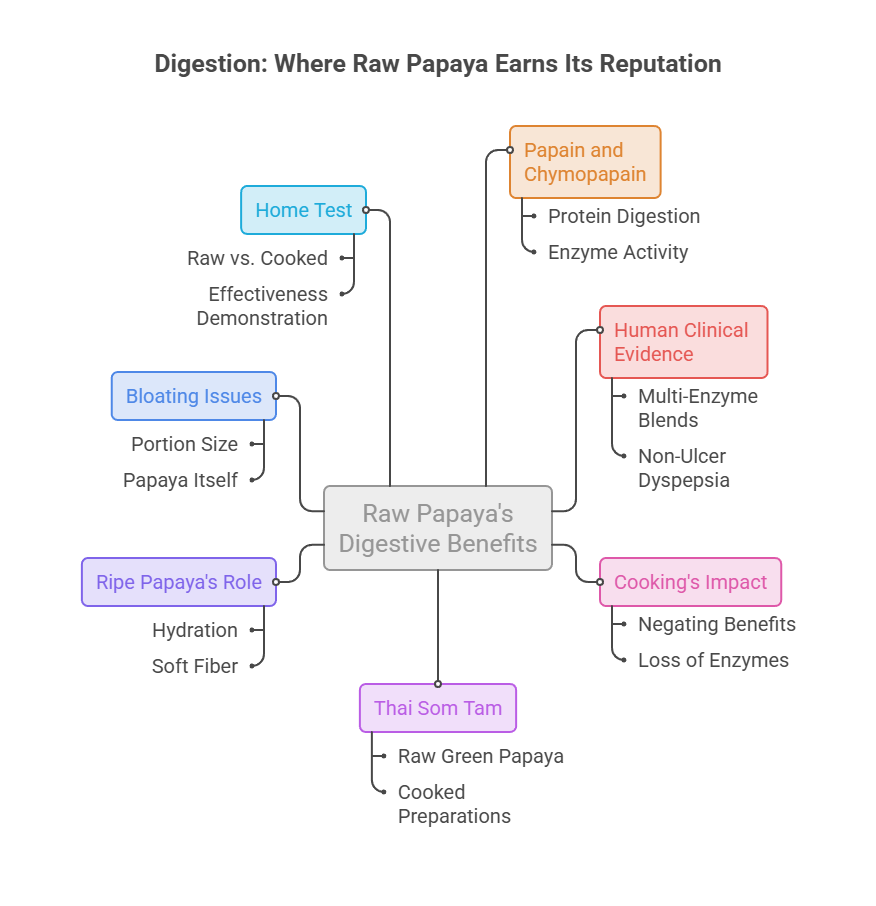
Digestion: Where Raw Papaya Earns Its Reputation
If raw papaya has one legitimate claim to fame, this is it. And it deserves precision, because the popular version of the story is half wrong.
Papain and Chymopapain, Explained Without the Hype
Papain is a proteolytic enzyme. It breaks peptide bonds, cutting long protein chains into shorter, more absorbable fragments. Chymopapain sits beside it in the latex and works along similar lines.
Laboratory work on papaya latex proteinases confirms that papain, chymopapain, and papaya proteinase III all show strong protein-digesting activity in vitro. The biology is real.
The open question is whether eating the fruit produces a clinical effect in a human gut, which is a very different bar.
What the Clinical Evidence Actually Supports
The picture here is modest. Most human trials test papain inside multi-enzyme blends rather than alone, which makes it hard to credit papain specifically for any result.
One trial of 100 patients with non-ulcer dyspepsia using a fungal diastase and papain combination reported meaningful improvement in fullness, belching, bloating, and flatulence by day 14. A separate double-blind, placebo-controlled study of a standardized papaya preparation found symptom relief in people with chronic gastrointestinal complaints, with the authors describing the effect as moderate rather than curative.
Animal and reconstructed intestinal tissue research published in PubMed Central suggests papaya proteases can support protein digestion and shift gut microbiota. Encouraging, but not proof that a bowl of green papaya salad resolves indigestion.
In cases reviewed by our medical team, bloating complaints tied to papaya usually trace back to portion size and meal composition rather than the fruit itself. Papain helps at the margins. It is not a treatment.
The Cooking Trap Nobody Warns You About
Here is the most useful sentence in this article: papain is heat sensitive. Cook green papaya, and you deactivate the enzyme you paid for.
Nearly every article promoting raw papaya for digestion also recommends cooking it into curry, sabzi, or soup. Those two pieces of advice cancel each other out, and almost nobody says so.
Som Tam vs Green Papaya Curry
Thai som tam is raw shredded green papaya, pounded with lime, chili, garlic, and fish sauce, never heated. The papain survives intact.
A simmered green papaya curry is a perfectly good vegetable dish: fiber, potassium, very little sugar. What it is not is an enzyme delivery system.
Patients commonly ask us which preparation to pick. If digestion is the goal, keep it raw and cold. If the goal is a low-sugar vegetable, cook it however you like.
A Test You Can Run at Home
Rub a slice of raw green papaya on a piece of tough steak, leave it thirty minutes, and the surface goes visibly soft. Boil that same papaya slice first, then repeat, and nothing happens.
That is papain switching off in front of you. It is a two-dollar experiment that settles the argument better than any citation.
Where Ripe Papaya Helps Digestion Instead
Ripe papaya solves the same problem through a different route: water, soft fiber, and easy tolerability. At roughly 88% water and 1.7 grams of fiber per 100 grams, it moves things along without needing an enzyme argument at all.
For a sensitive gut, ripe papaya is also the gentler choice. Green papaya is fibrous, dense, and occasionally irritating in large raw servings.
Blood Sugar, Weight, and Heart Health
The Glycemic Index Confusion
Wellness sites routinely describe green papaya as a low glycemic index food. The supporting evidence is thin, and at least one recent study points the other way.
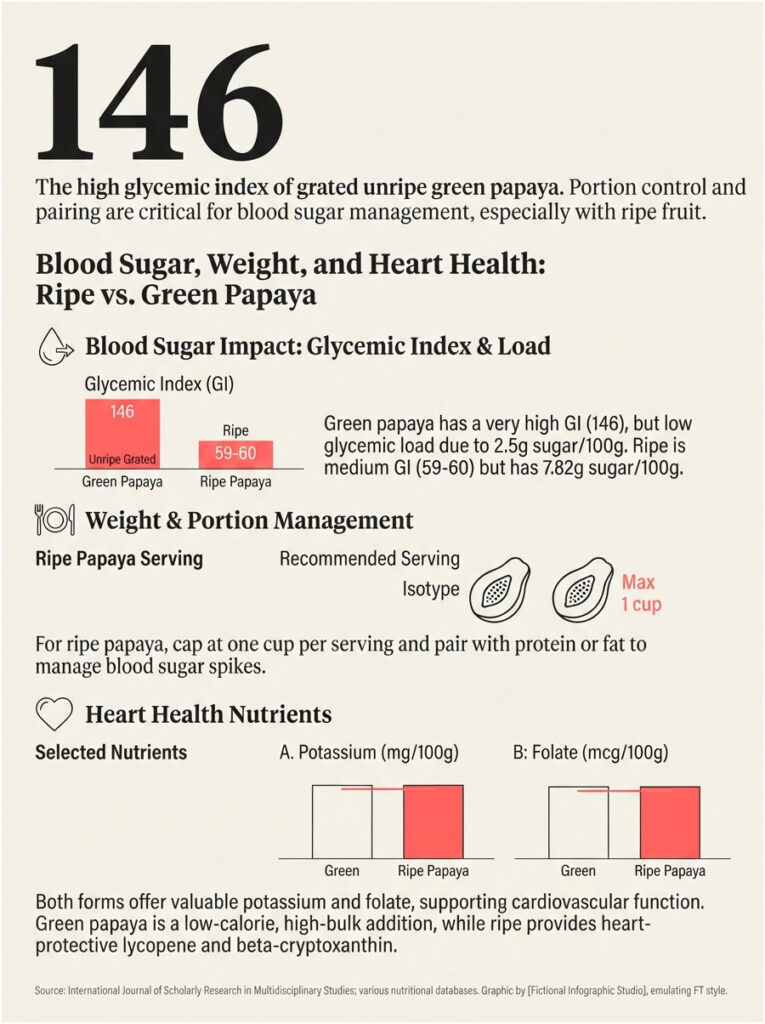
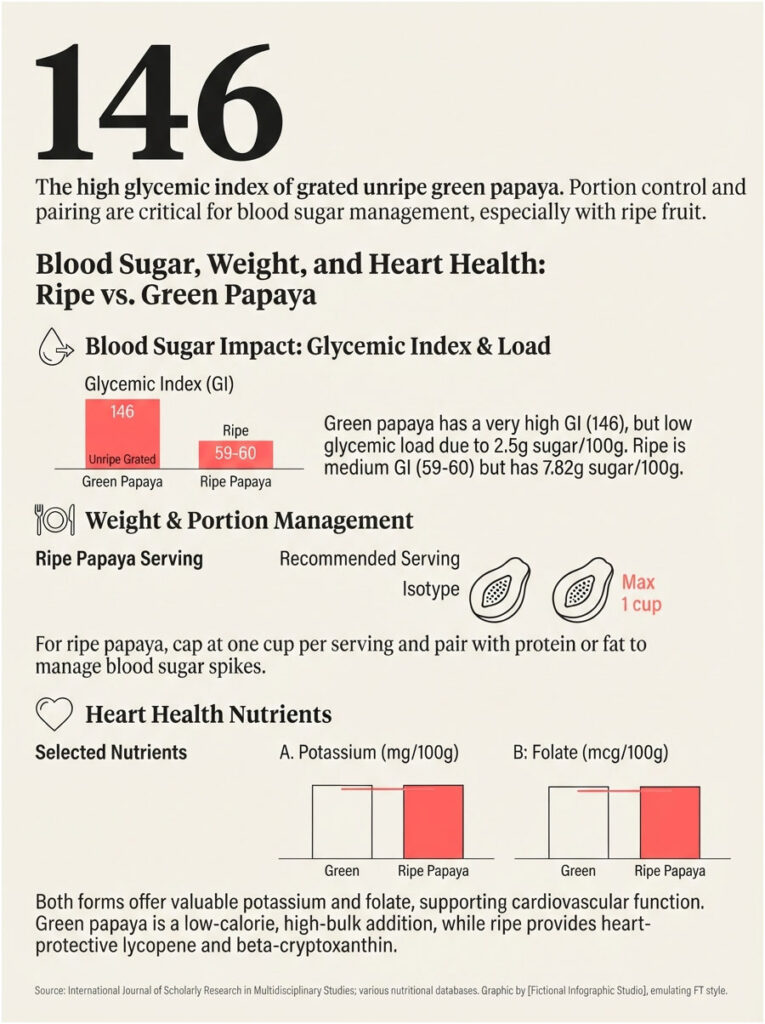
A 2024 animal study measuring the glycemic response to grated unripe green papaya calculated a glycemic index of 146, higher than glucose itself. That result, published in the International Journal of Scholarly Research in Multidisciplinary Studies, sits awkwardly beside the popular claim.
Ripe papaya, by contrast, has a reasonably well-documented glycemic index in the range of 59 to 60, which places it in the medium category.
Glycemic Load Is the Number That Matters
Glycemic index measures how fast a fixed dose of carbohydrate raises blood sugar. Glycemic load measures what a realistic portion actually does, and the portion is what you eat.
Green papaya wins on load for a simple reason: there is barely any sugar in it. Roughly 2.5 grams per 100 grams means even a generous serving delivers a small carbohydrate hit.
Ripe papaya at a medium GI and 7.82 grams of sugar per 100 grams still fits, but portion control carries more weight. One cup, not half a Maradol.
A Practical Protocol for Anyone Watching Blood Sugar
Cap ripe papaya at one cup per sitting. Pair it with protein or fat (Greek yogurt, cottage cheese, a small handful of nuts) so the sugar arrives more slowly.
Eat it after a meal rather than alone on an empty stomach. Test at 60 and 120 minutes the first two or three times, because individual glucose responses to the same fruit vary more than any published GI figure suggests.
Green papaya can be used more freely as a savory salad base. Laboratory work on green and yellow papaya extracts published in PubMed Central found effects on glucose uptake and lipid accumulation in cell models, though cell studies are a starting point, not a prescription.
Weight Management: Which Form Fits Which Goal
Green papaya is the better volume food. Low calories, low sugar, high bulk, and it works in savory meals where a sweet fruit would feel out of place.
Ripe papaya is the better dessert swap. Sixty-two calories per cup, nearly a full day of vitamin C, and enough sweetness to displace something considerably worse.
Neither burns fat. Both are useful because of what they replace on the plate.
Heart and Eye Health: The Ripe Papaya Advantage
Lycopene and beta-cryptoxanthin are the reason ripe papaya belongs in a heart-and-eye conversation at all. Green papaya simply does not carry them in meaningful quantity.
A review of papaya’s bioactive compounds hosted at PubMed Central describes the carotenoid and polyphenol profile as the fruit’s main antioxidant contribution, with the ripe pulp doing nearly all of the work.
Papaya also brings potassium and folate, both of which support cardiovascular function. Neither form has a monopoly there.
Safety: Pregnancy, Allergies, and Food Poisoning
Pregnancy: Ripe Is Fine, Raw and Semi-Ripe Are Not
Most advice on this topic lands in one of two ditches: “avoid papaya entirely” or “papaya is perfectly safe.” Both are wrong, and the gap between them causes real anxiety.
The distinction is latex, not papaya. Fully ripe papaya has almost none. Unripe and semi-ripe papaya have plenty.
What the Uterine Contraction Research Actually Found
Researchers tested ripe papaya juice and crude papaya latex against isolated rat uterine tissue. Ripe papaya juice produced no significant contractile effect on uterine smooth muscle from pregnant or non-pregnant animals.
Crude papaya latex behaved very differently. At 0.1 to 3.2 mg per milliliter, it triggered spasmodic contractions comparable to oxytocin and prostaglandin F2 alpha, the same agents used clinically to induce labor. In late-pregnancy tissue, the contractions were described as tetanic.
The authors concluded that normal consumption of ripe papaya during pregnancy is unlikely to pose significant danger, while unripe and semi-ripe papaya could be unsafe. The study is indexed on PubMed.
The Semi-Ripe Trap
The riskiest papaya in a pregnancy kitchen is not the obviously green one. It is the half-orange fruit that looks close enough.
Semi-ripe papaya still carries meaningful latex in the pale, firm center. If the flesh is not uniformly orange, or if any sap appears on the knife, set it aside. Confirm with your OB-GYN, since individual pregnancies differ.
Latex-Fruit Syndrome and Papaya Allergy
This risk almost never appears in consumer papaya content, and it should. People allergic to natural rubber latex frequently react to certain plant foods, a pattern called latex-fruit syndrome.
Papaya is one of the most common culprits. In one analysis of adults with natural rubber latex allergy, plant food specific IgE antibodies were detected in 88% of serum samples, with papaya the most frequent at 71%, per work indexed on PubMed.
A 2024 literature review in the Journal of Clinical Medicine, available through PubMed Central, identified banana, avocado, kiwifruit, and papaya as the fruits most often implicated, with systemic symptoms making up roughly 73% of reported reactions.
Our lab partners report that papaya-specific IgE rarely gets ordered until after a reaction has already happened. If your mouth itches when you eat papaya, and especially if you work in healthcare where latex exposure runs high, an allergy panel is a sensible next step.
Salmonella and Whole Papayas in the United States
This risk applies to both forms equally, because it lives on the rind rather than in the flesh.
The United States has had repeated papaya-linked Salmonella outbreaks. Five outbreaks tied to whole, fresh Maradol papayas in 2017 and 2019 produced 325 illnesses, according to research in the Journal of Food Protection indexed on PubMed.
The 2019 event was unusually severe. The CDC reported 71 illnesses across eight states with 27 hospitalizations, a hospitalization rate near 60% against the roughly 20% typical for Salmonella.
The fix is simple and non-negotiable. Wash the whole papaya under running water and dry it before cutting, because the knife drags bacteria from rind straight into flesh. Refrigerate cut papaya promptly.
Blood Thinners, Surgery, and Kidney Considerations
Papain has been studied for effects on clotting pathways, and concentrated papaya enzyme supplements are generally advised against alongside anticoagulants without medical review.
Whole fruit in normal portions is a different matter from a 500 mg capsule. Even so, anyone on warfarin, scheduled for surgery, or managing a bleeding disorder should raise it with their physician first.
Papaya also carries potassium, which matters for people with advanced kidney disease on a potassium-restricted diet. That is a conversation for a nephrologist, not a food blog.
What About Papaya Seeds, Leaves, and Overripe Fruit?
Papaya Seeds
The black seeds inside a ripe papaya are edible and taste sharply peppery. They contain benzyl isothiocyanate and are sometimes ground as a pepper substitute.
They are also the subject of aggressive online claims about parasites and detoxification that the evidence does not support at consumer doses. A teaspoon occasionally is harmless. Treating them as medicine is not warranted.
Papaya Leaf Extract
Papaya leaf is a separate product with a separate evidence base, most of it centered on platelet counts in dengue fever. It is not what you get from eating either the ripe or the raw fruit.
Anyone considering leaf extract should talk to a physician, particularly alongside medication. It has no bearing on the ripe vs raw papaya question.
When Papaya Has Gone Too Far
Overripe papaya turns translucent, watery, and slightly fermented in smell. Vitamin C degrades as the fruit sits past peak ripeness, so the nutritional argument weakens along with the texture.
Soft is good. Mushy, sour, or leaking liquid is past the line. Compost it.
US Reality Check: Where Your Papaya Comes From and What It Costs
| Metric | Figure | Period | Source |
| US fresh papaya imports | 501.2 million pounds (record) | 2023 | USDA Fruit and Tree Nuts Outlook |
| Per capita availability | 1.51 pounds per person | 2023 | USDA Economic Research Service |
| Per capita availability (baseline) | 0.75 pounds per person | 2000 to 2002 average | USDA Economic Research Service |
| Share of US supply that is imported | About 97% | Recent years | USDA Economic Research Service |
| Mexico’s share of import volume | About 82% | 2019 to 2023 average | USDA Economic Research Service |
| Retail price, Maradol and Tainung | $1.09 per pound, up 12% year over year | First half of 2024 | USDA Agricultural Marketing Service |
| Green cooking papaya, wholesale | About $0.53 per pound | Recent wholesale data | USDA Agricultural Marketing Service |
| Salmonella illnesses, five papaya outbreaks | 325 people | 2017 and 2019 | Journal of Food Protection |
Maradol, Tainung, and Solo
Maradol is the large, football-sized papaya with orange-red flesh that fills most American supermarket bins. Grown mainly in Mexico. This is the variety implicated in the Salmonella outbreaks.
Tainung is similar in size and profile, often sold interchangeably with Maradol at retail.
Solo is the small, pear-sized Hawaiian papaya with yellow flesh, sweeter and denser, and noticeably more expensive.
Price Per Pound
Green cooking papaya is usually a Maradol or Tainung harvested early, and it costs a fraction of the ripe price. Per USDA figures summarized by the University of Florida IFAS Extension, green cooking papaya has historically traded near $0.53 per pound wholesale against $1.34 to $2.33 per pound for Solo types.
That gap is worth knowing. If you are buying papaya for volume rather than sweetness, the green fruit is the better economic call by a wide margin.
Where to Actually Buy Green Papaya
Mainstream grocery chains rarely stock it. Look in Asian markets (H Mart, 99 Ranch), Latin American grocers, and Caribbean markets, where it is a staple rather than a novelty.
If you cannot find one, buy a rock-hard green Maradol and use it the same day. Do not let it sit on the counter, because the papain leaves as the color arrives.
How to Choose, Store, and Eat Each Form
| Your Situation | Choose This Form | Serving Guide | Reason |
| Pregnant, any trimester | Fully ripe only | 1 cup (145 g), a few times per week | Latex in unripe fruit triggers uterine contractions in lab models |
| Managing type 2 diabetes | Green as the base, ripe in small portions | 1 cup green; half cup ripe with protein or fat | Green cuts the sugar load; ripe fits with portion control |
| Chronic bloating after protein meals | Raw green papaya, uncooked | Half cup shredded, alongside the meal | Papain is heat sensitive and survives only raw preparation |
| Constipation | Fully ripe papaya | 1 cup in the morning | Water, soft fiber, and easy tolerability |
| Trying to lose weight | Green for volume, ripe as a dessert swap | 1 to 2 cups green; 1 cup ripe | Green runs about 28 kcal per 100 g; ripe displaces worse desserts |
| Low vitamin C, frequent colds | Fully ripe papaya | 1 cup daily | One cup delivers close to a full day’s vitamin C |
| Known latex allergy | Neither, until tested | Zero, pending an IgE panel | Papaya is among the most common latex cross-reactive foods |
| On warfarin or facing surgery | Ripe papaya, moderate amounts, doctor first | Discuss before adding | Papain has been studied for effects on clotting pathways |
How to Pick a Ripe Papaya
Look for skin that is mostly yellow to orange with minimal green. Press gently near the stem end. It should yield slightly, like a ripe avocado, without feeling mushy.
Smell it. Ripe papaya carries a sweet, faintly musky aroma at the stem. No smell usually means no flavor.
A papaya with a few yellow streaks will ripen on the counter over three to five days. Once ripe, refrigerate and eat within a week.
How to Pick and Prep Green Papaya
Choose one that is uniformly green, rock hard, and heavy for its size. Any softness means ripening has started, and the papain has already begun to fade.
The sap can irritate skin. Peel under running water or wear gloves, and rinse the blade between cuts.
Shred it cold on a mandoline or box grater, then dress it just before serving. Salt pulls water out fast and turns crisp shreds limp within twenty minutes.
Serving Sizes That Make Sense
One cup of diced ripe papaya (145 grams) is the standard serving: roughly 62 calories, about 11 grams of sugar, and close to a full day of vitamin C.
A cup of shredded green papaya runs nearer 40 calories and under 4 grams of sugar. That flexibility is exactly the point.
Across the readers HealthCareOnTime serves, the mistake is rarely eating too little papaya. It is eating half a Maradol in one sitting and wondering why blood sugar moved.
Five Mistakes That Waste the Fruit’s Benefits
- Cooking green papaya and still expecting the enzyme benefit
- Cutting an unwashed papaya, dragging rind bacteria straight into the flesh
- Letting green papaya ripen on the counter after buying it specifically for papain
- Eating semi-ripe papaya during pregnancy because it looked orange enough
- Buying papaya enzyme capsules when a raw green salad twice a week costs less and does the same job
The Verdict: Which One Should You Actually Eat?
Eat Ripe Papaya If
You want vitamin C, lycopene, beta-carotene, and beta-cryptoxanthin. You are pregnant. You have a sensitive gut. You want fruit that needs zero preparation and tastes good on its own.
For most Americans, most of the time, ripe papaya is the correct default.
Eat Raw Green Papaya If
You want the papain, and you are willing to eat it raw. You are cutting sugar aggressively. You want a low-calorie vegetable that behaves like a noodle in a salad.
Skip it entirely if you are pregnant or if you have a known latex allergy.
A Simple Weekly Rotation
Two servings of ripe papaya, one cup each, eaten in the morning or after a meal. One raw green papaya salad, shredded and dressed cold, alongside a protein-heavy dinner.
That covers the carotenoids, the vitamin C, the fiber, and the enzyme, at a total cost of maybe four dollars a week. No supplement replicates it.
The Honest Answer
The ripe vs raw papaya debate carries a false premise. These are not competing products. They are two harvest points on one plant, each doing something the other cannot.
Ripe papaya is the antioxidant fruit. Raw green papaya is the enzyme vegetable. Rotate both, and neither one has to do the other’s job badly.
Frequently Asked Questions
Is green papaya just unripe papaya?
Yes. Green papaya is the same fruit (Carica papaya) harvested before it ripens. Its flesh is pale and firm rather than orange and soft, its sugar content is far lower, and it carries the papain-rich latex that fades as the fruit matures. Nothing else about the plant differs.
Which has more vitamin C, ripe or raw papaya?
Within a single fruit, ripe wins. HPLC analysis of Maradol papaya across four ripeness stages showed vitamin C rising steadily as the fruit matured. USDA lists ripe papaya at 60.9 mg per 100 grams, about 68% of the Daily Value, which is more per gram than an orange.
Does cooking green papaya destroy papain?
Yes, and this is the fact most often missed. Papain is heat sensitive, so simmering green papaya into curry or soup deactivates it. If digestion is your reason for eating green papaya, keep it raw, shredded, and cold, the way Thai som tam is prepared.
Can you eat raw green papaya without cooking it?
You can, and for enzyme purposes you should. Peel it, scoop the seeds, shred it finely, and dress it with lime and chili. Wear gloves or work under running water, since the sap irritates skin. Anyone pregnant should avoid raw green papaya entirely.
Is raw papaya safe during pregnancy?
No. Unripe and semi-ripe papaya contain latex rich in papain, and laboratory research found that crude papaya latex triggered strong uterine contractions comparable to oxytocin. That is the scientific basis for the traditional warning. Avoid any papaya showing green skin or white sap while pregnant.
Is ripe papaya safe during pregnancy?
Generally yes, in normal portions. In the same laboratory model, ripe papaya juice produced no significant uterine contraction. Fully ripe papaya also supplies folate, vitamin C, and beta-carotene. Confirm with your OB-GYN, since individual pregnancies vary and the fruit must be fully ripe, not partly orange.
Can diabetics eat ripe papaya?
In controlled portions, usually yes. Ripe papaya has a medium glycemic index near 60 and 7.82 grams of sugar per 100 grams. Stick to one cup, pair it with protein or fat, and test your own glucose response. Green papaya carries roughly a third of the sugar if you need a lower-impact option.
Does papaya actually help with bloating and constipation?
Partly. Trials of enzyme blends containing papain showed improvement in bloating and fullness, though the effects were moderate and papain was rarely tested alone. Ripe papaya helps constipation through water and fiber rather than enzymes. Neither form substitutes for medical treatment of ongoing symptoms.
Why does papaya make my mouth or throat itch?
That may be latex-fruit syndrome. People allergic to natural rubber latex often cross-react to papaya, banana, avocado, and kiwifruit. In one study, papaya-specific IgE antibodies appeared in 71% of latex-allergic adults tested. Stop eating it and ask a physician about an allergy panel, especially if you work in healthcare.
How much papaya should you eat per day?
One cup of ripe papaya (145 grams) per day suits most adults: about 62 calories, 11 grams of sugar, and nearly a full day of vitamin C. Green papaya can be eaten more freely thanks to its lower sugar content, though excess fiber may cause discomfort in some people.
Is raw papaya better for weight loss than ripe papaya?
For calorie and sugar control, yes. Green papaya runs about 28 calories and 2.5 grams of sugar per 100 grams against 43 calories and 7.82 grams in ripe. Neither burns fat. Green papaya works better as a savory volume food; ripe papaya works better as a lower-calorie dessert replacement.
How do you ripen a green papaya at home?
Leave it on the counter at room temperature, away from direct sun, for three to five days until the skin turns mostly yellow and the stem end yields to gentle pressure. A paper bag with a banana speeds this along. Refrigerate once ripe and eat within a week.
Medical Disclaimer: This article is for general informational purposes and does not replace medical advice, diagnosis, or treatment from a qualified healthcare provider. Nutrient values vary by variety, growing conditions, and ripeness. Anyone who is pregnant, managing diabetes, taking anticoagulant medication, living with advanced kidney disease, or carrying a known latex or food allergy should consult a physician before making dietary changes involving papaya in any form.
References
- USDA FoodData Central, papaya raw (FDC #169926)
- Papaya consumption is unsafe in pregnancy: fact or fable? British Journal of Nutrition, PubMed
- Identification and quantification of phenols, carotenoids, and vitamin C from Maradol papaya, Food Research International
- A Series of Papaya-Associated Salmonella Illness Outbreak Investigations in 2017 and 2019, Journal of Food Protection, PubMed
- CDC Update: Outbreak of Salmonella Infections Linked to Papayas Imported from Mexico
- Revisiting Latex-Fruit Syndrome After 30 Years of Research, PubMed Central
- Latex-fruit syndrome: frequency of cross-reacting IgE antibodies, PubMed
- U.S. imports 97 percent of its papaya, USDA Economic Research Service
- United States fresh papaya imports reach a record high, USDA Fruit and Tree Nuts Outlook coverage
- An Overview of US Papaya Production, Trade, and Consumption, University of Florida IFAS Extension
- Papaya CpbHLH1/2 regulate carotenoid biosynthesis during fruit ripening, Horticulture Research
- Effects of Proteases from Pineapple and Papaya on Protein Digestive Capacity and Gut Microbiota, PubMed Central
- Characterization of Green and Yellow Papaya for Anti-Diabetic Activity, PubMed Central
- Benefits of Fermented Papaya in Human Health, PubMed Central
- Assessment of glycemic index of the unripe green papaya, International Journal of Scholarly Research in Multidisciplinary Studies
- Vitamin C Fact Sheet for Health Professionals, NIH Office of Dietary Supplements
- How Many Calories in Papaya? Full USDA Nutrition Breakdown, HealthCareOnTime