Here is the part that catches most people off guard: a below-range flag on a kidney marker usually has nothing to do with your kidneys.
Blood urea nitrogen sits on almost every routine panel, and when the number comes back under the reference range, the reflex is to assume something upstream has failed. In practice, the explanation is often sitting in your water bottle or on your dinner plate.
Table of Contents
| Quick Answer: A low BUN level most often comes down to three harmless things: low protein intake, drinking a lot of fluid, or pregnancy. Less often it points to liver disease, malnutrition, or a hormone imbalance. On its own, a mildly low blood urea nitrogen result rarely signals danger and rarely needs treatment. Your doctor reads it alongside creatinine, albumin, and liver enzymes before drawing any conclusion. |
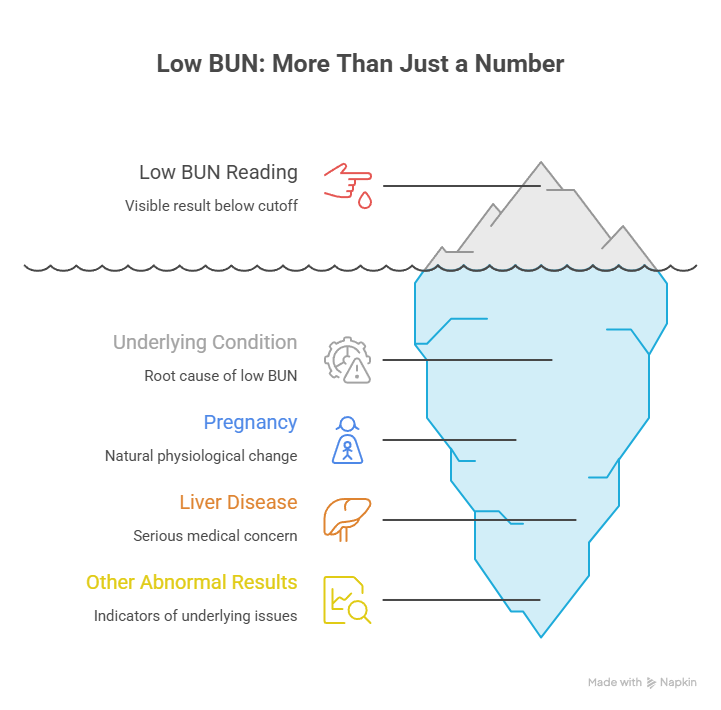
The five explanations that account for most low BUN results:
- Eating less protein than your body needs
- Drinking large volumes of water or receiving IV fluids
- Pregnancy, especially the second and third trimesters
- Liver disease that slows urea production
- Malnutrition or poor absorption of nutrients
| At a Glance Most adult labs call anything below 6 to 7 mg/dL a low BUN, though the cutoff varies by labLow BUN causes symptoms almost never; the underlying condition doesA single low reading with normal creatinine and normal albumin rarely needs follow-upPregnancy lowers BUN by design, because blood volume expands by roughly halfLiver disease is the cause that deserves the most attention, and it almost always shows up alongside other abnormal resultsA BUN under 5 mg/dL paired with fatigue, jaundice, swelling, or confusion warrants a same-week call to your doctorRaising a low BUN is only worth doing when the cause behind it needs fixing |
What a Low BUN Level Actually Means
BUN stands for blood urea nitrogen, and the name describes exactly what the test measures: the nitrogen portion of urea circulating in your bloodstream. It is a waste product, and its level reflects a chain of events rather than the health of a single organ.
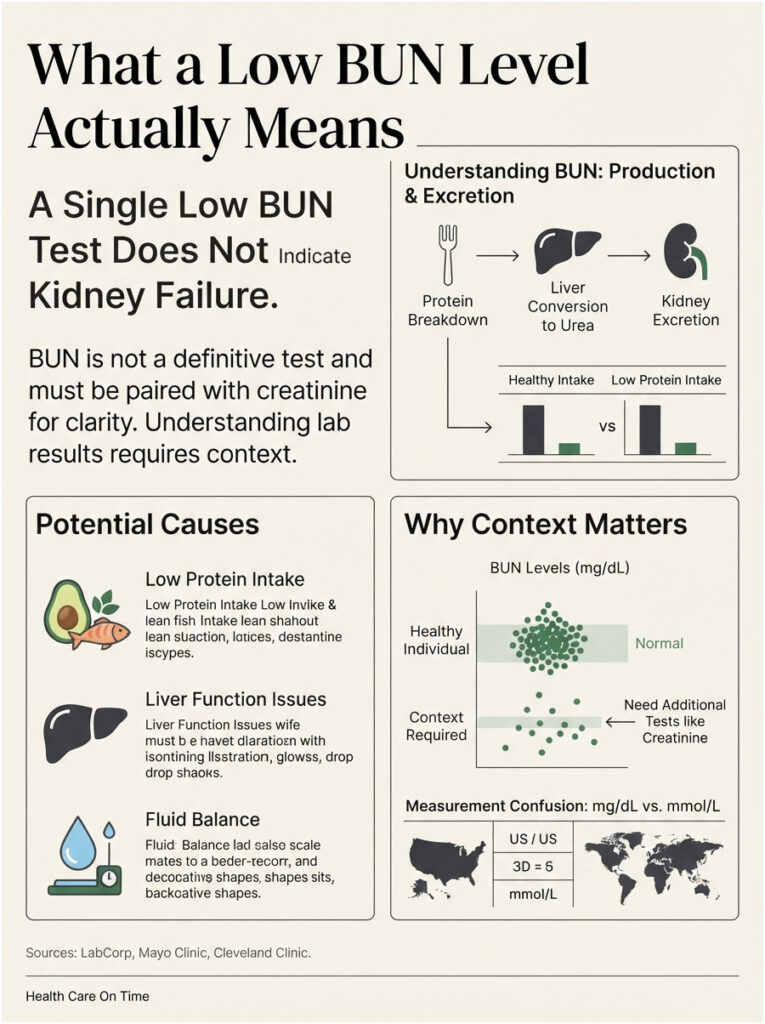
Our medical reviewers describe it to patients as a three-station relay. Protein breaks down, the liver packages the nitrogen waste into urea, and the kidneys clear that urea into urine.
How Your Liver Turns Protein Into Urea Nitrogen
When your body breaks down protein, whether from a steak at dinner or from your own muscle tissue during a fast, ammonia is released. Ammonia is toxic to the brain even at low concentrations, so the body cannot let it accumulate.
The liver solves this through the urea cycle, a five-enzyme pathway that converts ammonia into urea. Urea is water-soluble, comparatively harmless, and easy for the kidneys to excrete.
That urea travels through your blood to the kidneys, which filter most of it out. Whatever remains in circulation at the moment of your blood draw is what the BUN test captures.
Why BUN Reflects Three Organs, Not One
A low result can come from a break anywhere along that chain. Less protein coming in means less nitrogen to process. A liver working at reduced capacity produces less urea. Extra fluid in the bloodstream dilutes whatever urea is present.
This is why BUN is a weak standalone kidney test. Cleveland Clinic notes that providers do not use BUN by itself to define kidney failure and pair it with creatinine instead.
Patients booking a kidney function test through HealthCareOnTime often expect BUN to be the headline number. It is closer to a supporting actor.
What a Low BUN Does Not Tell You
It does not tell you your kidneys are failing. That picture requires a rising creatinine, a falling estimated GFR, or protein appearing in the urine.
It does not tell you that you are dehydrated. Dehydration pushes BUN up, not down.
And it does not tell you anything definitive by itself. A single BUN value without creatinine, albumin, and sodium beside it is a fragment of a sentence.
mg/dL, mmol/L, and Why Urea and Urea Nitrogen Are Different Numbers
US labs report BUN in milligrams per deciliter. Most of the rest of the world reports urea in millimoles per liter, and many report total urea rather than urea nitrogen alone.
Those are three different numbers describing the same molecule. A BUN of 14 mg/dL corresponds to roughly 5.0 mmol/L of urea, and to a total urea figure of about 30 mg/dL.
If you are comparing your American lab report against a chart from a UK or Indian lab, you will misread it. Read the range printed on your own report, in the units your own lab used.
What Counts as a Low BUN Number
There is no single national cutoff for a low BUN. Each laboratory sets its own reference interval based on its instruments and the population it draws from, which is why two labs can flag the same value differently.
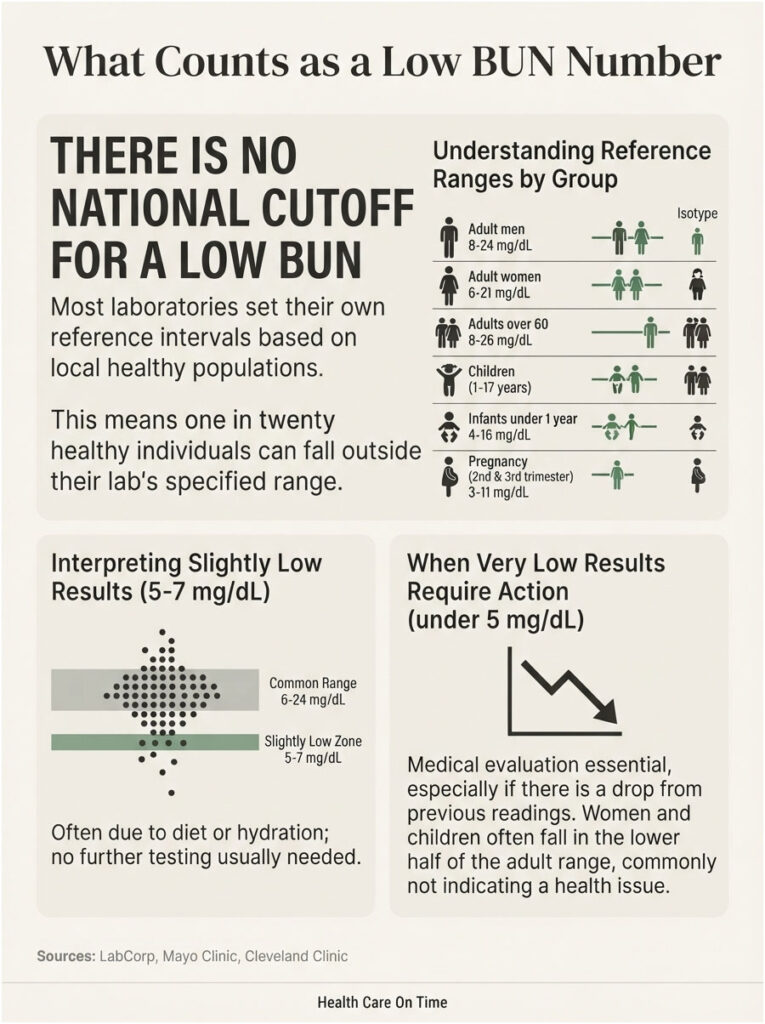
Most US labs use an adult range somewhere between 6 and 24 mg/dL. Some use a tighter 7 to 20 mg/dL. Anything below the lower bound gets marked.
Standard Reference Ranges by Group
| Group | Typical Reference Range (mg/dL) | Commonly Flagged Low Below | Notes |
| Adult men, 18 to 60 | 8 to 24 | 8 mg/dL | Higher average muscle mass raises baseline |
| Adult women, 18 to 60 | 6 to 21 | 6 mg/dL | Runs 1 to 3 points below men on average |
| Adults over 60 | 8 to 26 | 8 mg/dL | Range drifts upward as filtration slows |
| Children, 1 to 17 | 5 to 18 | 5 mg/dL | Lower baseline is expected, not a red flag |
| Infants under 1 year | 4 to 16 | 4 mg/dL | Rapid growth diverts nitrogen into tissue |
| Pregnancy, 2nd trimester | 3 to 11 | 3 mg/dL | Plasma volume expansion dilutes the result |
| Pregnancy, 3rd trimester | 3 to 11 | 3 mg/dL | Higher filtration rate clears urea faster |
Across the panels our lab partners process, women and children routinely land in the lower half of the adult range with nothing wrong. Healthwise clinical guidance describes the same pattern, tying it to differences in how protein is broken down.
Why Your Lab Range May Differ From the One You Found Online
Reference intervals are statistical constructs, not biological truths. Each lab builds one by testing a healthy local population and keeping the middle 95% of results.
That means one in twenty perfectly healthy people falls outside the range by definition. It also means a lab serving a younger, more athletic population will publish a different interval than one serving a nursing-home catchment.
Two consequences follow. A flagged value is not automatically abnormal, and a value that looks fine against an internet chart may be genuinely low against your own lab interval.
Slightly Low Versus Very Low
Practically speaking, there are two tiers worth distinguishing.
A result of 5 to 7 mg/dL in someone who feels well is a soft flag. Diet and hydration explain the large majority of these, and no further testing is usually needed.
A result under 5 mg/dL earns a real explanation, especially when it represents a drop from your own earlier readings. That is the threshold where our medical team recommends pulling liver markers and albumin rather than waiting for the next annual panel.
9 Possible Reasons for a Low Blood Urea Nitrogen Level
Below is the side-by-side view. Each of these low BUN causes leaves a slightly different fingerprint across the rest of your panel, and that fingerprint is how clinicians tell them apart.
| Cause | Typical BUN Seen | Companion Lab Changes | How Common | What It Usually Means |
| Low protein intake | 5 to 8 mg/dL | Albumin normal or borderline; creatinine normal | Very common | Diet-driven and reversible |
| Overhydration or IV fluids | 4 to 8 mg/dL | Sodium low-normal; hematocrit diluted; creatinine slightly low | Very common | Temporary dilution effect |
| Pregnancy | 3 to 9 mg/dL | Creatinine also low; eGFR elevated | Expected in pregnancy | Normal physiology |
| Liver disease | 3 to 7 mg/dL | Albumin low; AST and ALT abnormal; bilirubin and INR up; ammonia up | Uncommon | Reduced urea synthesis |
| Malnutrition or malabsorption | 3 to 7 mg/dL | Albumin and prealbumin low; iron and B12 often low | Uncommon | Not enough raw material |
| SIADH | 5 to 9 mg/dL | Sodium under 135; urine osmolality high; uric acid low | Uncommon | Water retention dilution |
| Medications, surgery, recovery | 5 to 9 mg/dL | Varies with the drug and fluid load | Situational | Fluid loading plus anabolic state |
| Urea cycle disorders | Under 5 mg/dL | Ammonia high; plasma glutamine high | Rare | Blocked urea production |
| Efficient kidneys, high fluid intake | 6 to 9 mg/dL | Everything else normal | Common in fit adults | Normal personal baseline |
1. Not Eating Enough Protein
This is the single most frequent explanation for a low BUN. Less dietary protein means less nitrogen entering the system, so the liver has less raw material to convert into urea.
It shows up in people on plant-based diets who have not planned protein sources deliberately, in older adults eating smaller and less varied meals, and in anyone recovering from an illness that flattened their appetite.
The lab pattern is clean: low BUN, normal creatinine, normal liver enzymes, and albumin sitting near the floor of its range. Patients booking metabolic panels through HealthCareOnTime ask about this combination more than any other.
The scale of the problem is larger than most people assume. An NHANES analysis published in the American Journal of Clinical Nutrition covering the 2011 to 2014 survey cycles found that between roughly 7% and 23% of females across the age bands from 9 to 70 years consumed protein below the RDA, compared with 2% to 11% of males in the same bands.
Older adults fare worse. Health ABC Study data drawn from NHANES found that 24% of women and 12% of men over 70 were eating less protein than the Estimated Average Requirement of 0.66 grams per kilogram of body weight per day.
2. Overhydration, IV Fluids, and Water Loading
Urea concentration depends on how much water it is dissolved in. Add fluid to the bloodstream and the concentration falls, even though total urea has not changed at all.
Endurance athletes who drink heavily through training blocks, people chasing aggressive daily water targets, and anyone who received IV fluids in the previous 24 hours can all show this. Clinical reference material lists overhydration as a standard cause of a low BUN value.
Hospital patients are the clearest illustration. A post-operative panel drawn after two liters of saline reads low across several markers at once, which is the giveaway that dilution rather than disease is at work.
3. Pregnancy
Pregnancy lowers BUN through two mechanisms operating together. Plasma volume expands by roughly 50% by the third trimester, and the glomerular filtration rate climbs, so urea is both diluted and flushed faster.
Creatinine falls alongside it. That parallel drop is the signature that separates pregnancy from a liver problem, where creatinine typically holds steady.
A BUN of 4 or 5 mg/dL in the third trimester is routine and needs no intervention. Values return toward baseline within a few weeks of delivery.
4. Liver Disease
This is the cause that earns the most attention, and reasonably so. The liver is where ammonia becomes urea, so a liver that has lost functional capacity produces less urea from the start.
Why a Damaged Liver Makes Less Urea
In cirrhosis, working liver cells are progressively replaced by scar tissue. Urea cycle enzyme capacity disappears with them, so blood urea nitrogen falls even while the kidneys function normally.
Ammonia climbs at the same time, because it is no longer being converted. Low BUN with rising ammonia is a meaningful pairing and one reason confusion appears in advanced liver disease.
The Lab Pattern That Raises Concern
Isolated low BUN is not a liver diagnosis. Liver-driven low BUN travels with company: albumin under 3.5 g/dL, elevated AST and ALT, rising bilirubin, and a prolonged INR.
In cases reviewed by our medical team, a low BUN appearing alongside two or more of those markers is the pattern that leads to imaging and a hepatology referral. A low BUN with a clean liver function test does not.
5. Malnutrition and Malabsorption
Malnutrition extends the protein-intake problem. The body is not only short on dietary protein; it may also be failing to absorb what does arrive.
Celiac disease, inflammatory bowel disease, chronic pancreatitis, and post-bariatric anatomy all reduce absorption. Eating disorders, alcohol use disorder, and extended hospital stays produce the same result by different routes.
Prealbumin drops first because it turns over fastest, then albumin, then BUN. Weight loss, muscle wasting, and slow wound healing usually appear before anyone examines the lab work.
6. SIADH and Fluid Retention
Syndrome of inappropriate antidiuretic hormone secretion causes the body to retain water it should be excreting. Everything dissolved in the blood gets diluted, BUN included.
The tell is sodium. SIADH drives serum sodium below 135 mmol/L while urine stays inappropriately concentrated, and uric acid runs low alongside it.
Triggers include lung disease, several cancers, central nervous system conditions, and a long list of medications: SSRIs, carbamazepine, certain diuretics, and some chemotherapy agents.
7. Medications, Surgery, and Recovery States
Most consumer health pages skip this category, which is a mistake. Standard laboratory reference texts list fluid excess, trauma, surgery, opioids, malnutrition, and anabolic steroid use among recognized causes of decreased BUN.
Anabolic steroids and growth hormone shift the body into a net protein-building state, so nitrogen goes into muscle rather than into urea. Opioids and standard post-surgical fluid protocols work through reduced intake and fluid loading.
If your BUN dropped after a hospital stay, a new prescription, or a steroid course, that timeline is the most useful thing you can bring to your appointment.
8. Urea Cycle Disorders
These are rare inherited conditions in which one urea cycle enzyme is missing or defective. The body cannot convert ammonia to urea efficiently, so BUN stays low while ammonia rises toward dangerous levels.
Most cases are identified in infancy through US newborn screening panels or through a metabolic crisis in the first days of life. Milder adult-onset forms exist and can present with confusion, lethargy, or unexplained vomiting after high-protein meals.
A BUN under 4 mg/dL with elevated ammonia and no evidence of liver disease is the combination that prompts specialist metabolic testing.
9. Efficient Kidneys and Normal Variation
Sometimes the number is simply low. Well-hydrated, physically active adults with strong filtration clear urea efficiently and sit near the bottom of the range as their personal baseline.
Reference intervals capture the middle 95% of a healthy population, so a portion of healthy people fall outside them permanently. Our lab partners see this on wellness panels every week.
If your BUN has read 6 or 7 mg/dL on every panel for five years and the rest of your bloodwork is unremarkable, that is your normal, not a finding.
How Often These Causes Show Up in the United States
Numbers help calibrate worry. The two causes people fear most, liver disease and malnutrition, are considerably less common than the two that explain most results.
| US Data Point | Figure | Source |
| Cirrhosis prevalence among insured US adults, 2012 to 2018 | Doubled from 0.34% to 0.71% | National insurer retrospective cohort, PMC |
| Liver fibrosis and cirrhosis deaths, adults over 25, 1999 to 2020 | 787,375 deaths | CDC WONDER analysis |
| Age-adjusted liver disease mortality, 1999 vs 2020 | Rose from 16.61 to 18.93 per 100,000 | CDC WONDER analysis |
| Females aged 9 to 70 below the protein RDA | 6.9% to 23.4% by age band | NHANES 2011 to 2014, AJCN |
| Males aged 9 to 70 below the protein RDA | 2.3% to 11.3% by age band | NHANES 2011 to 2014, AJCN |
| Women over 70 below the protein EAR | 24% | NHANES, Health ABC analysis |
| Alcohol share of US cirrhosis cases | Roughly 20% to 25% | American Liver Foundation |
| Most frequent US cirrhosis causes in insured adults | Alcohol 26.0%, NASH 20.9%, hepatitis C 20.0% | National insurer cohort, PMC |
Read that table sideways and the picture resolves. Cirrhosis affected 0.71% of insured US adults in 2018, roughly double the 0.34% recorded in 2012, while somewhere between one in eight and one in four older women is under-eating protein.
Liver disease is real and rising. A CDC WONDER analysis counted 787,375 liver cirrhosis-related deaths among adults over 25 between 1999 and 2020, with the age-adjusted mortality rate climbing from 16.61 to 18.93 per 100,000. That trend is exactly why clinicians take the low-BUN-plus-abnormal-liver-panel combination seriously.
The composition of those cases has shifted too. Among insured US adults with cirrhosis, alcohol-related disease accounted for 26.0% of cases, NASH for 20.9%, and hepatitis C for 20.0%.
Still, statistically, a random American with a low BUN is many times more likely to be under-eating protein than to have undiagnosed cirrhosis. Both possibilities deserve a look. Only one of them is likely.
Low BUN Versus High BUN Versus a Low BUN/Creatinine Ratio
The direction of the abnormality changes the entire list of possibilities. So does the relationship between BUN and creatinine, which is often more informative than either number alone.
What a High BUN Points To Instead
High BUN usually means the kidneys are not clearing urea well, or that something is flooding the system with nitrogen. Dehydration, heart failure, a very high-protein diet, gastrointestinal bleeding, burns, and tissue injury all push it upward.
This is the direction that genuinely flags kidney trouble, particularly when creatinine rises alongside it. Low BUN, by contrast, almost never does.
Reading the BUN/Creatinine Ratio
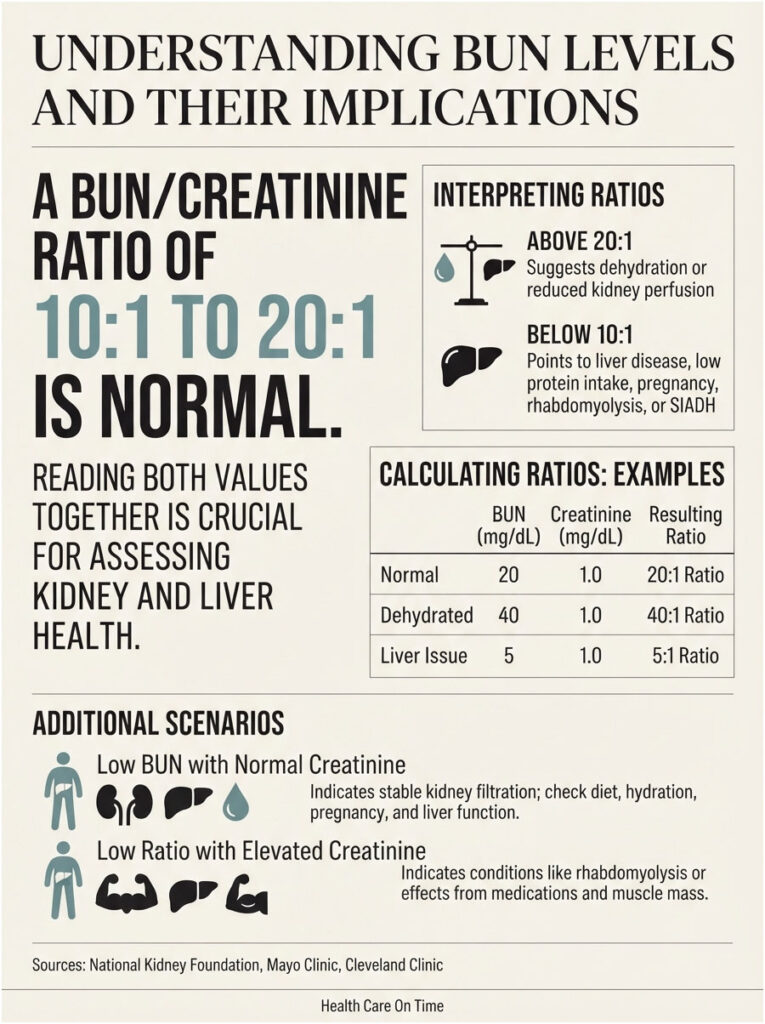
Dividing BUN by creatinine produces a ratio that most US labs calculate automatically. A normal ratio sits between roughly 10:1 and 20:1.
Above 20:1 suggests dehydration or reduced blood flow to the kidneys, because the kidneys reabsorb more urea when perfusion drops. Below 10:1 points toward liver disease, low protein intake, pregnancy, rhabdomyolysis, or SIADH.
Working the Math on Your Own Report
Take a BUN of 6 mg/dL with a creatinine of 0.9 mg/dL. The ratio is 6.7:1, which is low, and both numbers being at or below their ranges points toward dilution or reduced urea production.
Now take a BUN of 14 mg/dL with a creatinine of 1.9 mg/dL. The ratio is 7.4:1, also low, but here the driver is a high creatinine rather than a low BUN. That is a completely different clinical question.
The lesson our medical reviewers repeat: read the ratio and both raw numbers together, never the ratio alone.
Low BUN With Normal Creatinine
This is the most reassuring combination on the panel. It says urea production or dilution changed while kidney filtration held steady.
Diet, hydration, pregnancy, and liver function are the four things to check, in roughly that order of likelihood. Meaningful kidney disease is essentially off the table when creatinine and estimated GFR are both normal.
Low Ratio Without Low BUN
Here the ratio drops because creatinine is elevated. Rhabdomyolysis, the breakdown of skeletal muscle, releases large amounts of creatinine and crushes the ratio from the bottom.
Heavy muscle mass, creatine supplementation, and certain medications produce milder versions of the same effect. Dialysis also skews the ratio, since urea is removed more efficiently than creatinine during treatment.
Symptoms and Red Flags Worth Acting On
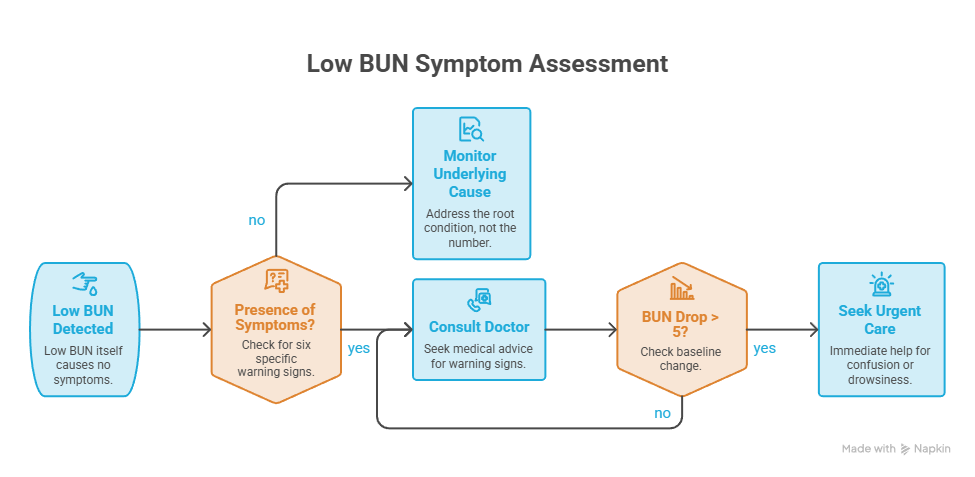
Patients regularly ask our team what a low BUN feels like. The honest answer is that it feels like nothing at all.
Why Low BUN Itself Rarely Causes Symptoms
Urea is a waste product on its way out of the body. Having less of it circulating does not impair a function, create a deficiency, or produce a sensation.
Every symptom associated with a low BUN belongs to the condition underneath it. Address the cause and the number follows on its own.
The Six Warning Signs That Change the Picture
A low BUN moves from routine to worth investigating when it appears alongside any of the following:
- Yellowing of the skin or eyes. Jaundice implicates the liver directly and needs prompt evaluation, not a wait-and-see approach.
- Unexplained swelling in the legs, ankles, or abdomen, which can reflect low albumin from liver disease or severe protein shortfall.
- Confusion, disorientation, or unusual drowsiness, which can signal elevated ammonia and should be treated as urgent.
- Unintentional weight loss exceeding 5% of body weight over six months.
- Persistent fatigue that has not improved with rest and is new since your previous panel.
- A sodium level under 135 mmol/L on the same draw, which raises the question of SIADH or overhydration.
When to Call Your Doctor the Same Week
Any of those six signs alongside a low BUN justifies a call rather than a wait. So does a BUN that has fallen more than 5 points from your own documented baseline without an obvious explanation such as pregnancy or recent IV fluids.
Confusion or new drowsiness with a very low BUN should be handled as urgent, not scheduled for the next available slot.
What Your Doctor Checks Next
A single flagged value rarely triggers an extensive workup. What follows depends on what else appears on the same page and what you report during the visit.
The Repeat Test and Why Timing Matters
The usual first step is a repeat panel drawn under controlled conditions. Fasting, normal fluid intake the night before, and no IV fluids in the preceding day remove the most common sources of a falsely low reading.
Two to four weeks later is the standard interval. Our medical reviewers note that a substantial share of isolated low BUN results normalize on that second draw with no intervention whatsoever.
Pre-Analytic Factors That Create a False Low
Not every low number reflects your physiology. Blood drawn from an arm with a running IV line is the classic false low, since the sample is partly saline.
Prolonged tourniquet time, sample dilution, and delays before processing can also shift the result. If your value looks wildly out of step with your history, ask how and where the sample was collected.
Liver Panel, Albumin, and Ammonia
If the low reading holds, attention shifts to the liver. AST, ALT, alkaline phosphatase, bilirubin, albumin, and INR together describe both liver injury and liver manufacturing capacity.
Albumin carries the most weight in this context, because like urea it is built by the liver from dietary protein. Low BUN plus low albumin narrows the field quickly to nutrition or liver synthesis.
Ammonia gets ordered when there is confusion, a known liver condition, or a genuine suspicion of a urea cycle disorder.
Nutrition Assessment
A dietary history covering the past three months, a documented weight trend, and prealbumin testing can settle the protein question without imaging or specialist referral. Many US practices bring in a registered dietitian at this stage.
What US Lab Panels Include BUN and What They Cost
BUN appears on both the basic metabolic panel, an eight-test screen, and the larger fourteen-test metabolic panel that adds liver enzymes and albumin. For a low BUN workup, the larger panel is the more useful order because it captures the companion markers on a single draw.
Cash prices at major US laboratories generally run between $20 and $60 for these panels. Both are covered by most insurance plans when ordered for a documented medical reason.
How to Raise a Low BUN Safely
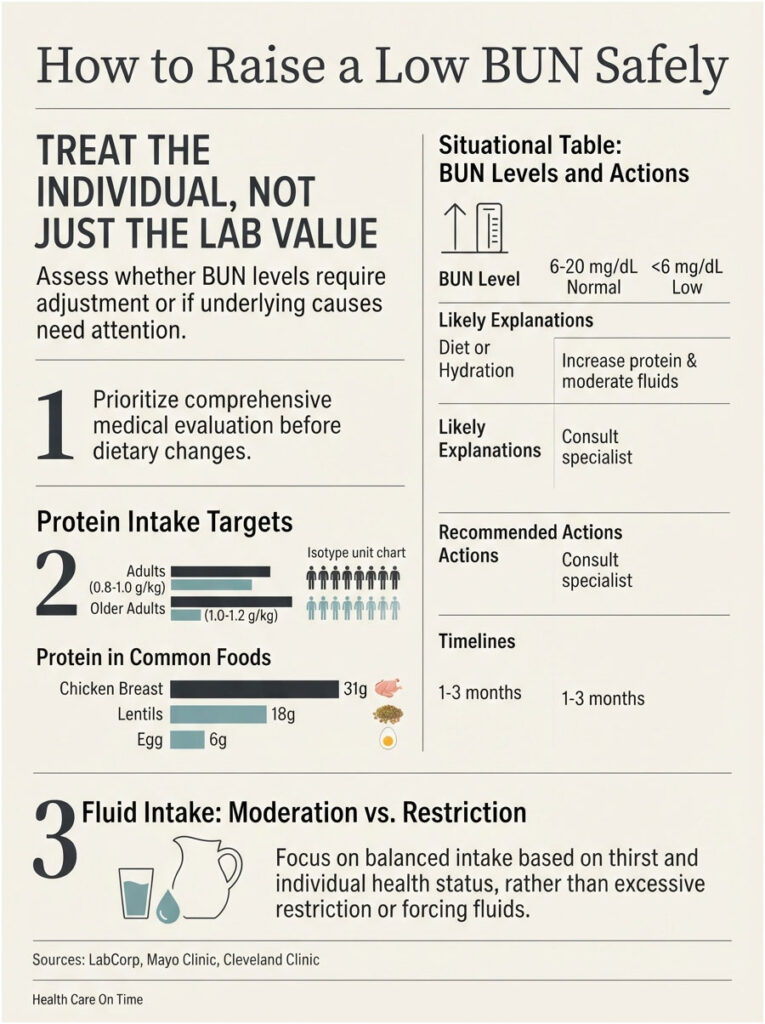
Before changing anything, answer one question: does the number need to move, or does the cause need attention? Those are different problems with different answers, and confusing them leads people to eat protein they do not need.
| Your Situation | Most Likely Explanation | Recommended Action | Timeline |
| BUN 6 to 7, everything else normal, feeling fine | Diet, hydration, or personal baseline | No treatment; recheck at next routine panel | 6 to 12 months |
| BUN under 5 with albumin below 3.5 g/dL | Protein shortfall or liver synthesis problem | Liver panel plus dietitian referral | Within 2 weeks |
| Low BUN with jaundice or new swelling | Possible advanced liver disease | Same-week appointment; liver panel and imaging | Within 7 days |
| Low BUN during pregnancy | Plasma volume expansion | Mention at next prenatal visit; no action needed | Routine prenatal schedule |
| Low BUN on a plant-based or very low protein diet | Inadequate protein intake | Raise protein toward 0.8 to 1.2 g per kg body weight | 4 to 8 weeks, then recheck |
| Low BUN within a week of surgery or IV fluids | Fluid dilution | Repeat panel once fluid load has cleared | 2 to 4 weeks |
| Low BUN plus sodium under 135 | Possible SIADH or overhydration | Medication review; urine osmolality and uric acid | Within 2 weeks |
| Low BUN with confusion or lethargy | Possible elevated ammonia | Urgent evaluation; ammonia level | Same day |
Protein Targets That Make Sense for Adults
The US RDA for protein is 0.8 grams per kilogram of body weight per day, which works out to roughly 55 grams for a 150-pound adult. That figure is a floor designed to prevent deficiency, not a target for good health.
Expert panels have argued for more in older adults. Research published in the Journals of Gerontology reported that increasing protein to 1.0 to 1.5 g/kg per day in malnourished older adults admitted to hospital improved survival in the NOURISH and EFFORT trials.
Practical Protein Amounts in Common US Foods
| Food | Standard Serving | Protein (grams) |
| Chicken breast, cooked | 4 oz | 35 |
| Greek yogurt, plain | 7 oz container | 20 |
| Canned tuna in water | 5 oz can | 30 |
| Firm tofu | 4 oz | 12 |
| Lentils, cooked | 1 cup | 18 |
| Large eggs | 2 eggs | 12 |
| Black beans, canned | 1 cup | 15 |
| Cottage cheese, low-fat | 1 cup | 26 |
Spread intake across meals rather than loading dinner. NHANES data shows older Americans concentrate protein heavily in the evening meal, which is less effective for maintaining muscle than an even distribution.
Adjusting Fluid Intake Without Overcorrecting
If heavy water intake is driving the number, the fix is moderation, not restriction. Drinking to thirst, with extra in heat or during exercise, works for most healthy adults.
Never restrict fluids to move a lab value. Dehydration causes measurable harm; a low BUN reading does not.
When Not to Chase the Number
If kidney function, liver function, and nutritional status all check out, leave the number alone. Eating extra protein to nudge a waste product into a reference range accomplishes nothing and can add load for people who already have reduced kidney function.
Our medical team standing advice: treat the person and the cause, not the printout.
Five Mistakes People Make Reading a Low BUN Result
- Reading BUN as a kidney score. A low BUN is one of the least likely findings to indicate kidney disease. High BUN with high creatinine is the pattern that matters there.
- Ignoring the rest of the panel. BUN in isolation says almost nothing. Albumin, creatinine, sodium, and liver enzymes on the same page carry most of the interpretive weight.
- Comparing against the wrong reference range. A range pulled from a search result, a different lab, or a different country will not match the one your lab applied. Read the interval printed on your own report.
- Acting on a single draw. Fluid status shifts hour to hour. One low value taken after a large water bottle or a saline drip is a snapshot, not a trend.
- Assuming low is always better than high. A low BUN is usually harmless, but usually is not always. A value that keeps falling across successive panels deserves the same curiosity as one that keeps climbing.
Frequently Asked Questions
Is a low BUN level dangerous?
Rarely. On its own, a mildly low BUN does not harm you and produces no symptoms. It becomes worth investigating when it persists, drops below 5 mg/dL, or appears alongside jaundice, swelling, confusion, or a low albumin. Your doctor interprets it against the full panel.
What is considered a dangerously low BUN?
There is no official danger threshold, because the number itself is not harmful. Most clinicians look more closely below 5 mg/dL, particularly when it represents a drop from your earlier results. What matters is the condition producing the value, not the value itself.
Can drinking too much water cause a low BUN?
Yes. Extra fluid in the bloodstream dilutes urea, lowering the measured concentration without changing how much your body actually produced. Athletes, heavy water drinkers, and anyone who received IV fluids show this effect. It typically corrects within a day or two of normal intake.
Does a low BUN mean my kidneys are healthy?
Not by itself, though it is reassuring when creatinine is also normal. Low BUN reflects urea production and dilution more than filtration capacity. Kidney health is better assessed with creatinine, estimated GFR, and a urine albumin measurement than with BUN alone.
What does a low BUN with normal creatinine mean?
It points away from kidney problems and toward diet, hydration, pregnancy, or liver function. This is one of the most common combinations on routine panels and one of the least concerning. Your doctor will usually check albumin and liver enzymes before considering anything further.
Is low BUN normal during pregnancy?
Yes, and it is expected. Blood volume expands by roughly 50% while kidney filtration increases, so urea is both diluted and cleared faster. Values of 3 to 9 mg/dL are common in the second and third trimesters, returning toward baseline after delivery without treatment.
Can a vegan or vegetarian diet cause a low BUN?
It can, especially on plant-based diets that have not been planned for adequate protein. Less protein means less nitrogen available for urea production. Well-planned vegan diets built on legumes, soy, seitan, nuts, and seeds usually keep BUN inside the reference range without difficulty.
Does low BUN cause fatigue?
Not directly. Urea is a waste product, so having less circulating does not drain your energy. Fatigue appearing alongside a low BUN belongs to the underlying cause, such as anemia, liver disease, thyroid dysfunction, or insufficient calorie and protein intake.
Can medications lower BUN levels?
Yes. Anabolic steroids and growth hormone shift nitrogen into tissue building rather than urea production. Opioids, high-volume IV fluid protocols, and drugs that trigger SIADH including SSRIs and carbamazepine can also lower it. Tell your doctor about every medication and supplement you take.
What does a low BUN and low albumin mean together?
This pairing carries more weight than either value alone, because the liver manufactures both from dietary protein. It points toward inadequate protein intake, malabsorption, or reduced liver synthetic function. Expect a full liver panel and a detailed dietary history as the next steps.
How can I raise my BUN level naturally?
Only when the cause calls for it. Increasing protein toward 0.8 to 1.2 grams per kilogram of body weight daily, spread evenly across meals, is the standard approach when intake is the issue. Moderating very high fluid intake helps. Do not restrict fluids to move a number.
Should I retest a low BUN, and how soon?
If you feel well and the rest of your panel is normal, rechecking at your next routine visit is reasonable. If the value sits under 5 mg/dL, or albumin or liver enzymes are also abnormal, most clinicians repeat the panel within two to four weeks under fasting conditions.
| Medical Disclaimer: This article is for general information only and does not replace personalized medical advice, diagnosis, or treatment. Laboratory reference ranges vary between facilities, and results must be interpreted in the context of your full medical history and current medications. Always discuss your lab results with a licensed healthcare provider before making changes to diet, fluid intake, or medication. |
References
- Cleveland Clinic: Blood Urea Nitrogen (BUN) Test
- CDC, Stats of the States: Cirrhosis and Other Chronic Liver Disease Mortality
- CDC MMWR QuickStats: Death Rates for Chronic Liver Disease and Cirrhosis
- Trends and Demographics of Liver Fibrosis and Cirrhosis-Related Mortality, CDC WONDER Analysis
- Increasing Prevalence of Cirrhosis Among Insured Adults in the United States, 2012 to 2018
- American Liver Foundation: Liver Disease Statistics
- Protein Intake Trends and Conformity With Dietary Reference Intakes, NHANES 2001 to 2014
- Protein Intake and Mobility Limitation in Community-Dwelling Older Adults, Health ABC Study
- Protein Intake and Muscle Function in Older Adults, National Institutes of Health
- Perspective: Protein Requirements and Optimal Intakes in Aging
- Nutritional Interventions: Dietary Protein Needs and Skeletal Muscle in Older Adults, Journals of Gerontology
- Healthwise Clinical Reference: Blood Urea Nitrogen (BUN) Test
- Contemporary Epidemiology of Chronic Liver Disease and Cirrhosis