
You finished your period seven days ago. You wipe, and there it is: a rusty brown smear that has no business being there.
Here is the part almost nobody tells you. The color brown is one of the least useful clues your body gives you. The calendar date is the clue that actually matters.
Table of Contents
Quick Answer
Brown blood a week after your period is usually old blood finishing a slow exit, or light spotting from the hormone shift around ovulation. In most cases it is light, lasts one to three days, and stops on its own. Get it checked promptly if it comes with odor, pelvic pain, fever, heavy flow, bleeding after sex, or if pregnancy is possible.
At a Glance
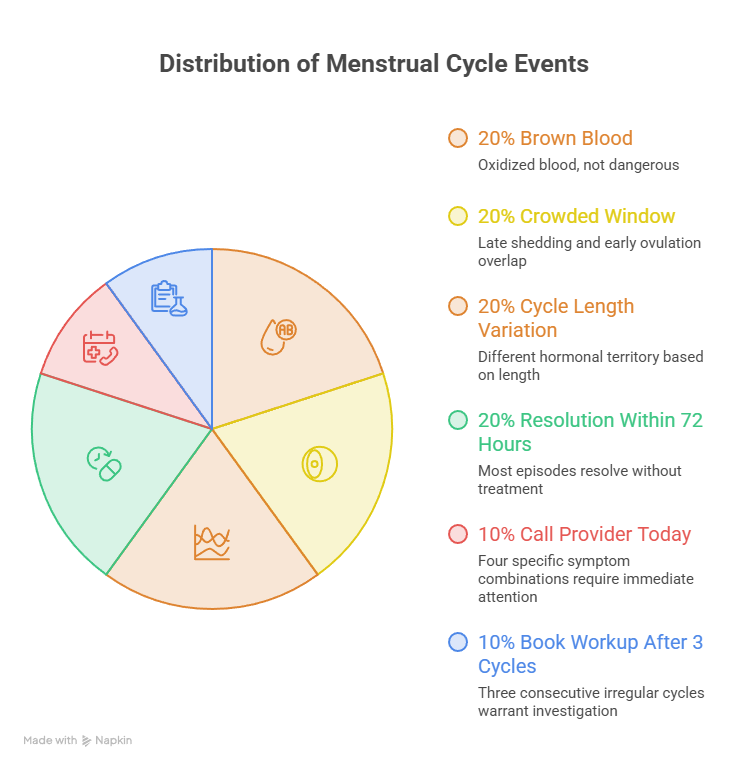
• Brown means oxidized, not dangerous. Blood darkens the longer it takes to leave your body.
• Day 7 after a period sits in a crowded window where late shedding and early ovulation can overlap.
• Your cycle length changes the answer completely. A 24-day cycle and a 34-day cycle put day 7 in totally different hormonal territory.
• Most episodes resolve inside 72 hours with no treatment at all.
• Four specific symptom combinations mean call a provider today, not next month.
• Three cycles in a row is the practical threshold for booking a workup.
• A short blood panel plus a pelvic ultrasound answers the question in most persistent cases.
What Brown Blood Actually Is (and Why Color Is a Clock, Not a Diagnosis)
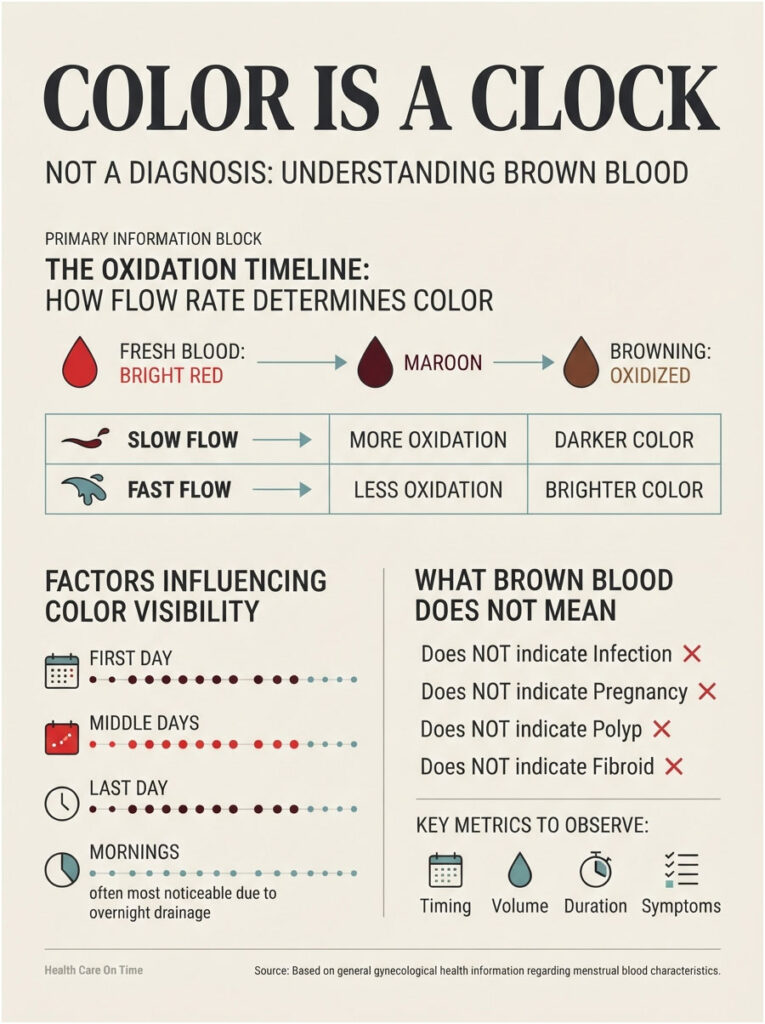
Blood leaving your body quickly looks bright red. Blood that lingers in the uterus or vaginal canal reacts with oxygen and darkens through rust, deep maroon, and finally brown.
That is the entire mechanism. It is the same reaction that turns a scrape on your knee dark by morning.
The Oxidation Timeline: Red to Rust to Brown
Fresh menstrual blood is bright because hemoglobin is still carrying oxygen in its ferrous state. As it oxidizes, the iron shifts form and the color deepens in a predictable sequence.
Slow flow gives oxidation more time to work. That is why the first and last days of a period so often look brown while the middle three days look red.
Why a Slow Exit Means a Darker Color
Volume drives speed. A heavy gush clears the cervix in minutes, while a few drops can linger for hours.
The distance is short but the pace is everything. Two women can shed the same amount of tissue and see two different colors purely because of flow rate.
Why Morning Is When You Notice It
Brown blood most often appears at the first bathroom visit of the day. Lying flat all night slows drainage from the cervix.
What shows up at 7 a.m. frequently left the uterine lining the previous evening. Patients booking cycle panels through HealthCareOnTime describe this exact pattern so often that our medical reviewers now ask about it directly.
Brown Blood, Brown Discharge, and Spotting Are Three Different Things
People use these terms interchangeably, which muddies the picture for their own provider.
Brown blood is visible blood, dark in color. Brown discharge is cervical mucus tinted by a small amount of blood, usually thicker and stickier. Spotting describes volume, meaning light enough that it does not fill a pad or tampon.
Precision pays off. Saying “bleeding” when you mean a single brown streak on toilet paper can steer a workup in the wrong direction.
Four Things the Color Cannot Tell You
Brown does not rule out infection. Brown does not rule out pregnancy. Brown does not rule out a polyp or fibroid. Brown does not tell you how much tissue was involved.
Cleveland Clinic Ob/Gyn Oluwatosin Goje, MD, frames vaginal discharge as a normal shedding process, with the meaningful signal being a change from your own usual pattern rather than any one color.
Read four things instead: the timing, the volume, the duration, and the symptoms traveling alongside it.
Why Day 7 Specifically? The Cycle Math Almost Nobody Explains
Nearly every article on this topic treats “after your period” as one undifferentiated blob of time. It is not.
Day 7 after bleeding stops lands in a very specific hormonal neighborhood, and which neighborhood depends entirely on how long your cycle runs.
First, Recount Your Cycle Day
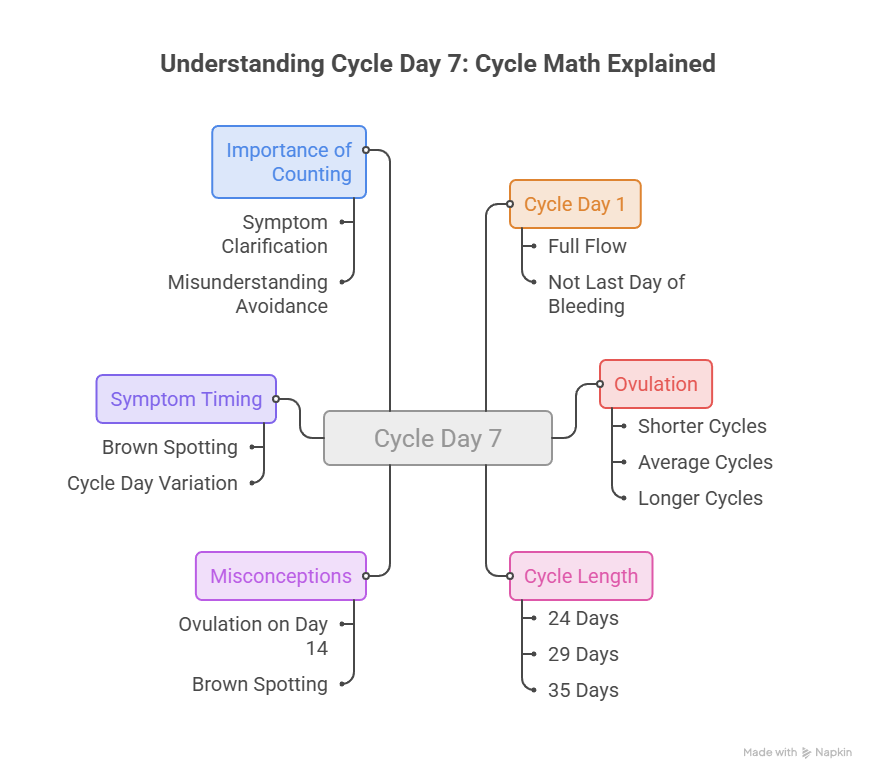
Cycle day 1 is the first day of full flow, not the day bleeding ends. This trips up almost everyone.
If your period ran five days and you are now seven days past the last day of bleeding, you are on roughly cycle day 12 or 13. That single recalculation reframes the whole question.
Three Worked Examples
The same symptom on the same calendar day means three different things depending on cycle length. Here is how the math plays out.
Scenario A: The 24-Day Cycle
Period runs days 1 through 4. Seven days later puts you on cycle day 11.
In shorter regular cycles, ovulation averages around day 12. You are sitting directly on the ovulatory window, and brown spotting here is textbook ovulation spotting. Expect one day, maybe two, often with a one-sided pelvic twinge.
Scenario B: The 29-Day Cycle
Period runs days 1 through 5. Seven days later puts you on cycle day 12.
In regular cycles between 21 and 35 days, ovulation averages around day 15. You are late follicular, approaching ovulation but not there yet. Estrogen is climbing, the lining is rebuilding, and leftover tissue from the last period is the more likely culprit than any hormonal event.
Scenario C: The 35-Day Cycle
Period runs days 1 through 6. Seven days later puts you on cycle day 13.
In longer regular cycles, ovulation averages closer to day 19. You are nowhere near it. Brown blood here has less obvious explanation, and if it repeats across cycles it deserves a hormone panel, since long cycles carry higher odds of an underlying ovulatory disorder.
The Day 14 Ovulation Myth
Most pamphlets in America still say ovulation happens on day 14. The data disagrees.
A Natural Cycles analysis of more than 600,000 ovulatory cycles found ovulation timing varied meaningfully by cycle length, averaging day 15 overall, day 12 in shorter cycles, and day 19 in longer ones.
Our medical reviewers see this misunderstanding constantly. A woman with a 23-day cycle assumes she cannot possibly be ovulating a week after her period, when that is precisely when she is.
Why Two Women With the Same Symptom Get Different Answers
Two people can report identical brown spotting on the same day of the month and have entirely different explanations. One is ovulating. One is clearing old lining. One may be neither.
Before assuming the worst, count your cycle days. It takes thirty seconds and it eliminates half the possibilities.
Nine Reasons You Are Seeing Brown Blood a Week After Your Period
The list below runs roughly from most to least common in reproductive-age American women. The table sets all nine side by side, then each gets a plain-English explanation.
Table 1: Brown Blood One Week After Period, Cause-by-Cause Comparison
| Likely Cause | Where It Falls in Your Cycle | Typical Volume and Duration | Symptoms That Travel With It | Concern Level |
| Leftover uterine lining | Cycle days 8 to 14, any cycle length | Streaks to light spotting, 1 to 3 days | None, or very mild cramping | Low |
| Ovulation spotting | Cycle days 11 to 19, tied to cycle length | A few drops to light spotting, 1 to 2 days | One-sided pelvic twinge, stretchy egg-white mucus, mild breast tenderness | Low |
| Hormonal birth control adjustment | Any cycle day, first 3 months of a new method | Intermittent spotting, days to weeks | Mild bloating, breast tenderness, mood shifts | Low, monitor |
| Implantation bleeding | 6 to 12 days post-ovulation, so cycle days 20 to 26 in short cycles | Pink to brown, very light, under 48 hours | Mild cramping, fatigue, missed or late period | Low, test for pregnancy |
| Thyroid or prolactin imbalance | Unpredictable, often recurring monthly | Light spotting, variable, tends to repeat | Fatigue, hair thinning, weight change, cold intolerance, nipple discharge | Moderate |
| Uterine fibroids or endometrial polyps | Any cycle day, repeats cycle after cycle | Spotting to light bleeding, several days | Heavy periods, pelvic pressure, longer periods, fatigue | Moderate |
| Cervical irritation or ectropion | Within 24 to 48 hours of sex, a Pap test, or a pelvic exam | Small amount, under 24 hours | Post-coital spotting, increased clear discharge | Low to moderate |
| Infection (BV, chlamydia, gonorrhea, PID) | Any cycle day | Variable, often persistent | Odor, itching, burning, pelvic pain, fever, pain during sex | High, evaluate quickly |
| Perimenopause | Any cycle day, usually age 40 and up | Irregular spotting, unpredictable pattern | Cycle length changes, hot flashes, sleep disruption, night sweats | Moderate |
1. Leftover Uterine Lining
The uterus does not always empty on schedule. A pocket of endometrial tissue can hang back and release days later, fully oxidized by the time it appears.
This single cause accounts for the majority of cases behind this search. It is light, it is brief, and it needs nothing but a panty liner.
Two features define it: no odor, and no escalation. If the color stays brown and the volume stays flat, this is almost always the answer.
2. Ovulation Spotting
When the follicle ruptures, estrogen falls sharply before progesterone rises to replace it. That brief hormonal gap can destabilize a thin sliver of lining.
Research is limited, but one study of over 200 women found roughly 5 percent experienced mid-cycle bleeding, typically lasting one to two days. Other estimates run as high as 9 percent of healthy menstruating women on a recurring basis.
In symptom questions our team fields, the strongest confirming clue is not the blood at all. It is the stretchy, clear, egg-white cervical mucus that shows up alongside it.
3. Hormonal Birth Control Adjustment
Pills, patches, rings, implants, and hormonal IUDs all thin the endometrium. During the adjustment window, that thinner lining sheds unpredictably.
Give a new method three full months before judging it. Spotting continuing past month four is a conversation with your prescriber, not a reason to stop cold.
Copper IUDs behave differently. They do not thin the lining; they irritate it, which can produce heavier periods and intermittent brown spotting for three to six months after placement.
The Missed-Pill Effect
A single skipped active pill can drop circulating hormone levels enough to trigger brown spotting two or three days later. Two missed pills makes it near certain.
Late pills count too. Taking a progestin-only pill more than three hours off schedule has roughly the same effect as missing it.
4. Implantation Bleeding
If conception occurred, the embryo burrows into the endometrium roughly 6 to 12 days after ovulation, which can nick tiny vessels.
The timing rarely lands one week after a period ends unless your cycle is short. When it does, the bleeding is minimal, pink or brown, and stops within a day or two.
First-trimester bleeding overall is not rare. NIH researchers note it occurs in 16 to 25 percent of pregnancies, and in the NICHD Fetal Growth Study across 12 US hospitals, 410 of roughly 2,300 women (17.8 percent) reported it.
5. Thyroid or Prolactin Imbalance
Your thyroid quietly governs cycle regularity. Both underactive and overactive thyroid function can produce off-schedule spotting.
Elevated prolactin does the same by suppressing ovulation. Patients commonly ask us why a cycle changed with no obvious trigger, and a simple TSH plus prolactin draw answers it more often than people expect.
The tell is repetition. Hormonal causes tend to produce the same pattern month after month, while mechanical causes come and go.
6. Uterine Fibroids or Endometrial Polyps
Benign growths distort the uterine cavity and its blood supply. Bleeding between periods is one of their signature complaints.
In an international survey of 21,746 women, those with a fibroid diagnosis reported bleeding between periods at 33.3 percent versus 13.5 percent among women without one. The same survey found heavy bleeding at 59.8 percent versus 37.4 percent.
Repeat spotting across three or more cycles, particularly alongside heavier or longer periods, is the pattern that should prompt imaging.
7. Cervical Irritation or Ectropion
The cervix is vascular and easily disturbed. Sex, a Pap test, a speculum exam, or a new menstrual cup can each cause a small bleed that surfaces brown a day later.
Cervical ectropion, where softer glandular cells extend onto the outer cervix, makes this more likely. It is a benign anatomical variation, common in women on combined hormonal contraception.
The giveaway is the trigger. If it follows sex or an exam every time and never appears otherwise, the cervix is the source.
8. Infection
Bacterial vaginosis, chlamydia, gonorrhea, trichomoniasis, and pelvic inflammatory disease can all cause spotting. Odor is the single symptom that most reliably separates infection from everything else on this list.
CDC 2024 provisional surveillance recorded more than 2.2 million reported cases of chlamydia, gonorrhea, and syphilis in the United States, a 9 percent decline from 2023 but still 13 percent above the total from a decade earlier.
Chlamydia is frequently silent, which is exactly why unexplained spotting warrants a swab even when nothing else feels wrong.
9. Perimenopause
The National Institute on Aging puts the average age of menopause in the United States at 52, with the transition typically beginning as changes to menstrual patterns. Those changes often start in the mid-forties.
The classic sequence runs: shorter cycles, then spotting between them, then longer cycles, then skipped months. Brown spotting is frequently the first sign anyone notices.
New spotting after 40 deserves evaluation rather than assumption, because fibroids and endometrial changes become more common at the same age.
How Common Is This Among American Women?
Search engines make every symptom feel universal. The prevalence data tells a more measured story.
What the Prevalence Data Shows
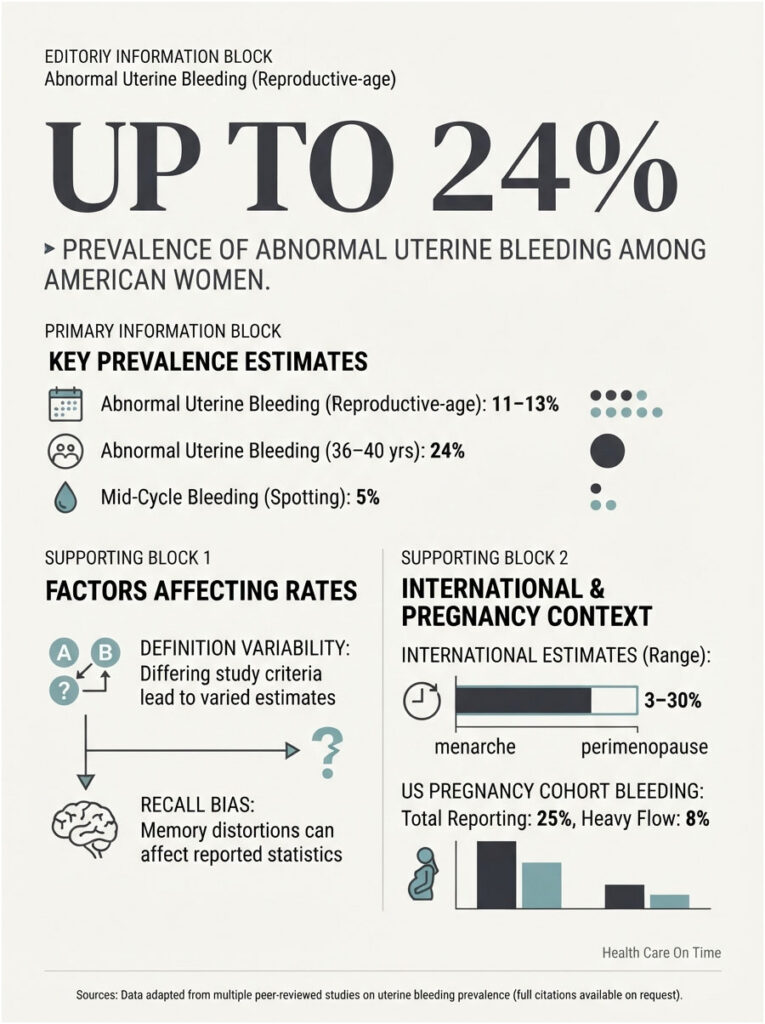
AHRQ Effective Health Care Program estimates abnormal uterine bleeding affects 11 to 13 percent of reproductive-age women at any given time, rising to 24 percent among women aged 36 to 40. StatPearls places international estimates in a wider 3 to 30 percent band, with peaks around menarche and perimenopause.
So this is common, but not universal, and the curve bends upward with age. That distinction matters for how seriously to treat a first-time episode at 43 versus 23.
Mid-Cycle Spotting Is Rarer Than the Internet Suggests
True documented mid-cycle bleeding sits in the low single digits. Most of what people call “spotting between periods” is the tail end of one period or the leading edge of the next.
In cases reviewed across our diagnostic network, the most useful clarifier is a two-cycle log. It turns a vague worry into a dated pattern a physician can act on in one visit.
Why Published Figures Vary So Widely
Studies differ on how they define bleeding, who they recruit, and whether they rely on memory or real-time logging.
A community pregnancy cohort of 4,539 US women found about one quarter reported bleeding, but only 8 percent of those described it as heavy, and most episodes lasted under three days.
Recall bias inflates some numbers and deflates others. Treat any single percentage as a range, not a verdict.
Table 2: US Data on Bleeding Between Periods and Related Conditions
| Finding | Figure | Population Studied | Source and Year |
| Abnormal uterine bleeding at any given time | 11 to 13 percent | US reproductive-age women, general population | AHRQ Effective Health Care Program |
| Abnormal uterine bleeding, ages 36 to 40 | 24 percent | US reproductive-age women | AHRQ Effective Health Care Program |
| Gynecology outpatient visits for heavy menstrual bleeding | Over 18 percent of all visits | US ambulatory gynecology care | Journal of Clinical Outcomes Management review |
| Documented mid-cycle bleeding | Approximately 5 percent | Cohort of 200-plus menstruating women | Mid-cycle bleeding study cited by Natural Cycles |
| First-trimester bleeding | 17.8 percent (410 of ~2,300) | NICHD Fetal Growth Study, 12 US hospitals | National Institutes of Health |
| Bleeding between periods, women with fibroids | 33.3 percent vs 13.5 percent without | International survey of 21,746 women | Peer-reviewed survey, NIH PubMed Central |
| Reported chlamydia, gonorrhea, and syphilis cases | More than 2.2 million | United States, all ages | CDC STI Surveillance, 2024 (Provisional) |
| PCOS prevalence | 5.2 percent in 2019 | Kaiser Permanente Washington members, ages 16 to 40 | US population-based cohort, 2006 to 2019 |
| Average age of menopause | 52 years | United States | National Institute on Aging |
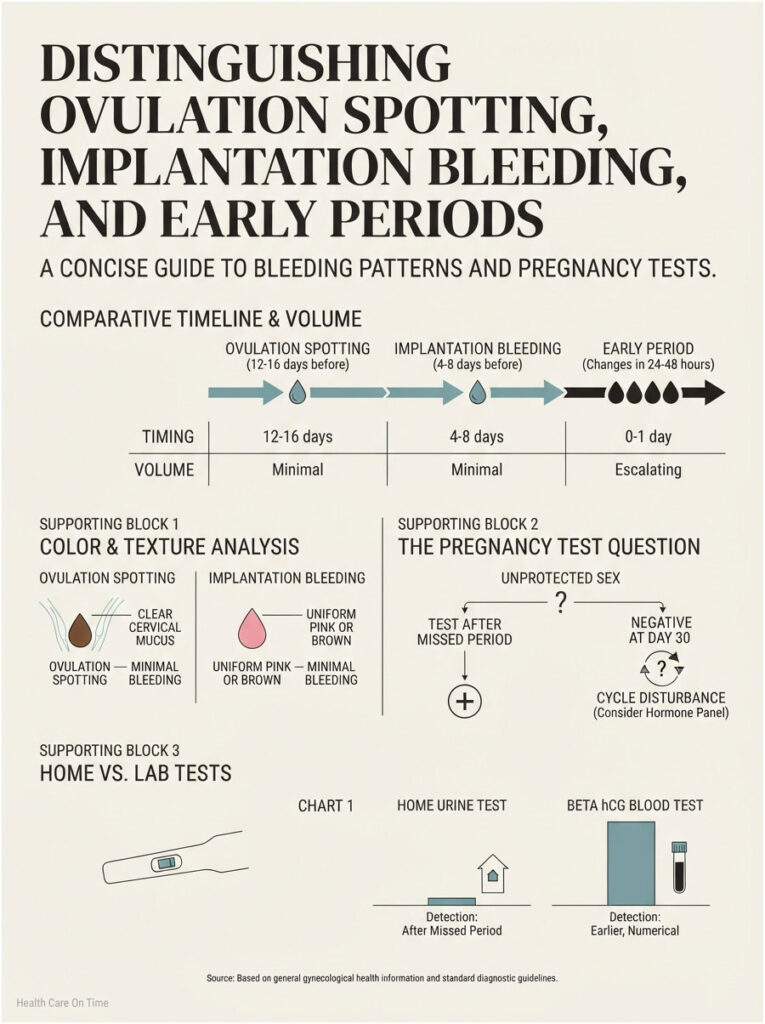
Ovulation Spotting, Implantation Bleeding, or an Early Period?
These three get confused constantly because all three can look brown and light. Four quick tests separate them.
The Timing Test
Count backward from your next expected period. Ovulation spotting lands roughly 12 to 16 days before it. Implantation bleeding lands 4 to 8 days before it.
An early period announces itself differently: it turns red and increases in volume within 24 to 48 hours.
The Volume Test
Ovulation spotting is drops. Implantation bleeding is drops. A period escalates.
If you needed to change a pad within four hours, it is not ovulation spotting and it is not implantation.
The Color and Texture Test
Ovulation spotting frequently mixes with stretchy, clear cervical mucus. That combination is close to diagnostic on its own.
Implantation bleeding tends to be uniform pink or brown without the stretchy quality, and without the one-sided ache.
The Pregnancy Test Question
If unprotected sex occurred in the previous three weeks, test. There is no downside to knowing, and a clear result removes the loudest worry in the room.
Home Urine Test Versus Beta hCG Blood Test
A home test detects hCG in urine and performs reliably from the day of a missed period. Testing earlier produces false negatives because hCG has not accumulated to detectable levels yet.
A quantitative beta hCG blood test detects pregnancy earlier and returns a number rather than a line. Patients commonly ask us which to choose, and the practical answer is: home test first, blood test if it reads negative but the period still does not arrive.
What a Negative Test at Day 30 Actually Means
A negative home test taken on or after the day your period was due, with the period still absent a week later, points away from pregnancy and toward a cycle disturbance.
That is the moment a hormone panel earns its place. Thyroid dysfunction, elevated prolactin, and ovulatory disorders all produce late periods with brown spotting and negative tests.
Red Flags: When Brown Blood Needs a Provider, Not a Search Bar
Most brown spotting is uneventful. These specific combinations are not.
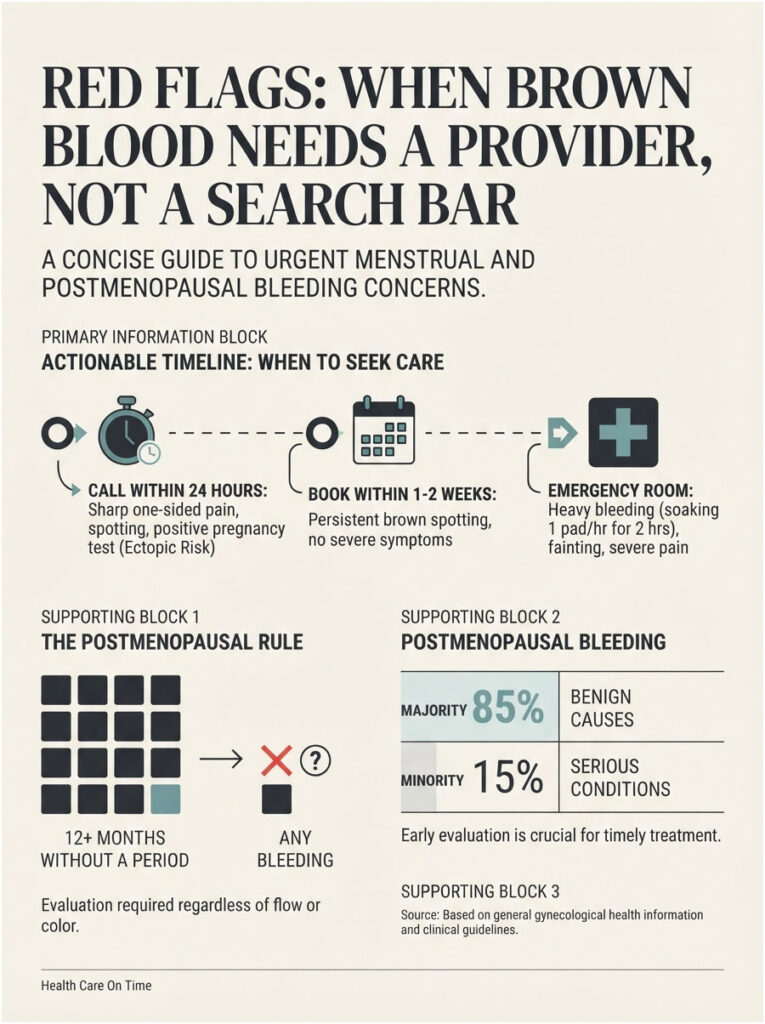
Call Within 24 Hours If
- The discharge carries a strong or fishy odor
- You have fever, chills, or pelvic pain that is worsening
- Bleeding follows sex every single time
- You are pregnant or could be, and the bleeding is increasing
- Pain is sharp, one-sided, and severe
That last one matters most. Sharp one-sided pain with spotting and a positive or possible pregnancy can indicate an ectopic pregnancy, which is a medical emergency.
Book Within One to Two Weeks If
- Spotting between periods has happened three or more cycles running
- Your periods have become noticeably heavier or longer
- You feel unusually tired, breathless on stairs, or look pale
- You have used the same birth control for over four months and spotting persists
- You are over 40 and this pattern is new to you
Go to the Emergency Room If
Soaking through a pad every hour for two consecutive hours, fainting or near-fainting, severe abdominal pain, or heavy bleeding with a positive pregnancy test all warrant immediate care.
Do not wait for an office to open. These signs are time-sensitive.
The Postmenopausal Rule
Our medical reviewers flag this one consistently. Any bleeding at all after 12 consecutive months without a period requires evaluation, no matter how light or how brown.
The overwhelming majority of postmenopausal bleeding turns out to be benign. The evaluation exists because the small minority that is not benign responds extremely well to early treatment.
What a Provider Will Actually Check
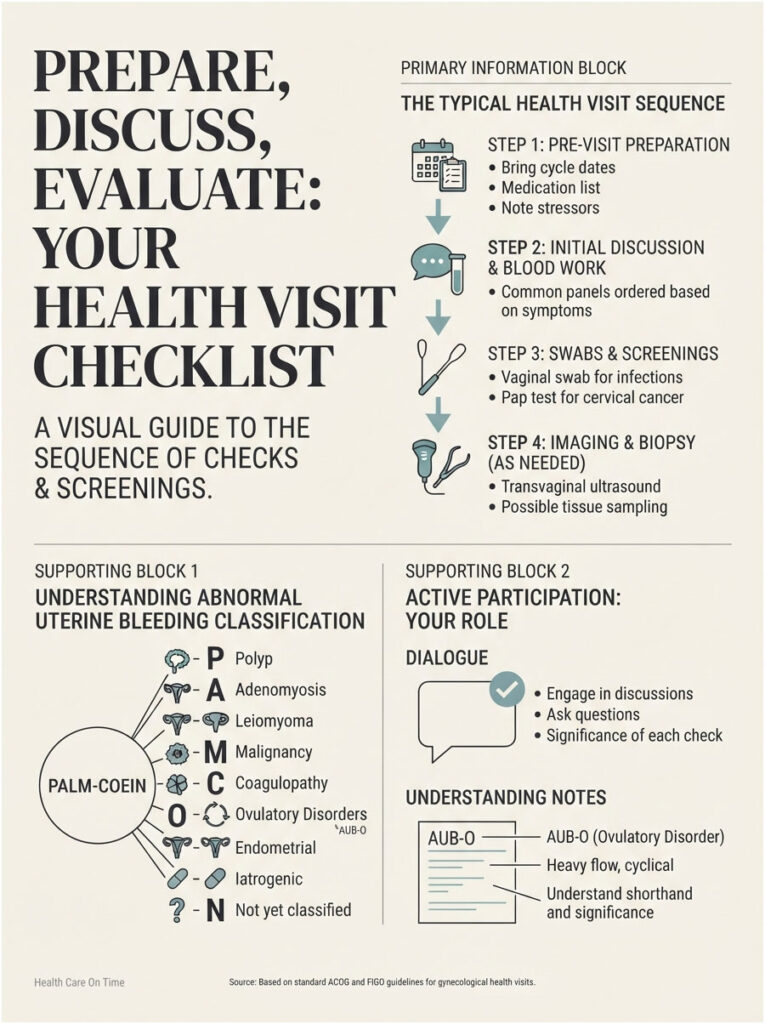
Knowing the workup in advance removes most of the dread. Here is the typical sequence.
The Conversation Comes First
Bring dates. Your last three cycle start dates, the specific days you spotted, how much, what color, and what else you felt.
Bring your medication list, supplements included. Blood thinners, certain antidepressants, thyroid medication, and emergency contraception all shift bleeding patterns.
Mention any new stressors, weight changes, or training load increases. These are relevant clinical information, not small talk.
Blood Work Commonly Ordered
The panels most frequently booked through HealthCareOnTime for this symptom cluster include:
- Beta hCG to confirm or definitively rule out pregnancy
- Complete blood count (CBC) to check for anemia from chronic blood loss
- Ferritin and iron studies because ferritin falls before hemoglobin does
- TSH with free T4 to screen thyroid function
- Prolactin when cycles have become irregular or absent
- FSH and estradiol in women over 40 to assess perimenopausal status
- Coagulation studies when there is a personal or family history of easy bruising or heavy bleeding
No patient needs all seven. A provider selects based on age, pattern, and accompanying symptoms.
Swabs and Screening
A vaginal swab checks for bacterial vaginosis, yeast, and trichomoniasis. A separate nucleic acid amplification test screens for chlamydia and gonorrhea.
CDC maintains national surveillance on these infections precisely because they are common and frequently produce no symptoms. Screening takes minutes and treatment is straightforward when something turns up.
A Pap test with HPV co-testing may be added if you are due, though that is cervical cancer screening rather than part of a bleeding workup.
Imaging and Biopsy
Transvaginal ultrasound is the workhorse. It measures endometrial thickness and identifies fibroids, polyps, and ovarian cysts in a single sitting.
If the lining appears thickened or the picture stays unclear, a saline infusion sonogram or an office endometrial biopsy may follow. Biopsy sounds alarming; in practice it takes a few minutes and feels like a strong cramp.
The PALM-COEIN Framework Behind Your Chart Notes
Since 2011, FIGO has classified abnormal uterine bleeding using the PALM-COEIN system, separating structural causes (polyp, adenomyosis, leiomyoma, malignancy or hyperplasia) from non-structural ones (coagulopathy, ovulatory dysfunction, endometrial, iatrogenic, and not otherwise classified).
If your chart reads “AUB-O,” that means an ovulatory disorder. “AUB-L” means fibroids. “AUB-I” means something iatrogenic, often a medication.
Knowing the shorthand lets you follow your own care instead of decoding it afterward.
What You Can Do at Home Starting Today
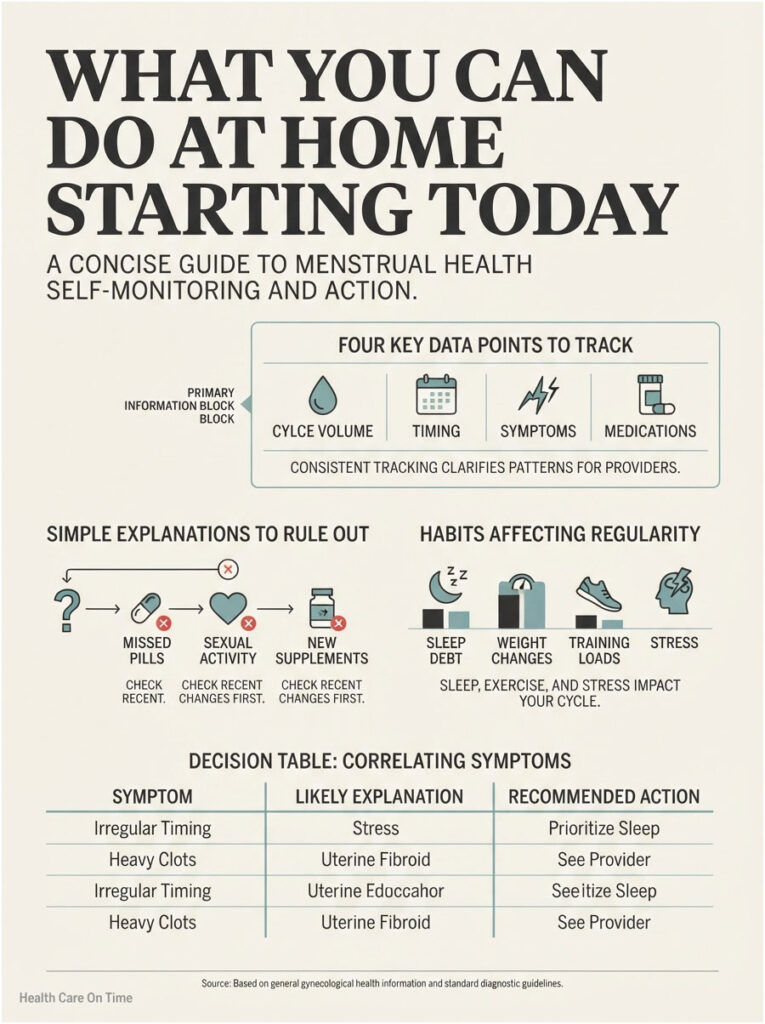
None of this replaces medical evaluation, but it makes any eventual appointment considerably more productive.
Track These Four Data Points
- Cycle day, counted from the first day of full flow
- Volume, described concretely (streak on tissue, quarter-sized spot on a liner, half a pad)
- Color, noting whether it stayed brown or turned red
- Companions, meaning cramps, odor, mucus type, breast changes, mood
Across the cycle logs patients share with us, the volume field is the one most often left blank and the one clinicians most want to see.
A free period app handles all four. A note on your phone handles them just as well.
Rule Out the Easy Explanations First
Did you miss or delay a pill? Did you have sex or a pelvic exam in the previous 48 hours? Did you start or stop a supplement? Did you use emergency contraception in the last month?
Any yes explains a great deal without further testing. Work through the list before booking anything.
Habits That Genuinely Move Cycle Regularity
Sleep debt, sharp weight change in either direction, heavy training loads, and sustained stress all disturb the hypothalamic signaling that times ovulation. Cycle irregularity is frequently the first visible sign.
None of these are moral failings. They are physiological inputs, and correcting them often shows up in the very next cycle.
Iron status matters too. Chronic light bleeding depletes ferritin quietly, and low ferritin worsens fatigue long before a CBC shows anemia.
Four Things Not to Do
Do not douche. It disrupts vaginal pH and raises infection risk without cleaning anything.
Do not take leftover antibiotics or borrow someone else’s birth control. Do not stop a prescribed contraceptive abruptly because of spotting. Do not wait six months for a monthly pattern to settle on its own.
Table 3: Your Situation, Your Next Move
| If This Describes You | Most Likely Explanation | Recommended Action | Timeframe |
| Light brown, 1 to 2 days, no other symptoms, regular cycle | Leftover uterine lining | Log it, take no further action | Watch through next cycle |
| Brown spotting plus a one-sided twinge, cycle under 26 days | Ovulation spotting | Track cycle day and mucus type to confirm | 1 to 2 cycles |
| Started a new pill, patch, ring, or IUD within 3 months | Adjustment bleeding | Continue as prescribed, log every episode | Reassess at 3 months |
| Unprotected sex in the last 3 weeks, period now late | Possible early pregnancy | Home urine test now; beta hCG blood test if negative and period still absent | Today, then again in 7 days |
| Brown discharge with odor, itching, burning, or pelvic pain | Possible infection | STI panel plus vaginal swab | Within 48 hours |
| Spotting 3 or more cycles running, heavy periods, fatigue | Possible fibroid, polyp, or iron deficiency | CBC, ferritin, TSH, transvaginal ultrasound | Within 2 weeks |
| Age 40 plus, new irregular spotting, cycles changing length | Possible perimenopause, other causes not excluded | FSH, estradiol, TSH, pelvic ultrasound | Within 2 to 4 weeks |
| Any bleeding 12 or more months after your last period | Requires evaluation regardless of amount | Contact your provider directly | Immediately |
Mistakes That Delay a Real Diagnosis
Assuming Brown Always Means Harmless
Brown tells you the blood is old. It says nothing about where it came from. An infection produces brown discharge just as readily as leftover lining does.
Waiting for the Pattern to Settle
The most common delay our team hears about is waiting four or five cycles hoping the spotting resolves itself. By then, iron stores may already be depleted.
Three consecutive cycles is the practical threshold. That is long enough to establish a pattern and short enough that treatable causes have not progressed.
Testing for Pregnancy Too Early
A negative test five days before a missed period means very little. Retest at the missed-period mark, then again a week later if the period still has not arrived.
Describing It Vaguely at the Appointment
Walking in with “it happens sometimes” costs you diagnostic accuracy and often an extra visit. Walking in with dates, volumes, and colors frequently shortens the workup by a full appointment cycle.
Frequently Asked Questions
Is brown blood a week after my period normal?
Usually, yes. Light brown spotting lasting one to three days that stops on its own is most often leftover uterine lining or a minor hormonal shift. It becomes concerning when it repeats every cycle, arrives with odor or pain, or appears after menopause.
How long should brown discharge last after a period?
Most brown discharge tied to a finished period clears within one to three days. Some women see it on and off for up to a week. Anything stretching past seven days, or recurring in the same pattern for several cycles, deserves a provider’s review.
Can brown discharge a week after my period mean I am pregnant?
It can, though the timing is unusual unless your cycle is short. Implantation bleeding typically arrives 6 to 12 days after ovulation, closer to your next expected period. Take a home pregnancy test if unprotected sex occurred within the previous three weeks.
Does ovulation cause brown blood?
Yes, in a minority of women. The sharp estrogen drop after the egg releases can shed a thin layer of lining. Studies suggest roughly 5 percent of women experience documented mid-cycle bleeding, usually lasting one to two days and often paired with stretchy cervical mucus.
Why do I get brown spotting every single month between periods?
A monthly, predictable pattern points toward ovulation spotting or a hormonal imbalance rather than a structural problem. Thyroid dysfunction, elevated prolactin, and progesterone shortfalls all produce repeating patterns. A basic hormone panel usually identifies the cause in one appointment.
Can stress cause brown spotting after a period?
Indirectly, yes. Sustained stress disrupts the hypothalamic signals that time ovulation, which can shift your cycle and cause off-schedule spotting. Sleep deprivation, heavy training, and rapid weight change do the same. These remain diagnoses of exclusion, not first assumptions.
What does brown discharge with a strong odor mean?
Odor is the most reliable marker of infection. Bacterial vaginosis, trichomoniasis, and several sexually transmitted infections all produce it. This combination should be evaluated within 48 hours through a vaginal swab and STI screening, since untreated infections can spread to the upper reproductive tract.
Is brown spotting normal on birth control?
During the first three months of a new method, yes. Hormonal contraception thins the endometrium, and that thinner lining sheds unpredictably. Spotting persisting past four months, or starting suddenly after a year of stability, should be raised with your prescriber rather than tolerated.
Can a new IUD cause brown discharge a week after my period?
Frequently. Both hormonal and copper IUDs commonly cause irregular spotting for three to six months after placement. Hormonal IUDs tend to lighten periods over time; copper IUDs may make them heavier. Persistent pain or foul-smelling discharge after placement needs prompt evaluation.
I am 47 and this is new. Is it perimenopause?
Quite possibly. Cycle changes are usually the first sign of the menopausal transition, and the average US menopause age is 52. Even so, new bleeding patterns after 40 should be evaluated rather than assumed, since fibroids, polyps, and endometrial changes also become more common with age.
My pregnancy test was negative but the spotting continues. What now?
Retest one week later, since early tests miss low hCG levels. If the second test is negative and spotting continues, book a workup: CBC, ferritin, TSH, prolactin, and a transvaginal ultrasound. That combination identifies the cause in the large majority of persistent cases.
What tests should I ask for if brown spotting keeps happening?
Start with beta hCG, a complete blood count, ferritin, and TSH. Add prolactin if cycles are irregular, and FSH with estradiol if you are over 40. Request a vaginal swab with STI screening, and a transvaginal ultrasound once spotting has recurred across three or more cycles.
Medical Disclaimer
This article is for general information and education only. It does not constitute medical advice, diagnosis, or treatment, and it is not a substitute for consultation with a licensed healthcare provider. Individual circumstances vary widely. Contact a qualified clinician about any bleeding pattern that concerns you, and seek emergency care for heavy bleeding, severe pain, fainting, or bleeding during a known or possible pregnancy.
References
- Abnormal Uterine Bleeding, StatPearls, NIH National Library of Medicine
- Primary Care Management of Abnormal Uterine Bleeding, AHRQ Effective Health Care Program
- More Than One Day of Early-Pregnancy Bleeding Linked to Lower Birthweight, National Institutes of Health
- Characterizing First-Trimester Bleeding, Right From the Start Cohort, NIH PubMed Central
- CDC Releases 2024 National STI Data, Centers for Disease Control and Prevention
- STI Statistics, Centers for Disease Control and Prevention
- What Is Menopause? National Institute on Aging
- Menopause Fact Sheet, NICHD, National Institutes of Health
- Brown Discharge: 4 Causes and What It Means, Cleveland Clinic
- Ovulation Bleeding: Research Summary and Cycle Timing Data, Natural Cycles
- Incidence, Prevalence, and Trends in Polycystic Ovary Syndrome Diagnosis: A United States Population-Based Study
- Prevalence, Symptoms and Management of Uterine Fibroids: An International Internet-Based Survey, NIH PubMed Central