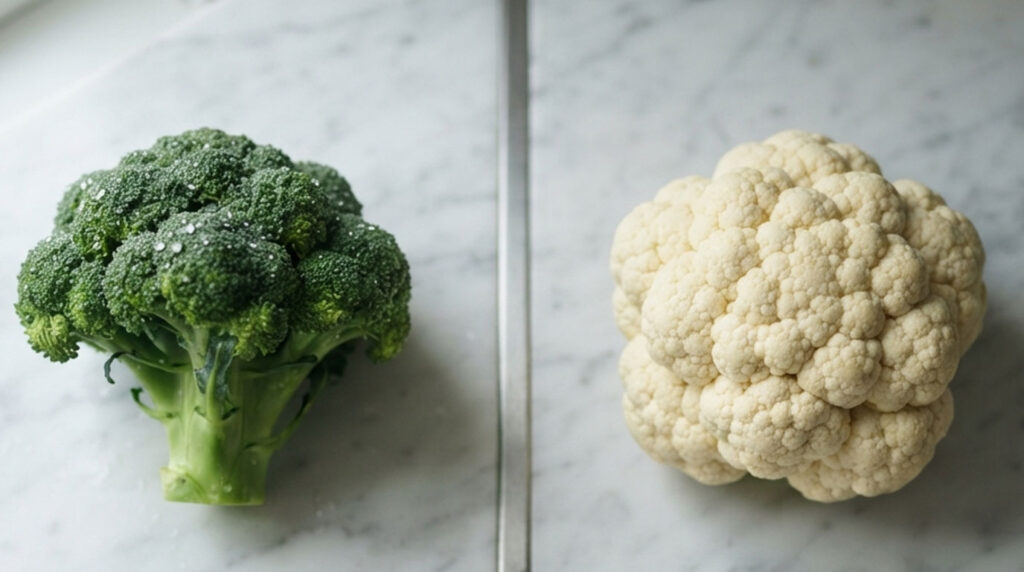
Nearly every broccoli vs cauliflower comparison online is rigged, and not on purpose. They line up one cup of broccoli against one cup of cauliflower. But a cup of chopped broccoli weighs 91 grams and a cup of cauliflower weighs 107 grams. That is an 18% head start handed to cauliflower before a single nutrient gets counted. Fix the math, and the answer sharpens considerably.
Table of Contents
Quick Answer: Broccoli is more nutritious gram for gram. It carries about 85% more vitamin C, roughly six times the vitamin K, more protein, more fiber, and a far higher yield of cancer-studied isothiocyanates. Cauliflower wins on calories, net carbs, choline, and price. Rotate both, and steam rather than boil.
At a Glance
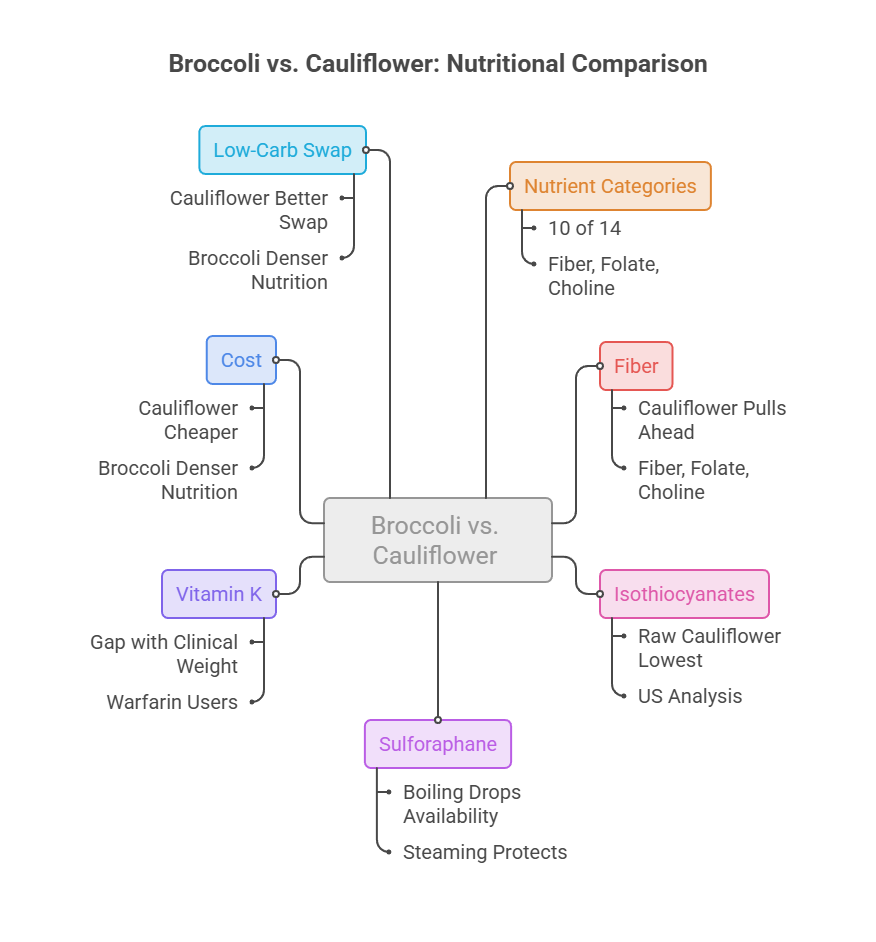
- Per 100 grams, broccoli takes 10 of 14 nutrient categories.
- Per 100 calories, cauliflower pulls ahead on fiber, folate, and choline.
- Raw cauliflower produced the lowest isothiocyanate yield of nine cruciferous vegetables tested in a US analysis.
- Boiling drops sulforaphane availability from about 37% to roughly 3.4%. A three to five minute steam protects it.
- Vitamin K is the one gap with clinical weight, and it matters mainly to people taking warfarin.
- Cauliflower is cheaper per pound and the better low-carb swap. Broccoli is the denser nutrition buy.
The Short Answer, Measured Three Ways
Ask which vegetable is more nutritious and you are really asking three questions. Per serving? Per gram? Per calorie? Each produces a different winner, which is why the internet cannot settle it.
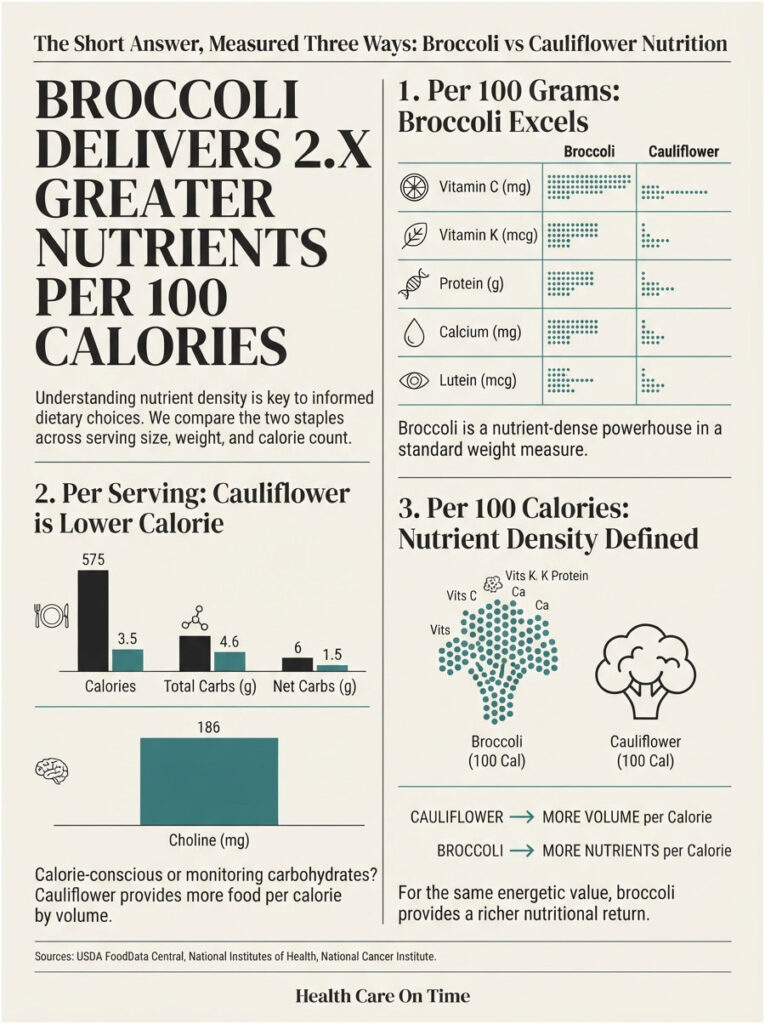
Here is the compressed verdict before the detail.
Table 1: The Core Comparison, Per 100 Grams Raw
| Nutrient | Broccoli | Cauliflower | Winner |
| Calories | 34 kcal | 25 kcal | Cauliflower |
| Protein | 2.8 g | 1.9 g | Broccoli |
| Fiber | 2.6 g | 2.0 g | Broccoli |
| Net carbs | 4.0 g | 3.0 g | Cauliflower |
| Vitamin C | 89.2 mg | 48.2 mg | Broccoli |
| Vitamin K | 101.6 mcg | 15.5 mcg | Broccoli |
| Folate | 63 mcg | 57 mcg | Broccoli |
| Choline | 18.7 mg | 44.3 mg | Cauliflower |
| Calcium | 47 mg | 22 mg | Broccoli |
| Lutein + zeaxanthin | 1,403 mcg | Trace | Broccoli |
Values from USDA FoodData Central.
Patients booking nutrition and vitamin panels through HealthCareOnTime often ask which vegetable to prioritize when money and fridge space are tight. The useful answer starts with normalized numbers, not a slogan.
Where broccoli clearly wins
Vitamin C, vitamin K, protein, calcium, and vitamin A are not close calls. Broccoli also supplies lutein and zeaxanthin, the carotenoids concentrated in the macula of your eye, which cauliflower essentially lacks.
The gap widens further on glucosinolates, the sulfur compounds behind the cruciferous reputation. That gets its own section below, because it is the part everyone else skips.
Where cauliflower clearly wins
Cauliflower is lower in calories, lower in total and net carbs, and carries more than double the choline, a nutrient the average American diet underdelivers.
It is also cheaper, milder, and far more useful as a starch replacement. If you eat by volume rather than by weight, which is how most people actually eat, cauliflower gives you more food per calorie.
The full picture, all three measures
Table 1b: Broccoli vs Cauliflower Nutrition, Normalized Three Ways
| Nutrient | Broccoli 100 g | Cauliflower 100 g | Broccoli 1 cup (91 g) | Cauliflower 1 cup (107 g) | Per 100 kcal winner |
| Calories | 34 kcal | 25 kcal | 31 kcal | 27 kcal | Cauliflower |
| Protein | 2.8 g | 1.9 g | 2.6 g | 2.1 g | Broccoli |
| Total carbs | 6.6 g | 5.0 g | 6.0 g | 5.3 g | Cauliflower |
| Fiber | 2.6 g | 2.0 g | 2.4 g | 2.1 g | Cauliflower |
| Net carbs | 4.0 g | 3.0 g | 3.6 g | 3.2 g | Cauliflower |
| Vitamin C | 89.2 mg | 48.2 mg | 81 mg | 52 mg | Broccoli |
| Vitamin K | 101.6 mcg | 15.5 mcg | 92 mcg | 17 mcg | Broccoli |
| Folate | 63 mcg | 57 mcg | 57 mcg | 61 mcg | Cauliflower |
| Choline | 18.7 mg | 44.3 mg | 17 mg | 47 mg | Cauliflower |
| Potassium | 316 mg | 299 mg | 288 mg | 320 mg | Cauliflower |
| Calcium | 47 mg | 22 mg | 43 mg | 24 mg | Broccoli |
| Vitamin A (RAE) | 31 mcg | 0 mcg | 28 mcg | 0 mcg | Broccoli |
| Lutein + zeaxanthin | 1,403 mcg | Trace | 1,277 mcg | Trace | Broccoli |
| Isothiocyanate yield | High | Lowest of 9 crucifers tested | High | Lowest | Broccoli |
Values from USDA FoodData Central; isothiocyanate ranking from the Linus Pauling Institute.
To reach 100 calories you would eat roughly 294 grams of broccoli or 400 grams of cauliflower. At that equivalence broccoli still delivers about 262 mg of vitamin C against 193 mg, and 299 mcg of vitamin K against 62 mcg.
But cauliflower nudges ahead on fiber, folate, potassium, and choline. Cauliflower is not the weaker vegetable. It is the lighter one.
Nutrient by Nutrient, Without the Hand-Waving
Fiber and protein
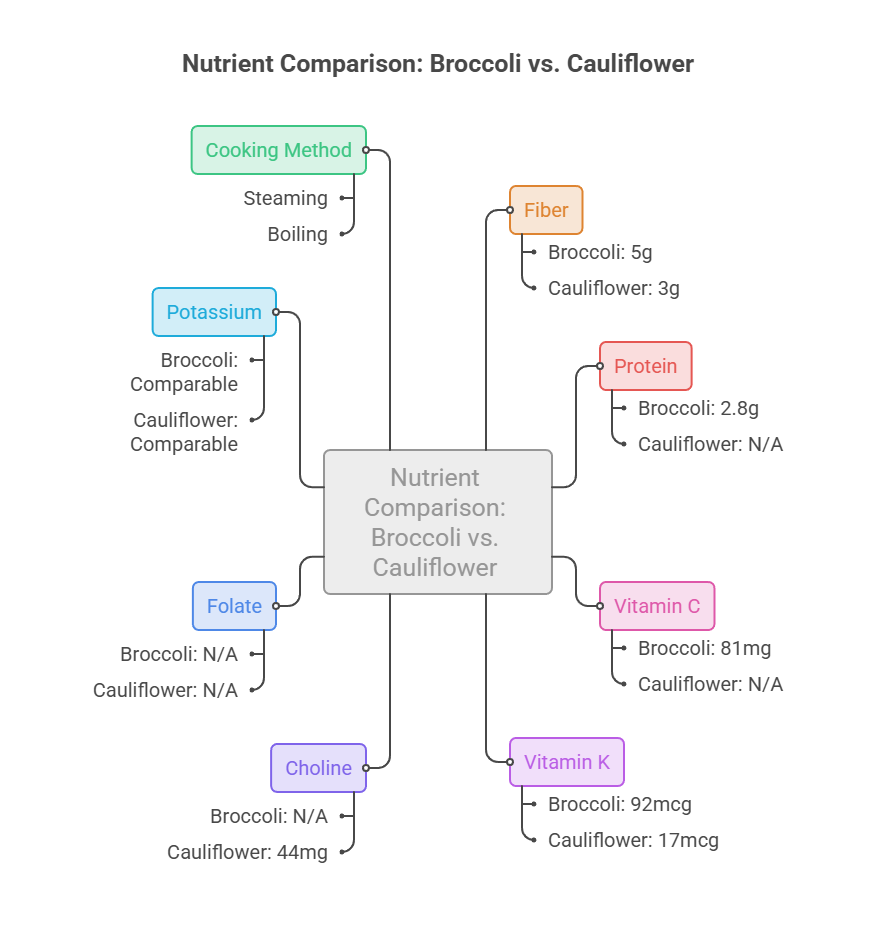
Raw, the fiber difference is modest at 2.6 grams versus 2.0 grams per 100 grams. Cooked, it widens, because cooked florets pack more densely into a measuring cup.
A cup of cooked broccoli lands near 5 grams of fiber against roughly 3 grams for cauliflower. If you are chasing the 25 to 38 gram daily fiber target, cooked broccoli is the more efficient vehicle.
Protein is a minor category for both, though broccoli 2.8 grams per 100 grams is respectable for something with 34 calories.
Vitamin C rivals an orange
One cup of raw broccoli carries about 81 mg of vitamin C, matching or beating a medium orange. Cauliflower delivers roughly 52 mg for the same cup, still a strong showing.
Both lose vitamin C to water. Boiling leaches it into the pot, which is one more reason steaming keeps winning.
Vitamin K, the six-fold gap that matters
This is the largest single difference between the two vegetables and the only one with real clinical consequences. Broccoli carries about 92 mcg of vitamin K per cup against cauliflower 17 mcg.
For most people, more vitamin K is straightforwardly good for bone and vascular health. For someone on warfarin, it is a variable to manage rather than avoid.
Our medical reviewers note that vitamin K becomes a clinical issue only in specific situations, and even then the guidance is consistency, not elimination.
Folate, choline, and potassium
The cauliflower choline advantage is real and underappreciated. At 44 mg per 100 grams against broccoli 19 mg, cauliflower supplies more than double, and choline supports liver function, memory, and fetal brain development.
Folate is nearly tied per gram, with cauliflower edging ahead per cup and per calorie. Potassium is effectively a wash.
Which One Actually Helps More With Weight Loss?
This is the single most searched angle on the comparison, and the honest answer is not the one most articles give.
Calorie density is the cauliflower argument
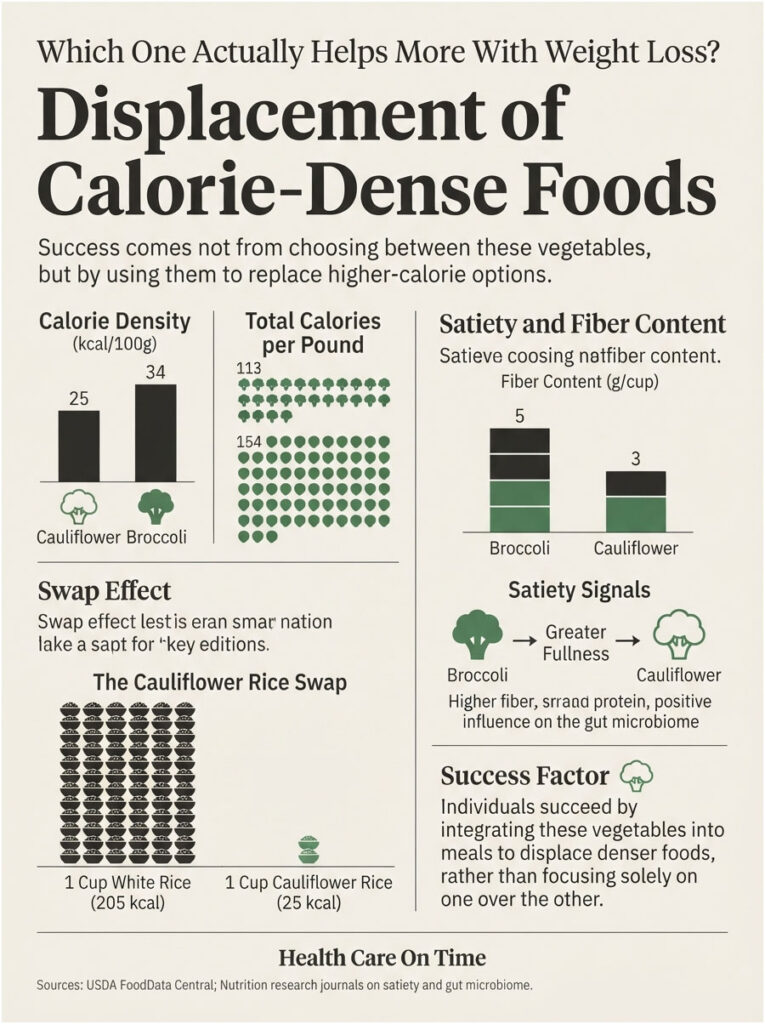
At 25 calories per 100 grams against broccoli 34, cauliflower lets you fill a plate for less. That difference compounds across a full meal.
A pound of cauliflower is about 113 calories. A pound of broccoli is about 154. Neither number is a problem, but if you are eating volume to manage hunger, cauliflower stretches further.
Satiety is the broccoli argument
Fiber and protein drive fullness, and broccoli carries more of both. Cooked, the fiber gap runs roughly 5 grams per cup against 3 grams.
Research shows that eating broccoli can positively shift the composition of the gut microbiome, and fiber fermentation is part of what signals satiety downstream.
The swap effect beats both
Neither vegetable causes weight loss on its own. What moves the needle is displacement.
One cup of cauliflower rice runs roughly 5 grams of carbohydrate and 25 calories. One cup of cooked white rice runs about 45 grams and 205 calories. That single substitution removes more calories than any nutrient difference between the two vegetables ever will.
Across the patients we serve, the people who succeed with either vegetable are the ones using it to replace something denser, not the ones agonizing over which floret to buy.
The Difference Nobody on Page One Is Telling You About
Search this comparison and you will read a dozen times that both vegetables contain sulforaphane. Technically true. Practically misleading.
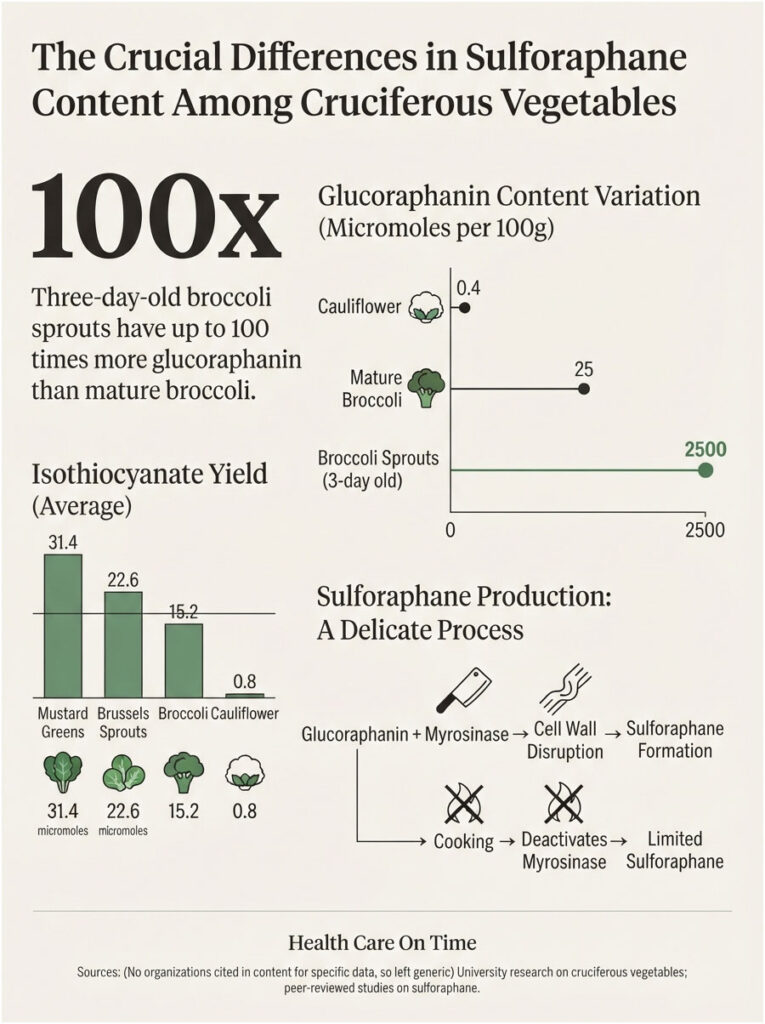
How sulforaphane actually forms
Sulforaphane is not sitting in the vegetable waiting for you. It is built on demand from a precursor called glucoraphanin plus an enzyme called myrosinase, which live in separate cellular compartments until you chop or chew.
Break the cell walls and the two meet. Kill the enzyme with heat first, and the precursor passes through mostly unconverted.
Fresh broccoli glucoraphanin content swings wildly by cultivar and growing conditions, with published values ranging from 11 to 296 micromoles per 100 grams of fresh weight. Two heads from the same store can differ by an order of magnitude.
The 41-fold spread across cruciferous vegetables
Here is the number that reframes the comparison. Researchers at the Linus Pauling Institute at Oregon State University reviewed an analysis of 73 samples from nine types of raw cruciferous vegetables commonly eaten in the US, including broccoli, cabbage, cauliflower, Brussels sprouts, kale, collard greens, mustard greens, and turnip greens.
The average isothiocyanate yield was 16.2 micromoles per 100 grams of wet weight, with a 41-fold difference between highest and lowest. Raw cauliflower came in lowest of the entire group at 1.5 micromoles per 100 grams, while raw mustard greens topped it at 61.3 micromoles.
Cauliflower did not place second. It placed last, out of nine.
In cases reviewed by our medical team, patients routinely assume cruciferous vegetables are interchangeable for their protective compounds. On fiber and vitamin C, close enough. On isothiocyanates, not remotely.
The sprout outlier
If sulforaphane specifically is your goal, neither mature vegetable is the efficient choice. Broccoli sprouts contain roughly 20 times more methylsulfinylalkyl glucosinolates, the glucoraphanin and glucoerucin group, than mature broccoli.
Broader reviews put it more starkly, noting that three-day-old broccoli and cauliflower sprouts carry 10 to 100 times higher glucoraphanin levels per gram than their mature forms.
A small handful of sprouts on a sandwich can outperform a full head of either vegetable on this one metric.
What this means for cancer risk, honestly
Isothiocyanates activate detoxification enzymes and show consistent anticancer activity in laboratory and animal models. Human evidence is thinner and mostly observational.
Higher cruciferous intake tracks with lower rates of several cancers in population studies, but those studies cannot separate the vegetable from the lifestyle around it. Treat this as one good reason among several, not as a therapy.
Cooking Changes the Answer More Than the Vegetable Does
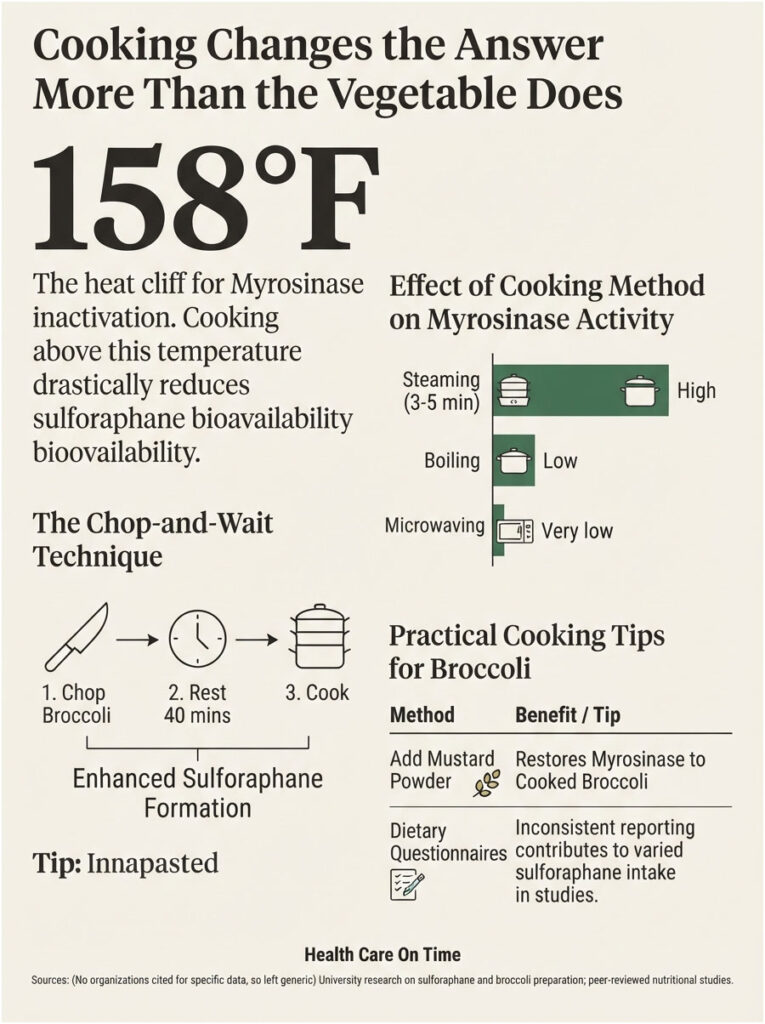
The heat cliff at 158 degrees Fahrenheit
Myrosinase is fragile. It is inactivated above roughly 70 degrees Celsius, or 158 degrees Fahrenheit, and boiling drops sulforaphane bioavailability from about 37% in raw broccoli to around 3.4% once cooked.
That is not a rounding error. That is discarding roughly nine tenths of the compound you were eating the vegetable for.
Steaming beats everything else
Research from Elizabeth Jeffery at the University of Illinois compared boiling, microwaving, and steaming. Steaming for up to five minutes best retained myrosinase, while boiling and microwaving for even one minute or less destroyed most of the enzyme.
Practically: three to five minutes, until the florets are bright green and tender-crisp. Once the color turns dull olive, you have passed the useful window.
The chop-and-wait rule
If you plan to roast or stir-fry past the safe zone, there is a workaround. Chop the vegetable and let it rest at room temperature for about 40 minutes before heat touches it.
During that rest, myrosinase works at room temperature and converts a portion of the glucoraphanin in advance. Already-formed sulforaphane is more heat-stable than the enzyme that makes it, so it survives cooking the enzyme would not.
The mustard powder rescue
The Jeffery group also found that people eating fully cooked broccoli could still generate sulforaphane by adding a raw myrosinase source to the same meal. Participants who ate a second food containing myrosinase alongside a myrosinase-free broccoli supplement showed significantly higher sulforaphane levels in blood and urine, and mustard, radish, arugula, wasabi, and raw coleslaw all worked.
A quarter teaspoon of mustard powder stirred into roasted broccoli is a functional fix, not a folk remedy.
Table 4: What Each Cooking Method Does
| Method | Time | Effect on Myrosinase | Practical Verdict |
| Raw | None | Fully intact | Best enzyme retention, hardest on digestion |
| Steaming | 3 to 5 minutes | Largely preserved | The default recommendation |
| Steaming | 7+ minutes | Largely destroyed | Overcooked, dull color, bitter notes |
| Microwaving | Under 1 minute | Majority destroyed | Convenient, poor for sulforaphane |
| Boiling | 5 to 10 minutes | Destroyed, plus vitamin C leaching | Worst option unless you drink the liquid |
| Roasting or air frying | 15 to 25 min at 425 F | Destroyed unless chop-and-wait is used | Great flavor, pair with mustard or radish |
Our lab partners report that dietary questionnaires almost never record cooking method, which helps explain why observational studies on cruciferous vegetables produce such inconsistent effect sizes. Two people reporting four servings of broccoli a week may be getting wildly different doses of the active compound.
What the Human Research Actually Shows
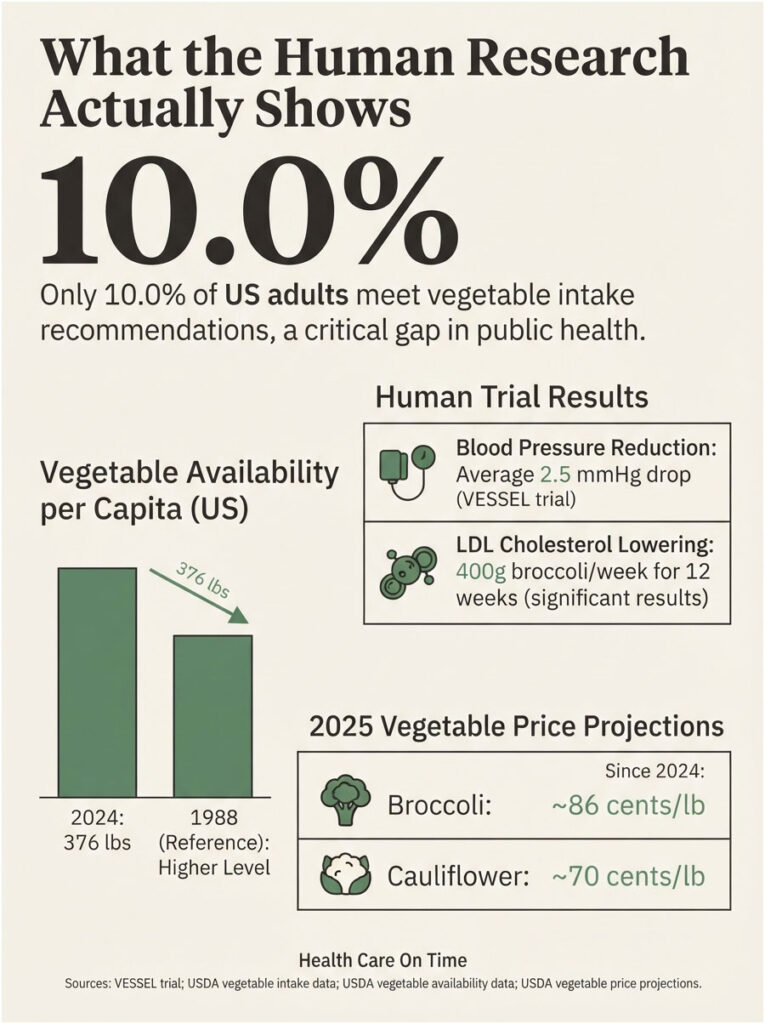
Blood pressure
The strongest recent evidence treats cruciferous vegetables as a category rather than picking a winner. In the VESSEL trial published in BMC Medicine in 2024, 18 adults aged 56 to 72 with systolic blood pressure between 120 and 160 mmHg completed two two-week dietary periods in random order, eating four servings, about 300 grams daily, of broccoli, kale, cauliflower, and cabbage as soup, against an equal amount of potato, sweet potato, carrot, and pumpkin.
The cruciferous period produced an average 2.5 mmHg drop in 24-hour brachial systolic blood pressure. Small trial, short duration, but a real signal for a change with no downside.
For context, the active soup was 40% broccoli, 25% cabbage, 25% cauliflower, and 10% kale. Both of our vegetables were in the mix. The trial ran in Australia with a small, mostly white female sample, so generalizing to the broader US population deserves caution.
Cholesterol
A glucoraphanin-enriched broccoli variety has been tested head to head. Across two randomized, double-blind parallel studies including 130 adults aged 50 and older at cardiovascular risk, eating 400 grams per week of glucoraphanin-rich broccoli for 12 weeks significantly reduced plasma LDL cholesterol compared with standard broccoli. That work, published by Armah and colleagues in 2015, remains one of the few controlled trials isolating the compound.
400 grams a week is roughly four cups. That is an achievable target, not a laboratory dose.
Where the evidence is thinner
Cancer prevention data leans on observational cohorts and mechanistic lab work. Randomized human trials have been small and inconsistent, including some that found no effect on tissue biomarkers.
The practical read is straightforward. Eat crucifers regularly because the risk profile is excellent and the signal is consistent, not because any single trial settled the question.
Table 2: The Numbers Behind the Recommendations
| Finding | Number | Population or Design | Source |
| Cruciferous vegetables lowered systolic BP | 2.5 mmHg reduction | 18 adults, 56 to 72 years, randomized crossover, 2 weeks | VESSEL trial, BMC Medicine, 2024 |
| Glucoraphanin-rich broccoli lowered LDL-C | 400 g/week for 12 weeks | 130 adults aged 50+, two double-blind trials | Armah et al., 2015 |
| Raw cauliflower isothiocyanate yield | 1.5 micromol/100 g, lowest of 9 crucifers | 73 samples, 9 US cruciferous vegetables | Linus Pauling Institute, Oregon State University |
| Nine-vegetable average isothiocyanate yield | 16.2 micromol/100 g, 41-fold spread | Same 73-sample analysis | Linus Pauling Institute |
| Sulforaphane bioavailability, raw vs boiled | 37% vs 3.4% | Human clinical bioavailability studies | Vermeulen, Clarke, and Fahey trials |
| US adults meeting vegetable recommendations | 10.0% | 294,566 BRFSS respondents, 49 states plus DC | CDC MMWR, 2019 BRFSS |
| US per capita vegetable availability | 376 lb in 2024, lowest since 1988 | National food supply data | USDA Economic Research Service |
| Broccoli price, Jan to Oct 2025 | About 86 cents per pound, 13% below 2024 | US grower-level pricing | USDA ERS Vegetables and Pulses Outlook |
| Cauliflower price, Jan to Oct 2025 | About 70 cents per pound, 12% below 2024 | US grower-level pricing | USDA ERS Vegetables and Pulses Outlook |
Those last three rows deserve attention. CDC data show only 10.0% of US adults met vegetable intake recommendations, ranging from 5.6% in Kentucky to 16.0% in Vermont. USDA reports total per capita vegetable and pulse availability fell to 376 pounds in 2024, the lowest in more than 35 years, down from a 1996 peak of 426 pounds.
Against that backdrop, arguing over which crucifer is 12% better misses the point. Eating either one more often is the win.
Cost, Frozen vs Fresh, and Getting Your Money’s Worth
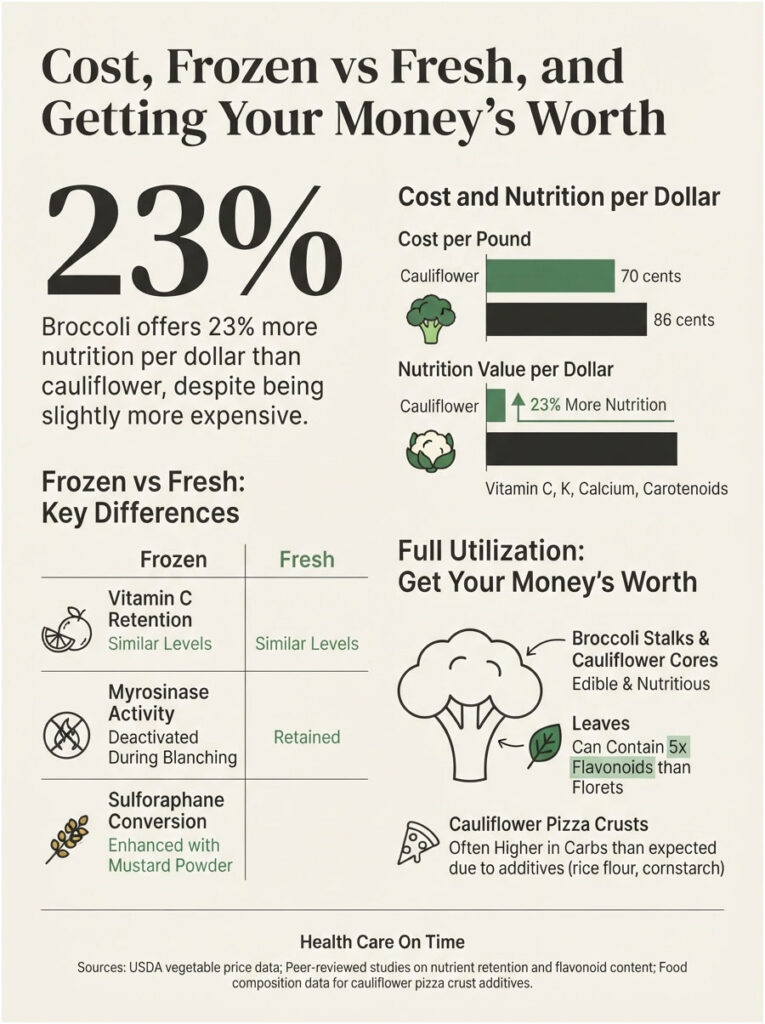
What each costs
USDA tracked broccoli at roughly 86 cents per pound and cauliflower at roughly 70 cents per pound from January through October 2025, with broccoli running 13% below 2024 levels and cauliflower 12% below 2024 and 25% below 2023.
Retail prices run higher than these grower-level figures, but the ratio holds. Cauliflower is consistently the cheaper vegetable per pound in American supermarkets.
Per unit of nutrition, broccoli usually wins. You pay about 23% more per pound for substantially more vitamin C, vitamin K, calcium, and carotenoids.
Frozen is not the compromise you think
Frozen broccoli and cauliflower are blanched before freezing, which preserves color and texture and locks in vitamin C at levels often matching fresh produce that has spent a week in transit.
The catch is specific. Blanching deactivates myrosinase. Frozen crucifers still deliver fiber, vitamins, and minerals, but they convert far less glucoraphanin into sulforaphane on their own.
The fix is the same mustard powder trick, and it costs about eleven cents.
The cauliflower crust trap
Cauliflower rice is a legitimate carb reduction tool, worth roughly 40 grams of carbohydrate per cup swapped.
Cauliflower pizza crust is a different story. Most commercial versions are bound with rice flour, cornstarch, or cheese, and a slice often carries more carbohydrate than the name suggests. Read the panel, not the front of the box.
Stop discarding stems and leaves
Broccoli stalks are edible, high in fiber, and pleasant peeled and sliced thin. The cauliflower core is the same story.
The leaves are worth keeping too. Research comparing plant parts across broccoli and cauliflower cultivars found total flavonoid content significantly higher in leaves than florets, with some cultivars showing roughly fivefold more flavonoids in leaf tissue. Roast them like kale chips.
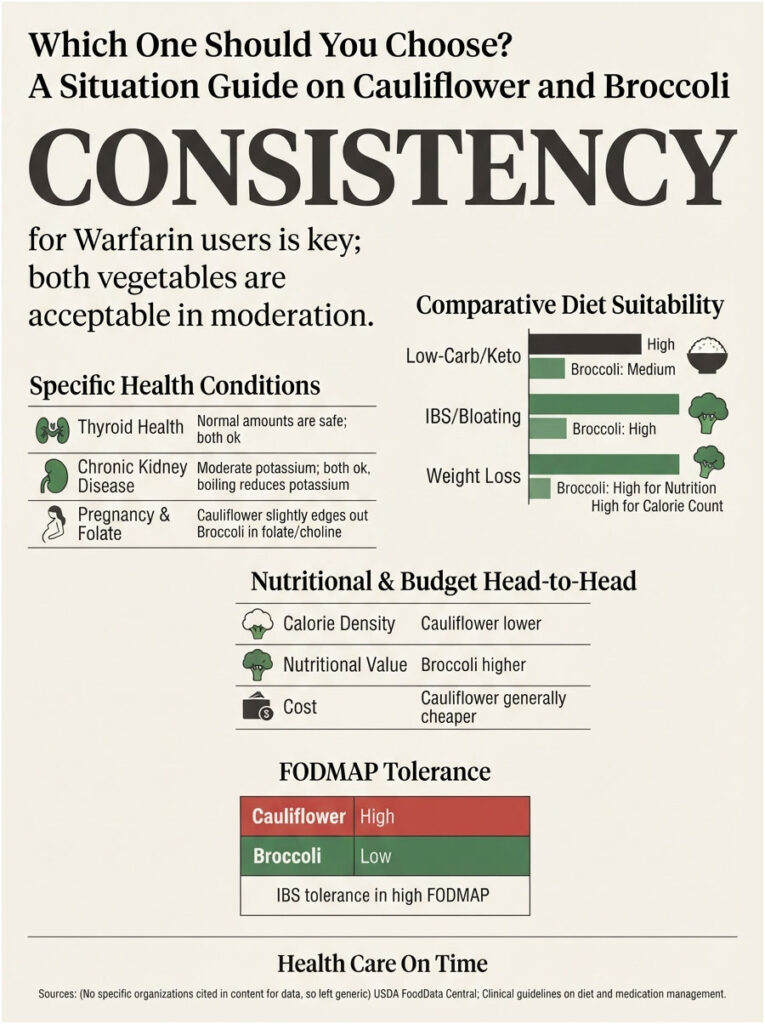
Which One Should You Choose? A Situation Guide
Low-carb, keto, and blood sugar
Cauliflower, narrowly, and mostly for what it replaces. Both fit any ketogenic target, but the neutral flavor of cauliflower makes it the better mash, rice, and crust base.
For blood sugar specifically, either works. Fiber and low glycemic load are the operative features, not the small carbohydrate difference.
On warfarin or another vitamin K antagonist
Patients commonly ask us whether starting a blood thinner means giving up broccoli. In nearly all cases, no.
Anticoagulation clinics advise consistency, not avoidance. Wildly variable vitamin K intake destabilizes INR, while a steady weekly amount is easy to dose around.
Cauliflower, at roughly 17 mcg per cup, is the lower-variability choice if you would rather not think about it. Discuss any planned change with the clinician managing your INR.
IBS, bloating, and FODMAPs
This one favors broccoli, which surprises people. Broccoli contains raffinose, a complex sugar that gut bacteria ferment, while cauliflower contains oligosaccharides like fructan that pull water into the gut.
Cauliflower is classified as high in mannitol, a polyol poorly tolerated on a low-FODMAP protocol. Broccoli heads are generally tolerated in modest portions, while the stalks carry more fructan.
If you are following a structured elimination plan, work with a dietitian rather than self-sorting.
Thyroid concerns
The goitrogen worry attached to cruciferous vegetables is largely a myth at normal intakes. Reviewing the evidence, researchers concluded that even at the highest glucosinolate concentrations, a diet containing a normal serving of brassicas at 100 to 200 grams of fresh weight does not affect thyroid function, and healthy volunteers drinking a broccoli sprout beverage supplying 600 micromoles of glucoraphanin daily for 84 days showed no adverse thyroid effects.
If you have diagnosed hypothyroidism and eat very large raw quantities daily, mention it at your next visit. Otherwise, eat the vegetable.
Chronic kidney disease
Both are moderate-potassium vegetables at roughly 300 mg per 100 grams, far below potatoes or tomatoes, and both usually fit a renal diet in controlled portions.
Boiling and discarding the water reduces potassium further, one of the rare situations where boiling is the right call.
Pregnancy and folate
Slight edge to cauliflower per cup and per calorie on folate, plus meaningfully higher choline for fetal brain development. Neither replaces a prenatal supplement.
Table 3: Your Situation, Your Pick
| If You Are… | Choose | Why | Watch Out For |
| Following keto or low-carb | Cauliflower | 3.0 g net carbs per 100 g, works as rice or mash | Store-bought crusts often add starch |
| Targeting maximum sulforaphane | Broccoli, or broccoli sprouts | Raw cauliflower yielded the lowest isothiocyanates of 9 crucifers | Boiling destroys the benefit either way |
| Taking warfarin | Either, kept consistent | Consistency stabilizes INR better than avoidance | Broccoli at 92 mcg vitamin K per cup needs steady intake |
| Managing IBS or bloating | Broccoli heads, small portions | Cauliflower is high in mannitol, a common trigger | Broccoli stalks carry more fructan than florets |
| Trying to lose weight | Cauliflower by volume, broccoli by nutrition | Cauliflower is 25 kcal per 100 g vs 34 | Cheese sauce erases the calorie advantage |
| Pregnant or planning pregnancy | Cauliflower, slight edge | More choline and comparable folate per serving | Neither substitutes for prenatal folic acid |
| Focused on eye health | Broccoli | About 1,400 mcg lutein and zeaxanthin per 100 g vs trace | Add olive oil, carotenoids need fat |
| Shopping on a tight budget | Cauliflower fresh, broccoli frozen | Cauliflower about 70 cents/lb vs broccoli about 86 cents/lb in 2025 | Frozen is blanched, add mustard powder |
| Cooking for picky eaters | Cauliflower | Milder, sweeter, less sulfurous | Roasting brings out sweetness in both |
| Building bone density | Broccoli | About double the calcium, six times the vitamin K | Vitamin K interacts with anticoagulants |
Five Mistakes That Cancel Out the Benefits
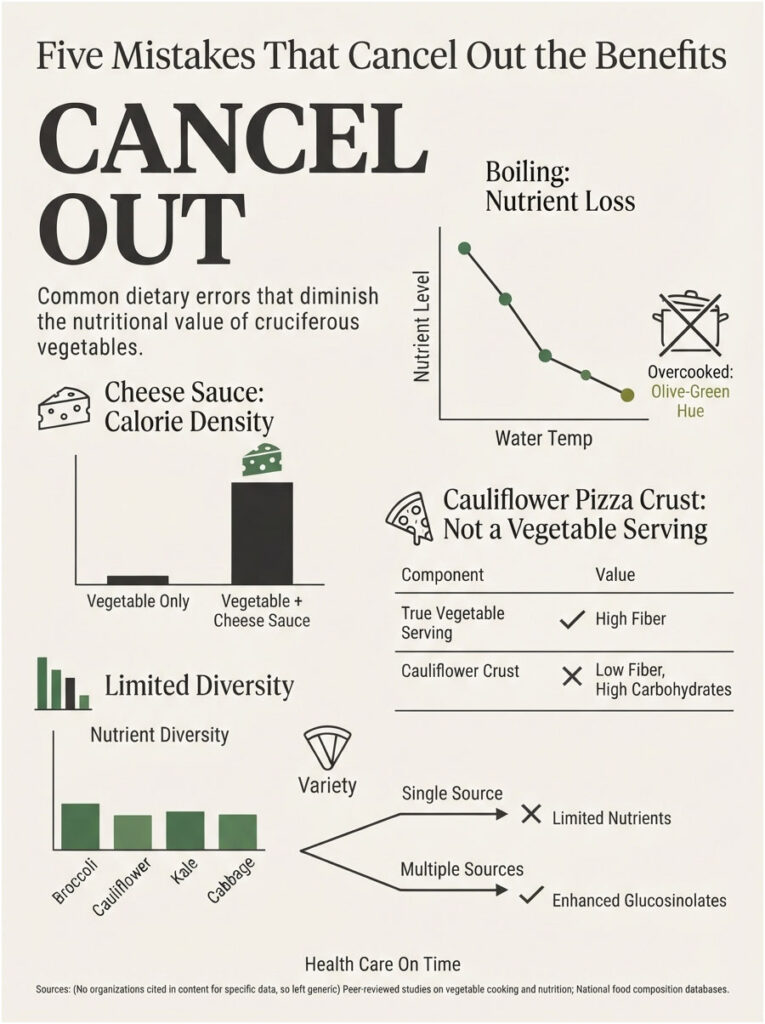
Boiling until the color turns olive
The most common error and the costliest. You lose the enzyme, you lose vitamin C to the water, and you lose the texture.
Drowning it in cheese sauce
A cup of broccoli is 31 calories. A half cup of cheddar sauce can run 200 or more, mostly saturated fat and sodium. Olive oil, lemon, garlic, and salt do the job for a fraction of the load.
Counting cauliflower pizza crust as a vegetable serving
It is not one. Most commercial crusts contain modest cauliflower plus binding starches. Treat it as a lighter crust, not as produce.
Eating only one of them, forever
Different crucifers carry different glucosinolate profiles, and rotation broadens the range. Cabbage, Brussels sprouts, arugula, and radishes each contribute compounds neither broccoli nor cauliflower supplies in quantity.
Buying past-peak produce
Yellowing broccoli florets and brown-spotted cauliflower have sat too long, and glucosinolate content declines in storage. Firm, tight heads with fresh-cut stems are the ones to grab.
A Practical Week of Both
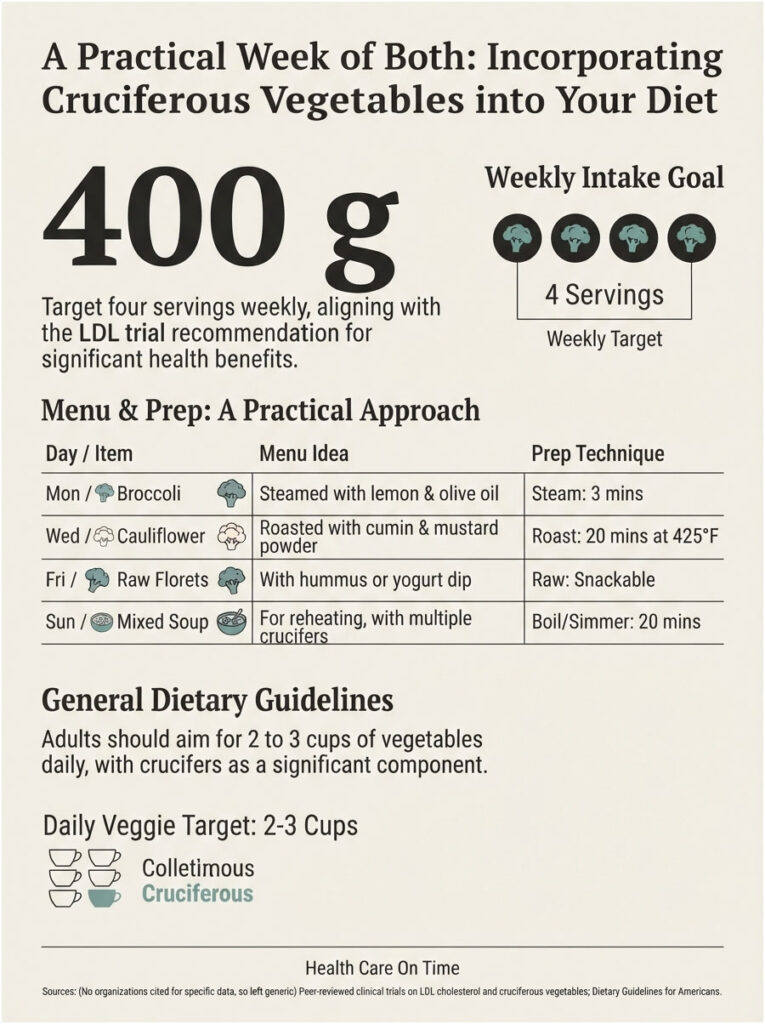
Four servings a week of cruciferous vegetables is a reasonable, evidence-aligned target, and it lines up with the 400 grams per week used in the LDL trial. Here is what that looks like without turning cooking into a project.
Monday, steamed broccoli with lemon and olive oil, four minutes. Wednesday, roasted cauliflower with cumin and a pinch of mustard powder. Friday, raw florets of both with hummus. Sunday, a mixed crucifer soup that reheats through the week.
Four fast preparations worth memorizing: a three-minute steam, a sheet-pan roast at 425 degrees Fahrenheit for 20 minutes, a two-minute stir-fry after a 40-minute chop-and-wait, and raw florets with a yogurt dip.
The Dietary Guidelines for Americans put adult vegetable targets at 2 to 3 cups daily. Crucifers should be a recurring part of that, not the whole thing.
Frequently Asked Questions
Which has more fiber, broccoli or cauliflower?
Broccoli, by a small margin. Raw broccoli has about 2.6 grams of fiber per 100 grams against 2.0 grams in cauliflower. Cooked, the gap widens to roughly 5 grams per cup for broccoli versus 3 grams for cauliflower, since cooked florets pack more densely into the same measure.
Is cauliflower or broccoli better for weight loss?
Cauliflower gives you more food per calorie at 25 kcal per 100 grams against broccoli 34. Broccoli gives you more fiber and protein, which drive fullness. The bigger factor is what either one replaces. Swapping cauliflower rice for white rice removes about 40 grams of carbohydrate per cup.
Does cauliflower contain sulforaphane?
Yes, but far less than broccoli. In an analysis of 73 samples across nine cruciferous vegetables, raw cauliflower produced the lowest isothiocyanate yield at 1.5 micromoles per 100 grams, against a nine-vegetable average of 16.2 micromoles. If sulforaphane is your goal, broccoli or broccoli sprouts are better choices.
Can I eat broccoli while taking warfarin?
Usually yes. Broccoli carries about 92 mcg of vitamin K per cup, and standard clinical guidance is consistent intake rather than avoidance, since fluctuating vitamin K destabilizes INR. Cauliflower 17 mcg per cup is the lower-variability option. Confirm any planned dietary change with the clinician managing your anticoagulation.
Which causes more gas, broccoli or cauliflower?
It depends on the person. Broccoli contains raffinose, which gut bacteria ferment into gas. Cauliflower contains fructans and mannitol, which draw water into the intestine. People sensitive to FODMAPs typically react more to cauliflower. Cooking breaks down some of these compounds in both vegetables.
Is frozen broccoli as nutritious as fresh?
For vitamins, minerals, and fiber, yes, and sometimes better than fresh produce that has traveled for a week. The exception is sulforaphane. Freezing requires blanching, which deactivates myrosinase. Adding a quarter teaspoon of mustard powder after cooking restores much of that conversion capacity.
How long should I steam broccoli?
Three to five minutes, until florets are bright green and tender-crisp. Research comparing methods found steaming up to five minutes best preserved myrosinase, while boiling and microwaving destroyed most of it. Past roughly seven minutes the color dulls and the enzyme is largely gone.
Is cauliflower bad for the thyroid?
Not at normal intakes. Reviews concluded that a typical serving of 100 to 200 grams of cruciferous vegetables does not affect thyroid function, and a trial giving 600 micromoles of glucoraphanin daily for 84 days found no adverse thyroid effects. Discuss very high raw intakes with your physician.
How many carbs are in cauliflower rice versus white rice?
One cup of cauliflower rice has roughly 5 grams of carbohydrate and about 25 calories. One cup of cooked white rice has around 45 grams of carbohydrate and roughly 205 calories. The swap removes about 40 grams of carbs, which is why it anchors so many low-carb meal plans.
Are broccoli stems worth eating?
Yes. Stalks are edible, fiber-rich, and pleasant peeled and sliced thin for stir-fries or slaw. The leaves are worth keeping too. Studies comparing plant tissues found flavonoid content significantly higher in leaves than florets, with some cultivars showing about fivefold more in leaf tissue.
Which is better for people with diabetes?
Both are excellent and the difference is minimal. Each is low in net carbs, high in fiber, and has negligible effect on blood glucose. Cauliflower has a slight edge as a starch replacement, which is where the real blood sugar benefit comes from rather than from the vegetable itself.
How much should I eat per week?
Around four servings of cruciferous vegetables weekly is a sensible target, roughly 400 grams total, matching the amount used in the LDL cholesterol trial. The blood pressure trial used a more intensive 300 grams daily. Both are achievable with a few steamed or roasted sides.
Medical Disclaimer: This article is for general education and is not medical advice, diagnosis, or treatment. Nutrient values vary by cultivar, growing conditions, storage, and preparation. Anyone taking warfarin or another anticoagulant, managing chronic kidney disease, living with a thyroid condition, or following a therapeutic diet should consult their physician or a registered dietitian before making significant dietary changes. HealthCareOnTime provides diagnostic testing information and does not replace individualized clinical care.
References
- USDA FoodData Central, Broccoli, raw
- USDA FoodData Central, Cauliflower, raw
- Linus Pauling Institute, Oregon State University: Isothiocyanates
- American Institute for Cancer Research: Broccoli, Steam It to Boost Cancer-Fighting Compounds
- Connolly et al., VESSEL randomized crossover trial, BMC Medicine
- Glucosinolates From Cruciferous Vegetables and Their Potential Role in Chronic Disease, PMC
- Fahey et al., Broccoli sprouts as a rich source of inducers of protective enzymes, PNAS
- Chemical Composition and Antioxidant Activity in Different Tissues of Brassica Vegetables, PMC
- Glucoraphanin overview and thyroid safety data, ScienceDirect
- CDC MMWR: Adults Meeting Fruit and Vegetable Intake Recommendations, United States, 2019
- USDA Economic Research Service: Vegetables and Pulses
- USDA ERS Vegetables and Pulses Outlook, VGS-377