
Brown is a timestamp, not a diagnosis. When blood sits inside the uterus or vagina long enough to meet oxygen, the iron in hemoglobin oxidizes and the color shifts from bright red toward rust, coffee, or near-black. The question that matters is never why it is brown. It is why there is blood at all on a day your period is nowhere in sight.
Table of Contents
Quick Answer: Brown discharge with no period is almost always old blood that left the uterus slowly enough to oxidize. The five most common causes are leftover blood from your last cycle, ovulation spotting, hormonal birth control adjustment, early pregnancy implantation, and perimenopause. Take a pregnancy test if your period is late. Any bleeding after 12 months without a period needs medical evaluation within one to two weeks.
At a Glance
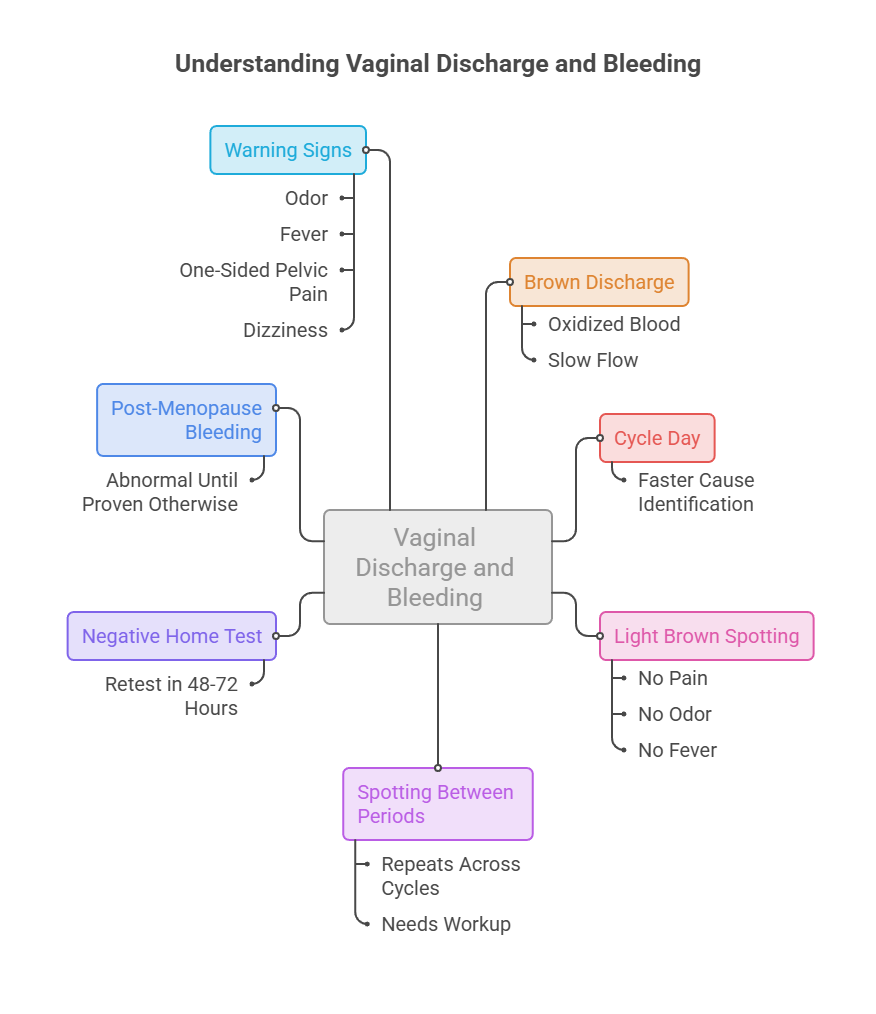
• Brown discharge is oxidized blood, so the color tells you the blood was slow, not that it is dangerous.
• Your cycle day narrows the cause faster than any other single clue.
• One to three days of light brown spotting with no pain, odor, or fever rarely needs a visit.
• Spotting between periods that repeats across three cycles needs a workup, not another month of waiting.
• A negative home test taken before your period is due can be wrong. Retest in 48 to 72 hours.
• Any vaginal bleeding after menopause is treated as abnormal until proven otherwise.
• Odor, fever, one-sided pelvic pain, or dizziness moves this from monitor to call today.
The 30-second urgency read. No pain, no odor, under three days, near your period: watch it. Repeating monthly at mid-cycle: mention it at your annual visit. Period late with a negative test: retest, then book. Positive test with pain or dizziness: emergency department. Any spotting a year past your last period: evaluation within two weeks. The rest of this article explains why each of those thresholds exists.
What Brown Discharge Actually Is
Your vagina sheds cells and fluid continuously. Cleveland Clinic describes healthy discharge as clear, milky white, or off-white, with texture that changes across the cycle and at most a mild odor. Anything carrying blood sits outside that baseline.
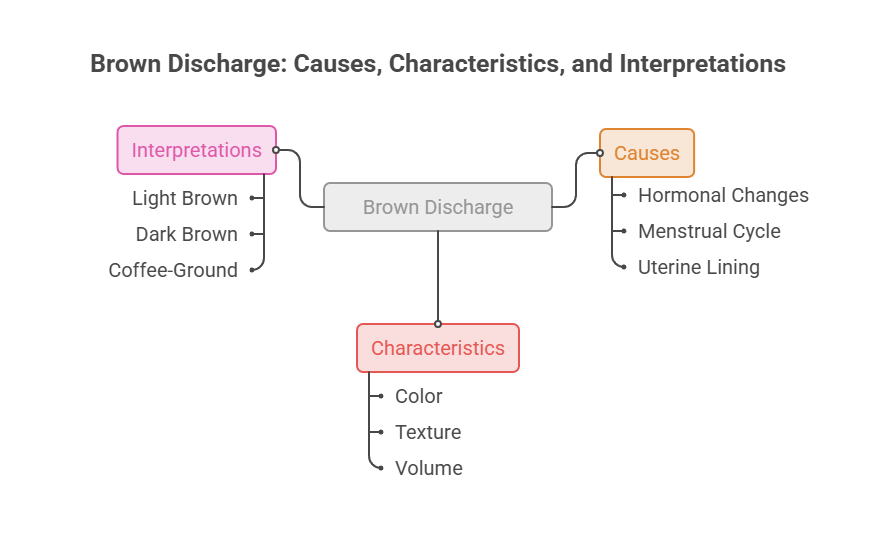
Brown discharge is that normal fluid mixed with a small amount of blood that has aged. The volume is usually tiny, enough to mark underwear or show on toilet paper and no more.
Across the women’s health panels ordered through HealthCareOnTime, this is one of the most frequent symptoms people describe when they book a first hormone workup, and it is almost never the emergency they arrived worried about.
Why Old Blood Turns Brown
Fresh menstrual blood runs bright red because the hemoglobin is still oxygen-bound and structurally intact. Given time and air exposure, the iron oxidizes and the pigment darkens through brick red, then rust, then brown.
The rate depends entirely on flow speed. A heavy gush exits in minutes and stays red. A slow trickle from a thin uterine lining can take a day or two to travel out, arriving brown.
The Discharge Color Spectrum
Color alone is a weak diagnostic, but it does sort probabilities quickly. Clear and stretchy points to ovulatory mucus. Thick and white points to normal luteal-phase discharge or yeast. Gray with odor points to bacterial vaginosis. Green or frothy points to trichomoniasis.
Brown sits in its own category because it always means blood is present, however small the amount. That is what separates brown discharge but no period from every other discharge question.
Light Brown vs Dark Brown vs Coffee-Ground
Light brown or tan usually means a very small amount of blood diluted in a lot of normal discharge. This is the most common presentation and the least concerning one.
Dark brown means more blood, older blood, or both. Coffee-ground texture, meaning gritty dark specks, indicates blood retained the longest, often after a delayed or incomplete shed.
Our medical reviewers note a pattern worth remembering: consistency across several episodes matters far more than the shade of any single one.
Why Your Cycle Day Changes the Whole Answer
Two people can report identical brown discharge with no period and have completely unrelated explanations, separated only by where they sit in the cycle. Cycle day is the fastest filter available before any test is run.
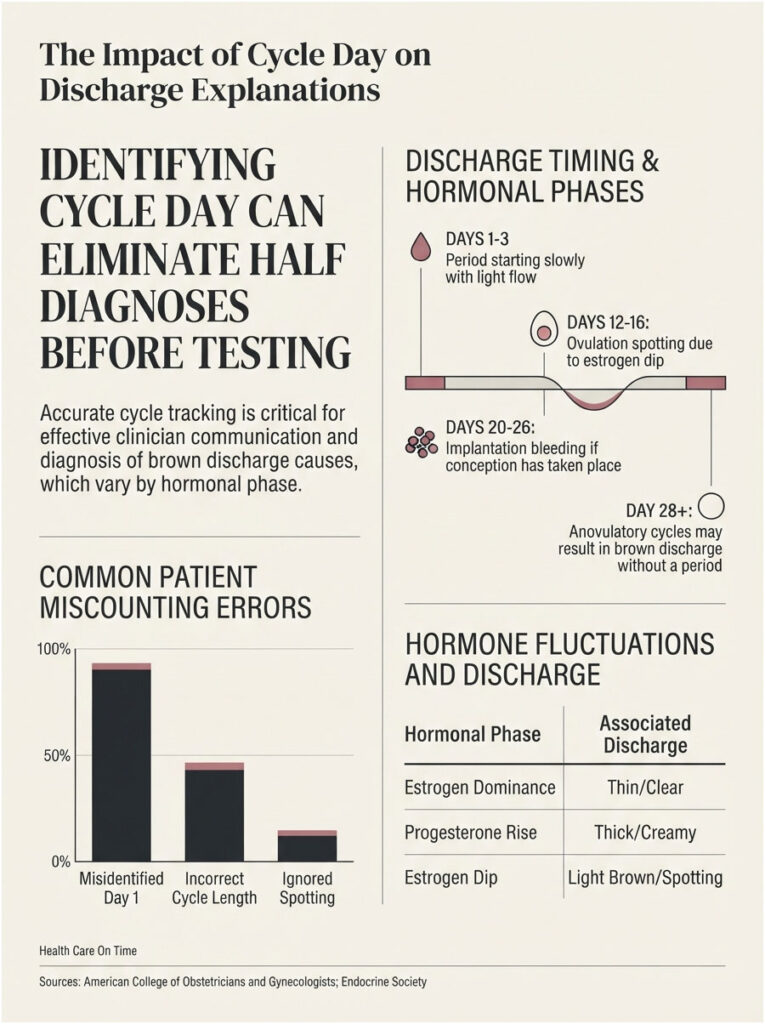
Count day 1 as the first day of full flow of your last real period. If you cannot pin that date down, that gap is itself useful information for your clinician.
| Cycle Day | What Is Happening Hormonally | Most Likely Cause | Typical Duration | Action Needed |
| Days 1 to 3 | Estrogen and progesterone at cycle low | Period starting slowly, light initial flow | 1 to 2 days before red flow | None |
| Days 4 to 7 | Estrogen beginning to rise | Tail end of the period, residual blood clearing | 1 to 3 days | None |
| Days 8 to 11 | Estrogen climbing, lining rebuilding | Polyp, cervical irritation, or post-coital contact bleeding | 1 day, often after sex | Note if it repeats |
| Days 12 to 16 | LH surge, brief estrogen dip at ovulation | Ovulation spotting | Under 48 hours | None unless recurring |
| Days 17 to 19 | Progesterone rising, corpus luteum active | Early luteal instability, low progesterone | 1 to 2 days | Track across 3 cycles |
| Days 20 to 26 | Progesterone peak, then decline | Implantation bleeding or luteal phase defect | 1 to 3 days | Pregnancy test if late |
| Day 28 plus, negative test | No progesterone withdrawal, no ovulation | Anovulatory cycle, PCOS, thyroid, stress | Days to weeks | Retest, then book a visit |
| Any day, 12 months past last period | Postmenopausal, estrogen persistently low | Atrophy, polyp, hyperplasia, or malignancy | Any | Evaluate within 1 to 2 weeks |
Patients booking cycle-tracking panels with us are asked for this exact information first, because the cycle day alone eliminates roughly half the differential before a single tube of blood is drawn.
Days 1 to 7: A Period You Did Not Count
Plenty of people mark their period from the first day of heavy flow, not the first day of any bleeding at all. That habit quietly hides a day or two of brown lead-in at the front and a day or two of brown tail at the back.
If your brown discharge lands within a week either side of your last flow, the likeliest answer is that your period is simply longer than you have been recording it.
Days 12 to 16: The Estrogen Dip Window
Just before an egg releases, estrogen peaks and then drops sharply for several hours before progesterone takes over. That brief dip can destabilize the uterine lining enough to release a trace of blood.
Ovulation spotting usually shows as light brown or pink, lasts under two days, and sometimes pairs with one-sided twinge pain called mittelschmerz. Patients commonly describe it to us as clockwork, arriving on the same two cycle days every month.
Days 20 to 26: The Implantation Window
If conception occurred, the embryo attaches to the uterine wall roughly 6 to 12 days after ovulation, and that attachment can disturb tiny blood vessels.
The result is typically a few hours to two days of light pink or brown spotting, well short of a period in volume. It arrives a few days before your period was due, which is precisely why it gets mistaken for one.
Day 28 and Beyond With Nothing Arriving
This is the scenario that sends most people searching. The period has not come, the test reads negative, and small amounts of brown discharge keep appearing.
The usual mechanism is anovulation. With no ovulation there is no progesterone surge, and with no progesterone withdrawal there is no organized shed. The lining instead breaks down in patches and leaks slowly.
The 11 Causes, Ranked From Routine to Urgent
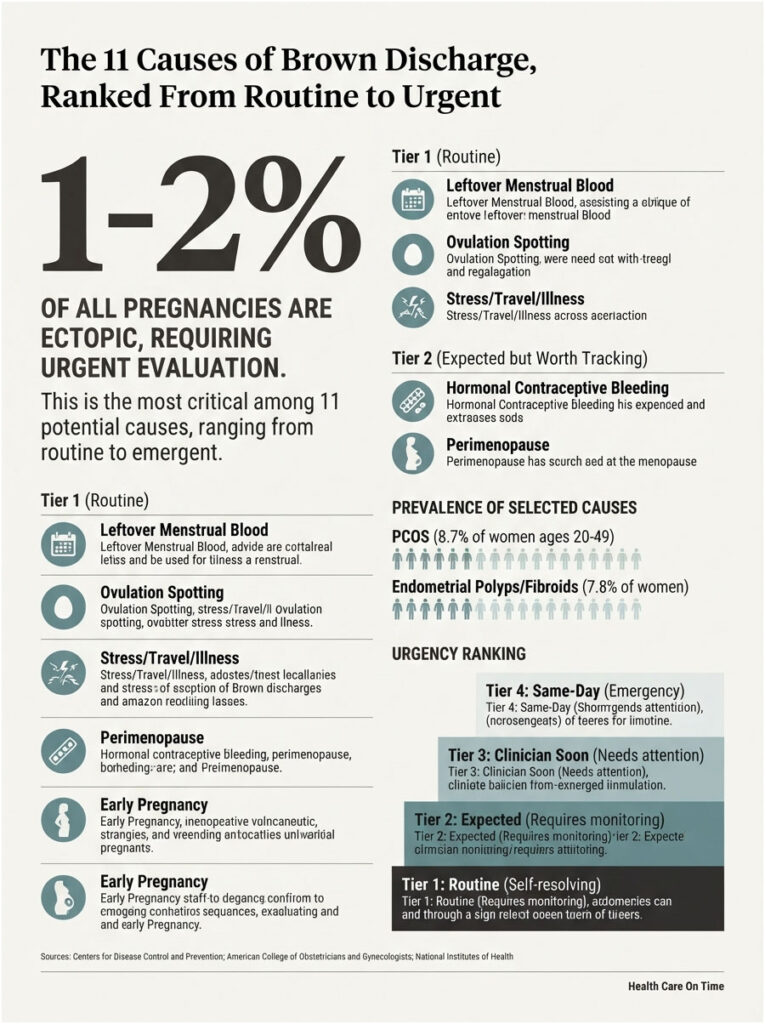
Everything below is sorted by how fast you need to act, not by how common it is. Tier 1 needs nothing. Tier 4 needs a phone call today.
Tier 1: Routine and Self-Resolving
1. Leftover Menstrual Blood
The uterus does not empty on a schedule. Small amounts of blood can pool near the cervix and take several days to clear, especially after a light flow or a stretch of time spent lying down.
This is the single most common reason for brown discharge with no period, and it needs no treatment whatsoever.
2. Ovulation Spotting
Around mid-cycle, the estrogen dip described above produces a day or two of light brown discharge in a minority of cycles. It is not a sign of a problem and does not affect fertility.
If it appears every cycle without fail and is heavy enough to need a liner, that pattern belongs in the conversation at your next annual visit.
3. Stress, Travel, Illness, and Weight Shifts
Your hypothalamus decides when to trigger ovulation, and it responds sharply to disruption. A punishing work stretch, cross-country travel, a viral illness, aggressive dieting, or a sudden jump in training volume can delay or cancel ovulation outright.
Delayed ovulation pushes the period late and often produces brown spotting in the gap. Cycles usually settle within one to three months once the stressor lifts.
Tier 2: Expected but Worth Tracking
4. Hormonal Contraceptive Breakthrough Bleeding
Every hormonal method thins the uterine lining. A thin lining is fragile and sheds in small, slow amounts that arrive brown rather than red.
This is the intended mechanism working, not a malfunction. The section on birth control below breaks the expected timelines down method by method.
5. Perimenopause
Beginning in the mid-forties for many women, and sometimes the late thirties, estrogen output turns erratic rather than steadily declining. Cycles lengthen, shorten, skip, and generate spotting between periods.
Brown discharge in this window frequently reflects an anovulatory cycle. The reassuring version is intermittent and painless. The version needing evaluation is heavy, prolonged, or paired with cycles shorter than 21 days.
6. Early Pregnancy and Implantation
First-trimester bleeding affects an estimated 15 to 25 percent of clinically recognized pregnancies, and much of that is light spotting rather than true bleeding.
Brown is generally the more reassuring color here, because it points to old, resolved bleeding rather than an active source. Bright red bleeding with cramping is the presentation that warrants a same-day call.
Tier 3: Needs a Clinician Soon
7. PCOS and Chronic Anovulation
Polycystic ovary syndrome disrupts the LH-to-FSH signaling that triggers ovulation. Without regular ovulation, the lining thickens under unopposed estrogen and then breaks down unpredictably.
The classic pattern is long gaps between periods punctuated by brown spotting, often alongside acne, unwanted hair growth, or stubborn weight gain. CDC’s National Center for Health Statistics reports that 8.7 percent of US women ages 20 to 49 have ever been diagnosed with PCOS, based on 2022 to 2023 National Survey of Family Growth data.
8. Thyroid Dysfunction and High Prolactin
Both underactive and overactive thyroid states interfere with the reproductive axis. Hypothyroidism raises thyrotropin-releasing hormone, which can drive prolactin up, which in turn suppresses ovulation.
In cases reviewed across our diagnostic network, TSH and prolactin are the two results most often flagged in people reporting months of irregular spotting with an otherwise normal pelvic exam.
9. Endometrial Polyps and Uterine Fibroids
Polyps are soft overgrowths of the uterine lining with a fragile blood supply that bleeds on contact. Submucosal fibroids distort the cavity and stop it from shedding cleanly.
Both produce intermenstrual spotting that is often brown, sometimes triggered by intercourse or exercise. The same NCHS analysis found 7.8 percent of US women ages 20 to 49 had been diagnosed with uterine fibroids, rising to 12.5 percent among Black non-Hispanic women.
10. Infection: BV, Cervicitis, and STIs
An inflamed cervix bleeds easily, and that blood exits slowly enough to oxidize. Bacterial vaginosis, chlamydia, gonorrhea, trichomoniasis, and pelvic inflammatory disease all produce cervicitis.
The distinguishing features are odor, itching, burning with urination, pain during sex, or discharge that changed texture as well as color. CDC’s 2024 provisional surveillance recorded more than 2.2 million combined cases of chlamydia, gonorrhea, and syphilis in the United States, a 9 percent drop from 2023 but still 13 percent above the level of a decade earlier.
Tier 4: Same-Day or Same-Week Evaluation
11. Ectopic Pregnancy, Retained Tissue, and Postmenopausal Bleeding
An ectopic pregnancy implants outside the uterine cavity, most often in a fallopian tube. Brown spotting plus a positive pregnancy test plus one-sided pelvic pain is an emergency department presentation, not a wait-and-see one. The American Academy of Family Physicians estimates ectopic pregnancy occurs in 1 to 2 percent of US pregnancies, and ruptured cases account for 2.7 percent of pregnancy-related deaths.
Retained tissue after a miscarriage or delivery causes persistent brown discharge with a distinct odor. And any bleeding at all after 12 consecutive months without a period is postmenopausal bleeding, which is handled on a different track from everything above.
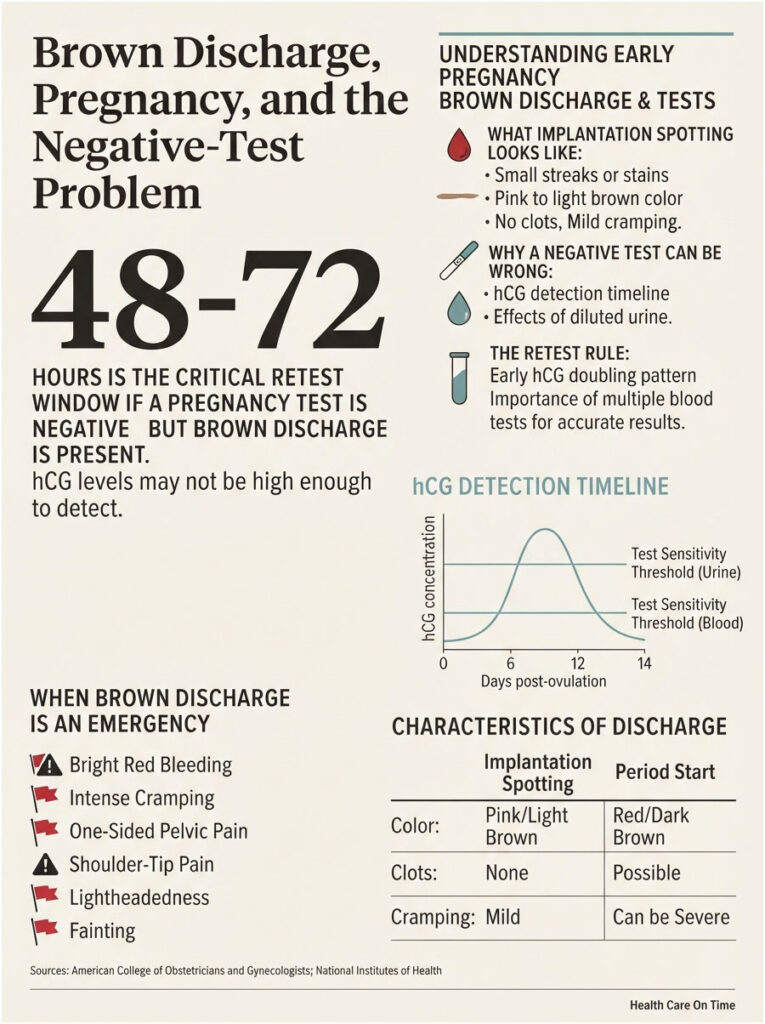
Brown Discharge, Pregnancy, and the Negative-Test Problem
What Implantation Spotting Looks Like
It is small. Most people describe a few streaks on toilet paper, or a stain smaller than a quarter, appearing on and off across a day or two rather than continuously.
Color runs pink to light brown. There are no clots. Cramping, when present, is mild and dull rather than the sharp waves of a period.
Why a Negative Test Can Still Be Wrong
Home tests detect hCG, and hCG only reaches urine-detectable levels about 12 to 14 days after ovulation. If you ovulated later than you assumed, your day 28 test is functionally a day 22 test.
Diluted urine compounds the problem. Test with first-morning urine, and if the period still has not arrived, retest in 48 to 72 hours before drawing any conclusion.
The Retest Rule
Early hCG roughly doubles every 48 to 72 hours in a viable intrauterine pregnancy. A quantitative beta hCG blood test detects levels a home strip misses and, when repeated, shows whether the trend is rising normally.
Patients commonly ask us whether a single blood test settles it. It rarely does. The pattern across two draws carries the information.
When Brown Discharge in Pregnancy Is an Emergency
Call immediately for bleeding that turns bright red and increases, cramping that intensifies, one-sided pelvic pain, shoulder-tip pain, lightheadedness, or fainting. Shoulder pain in particular can signal internal bleeding irritating the diaphragm.
Birth Control, Device by Device
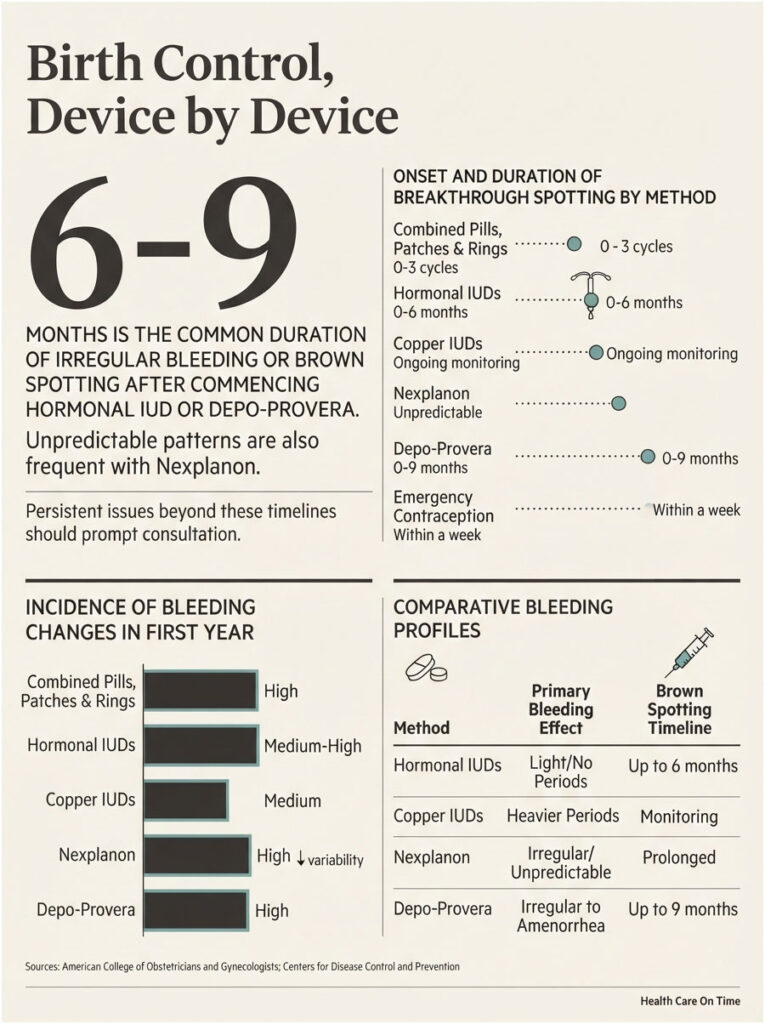
Breakthrough spotting is the most under-explained cause of brown discharge with no period, largely because most guidance stops at the phrase birth control can do that. Method matters, and so does timing.
Combined Pills, Patch, and Ring
Expect breakthrough spotting for the first two to three cycles after starting, switching brands, or moving to continuous dosing. Brown is typical here because the lining is thin and the flow is slow.
Missed or late pills are the other frequent trigger. Spotting persisting past three full cycles is a reason to discuss a different formulation, not a reason to stop the method on your own.
Hormonal IUDs and the Copper IUD
Hormonal IUDs such as Mirena and Kyleena thin the lining aggressively. Irregular brown spotting through months one to six is expected, and many users eventually stop having periods altogether.
The copper IUD works without hormones and tends to produce heavier, sometimes longer periods rather than brown spotting. New brown discharge with a copper IUD in place, especially with pain or odor, deserves a check for infection or displacement.
The Implant and the Shot
Nexplanon has the least predictable bleeding profile of any common method. Prolonged irregular spotting, often brown, is the leading reason users request removal.
Depo-Provera usually causes irregular bleeding across the first six to nine months, then increasing absence of periods with continued use. Our medical reviewers note that both methods deserve a full year of expectation-setting before their bleeding pattern gets judged.
Emergency Contraception and Recent Starts or Stops
Levonorgestrel emergency contraception delivers a large hormone dose that frequently produces spotting within the following week and shifts the timing of the next period. Stopping any hormonal method can also produce a stretch of brown discharge while your own cycle restarts.
How Common Is This? The US Numbers
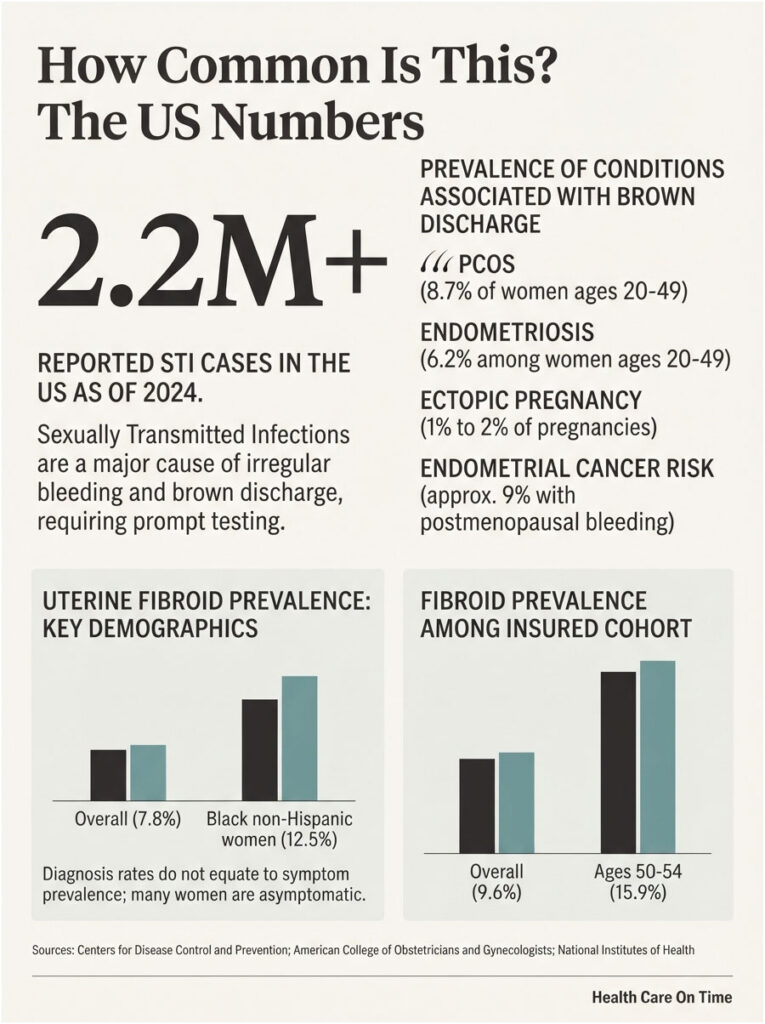
Brown discharge is a symptom, not a tracked condition, so the useful data sits in the prevalence of the conditions behind it. These figures reframe the question from is this rare to which of these applies to me.
| Condition or Finding | US Figure | Population | Source |
| PCOS ever diagnosed | 8.7% | Women ages 20 to 49, 2022 to 2023 | CDC NCHS, National Survey of Family Growth |
| Uterine fibroids ever diagnosed | 7.8% overall, 12.5% Black non-Hispanic | Women ages 20 to 49, 2022 to 2023 | CDC NCHS, National Survey of Family Growth |
| Endometriosis ever diagnosed | 6.2% | Women ages 20 to 49, 2022 to 2023 | CDC NCHS, National Survey of Family Growth |
| Fibroid prevalence, insured cohort | 9.6% overall, 15.9% at ages 50 to 54 | Women 18 to 65, Kaiser Permanente Washington | Yu et al., Am J Obstet Gynecol |
| Endometrial cancer risk with postmenopausal bleeding | About 9% pooled | 34,432 women across 129 studies | Clarke et al., JAMA Internal Medicine |
| Ectopic pregnancy prevalence | 1% to 2% of pregnancies | US pregnancies | American Academy of Family Physicians |
| Reported chlamydia, gonorrhea, syphilis cases | More than 2.2 million | United States, 2024 provisional | CDC STI Surveillance |
What This Data Does and Does Not Tell You
These are diagnosis rates, not spotting rates. Most women with fibroids never develop symptoms, and most episodes of brown discharge involve none of these conditions at all.
What the numbers establish is scale. Roughly one in twelve US women of reproductive age carries a PCOS diagnosis, which makes anovulatory spotting a mainstream explanation rather than an exotic one. That framing shapes how our lab partners triage the panels ordered for irregular bleeding.
Red Flags That Change the Timeline
The Seven-Day Rule
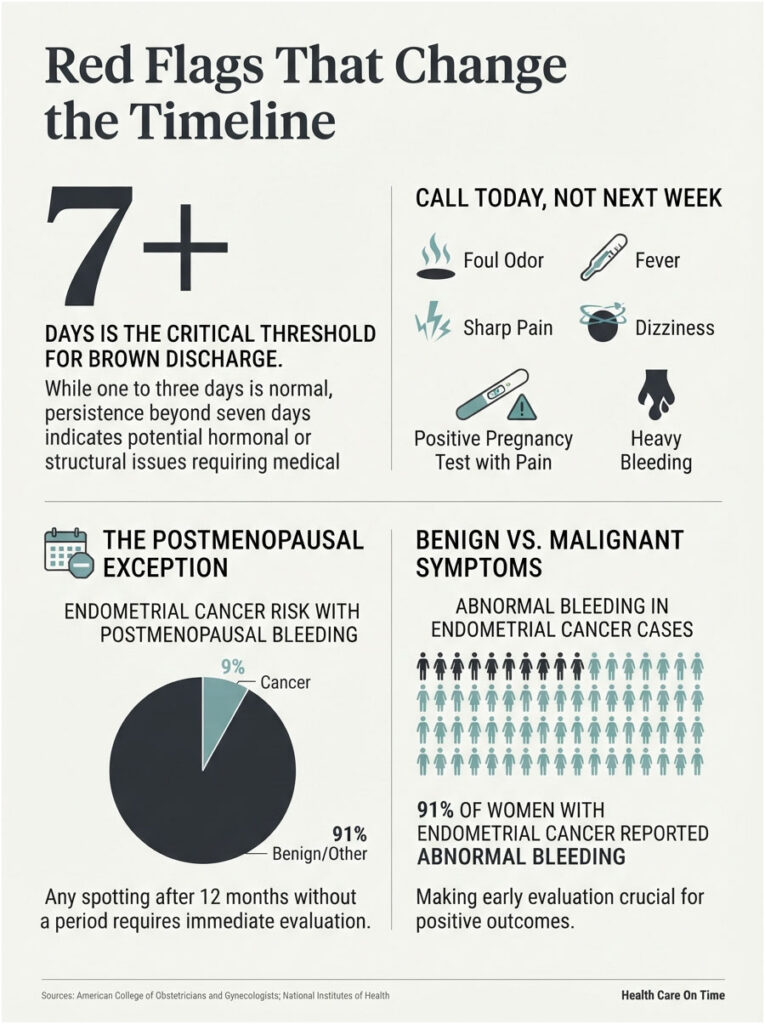
Brown discharge lasting one to three days with no other symptoms is background noise. Past seven continuous days, or recurring across three consecutive cycles, the probability shifts toward a hormonal or structural cause that will not clear on its own.
Waiting a fourth cycle adds no diagnostic information. It only delays the answer.
Call Today, Not Next Week
Seek prompt medical care for any of the following:
• Foul or fishy odor, or discharge that changed texture as well as color
• Fever, chills, or pelvic pain that keeps worsening
• Sharp one-sided pelvic or lower abdominal pain
• Dizziness, fainting, or a racing heart
• A positive pregnancy test paired with any pain or bleeding
• Shoulder-tip pain in early pregnancy
• Soaking through a pad in an hour, or passing clots larger than a quarter
• Bleeding after intercourse that happens more than once
The Postmenopausal Exception
Once you have gone 12 consecutive months without a period, the rules change completely. Any spotting, including a single episode of light brown discharge, counts as abnormal uterine bleeding and gets evaluated.
Pooled analysis of 129 studies found that about 9 percent of women presenting with postmenopausal bleeding were diagnosed with endometrial cancer, while roughly 91 percent of women who had endometrial cancer reported postmenopausal bleeding.
Read that in both directions. Nine times out of ten the cause turns out benign, most often vaginal atrophy or a polyp. But because bleeding is the symptom that catches nearly all endometrial cancers early, the evaluation is exactly what makes the good outcome possible.
What Your Doctor Will Actually Do
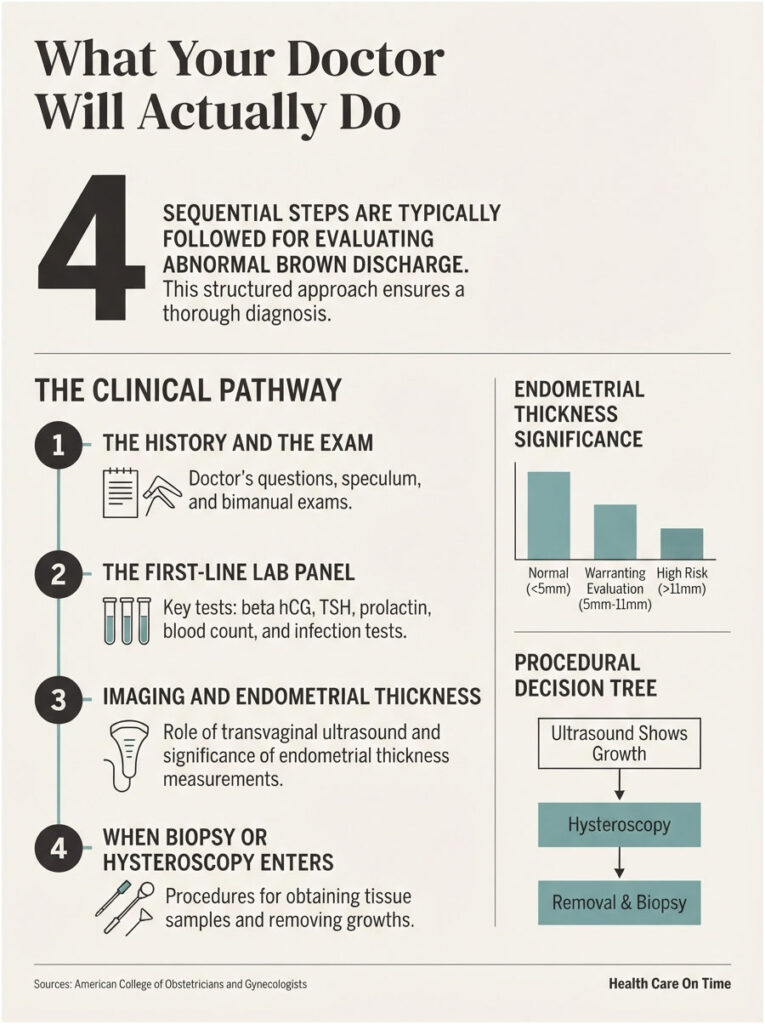
The History and the Exam
Expect questions about your last real period, cycle length over the past year, contraception, sexual activity, recent weight change, and any pain pattern. A speculum exam checks the cervix directly for polyps, inflammation, or a visible bleeding source.
A bimanual exam assesses uterine size and tenderness. Together, those two steps resolve a meaningful share of cases before any lab is drawn.
The First-Line Lab Panel
Pregnancy, Thyroid, Prolactin, Blood Count, Infection
A quantitative beta hCG comes first for anyone of reproductive age, whatever the home test showed. TSH screens thyroid function, and prolactin screens for the pituitary causes of anovulation.
A complete blood count with ferritin identifies iron depletion from chronic low-grade bleeding, which is common and frequently missed. Nucleic acid amplification testing for chlamydia and gonorrhea is standard whenever there is exposure risk.
In tests booked through HealthCareOnTime, this five-test cluster identifies a cause in the majority of persistent-spotting presentations before imaging is ordered at all.
Imaging and the Endometrial Thickness Threshold
Transvaginal ultrasound measures endometrial thickness and looks for polyps, fibroids, and ovarian findings. In postmenopausal women with bleeding, a lining measuring 4 mm or less carries a very low cancer probability and often closes the workup.
A thicker lining, a focal mass, or bleeding that continues despite a thin lining moves things forward. Saline infusion sonohysterography adds contrast to outline cavity lesions the standard scan can miss.
When Biopsy or Hysteroscopy Enters the Picture
Endometrial biopsy is an in-office procedure that takes a small tissue sample, usually a few minutes with cramping similar to a strong period. It is standard for postmenopausal bleeding and for women over 45 with persistent abnormal uterine bleeding.
Hysteroscopy places a camera inside the uterus and allows a polyp or submucosal fibroid to be removed in the same session.
What to Do Before Your Appointment
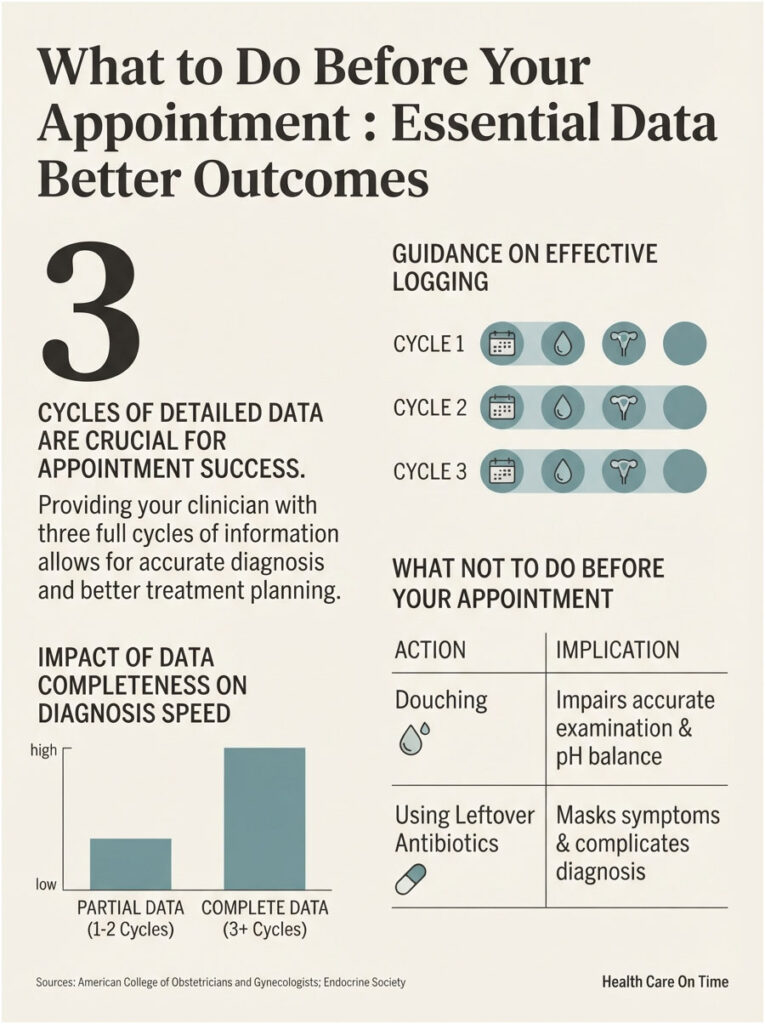
Walking in with three cycles of data changes the entire conversation. Most visits stall because nobody can reconstruct the timeline.
| Your Scenario | What It Most Likely Means | Do This | Timeframe |
| Under 3 days of light brown, no other symptoms, near your period | Cycle lead-in or tail | Log the dates, no action needed | Monitor 1 cycle |
| Mid-cycle brown spotting under 48 hours, repeating monthly | Ovulation spotting | Log which cycle days, mention at annual visit | Routine |
| Brown discharge but no period, more than 7 days late, negative test | Delayed ovulation or anovulation | Retest with first-morning urine | Retest in 48 to 72 hours |
| Brown spotting plus positive pregnancy test, no pain | Possible implantation or early pregnancy bleeding | Call your OB-GYN for a quantitative hCG | Within 24 to 48 hours |
| Brown spotting plus one-sided pain or dizziness | Possible ectopic pregnancy | Go to the emergency department | Immediately |
| Brown discharge plus odor, itching, or fever | Infection or cervicitis | Book an exam plus STI testing | Within 24 to 72 hours |
| New spotting on a contraceptive started under 3 months ago | Expected adjustment bleeding | Take doses at a fixed time, keep a log | Reassess at 3 months |
| Spotting between periods past 3 full cycles on any method | Formulation mismatch or a second cause | Book a visit, request TSH, prolactin, CBC | Within 2 to 4 weeks |
| Any spotting 12 months past your last period | Postmenopausal bleeding | Book an evaluation with ultrasound | Within 1 to 2 weeks |
The Three-Cycle Log That Changes Your Appointment
Record four things per episode: the date, the cycle day, the color, and the amount using a fixed reference such as liner, pad, or toilet paper only. Add any pain, odor, or sexual activity in the preceding 48 hours.
A cycle tracking app works, and so does a note on your phone. What matters is that the data exists when you sit down.
What Not to Do
Do not douche. It disrupts the vaginal microbiome and raises the risk of bacterial vaginosis and pelvic inflammatory disease without treating anything.
Do not take leftover antibiotics from an old prescription. Doing so masks symptoms, drives resistance, and can make an active infection harder to identify on testing.
Myths That Keep Sending People to Urgent Care
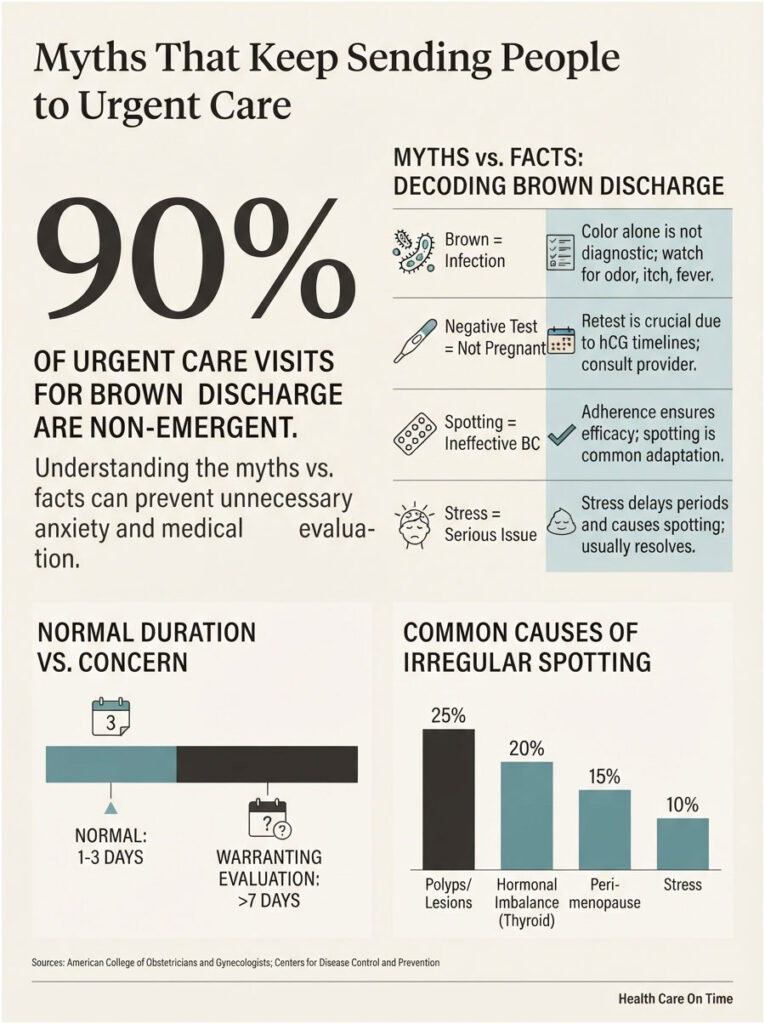
Brown Means Infection
Color has nothing to do with bacteria. Infection announces itself through odor, texture change, itching, burning, and fever. Brown alone, with none of those, points away from infection rather than toward it.
Brown Is Old Blood, So It Is Always Fine
The oxidation explanation is correct and incomplete. Old blood from a polyp, a submucosal fibroid, or an endometrial lesion is still old blood. The color explains the delay, not the source.
A Negative Test Rules Out Pregnancy
It rules out pregnancy at that hCG level on that day. Late ovulation, diluted urine, and testing too early all produce false negatives that resolve on a retest 48 to 72 hours later.
Spotting on Birth Control Means It Stopped Working
Breakthrough bleeding does not indicate reduced contraceptive effectiveness. Missed pills do reduce effectiveness, and missed pills also cause spotting, so treat the spotting as a prompt to check adherence rather than a warning about the method itself.
Frequently Asked Questions
How long can brown discharge last without a period?
One to three days is typical and needs no action. Up to seven days can still be normal if it stays light and painless. Past seven continuous days, or if it recurs across three consecutive cycles, book an evaluation rather than waiting another month for it to resolve.
Is brown discharge a sign of pregnancy or a period coming?
Both are possible, and timing separates them. Implantation bleeding appears roughly 6 to 12 days after ovulation, stays very light, and stops within two days. Period lead-in spotting arrives within a day or two of your expected start date and progresses into red flow.
Can stress cause brown discharge and no period?
Yes. Significant stress suppresses the hypothalamic signals that trigger ovulation, which delays or cancels the period. Without progesterone withdrawal, the lining sheds in patches instead of all at once, producing brown spotting. Cycles usually normalize within one to three months once the stressor eases.
Why do I have brown discharge but no period with a negative test?
The most common answer is an anovulatory cycle, where no egg released and no organized period followed. Late ovulation causing a false negative is the second possibility. Retest with first-morning urine in 48 to 72 hours, and if the period still does not arrive, book a visit.
Is brown discharge with no period normal on the pill?
For the first two to three cycles on a new pill, yes. The lining is thinning, and thin linings shed slowly enough to arrive brown. Missed or late doses are the other frequent trigger. Spotting that continues past three full cycles is worth a formulation change discussion.
Can PCOS cause brown discharge instead of a period?
Yes, and it is a classic presentation. Without regular ovulation, estrogen builds the lining with no progesterone to organize the shed, so the lining breaks down unpredictably in small amounts. Long gaps between periods punctuated by brown spotting is the pattern to describe to your clinician.
What does brown discharge mean after menopause?
It is treated as abnormal until evaluated, even a single light episode. About nine in ten cases turn out benign, most often vaginal atrophy or a polyp. Because bleeding is the symptom that catches most endometrial cancers early, the evaluation is what makes early detection possible.
Can a thyroid problem cause brown discharge?
Yes. Both hypothyroidism and hyperthyroidism disrupt the hormonal signaling that governs ovulation. Hypothyroidism can also raise prolactin, which suppresses ovulation further. A TSH test is standard first-line screening for anyone with several months of unexplained irregular spotting.
Does brown discharge with an IUD mean something is wrong?
With a hormonal IUD, irregular brown spotting during the first six months is expected as the lining thins. With a copper IUD, new brown discharge is less typical and deserves a check. Pain, odor, fever, or a string you cannot locate warrants prompt evaluation regardless of type.
Why does my brown discharge have a smell?
Odor indicates a bacterial component, not oxidized blood. A fishy odor suggests bacterial vaginosis. A foul odor with pain or fever suggests cervicitis, pelvic inflammatory disease, or retained tissue. Book an exam and testing within a few days rather than trying over-the-counter treatments first.
Can brown discharge mean cancer?
Rarely, and almost never in premenopausal women without other findings. The risk profile shifts after menopause, where pooled data puts endometrial cancer at roughly 9 percent of women presenting with bleeding. That is why postmenopausal spotting gets a fast workup while premenopausal spotting gets tracked first.
What tests should I ask for if brown discharge keeps happening?
A reasonable first panel is quantitative beta hCG, TSH, prolactin, a complete blood count with ferritin, and chlamydia and gonorrhea testing if there is exposure risk. If those come back unremarkable and spotting between periods continues, transvaginal ultrasound is the standard next step.
Medical Disclaimer: This article is provided by HealthCareOnTime for general educational purposes and does not replace individual medical advice, diagnosis, or treatment. Vaginal bleeding patterns vary widely between individuals, and only a licensed clinician who can examine you and review your history can determine what applies to your situation. Seek immediate care for severe pain, heavy bleeding, fever, dizziness, or any bleeding after menopause. Never delay or disregard professional medical advice because of something you read here.
References
- Endometriosis, Polycystic Ovary Syndrome, and Uterine Fibroids in Women Ages 20 to 49: United States, 2022 to 2023 (CDC NCHS Health E-Stat)
- Sexually Transmitted Infections Surveillance, 2024 (Provisional), CDC
- Clarke MA et al. Association of Endometrial Cancer Risk With Postmenopausal Bleeding in Women: A Systematic Review and Meta-analysis. JAMA Internal Medicine
- Yu O et al. A US Population-Based Study of Uterine Fibroid Diagnosis Incidence, Trends, and Prevalence. American Journal of Obstetrics and Gynecology
- Ectopic Pregnancy: Diagnosis and Management. American Family Physician
- Vaginal Discharge: Causes, Colors and What Is Normal. Cleveland Clinic
- Brown Discharge: Causes and What It Means. Cleveland Clinic
- Evaluation of Women Presenting With Bleeding in the First Trimester of Pregnancy. National Library of Medicine
- CDC Releases 2024 National STI Data, National Center for HIV, Viral Hepatitis, STD, and TB Prevention
- STI Statistics Overview, CDC