You would have to eat an entire 5 ounce clamshell of baby spinach, the whole plastic tub, to match the calories in a single saltine cracker. That is not a typo.
Table of Contents
Spinach sits so far down the calorie scale that most Americans stop asking after they see the number. The problem is that the number moves. Ask three sources how many calories are in spinach and you will get 7, 23, and 41, all of them correct.
Quick Answer
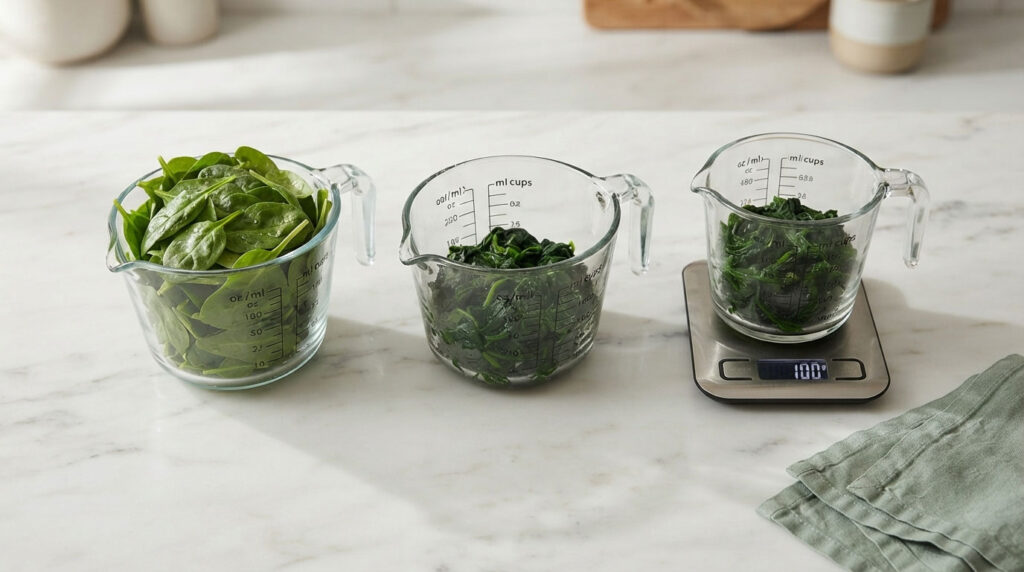
One cup of raw spinach (30 grams) has 7 calories. One hundred grams of raw spinach, about 3.5 ounces, has 23 calories. One cup of cooked, boiled, and drained spinach (180 grams) has 41 calories. Cooked spinach looks higher only because heat collapses the leaves, so six times more spinach fits inside the same measuring cup. Per gram, raw and cooked spinach are nearly identical.
At a Glance
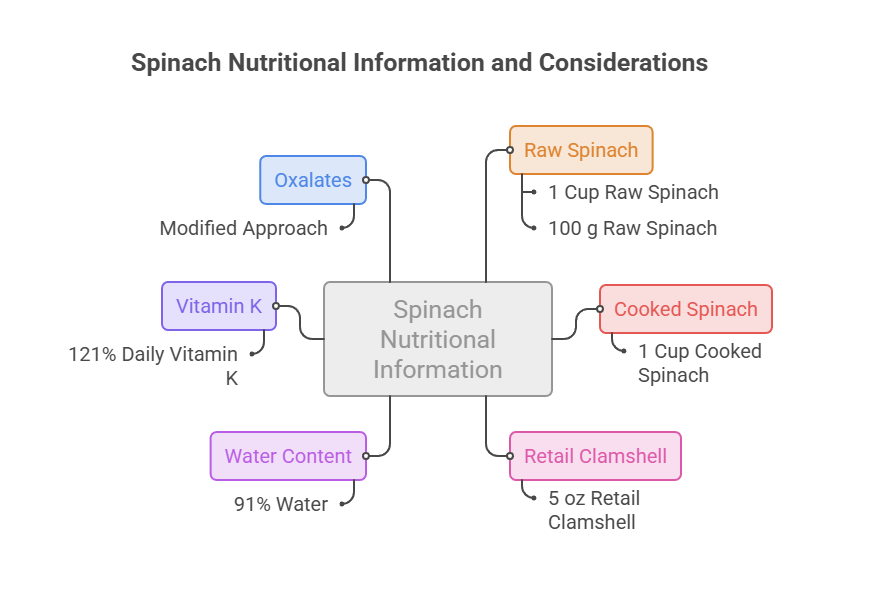
- 1 cup raw spinach: 7 calories, 0.9 g protein, 1.1 g carbs, 0.7 g fiber
- 100 g raw spinach: 23 calories, the figure printed on most nutrition labels
- 1 cup cooked spinach: 41 calories, 5.3 g protein, 4.3 g fiber
- A full 5 oz retail clamshell: about 33 calories
- Raw spinach is roughly 91% water, which explains nearly everything
- One raw cup delivers 121% of a man’s daily vitamin K, which matters on blood thinners
- Spinach is high in oxalates, so calcium oxalate stone formers need a modified approach
Every figure below comes from USDA FoodData Central records 168462 (raw) and 168463 (cooked). Our medical reviewers pulled them directly so you can verify each one against the source.
The Short Answer: Spinach Calories by Serving Size
Most calorie questions have one answer. Spinach has five, because Americans buy and measure it five different ways.
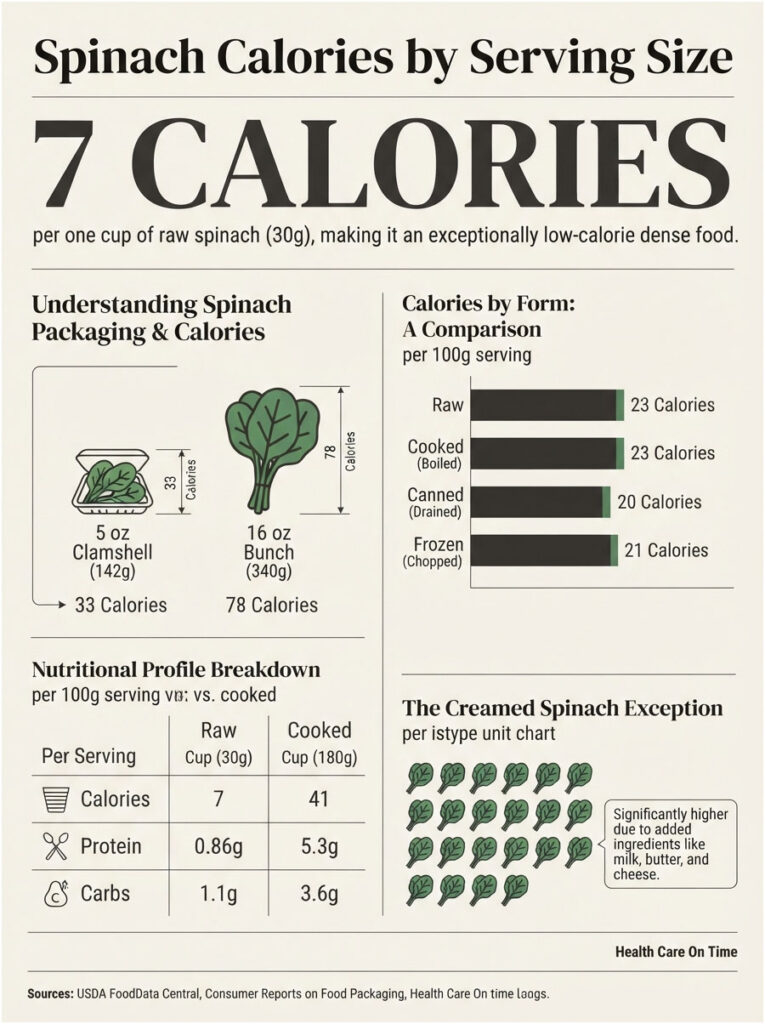
One cup of raw spinach
A standard measuring cup of loose raw leaves weighs about 30 grams. That cup carries 7 calories, 0.86 grams of protein, 1.1 grams of carbohydrate, and 0.66 grams of fiber, per USDA FoodData Central.
Subtract the fiber and net carbs land near 0.4 grams. That is why spinach appears in nearly every low-carb meal plan written in the last decade.
100 grams and 3.5 ounces of raw spinach
The figure you will see on packaging and in most databases is 23 calories per 100 grams, roughly 3.5 ounces or a little over three loose cups.
At that weight, raw spinach delivers 2.9 grams of protein, 3.6 grams of carbohydrate, 2.2 grams of fiber, and 0.4 grams of fat. Water accounts for about 91% of the total.
One cooked cup, boiled and drained
Here is where the confusion starts. A cup of boiled and drained spinach weighs 180 grams, not 30, and carries 41 calories per USDA FoodData Central record 168463.
That same cup supplies 5.3 grams of protein and 4.3 grams of fiber, which is 15% of the Daily Value, from a food most people file under “basically free.”
The units Americans actually buy
Nobody walks out of Kroger holding 30 grams of spinach. Real shopping units look different, and the math should match them.
A 5 ounce triple-washed clamshell holds 142 grams and totals about 33 calories. A 16 ounce bunch of mature spinach runs 340 grams and about 78 calories. One handful tossed into a smoothie adds 6 or 7 calories.
Patients who track macros through HealthCareOnTime tell us regularly that they logged “a whole bag of spinach” and assumed it wrecked the day. A whole bag is about one-third of a banana.
Table 1: Spinach Calories and Macros by Form and Serving (USDA Data)
| Form and Serving | Calories | Protein (g) | Carbs (g) | Fat (g) |
| Raw, 1 oz handful (28 g) | 7 | 0.81 | 1.03 | 0.11 |
| Raw, 1 cup (30 g) | 7 | 0.86 | 1.09 | 0.12 |
| Raw, 100 g (3.5 oz) | 23 | 2.86 | 3.63 | 0.39 |
| Raw, 5 oz clamshell (142 g) | 33 | 4.06 | 5.15 | 0.55 |
| Raw, 1 bunch (340 g) | 78 | 9.72 | 12.34 | 1.33 |
| Cooked, boiled and drained, 100 g | 23 | 2.94 | 3.78 | 0.26 |
| Cooked, boiled and drained, 1 cup (180 g) | 41 | 5.35 | 6.75 | 0.47 |
| Canned, drained, 1 cup (214 g) | 49 | 6.01 | 7.28 | 1.07 |
| Frozen, cooked and drained, 1 cup (190 g) | 61 | 7.58 | 9.75 | 0.95 |
| Creamed spinach, 1 cup | 148 | 6.66 | 11.94 | 9.02 |
Look at the last row. Creamed spinach carries more calories than the nine servings above it combined. The spinach did not change. The cream and butter did.
Why Cooked Spinach Has Six Times the Calories of Raw
This one point trips up more calorie trackers than any other leafy-green question, and none of the top-ranking pages explain it properly.
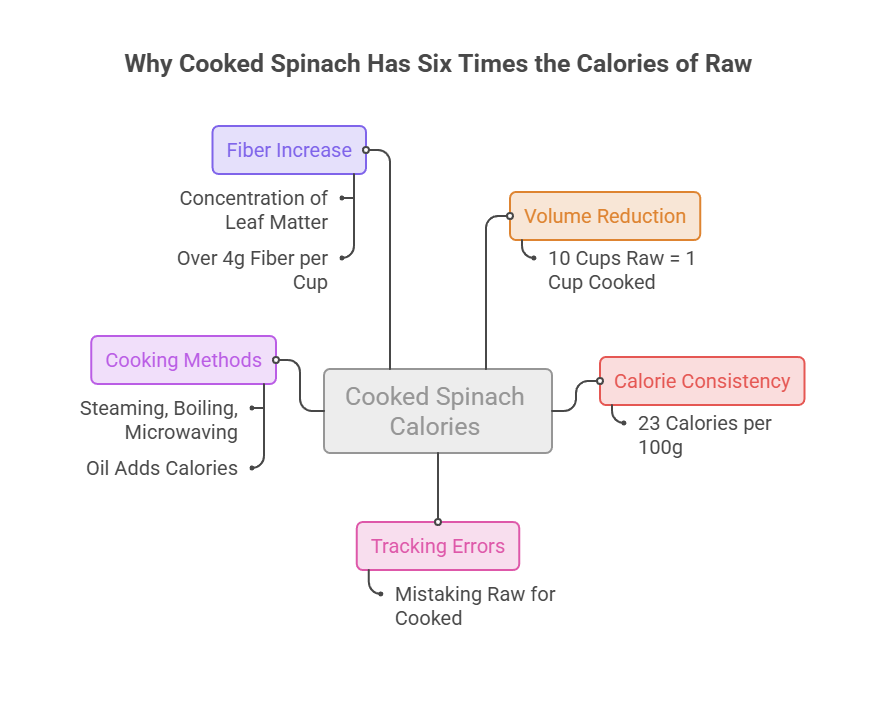
The shrinkage math nobody spells out
Spinach is a leaf holding water inside a rigid cell structure. Apply heat, the cell walls break down, water escapes, and the leaf collapses into a fraction of its former volume.
More than ten cups of raw spinach reduce down to roughly one cup once cooked. So a cooked cup contains about six times more actual plant matter than a raw cup does.
Calories per gram barely move
Compare like with like and the illusion disappears. Raw spinach is 23 calories per 100 grams. Boiled and drained spinach is also about 23 calories per 100 grams.
Boiling does not add energy to food. It removes water, concentrates what stays behind, and changes how much fits inside your measuring cup.
What this means for your food-tracking app
Log raw spinach by cup if you like; the error margin is a rounding difference. Log cooked spinach by weight, because a “cup” of cooked spinach can swing 40% depending on how hard you pressed it down.
Our nutrition reviewers see the same mistake constantly. Someone sautés a full bag, measures the shrunken result as one cup, then enters the raw-cup value of 7 calories. The real number is closer to 33 plus whatever went into the pan.
Does the cooking method change the count?
Steaming, boiling, microwaving, and dry sautéing all land in the same calorie range. Heat alone adds nothing.
Oil is the variable that matters. One tablespoon of olive oil adds about 120 calories, more than three full clamshells of raw spinach. Butter, cream, cheese, and bacon fat follow the same rule.
The fiber jump is real, though
Raw spinach carries a little over half a gram of fiber per cup, while boiled spinach delivers more than 4 grams per cup. Same explanation as the calories: more leaf per cup, not a chemical change.
Full USDA Micronutrient Breakdown: Raw Cup vs Cooked Cup
Calories tell you almost nothing about spinach. The reason it earns its reputation lives in the micronutrient column.
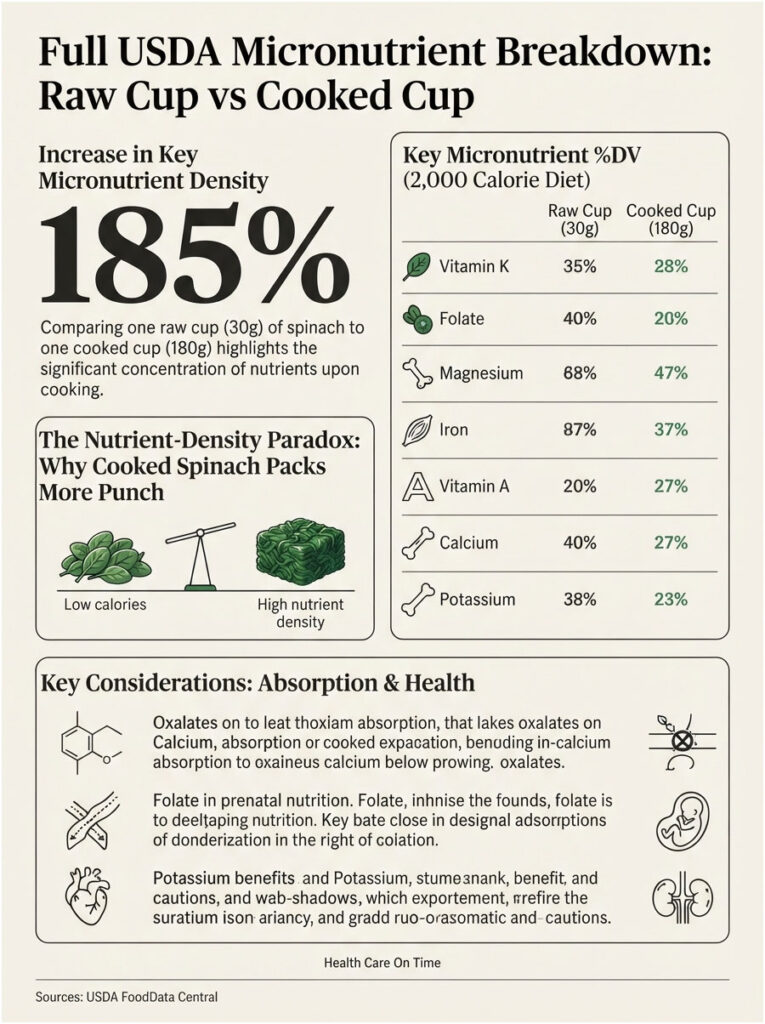
Nutrient Panel: One Raw Cup vs One Cooked Cup
| Nutrient | 1 Cup Raw (30 g) | 1 Cup Cooked (180 g) | %DV, Cooked Cup |
| Calories | 7 | 41 | 2% |
| Protein | 0.86 g | 5.3 g | 11% |
| Fiber | 0.66 g | 4.3 g | 15% |
| Vitamin K | 145 mcg | 889 mcg | 740% |
| Vitamin A (RAE) | 141 mcg | 943 mcg | 105% |
| Folate (B9) | 58 mcg | 263 mcg | 66% |
| Vitamin C | 8.4 mg | 17.6 mg | 20% |
| Vitamin E | 0.61 mg | 3.7 mg | 25% |
| Riboflavin (B2) | 0.06 mg | 0.42 mg | 33% |
| Vitamin B6 | 0.06 mg | 0.44 mg | 26% |
| Iron | 0.81 mg | 6.4 mg | 36% |
| Magnesium | 24 mg | 157 mg | 37% |
| Calcium | 30 mg | 245 mg | 19% |
| Potassium | 167 mg | 839 mg | 18% |
| Manganese | 0.27 mg | 1.7 mg | 73% |
| Sodium | 24 mg | 126 mg | 5% |
Vitamins
Vitamin K is the headline. One raw cup covers 121% of the daily target for men and 161% for women. A cooked cup pushes past 700% of the Daily Value.
Vitamin A arrives as beta-carotene, about 1,688 micrograms per raw cup and 11,318 micrograms per cooked cup. Your body converts only what it needs, so the toxicity risk attached to preformed retinol supplements does not apply here.
Folate is the quiet standout. A cooked cup covers roughly two-thirds of the Daily Value, which is why spinach shows up throughout prenatal nutrition guidance.
Vitamin C survives cooking less well than the fat-soluble vitamins, though a cooked cup still lands at 20% of the Daily Value because of the concentration effect.
Minerals
Magnesium at 157 milligrams per cooked cup moves the needle on a nutrient a large share of American adults fall short on. Manganese hits 73% of the Daily Value in the same serving.
Potassium reaches 839 milligrams per cooked cup, more than a medium banana. That is a benefit for most people and a caution for one specific group covered later.
Calcium at 245 milligrams per cooked cup looks impressive on paper. Absorption is another matter, since spinach oxalates bind a large portion of it before it reaches your bloodstream.
The nutrient-density paradox
How does a 7 calorie food deliver triple-digit percentages of anything? Because calories measure energy, and vitamins are not energy.
Vitamin K, folate, and beta-carotene contribute zero calories to the total. Spinach is essentially a water-based delivery vehicle for compounds your body cannot manufacture on its own.
What the %DV numbers are based on
Every Daily Value percentage on a US label references a 2,000 calorie daily diet, a standard set by the FDA. If you eat 1,500 or 2,800 calories a day, the percentage shifts while the milligram amounts stay fixed.
Spinach vs Other Leafy Greens: The Calorie Comparison
“Is spinach the lowest-calorie green?” comes up constantly. The honest answer is no, and the greens that beat it are not the ones people expect.
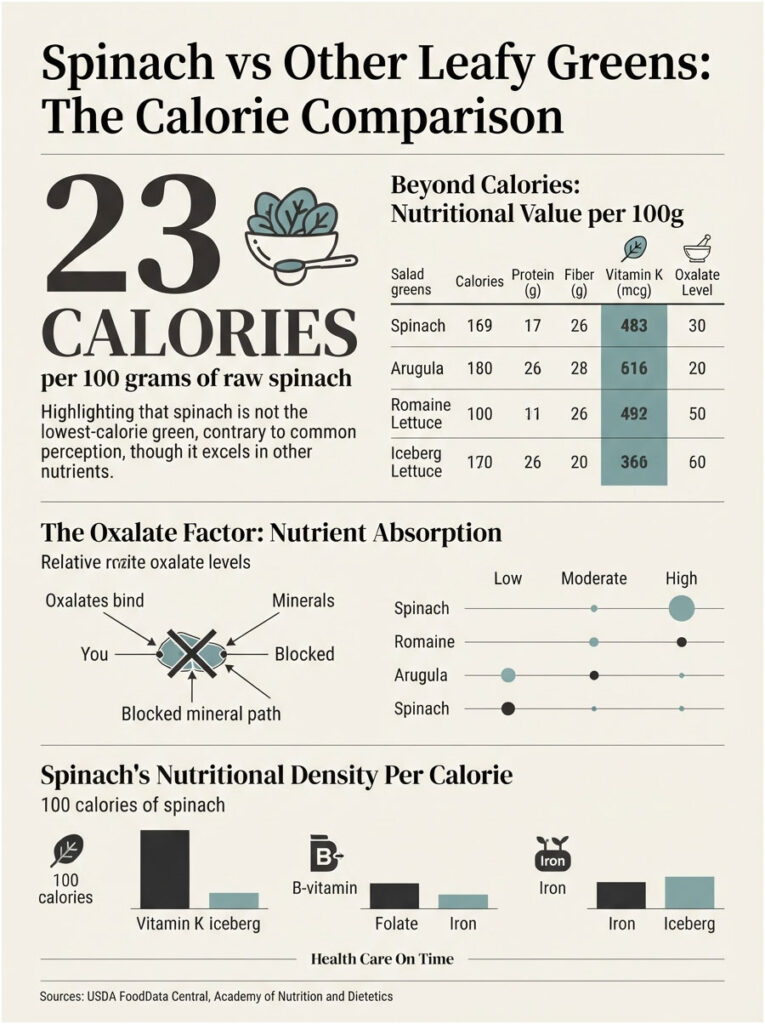
Common US Salad Greens, Per 100 Grams Raw
| Green | Calories | Protein (g) | Fiber (g) | Vitamin K (mcg) | Oxalate Level |
| Watercress | 11 | 2.3 | 0.5 | 250 | Low |
| Butterhead lettuce | 13 | 1.4 | 1.1 | 102 | Low |
| Iceberg lettuce | 14 | 0.9 | 1.2 | 24 | Low |
| Romaine lettuce | 17 | 1.2 | 2.1 | 103 | Low |
| Swiss chard | 19 | 1.8 | 1.6 | 830 | High |
| Spinach | 23 | 2.9 | 2.2 | 483 | High |
| Arugula | 25 | 2.6 | 1.6 | 109 | Low |
| Collard greens | 32 | 3.0 | 4.0 | 437 | Moderate |
| Kale | 35 | 2.9 | 4.1 | 390 | Low |
Iceberg and romaine beat spinach on raw calories. They also deliver a fraction of the protein, iron, folate, and carotenoids, which makes the comparison misleading if calories are your only filter.
The more useful read is calories per unit of nutrition. Spinach gives you more vitamin K, folate, and iron per calorie than anything else on this list. Kale costs 50% more calories for a lower vitamin K return but carries far less oxalate.
For anyone building a rotation, our nutrition reviewers suggest alternating spinach with a low-oxalate green such as arugula or romaine rather than eating spinach daily.
Spinach in Prepared Dishes: Where the Calories Actually Come From
Nobody eats plain boiled spinach. The calorie count on your plate depends almost entirely on what joined the spinach on the way there.
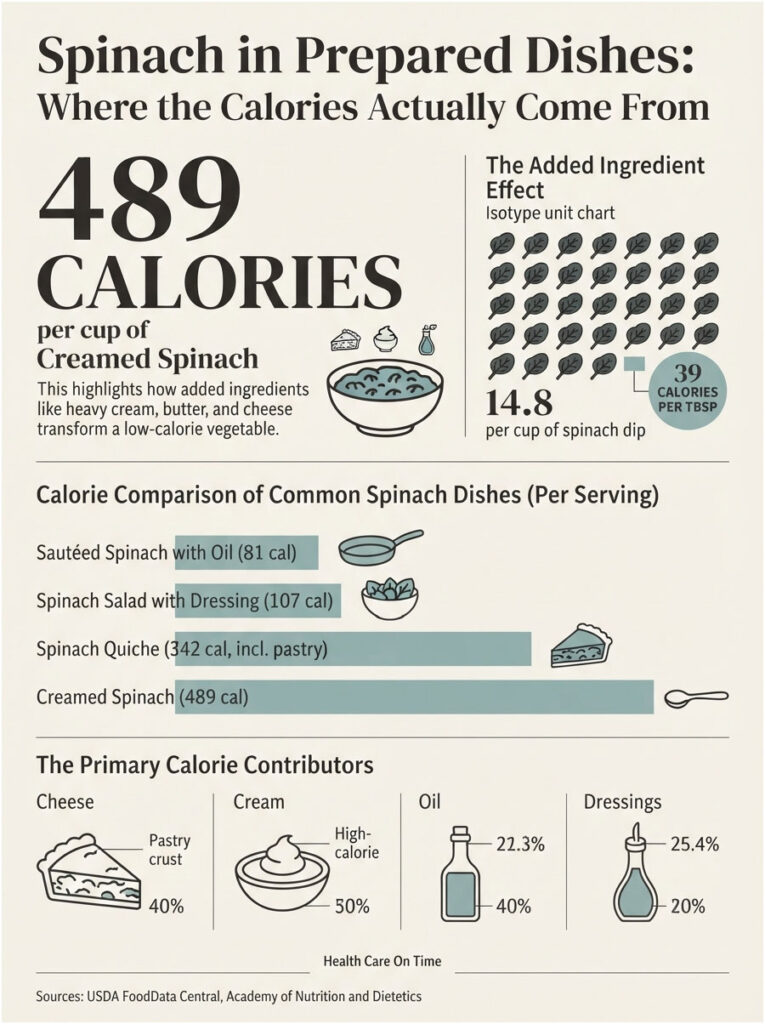
Common US Spinach Dishes
| Dish | Serving | Calories | Fat (g) |
| Spinach in a green smoothie | 1 cup raw added | 7 | 0.1 |
| Sautéed spinach, 1 tsp olive oil | 1 cup cooked | 81 | 5.0 |
| Spinach salad with dressing | 1 cup | 107 | 4.8 |
| Creamed spinach | 1 cup | 148 | 9.0 |
| Spinach soup | 1 cup | 203 | 12.3 |
| Spinach dip | 1 tbsp | 39 | 3.8 |
| Spinach souffle | 1 cup | 233 | 17.6 |
| Spinach quiche | 1 slice | 342 | 26.1 |
A slice of spinach quiche carries 49 times the calories of a raw cup. Spinach dip at a party costs 39 calories per tablespoon, and almost nobody stops at one tablespoon.
The pattern is consistent. Spinach itself never breaks 100 calories in a normal serving. Cheese, cream, oil, pastry, and dressing do all the work.
What Those Calories Buy You
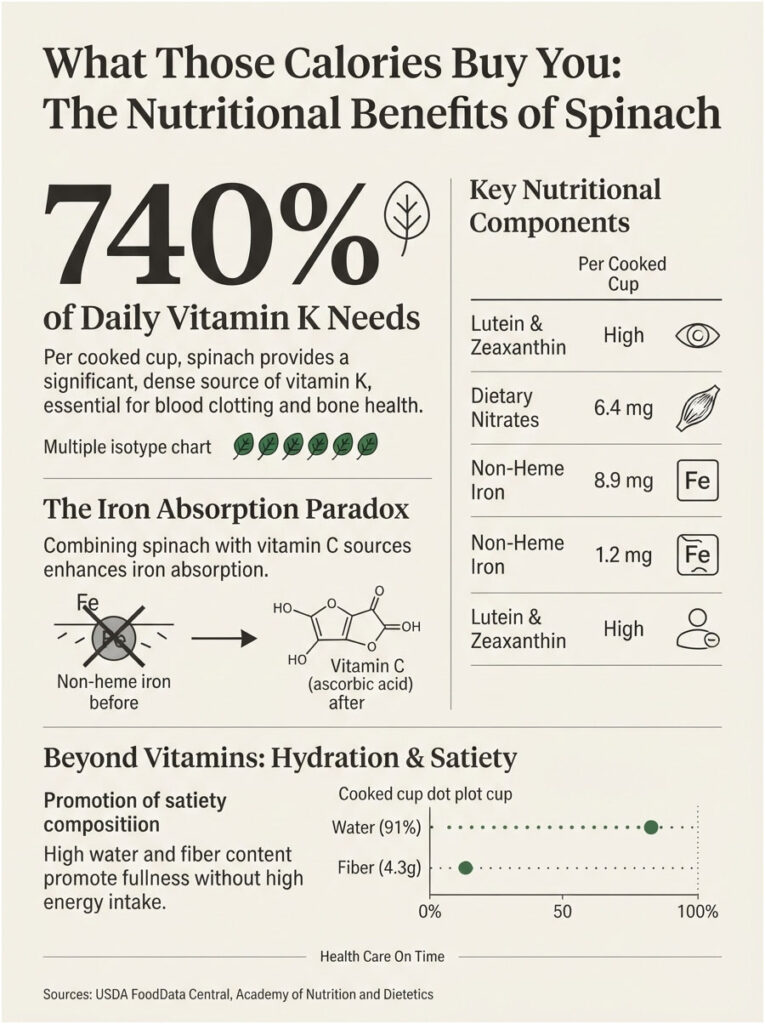
A 41 calorie cup covering 740% of your vitamin K needs is doing something unusual. Here is what the research actually supports.
Blood pressure and dietary nitrates
Spinach is naturally high in nitrates, which the body converts into nitric oxide, a compound that relaxes blood vessel walls. One study found participants who drank a spinach beverage had lower blood pressure for up to five hours afterward.
The effect appeared in diastolic pressure, the bottom number reflecting arterial pressure between heartbeats. Potassium and magnesium contribute through separate pathways pointing the same direction.
The American Heart Association notes that potassium-rich diets help counteract sodium and relax vessel walls, which is a large part of why leafy greens keep appearing in blood pressure guidance.
Eye health, lutein and zeaxanthin
Spinach carries roughly 11.9 milligrams of lutein plus zeaxanthin per 100 grams, second only to kale among common vegetables. These two carotenoids are the only ones that accumulate in the retina.
A small study found that eating half a cup of frozen spinach daily for two months raised both lutein levels and eye pigment density. Higher macular pigment is associated with lower age-related macular degeneration risk, though that evidence remains observational rather than causal.
Iron, and the Popeye correction
Spinach does contain iron: 6.4 milligrams per cooked cup, or 36% of the Daily Value. The catch is bioavailability.
Plant iron is non-heme iron, absorbed far less efficiently than the heme iron in red meat. Spinach compounds the problem with oxalates, which bind iron in the gut before absorption happens.
Patients who come to HealthCareOnTime for iron studies and complete blood counts often assume a spinach-heavy diet rules out deficiency. It does not. Pairing spinach with a vitamin C source such as bell pepper, citrus, or tomato measurably improves non-heme iron uptake.
Satiety and weight management
At 91% water and 4.3 grams of fiber per cooked cup, spinach fills stomach volume without contributing meaningful energy. That is the entire premise behind volume eating.
Extracts from spinach thylakoids have been shown to increase feelings of fullness after eating, although that effect has not been studied extensively in whole spinach.
The practical version is simpler. Two cups of raw spinach under a normal dinner portion adds bulk, chewing time, and 14 calories.
Bone health and blood clotting
Vitamin K activates clotting factors and the proteins that bind calcium into bone matrix. Spinach is among the densest dietary sources available in an American supermarket.
That same density is what turns spinach into a medication concern for one specific group of patients.
The Limits: Who Should Watch Their Spinach Intake
A food this nutrient-dense is not automatically safe in unlimited amounts. Four groups need a modified approach.
Oxalates and calcium oxalate kidney stones
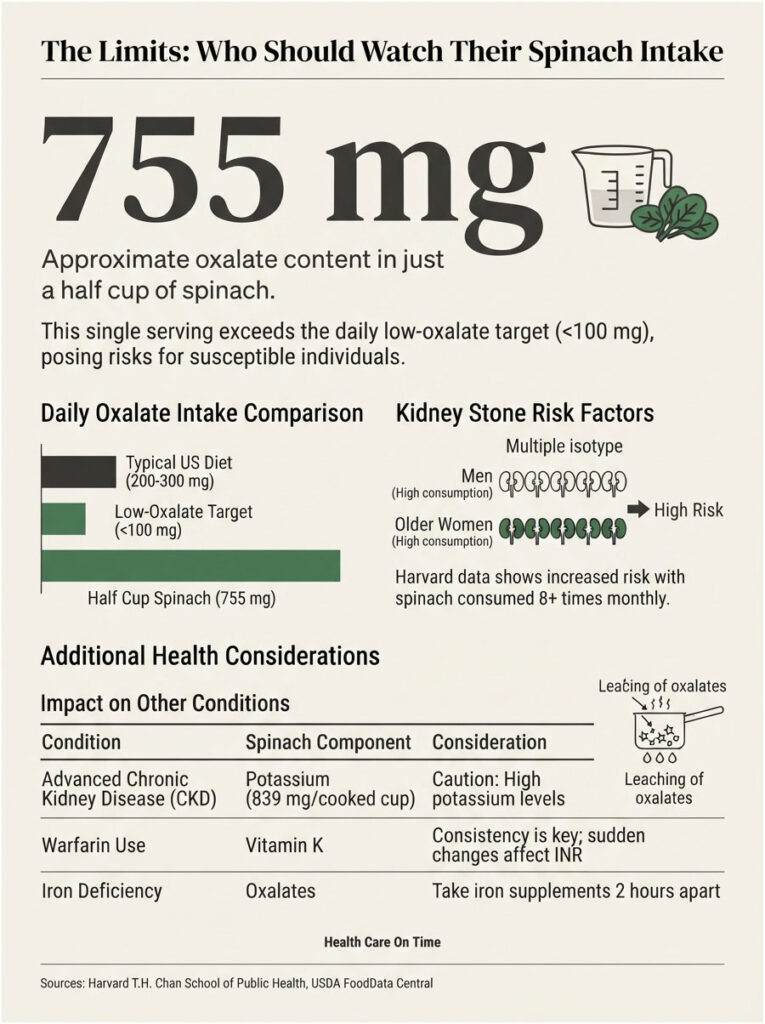
Spinach ranks among the highest-oxalate foods in the American diet. A half cup of cooked spinach contains roughly 755 milligrams of oxalate.
For scale, a typical American diet supplies 200 to 300 milligrams of oxalate daily, and a low-oxalate protocol targets under 100 milligrams. Spinach alone may account for as much as 40% of total oxalate intake in the United States.
Harvard cohort data found that men and older women who ate spinach eight or more times a month had about 30% higher risk of developing kidney stones. That is a real signal, though it applies most to people already predisposed to stone formation.
Elimination is rarely the right answer. Steaming reduces oxalate by about 30%, and boiling cuts levels by more than half, with roughly 60% leaching into the cooking water. Pour that water down the drain rather than saving it for soup.
Johns Hopkins Medicine advises calcium oxalate stone formers to eat adequate dietary calcium rather than restricting it, since calcium binds oxalate in the gut and carries it out in stool before absorption occurs. Spinach eaten with yogurt, cheese, or fortified milk beats spinach avoidance.
Vitamin K and warfarin
If you take warfarin or another vitamin K antagonist, spinach is not forbidden. Inconsistency is the danger, not the vegetable.
Warfarin dosing is calibrated against your habitual vitamin K intake. A patient who eats spinach three times a week and then stops for a month will watch their INR drift, and the reverse holds equally.
In cases reviewed by our medical team, the recurring pattern is never a patient eating too much spinach. It is a patient who started a new diet and swung from zero leafy greens to daily green smoothies without telling their prescriber. Keep intake steady and keep PT/INR monitoring on schedule.
Potassium and advanced chronic kidney disease
A cooked cup carries 839 milligrams of potassium. For healthy kidneys that is a benefit. For someone in stage 4 or 5 chronic kidney disease on a potassium restriction, it is a meaningful load.
Boiling and draining removes potassium alongside oxalate. Anyone on a renal diet should get portion targets from a nephrologist or renal dietitian rather than a general nutrition article.
Iron supplements and timing
Oxalates bind iron. If you take a prescribed iron supplement, space it about two hours away from a large spinach serving so the two are not competing in the same digestive window.
Food safety and the triple-washed label
Packaged spinach carries a documented recall history in the United States, and leafy greens remain a recurring subject of foodborne illness investigations. Rinsing does not eliminate risk, though it reduces surface contamination and costs nothing.
How to Get the Most From Every Spinach Calorie
Seven calories per cup means the penalty for eating spinach wrong is low. The cost of missing what it offers is higher.
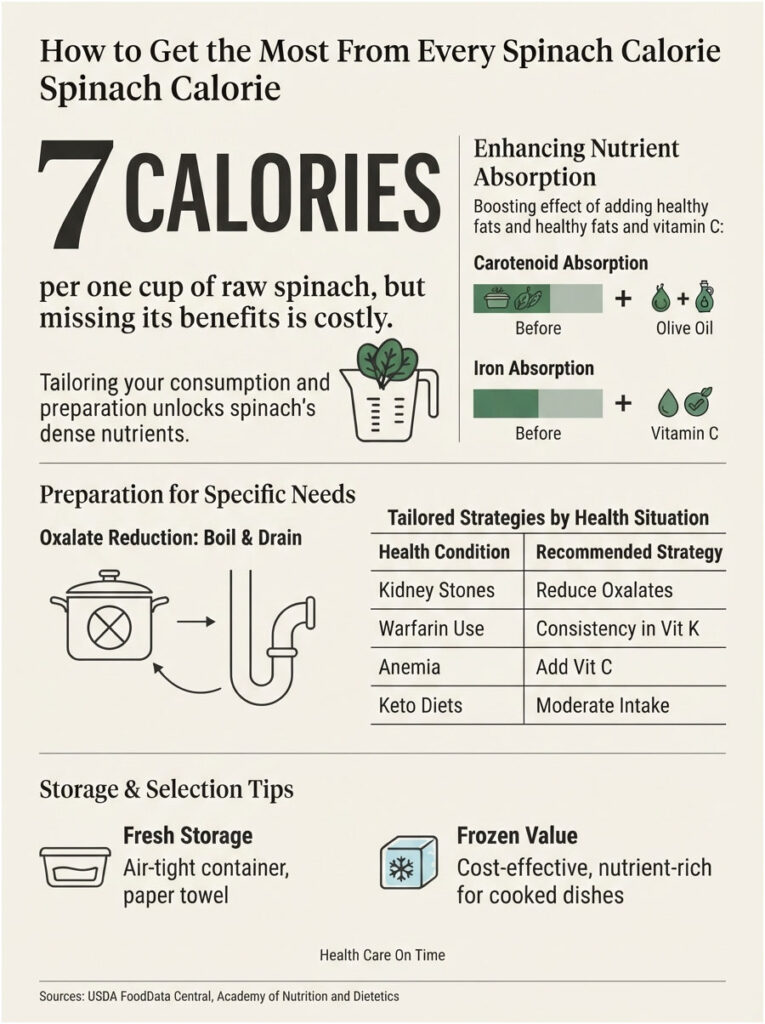
Boil and drain if oxalates concern you
Use plenty of water, cook for several minutes, then pour it off. Do not reuse the liquid as a stock base, since that returns exactly what you just removed.
Add fat to absorb the carotenoids
Vitamin A, vitamin E, lutein, and zeaxanthin are all fat-soluble. A dry spinach salad delivers a fraction of the carotenoids that the same salad with olive oil provides.
A teaspoon of oil adds about 40 calories and multiplies absorption of compounds worth considerably more than that.
Add vitamin C to absorb the iron
Squeeze lemon over cooked spinach. Toss baby spinach with strawberries or orange segments. Combine with tomatoes or bell pepper in a sauté.
Ascorbic acid converts iron into a form the small intestine takes up more readily, partly offsetting the oxalate penalty.
Buy frozen when you plan to cook it
Frozen spinach is blanched at peak freshness, costs less per usable ounce, and never turns to slime in the crisper drawer. A 10 ounce box replaces roughly two and a half fresh clamshells.
Storage that actually works
Keep fresh spinach in an airtight container with a dry paper towel to absorb condensation. Expect five to seven days. Do not pre-wash bunches you plan to store, since surface moisture speeds spoilage.
Table 3: Your Situation, Your Spinach Strategy
| If This Is You | Do This | Why It Works |
| Counting calories strictly | Log raw spinach by cup, cooked spinach by gram weight | A cooked cup holds six times the leaf mass of a raw cup, so cup-based logging under-counts by 30 or more calories |
| Prone to calcium oxalate kidney stones | Boil and drain, cap intake near half a cup cooked, pair with dairy | Boiling removes over half the oxalate; dietary calcium binds the rest before absorption |
| Taking warfarin or another vitamin K antagonist | Keep spinach intake consistent week to week, stay current on PT/INR testing | Warfarin dosing is calibrated to habitual vitamin K intake, so swings matter more than totals |
| Low in iron or diagnosed with anemia | Pair spinach with vitamin C, space iron supplements two hours apart | Vitamin C boosts non-heme iron uptake; oxalates block it when taken together |
| Eating keto or low carb | Use raw spinach freely as a salad and smoothie base | About 0.4 g net carbs per raw cup, effectively free within keto macros |
| Managing stage 4 or 5 CKD | Boil, drain, and get a portion target from your nephrologist | 839 mg potassium per cooked cup can consume a renal allowance quickly |
| Cooking for a family on a budget | Buy 10 oz frozen boxes for cooked dishes, clamshells only for salads | Frozen costs less per usable ounce, wastes nothing, holds nutrients through blanching |
Spinach in the American Diet
Annual per capita consumption of fresh spinach in the United States was 1.5 pounds per person as of 2016, down from a record 2.0 pounds in 2007. Spread across a year, that is under a tenth of an ounce daily.
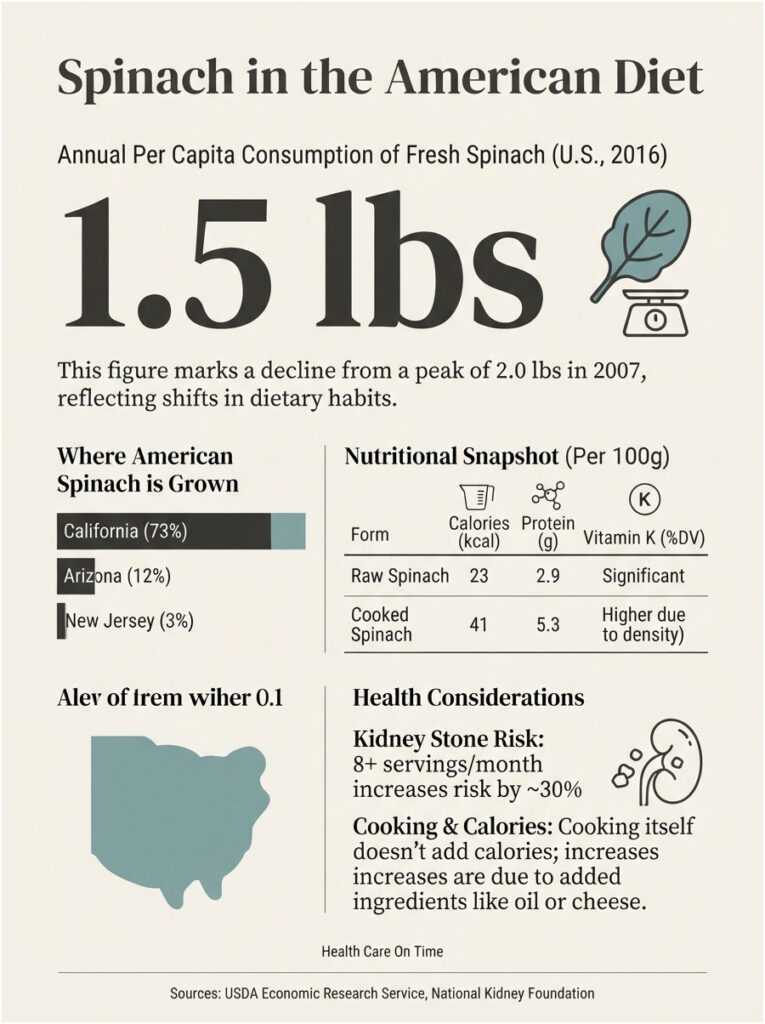
More recent standalone figures are hard to come by. USDA folded canned and frozen spinach into a combined processing category after 2019, so separate breakouts are no longer published.
California grows roughly 73% of the national crop, Arizona about 12%, and New Jersey about 3%. Production shifts to the Yuma, Arizona desert in winter, which is why bag prices and leaf quality swing with the season.
Table 2: Spinach by the Numbers, USA
| Metric | Figure | Source |
| Calories, 1 raw cup (30 g) | 7 kcal | USDA FoodData Central, FDC 168462 |
| Calories, 1 cooked cup (180 g) | 41 kcal | USDA FoodData Central, FDC 168463 |
| Water content, raw spinach | About 91% | USDA FoodData Central |
| Vitamin K, 1 raw cup | 145 mcg (121% DV) | USDA FoodData Central / American Heart Association |
| Lutein plus zeaxanthin | About 12 mg per 100 g | USDA FoodData Central |
| US per capita fresh spinach use | 1.5 lb (2016), peak 2.0 lb (2007) | USDA Economic Research Service / AgMRC |
| Share of US dietary oxalate from spinach | Up to 40% | NutritionFacts.org oxalate review |
| Kidney stone risk, 8+ spinach servings monthly | About 30% higher | Harvard cohort studies |
Frequently Asked Questions
How many calories are in a whole 5 oz bag of spinach?
A 5 ounce clamshell holds 142 grams of raw spinach and contains about 33 calories total. That entire bag also delivers roughly 4 grams of protein, 3 grams of fiber, and more than 600% of the Daily Value for vitamin K. Eating the whole bag in one sitting is nutritionally reasonable for most people.
Is spinach a negative-calorie food?
No. The negative-calorie concept is a myth. Digesting spinach costs your body a small amount of energy, but nowhere near the 7 calories a raw cup provides. Spinach is extremely low in calories, which is a different and far more useful claim than negative.
How many calories are in 100 grams of spinach?
Raw spinach contains 23 calories per 100 grams according to USDA FoodData Central. Cooked, boiled, and drained spinach also comes in around 23 calories per 100 grams. Weight for weight, cooking barely changes the energy density of spinach at all.
Does cooking spinach add calories?
Cooking alone adds nothing. A cooked cup shows 41 calories instead of 7 because roughly six times more spinach fits into the cup once the leaves collapse. Any genuine calorie increase comes from oil, butter, cream, or cheese added during preparation, not from the heat itself.
How many calories are in frozen spinach?
One cup of frozen spinach, cooked and drained (190 grams), contains about 61 calories. The figure runs above fresh cooked spinach because frozen spinach is chopped and packs more densely into the same measuring cup. Nutrient content is otherwise close to fresh.
How many calories are in creamed spinach?
About 148 calories per cup, with 9 grams of fat. The spinach accounts for under 40 of those calories. Cream, butter, flour, and cheese supply the rest, which is why creamed spinach behaves nutritionally more like a side dish than a vegetable serving.
Is baby spinach lower in calories than mature spinach?
No. Baby and mature spinach carry the same calories per gram, around 23 per 100 grams. Baby leaves are simply younger, more tender, and less bitter than the mature leaves usually sold in bunches. Choose based on texture and taste, not calories.
How much protein is in a cup of spinach?
A raw cup gives you 0.86 grams. A cooked cup gives you 5.3 grams, or 11% of the Daily Value. Spinach is not a primary protein source, though its protein-to-calorie ratio is unusually favorable for a vegetable and it contains all nine essential amino acids.
Is spinach keto friendly?
Yes. Raw spinach carries about 1.1 grams of total carbohydrate and 0.66 grams of fiber per cup, leaving roughly 0.4 grams of net carbs. Most keto plans treat it as effectively free, and its magnesium and potassium help offset the electrolyte losses common in early keto.
How much raw spinach equals one cup cooked?
More than ten cups of raw spinach cook down to about one cup. A practical rule for meal prep: one full 10 ounce bag of fresh spinach yields roughly one cooked cup. Buy considerably more than you think you need.
Can you eat too much spinach in a day?
For most healthy people yes, but only at high volumes. Harvard cohort data linked eating spinach eight or more times a month to about 30% higher kidney stone risk in men and older women. Daily large-volume green smoothies drive the problem, not a side salad.
Is spinach or kale lower in calories?
Raw spinach has 23 calories per 100 grams; raw kale runs closer to 35. Spinach wins on calories, folate, and vitamin K. Kale wins on fiber and vitamin C and carries far less oxalate, making it the better daily green for anyone prone to kidney stones.
Medical Disclaimer
This article is for general information only and does not substitute for advice from a licensed physician, registered dietitian, or nephrologist. Nutrient values are drawn from USDA reference data and vary with growing conditions, variety, and preparation method. If you take warfarin or another anticoagulant, have chronic kidney disease, have a history of kidney stones, or manage diagnosed anemia, talk with your healthcare provider before making significant changes to your spinach intake. HealthCareOnTime does not diagnose or treat medical conditions.
References
- USDA FoodData Central, Spinach, raw (FDC ID 168462)
- USDA FoodData Central, Spinach, cooked, boiled, drained, without salt (FDC ID 168463)
- USDA FoodData Central, Agricultural Research Service
- USDA Economic Research Service, Vegetables and Pulses
- USDA Economic Research Service, Food Availability (Per Capita) Data System
- Agricultural Marketing Resource Center, Spinach Commodity Profile
- American Heart Association News, Among Leafy Green Powerhouses, Spinach Packs a Wallop
- Cleveland Clinic Health Essentials, 7 Reasons You Should Eat More Spinach
- NutritionFacts.org, High Oxalate Greens and Kidney Stones
- WebMD, Foods High in Oxalates
- Lutein and Zeaxanthin and Their Roles in Age-Related Macular Degeneration, National Library of Medicine