
You open your lab report, scan past the numbers, and there it sits: “RBC Auto.” Your stomach tightens. Is “Auto” a new test? A red flag? Something your doctor didn’t mention?
Table of Contents
Take a breath. That little word is far less dramatic than it looks.
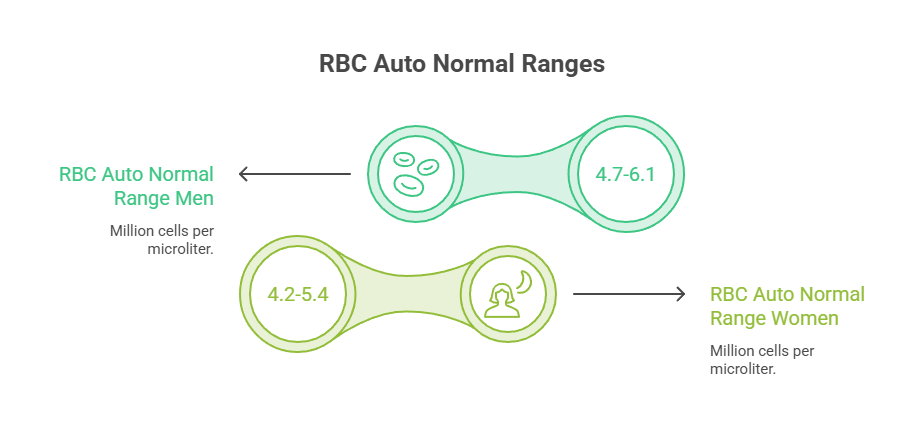
Quick Answer: “RBC Auto” means your red blood cell count was measured by an automated hematology analyzer, a machine that counts cells electronically, rather than by hand under a microscope. It is the same red blood cell count, just labeled by the method used. The “Auto” tag is routine, and a normal adult result falls between roughly 4.2 and 6.1 million cells per microliter.
At a Glance
- “Auto” describes the counting method (an automated machine), not a different or special test.
- Your RBC Auto value uses the same units and the same reference range as any RBC count.
- Normal adult ranges run about 4.7 to 6.1 million/µL for men and 4.2 to 5.4 million/µL for women.
- Automated counting is faster and more accurate than manual counting for routine samples.
- A lab switches to a manual count only when the analyzer flags something unusual.
- One number rarely tells the whole story; RBC is read alongside hemoglobin, hematocrit, and other indices.
People search “RBC Auto” at the exact moment they’re holding a fresh result, half convinced it’s bad news. The reassuring reality is that the label is one of the most ordinary things on the page. This guide walks through what it means, what your number is telling you, and when (if ever) it’s worth a second look.
What “RBC Auto” Actually Means on Your Report
The “RBC” part stands for red blood cells, also called erythrocytes. These cells carry oxygen from your lungs to the rest of your body and bring carbon dioxide back to be exhaled, as MedlinePlus explains.
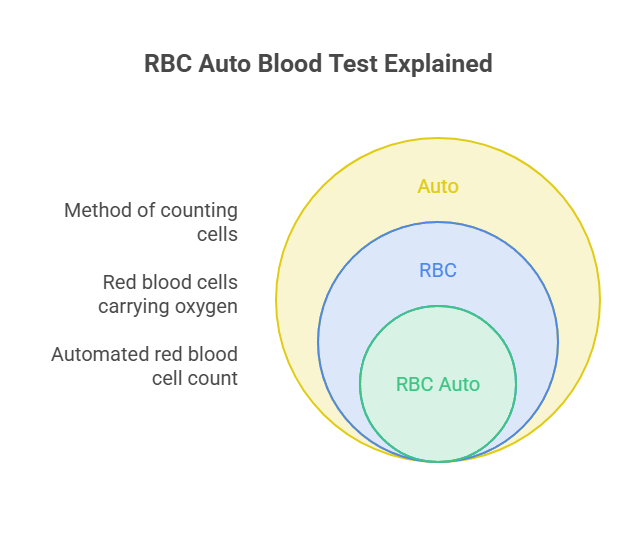
The “Auto” part simply records how those cells were counted. An automated analyzer did the work, not a technician counting by eye.
Patients booking a CBC through HealthCareOnTime often ask whether an RBC auto blood test result is less reliable or somehow incomplete. The opposite is closer to the truth, and the rest of this section explains why.
Why the word “Auto” is there
Labs label results by method for transparency and quality control. When a result reads “RBC Auto,” the report is telling your doctor that a validated machine produced the number.
Had a technician counted cells by hand, the report might instead read “RBC manual” or show an “estimated” count. Seeing “Auto” is the common, expected case.
Picture a photo tagged with the camera that took it. The tag tells you the source; it doesn’t change what’s in the picture.
Auto is the method, not a different test
Here’s the point our medical reviewers stress to worried readers: RBC and RBC Auto measure the exact same thing. Both report how many red blood cells sit in a set volume of your blood.
The value, the units, and the reference range don’t change based on the label. A result of 5.1 million/µL means the same whether your report says “RBC” or “RBC Auto.”
Been comparing your “Auto” number to a friend’s plain “RBC” number? You can stop second-guessing. They’re the same measurement on the same scale.
| Feature | Automated Count (RBC Auto) | Manual Count | What It Means for You |
| How cells are counted | Machine counts cells electronically | Technician counts cells by eye on a slide | Auto evaluates far more cells, so it’s more precise |
| Speed | Seconds per sample | Many minutes per sample | Faster turnaround on your results |
| Accuracy for routine blood | Very high | Lower, prone to human variation | Auto is the standard for normal samples |
| Cells analyzed per run | Tens of thousands | A few hundred | A larger count reduces random error |
| When it’s used | Almost all routine CBCs | Special cases or analyzer flags | “Auto” on your report is the normal case |
| Units reported | million cells/µL | million cells/µL | Identical, so reference ranges match |
Across studies comparing the two approaches, automated and manual results track closely. One US analyzer study found that automated and manual nucleated red cell counts correlated at a Pearson r of 0.97, a very strong agreement, per the American Journal of Clinical Pathology.
How an Automated Analyzer Counts Your Red Cells
Modern hematology analyzers use one of two main technologies, and many use both together. Both are well established across US clinical labs.
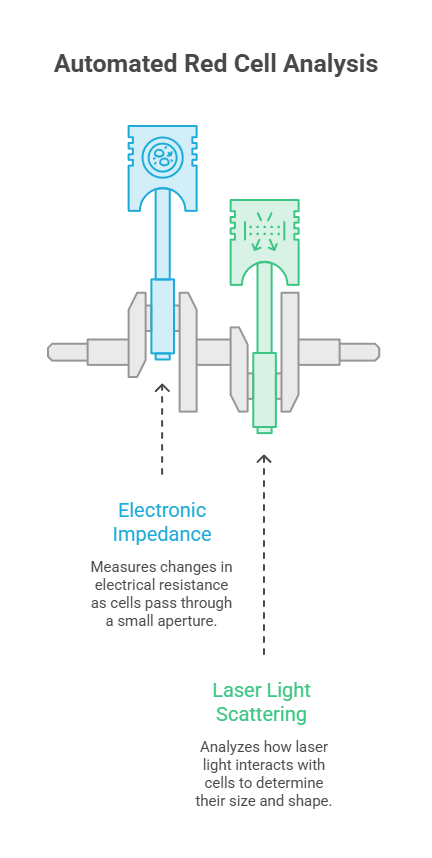
Understanding the basics helps the “Auto” label feel less like a black box. The machine isn’t guessing; it’s measuring physical signals from your cells thousands of times per second.
Electronic impedance (the Coulter principle)
In impedance counting, your diluted blood passes through a tiny opening with an electric current running across it. Each cell that passes briefly disrupts that current, as eClinpath at Cornell University describes.
The analyzer counts each disruption as one cell and gauges the cell’s size by how much the current changes. It’s a decades-old, trusted method still used worldwide.
A bigger dip in current signals a bigger cell. That’s how a single run can count your cells and estimate their average size at the same time.
Laser light scattering (flow cytometry)
The optical method sends cells single file through a laser beam. Each cell scatters light in a pattern that reveals its size and internal contents, again per eClinpath.
Many high-volume US labs favor this approach because it captures extra detail about cell shape and type. Some analyzers run both impedance and optical counting, then compare the two for consistency.
When those two internal methods disagree, the analyzer often flags the sample for human review. That built-in cross-check is part of why automated results are dependable.
Why machines beat manual counting for speed and accuracy
A manual count examines only a few hundred cells at most. An automated analyzer evaluates tens of thousands in seconds, which sharply cuts random error, as eClinpath notes.
The complete blood count is one of the most frequently ordered lab tests in US medicine, and that volume would be impossible to handle by hand, according to NCBI StatPearls. Automation is what makes same-day results realistic.
In cases reviewed across our diagnostic network, the automated result is the workhorse number on the vast majority of reports. Manual counting stays the rare exception, reserved for samples that need a closer look.
Automation also brings consistency. Because the same calibrated method runs every sample, your result can be compared more reliably from one visit to the next, which helps your doctor spot real trends instead of chasing noise.
RBC Auto Normal Range (and How to Read Yours)
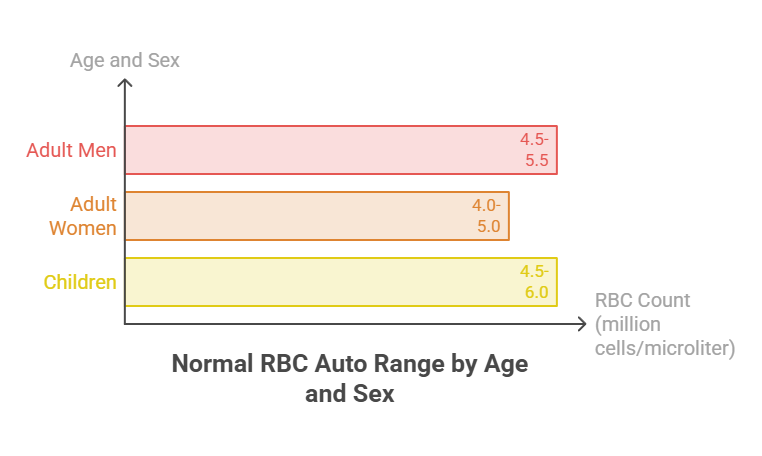
A normal RBC Auto result depends on your age and sex. Red blood cell counts naturally differ between men, women, and children, which is why one fixed cutoff doesn’t fit everyone.
Compare your number to the reference range printed on your own report. That range, set by your specific lab, is the one that matters for you.
Adult men, women, and children
For adult men, a typical normal range runs about 4.7 to 6.1 million cells per microliter. For adult women, it’s roughly 4.2 to 5.4 million/µL, per MedlinePlus and WebMD.
Children often sit a little lower, around 4.0 to 5.5 million/µL. Treat these as general guidelines, not strict pass-fail lines.
The sex difference is normal physiology, partly tied to testosterone’s effect on red cell production and to differences in blood volume. A woman’s lower number isn’t a problem; it’s expected.
Why your lab’s reference range may differ
Reference ranges vary slightly from lab to lab because of the equipment used and the local population the range was built from, as Cleveland Clinic points out. A value flagged “high” at one lab might read “normal” at another.
Units can also change how the number looks. Most US labs report in millions per microliter (×10⁶/µL), though you may see it written as million/mm³, which is the same thing.
Altitude plays a part too. People living at high elevation often run higher counts because thinner air pushes the body to make more oxygen-carrying cells. That’s adaptation, not illness.
| Group | Typical RBC Normal Range | Source |
| Adult men | 4.7 to 6.1 million/µL | MedlinePlus (NIH) |
| Adult men (alternate reference) | 4.6 to 6.2 million/µL | NCBI StatPearls |
| Adult women | 4.2 to 5.4 million/µL | MedlinePlus / WebMD |
| Children | 4.0 to 5.5 million/µL | WebMD |
| High count threshold (men/women) | Above ~6.1 / ~5.4 million/µL | Cleveland Clinic |
| Standard reporting unit | million cells/µL (×10⁶/µL) | Cleveland Clinic |
What a High RBC Auto Result Can Mean
A high RBC Auto value means more red blood cells than expected for your group. On its own, it isn’t a diagnosis. It’s a signal that points your doctor toward the next step, as Cleveland Clinic explains.
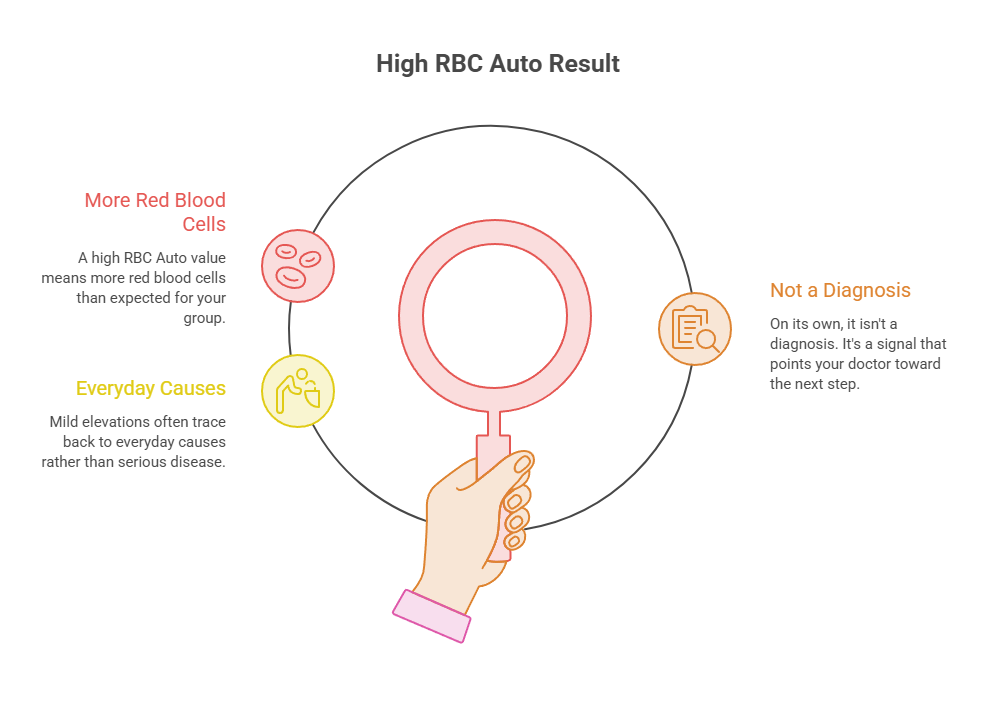
Across the reports our diagnostic partners review, mild elevations often trace back to everyday causes rather than serious disease.
Common causes
Dehydration is one of the most frequent reasons. When you’re low on fluid, your blood is more concentrated, so cells look more crowded even though their actual number hasn’t changed much, per Cleveland Clinic.
Other causes include smoking, living at high altitude, lung disease, and heart disease. A bone marrow condition called polycythemia vera can also raise the count, and certain kidney problems play a role.
Some athletes and people with sleep apnea run higher counts as well. The body simply makes more cells when it senses it needs more oxygen delivery.
Doctors also separate a relative rise from a true one. A relative increase comes from low fluid volume making cells look concentrated, while a true increase means your body is actually producing more red cells, a distinction Cleveland Clinic notes when sorting out the cause.
Symptoms that sometimes come with it
Many people with a high count feel nothing at all. When symptoms do appear, they can include headaches, dizziness, fatigue, blurred vision, or flushed skin, as Cleveland Clinic describes.
When a result comes back high, our medical reviewers suggest confirming your hydration first, then following your doctor’s guidance on whether to repeat the test. One borderline reading rarely means much by itself.
What a Low RBC Auto Result Can Mean
A low RBC Auto value means fewer red blood cells than expected. This often points toward anemia, though the underlying cause still needs investigation, per MedlinePlus.
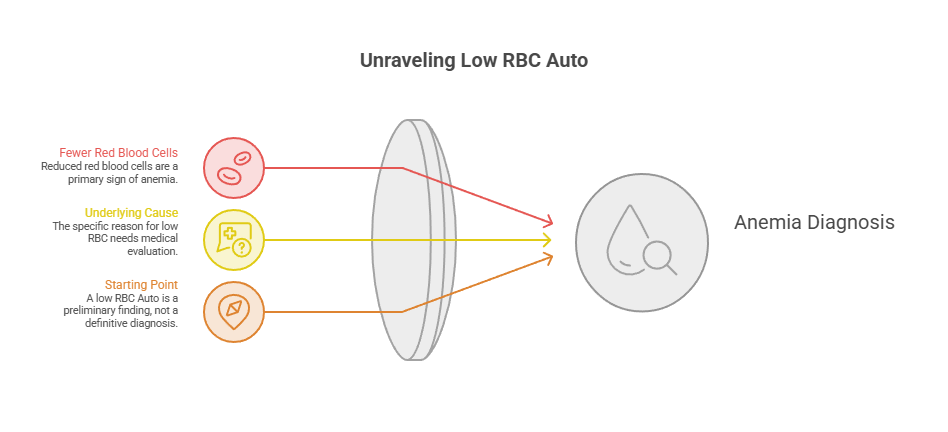
A single low reading doesn’t confirm anything by itself. It’s the starting point for a closer look, not the final word.
Common causes
Iron, vitamin B12, or folate deficiency can slow red cell production. Blood loss, whether from heavy periods, a stomach ulcer, or an injury, is another common driver, as MedlinePlus and the University of Rochester Medical Center note.
Chronic kidney disease, bone marrow disorders, and some cancers can also lower the count. Pregnancy can dilute the blood, which nudges the value down without signaling a problem.
Certain medications and chronic inflammatory conditions, such as rheumatoid arthritis, contribute in some cases. This is why context, not just the number, drives the diagnosis.
Age and sex shape the baseline too. Older adults sometimes run slightly lower counts, and menstruating women lose iron steadily over time, which is part of why anemia turns up more often among them.
Why RBC is read alongside hemoglobin and hematocrit
The RBC count alone doesn’t measure how well your blood carries oxygen. That’s why doctors read it together with hemoglobin and hematocrit, as NCBI StatPearls explains.
Red cell indices like MCV (average cell size) and RDW (variation in size) help pin down the type of anemia. The full picture comes from the whole panel, not one isolated line.
Patients commonly ask us why the doctor didn’t react to a single low number. The answer is that one value is a clue; the pattern across the panel is the story.
How RBC Auto Fits With Your Other Red Cell Numbers
Your RBC Auto count never travels alone. On the same CBC, it sits beside a small family of red cell indices that turn a raw number into a fuller story, as NCBI StatPearls describes.
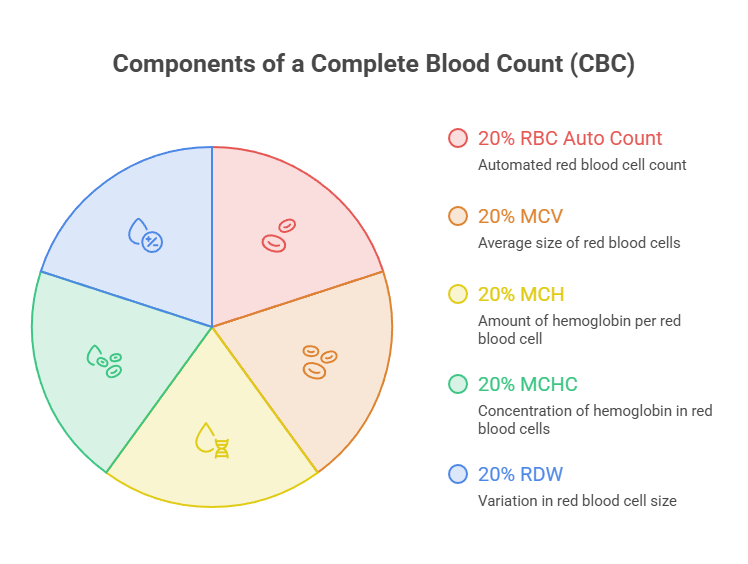
Reading them together is how a doctor tells one type of anemia from another, or spots when a normal-looking count still hides a problem worth checking.
MCV, the average size of your red cells
Mean corpuscular volume (MCV) measures how large your red blood cells are on average. A low MCV points toward small cells, often from iron deficiency, while a high MCV suggests larger cells, sometimes from vitamin B12 or folate shortfalls, as Cleveland Clinic explains.
That’s why two people with the same low RBC Auto count can have very different causes behind it. The MCV is one of the first numbers a doctor uses to tell them apart.
MCH and MCHC, how much hemoglobin your cells carry
Mean corpuscular hemoglobin (MCH) and its concentration counterpart (MCHC) describe how much oxygen-carrying hemoglobin is packed into your red cells. Low values can signal pale, underfilled cells, a pattern common in iron-deficiency anemia.
Paired with your RBC Auto result, these indices hint at whether your cells are not just fewer in number, but also less effective at their core job of moving oxygen.
RDW, how uniform your cells are
Red cell distribution width (RDW) gauges how much your red cells vary in size. A high RDW means a mix of larger and smaller cells, which often shows up early in developing anemia, sometimes before the RBC count itself drops far, per Cleveland Clinic.
In samples our lab partners review, a rising RDW can act as an early clue worth raising with your doctor, even when the headline RBC Auto number still looks acceptable.
Hematocrit, the share of blood made of red cells
Hematocrit reports the percentage of your blood volume taken up by red cells. It tends to move in step with your RBC count and hemoglobin, so the three are usually read as a trio.
When all three drift in the same direction, the picture is clearer. When they disagree, that mismatch can itself be the clue your doctor chooses to follow.
Together, RBC Auto, hemoglobin, hematocrit, and the indices make up the red cell side of your CBC. No single value defines your health; the pattern across all of them is what guides care.
When Your Lab Switches to a Manual Count
Most of the time, the analyzer’s automated result stands as reported. But labs follow strict rules for when a human needs to step in and verify, as the Annals of Laboratory Medicine details.
A manual or estimated count on your report isn’t a bad sign. It usually means the lab took an extra, careful step on your behalf.
Analyzer flags and “review” triggers
Analyzers raise flags when a sample looks unusual, for instance when the histograms or scattergrams don’t match expected patterns. A flag prompts a technician to review a stained blood smear by hand, per the Annals of Laboratory Medicine.
In samples our lab partners process, these flags act as a routine quality safeguard, not a cause for alarm. The system is built to catch the few cases where a machine alone isn’t enough.
Interference that can fool machines
Certain conditions trip up automated counters. Cold agglutinins can make red cells clump together, which an analyzer may misread as fewer, larger cells, lowering the RBC count, as eClinpath explains.
Giant platelets, very small red cells, and fragmented cells called schistocytes can also distort results. Extremely small cells, with an MCV below about 60 fL, may even be miscounted as platelets, per the Annals of Laboratory Medicine.
Each of these is uncommon, and each is exactly the kind of thing a smear review catches. The automated count and the human eye work as a team.
What it means if your report shows a manual or estimated count
A manual or estimated count means a trained technician verified the number directly. It’s the backup the system is designed to use when needed, as eClinpath notes.
Should your report show this, your doctor already has a more carefully checked result in hand. There’s nothing extra for you to do because of it.
The Other “(Auto)” Labels on Your CBC
RBC isn’t the only line that may carry an “Auto” tag. Your complete blood count measures several cell types, and each can be machine-read, per NCBI StatPearls.
Patients often ask us about these companion labels once they spot the pattern across the page.
WBC Auto, Plt Auto, and Diff Auto explained
“WBC Auto” is your automated white blood cell count, tracking the cells that fight infection. “Plt Auto” is your automated platelet count, which relates to clotting, as Cleveland Clinic describes.
“Diff Auto,” or automated differential, breaks white cells into their five types (neutrophils, lymphocytes, monocytes, eosinophils, and basophils) automatically. It’s the same idea as an RBC auto blood test result: the analyzer did the counting.
So if half your report seems to say “Auto,” that’s normal. The lab is consistently noting which results the machine produced.
What Affects the Accuracy of Your RBC Auto Result
Automated counting is precise, but a few everyday factors can still nudge your number. Knowing them helps you read your result in context rather than in a panic.
None of these mean the test is wrong. They simply remind you that a snapshot reflects the moment the blood was drawn.
Hydration, recent exercise, sample handling, and timing
Dehydration concentrates your blood and can raise the count, while overhydration can lower it. Intense exercise right before the draw may temporarily bump it up, a point echoed across clinical references.
How the sample is stored and how quickly it reaches the analyzer also matter. This is why our team encourages normal hydration and following any prep instructions before your CBC.
Posture and how long the tourniquet stays on during the draw can nudge values slightly as well. These effects are small, but they are part of why a single number is best confirmed before any big decisions follow from it.
Surprised by a result? Timing and hydration are worth mentioning to your doctor. A simple repeat draw under steadier conditions often clears things up.
What to Do After You See Your RBC Auto Number
A lab value is information, not a verdict. The right move depends on whether your number sits inside or outside your report’s reference range, and on how you actually feel, as MedlinePlus advises.
The table below turns common situations into clear next steps you can act on.
| Your Situation | What It Might Mean | Recommended Action |
| RBC Auto within reference range | A typical, healthy result | No action beyond routine checkups |
| Slightly high, recently dehydrated | Likely a concentration effect | Rehydrate, then ask about a repeat test |
| Slightly low, feeling tired | Possible early anemia | Discuss iron, B12, and folate testing with your doctor |
| Result shown with a manual count | The lab double-checked it | Trust the verified number, follow up as advised |
| Markedly high or low | Needs further investigation | See your doctor promptly for additional testing |
| Confused by the “Auto” label | It’s just the counting method | No worry; it’s a standard automated result |
The thread running through every row is the same. Read your number against your own report’s range, factor in how you feel, and let your doctor interpret the full panel.
One result is a snapshot; a series of results is a trend. If you have past CBCs, comparing your RBC Auto values over time often tells your doctor more than any single reading, especially when a number sits just outside the range.
Frequently Asked Questions
Does “RBC Auto” mean a machine read my blood?
Yes. “Auto” stands for automated, meaning a hematology analyzer counted your red blood cells electronically instead of a technician counting them by hand. It’s the standard method in nearly every US lab today, and it’s both faster and more precise than manual counting for routine samples.
Is RBC Auto a different test from a regular RBC count?
No. RBC and RBC Auto measure the very same thing: the number of red blood cells in a set volume of blood. The “Auto” label only describes the counting method. The units and reference ranges are identical, so you read the result exactly the same way.
What is a normal RBC Auto result?
For adult men, normal is roughly 4.7 to 6.1 million cells per microliter. For adult women, it’s about 4.2 to 5.4 million/µL. Children often run slightly lower. Always compare your value to the reference range printed on your own lab report.
My RBC Auto is slightly high. Should I worry?
Often not. Mild elevations frequently come from dehydration, smoking, or living at altitude. A single high reading isn’t a diagnosis. Confirm you were well hydrated, then ask your doctor whether a repeat test makes sense before drawing any conclusions.
What does a low RBC Auto result mean?
A low value can point toward anemia from iron, B12, or folate deficiency, blood loss, kidney disease, or other causes. It’s a starting signal, not a final answer. Your doctor reads it together with hemoglobin, hematocrit, and other red cell indices.
Why does my report sometimes show a manual count instead?
When an analyzer flags an unusual sample, a technician reviews a blood smear by hand to verify the number. Triggers include clumping cells, giant platelets, or very small cells. A manual count means the lab took an extra step to confirm accuracy for you.
Are automated counts accurate?
Yes, very. Automated analyzers count tens of thousands of cells per sample, far more than any manual count, which lowers random error. Studies show automated and manual results track closely, with strong correlation reported between the two methods in US clinical research.
What units is RBC Auto reported in?
Most US labs report it in millions of cells per microliter, written as million/µL or ×10⁶/µL. You may also see million/mm³, which means the same thing. The unit affects how large the number looks, so always check your report’s listed range.
Can dehydration change my RBC Auto result?
Yes. When you’re dehydrated, your blood is more concentrated, so red cells appear more crowded and the count reads higher. Rehydrating can bring a borderline-high value back toward normal. This is one reason doctors may repeat a test before acting on a single result.
What’s the difference between RBC Auto and hemoglobin?
RBC Auto counts how many red blood cells you have. Hemoglobin measures the oxygen-carrying protein inside them. Doctors read both together because the count alone doesn’t show how well your blood delivers oxygen. Side by side, they give a fuller picture of red cell health.
Do I need to fast before an RBC test?
Usually not for the RBC count itself. Fasting may be required only if your CBC is bundled with other tests, like glucose or a lipid panel, that need it. Follow whatever preparation instructions your provider or lab gives you.
Should the “Auto” label affect how I read my result?
No. Treat an RBC Auto value exactly like any RBC count. Focus on whether it falls inside your report’s reference range and on any symptoms you have. The “Auto” tag is simply the lab noting that a machine did the counting.
Does a normal RBC Auto rule out anemia?
Not completely. Anemia is defined mainly by hemoglobin and hematocrit, so it is possible to have a borderline-normal RBC count alongside low hemoglobin. This is why doctors read the whole panel, including your indices, rather than judging anemia from the count alone.
Medical Disclaimer: This article is for general educational purposes and reflects information reviewed by the HealthCareOnTime team. It is not medical advice and does not replace care from a licensed healthcare provider. Always discuss your lab results, including any RBC Auto value, with your doctor, who can interpret them in the context of your full health history.
References
- MedlinePlus (NIH), Red Blood Cell (RBC) Count
- NCBI StatPearls (NIH), Normal and Abnormal Complete Blood Count With Differential
- Cleveland Clinic, Complete Blood Count (CBC)
- Cleveland Clinic, High Red Blood Cell Count
- WebMD, Red Blood Cell (RBC) Count Test
- eClinpath, Cornell University, RBC Count
- American Journal of Clinical Pathology, Automated Nucleated RBC Measurement
- Annals of Laboratory Medicine, Unreliable Automated CBC Results