
Most people read only one thing on a blood report: the little letter in the flag column that says H or L. The number sitting right next to it, the one that actually defines your result, gets a half-second glance at best.
That number is your red blood cell count, and what counts as “normal” shifts with your sex, your age, the altitude you live at, and even the machine your lab runs. Knowing your range turns a scary-looking flag into something you can read with confidence.
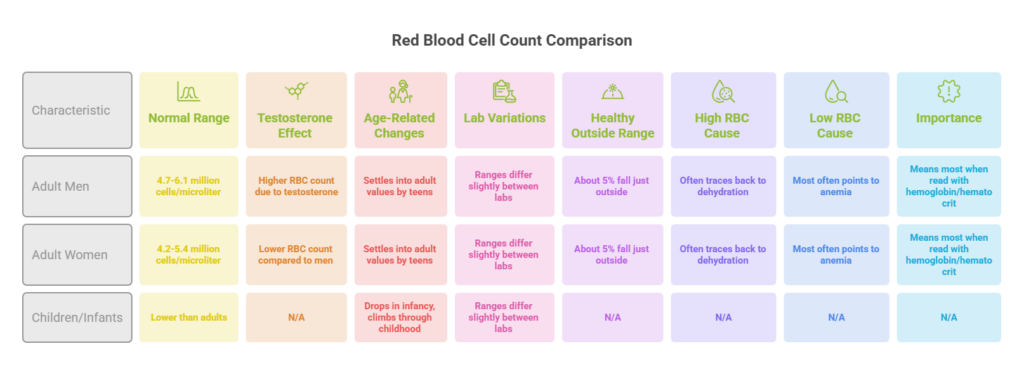
Quick Answer: A normal RBC count for adult men is roughly 4.7 to 6.1 million cells per microliter, and for adult women it’s about 4.2 to 5.4 million cells per microliter. Children and infants run lower. Ranges differ slightly between labs, so always read the reference range printed on your own report first. A result outside the range needs context, not panic.
At a Glance
- Men typically carry more red blood cells than women because of testosterone’s effect on production.
- The RBC normal range drops in infancy, climbs through childhood, and settles into adult values by the teen years.
- Labs publish slightly different ranges (4.5, 4.6, or 4.7 as the male low end), and each is correct for its own equipment.
- About 5% of perfectly healthy adults fall just outside the “normal” range.
- A high RBC count often traces back to dehydration; a low one most often points to anemia.
- Your RBC count means the most when read alongside hemoglobin and hematocrit.
What Is an RBC Count (and Why Your Report Shows It)
Red blood cells, also called erythrocytes, are the cells that carry oxygen from your lungs to every tissue in your body. They pick up carbon dioxide on the return trip so you can breathe it out.
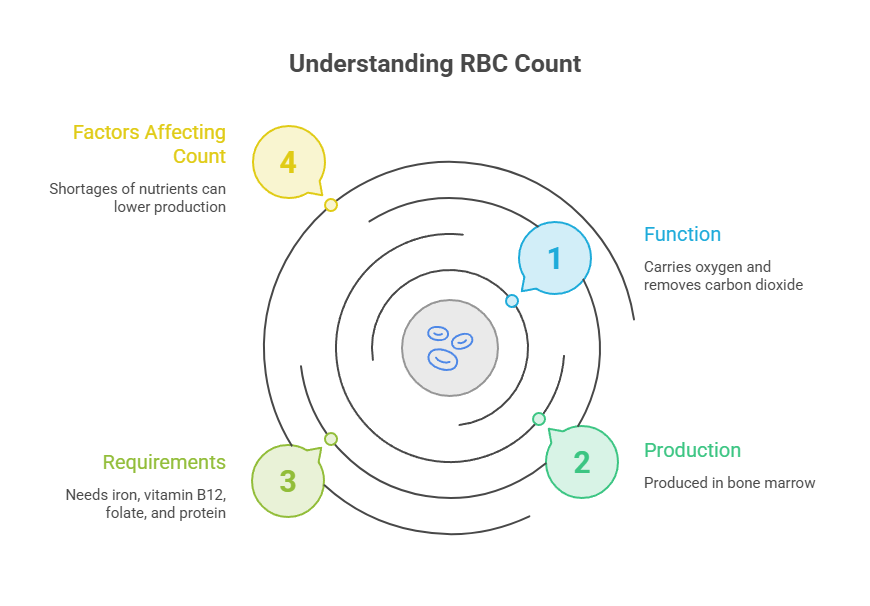
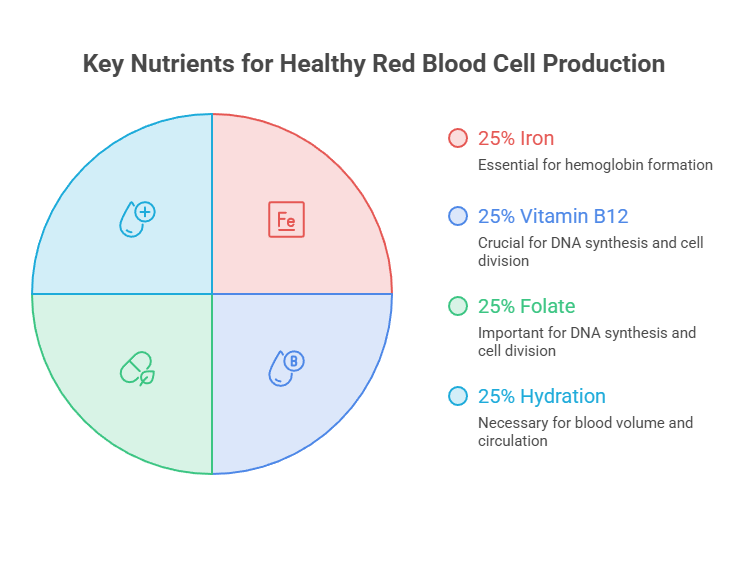
Your bone marrow produces new ones around the clock, a process that needs iron, vitamin B12, folate, and protein to keep running. When any of those run short, production slips and your count can fall over time.
Red Blood Cells in One Line
Picture each red blood cell as a tiny delivery truck for oxygen. The RBC count is simply how many of those trucks are on the road in a set volume of your blood, usually one microliter.
According to the Cleveland Clinic, red blood cells deliver oxygen to your tissues and carry carbon dioxide back to your lungs. Tissues turn that oxygen into energy, and the leftover carbon dioxide gets exhaled. Without enough cells, the whole delivery system slows.
How the Number Is Measured
The count is reported in millions of cells per microliter of blood, written as cells x10 to the sixth per microliter. One drop of blood holds roughly 40 to 50 microliters, so even a small sample contains a staggering number of cells.
Modern labs count and size your cells electronically using analyzers like the Coulter counter or Sysmex systems. These machines pass each cell through a narrow opening and register it individually, which is why results come back fast and stay consistent within a single lab.
Where RBC Sits in Your CBC
The RBC count rarely travels alone. It appears as one line inside a complete blood count, or CBC, next to hemoglobin, hematocrit, white blood cells, and platelets.
Patients booking a CBC through HealthCareOnTime often ask why the report lists so many red-cell numbers. The short version: RBC, hemoglobin, and hematocrit each measure your oxygen-carrying capacity from a different angle, and reading them together tells the real story rather than a fragment of it.
How the RBC Test Is Done and How to Prepare
An RBC count doesn’t ask much of you. It comes from the same simple blood draw used for a standard complete blood count, the test your provider orders at almost every routine checkup.
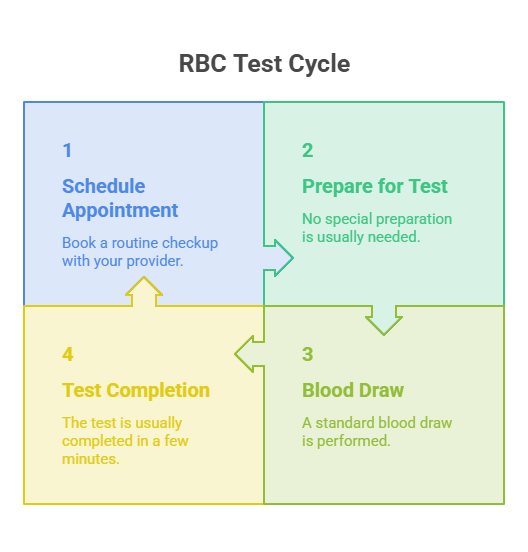
Knowing what to expect takes the edge off, especially if needles make you uneasy. The whole process usually wraps up in just a few minutes.
The Blood Draw
A phlebotomist cleans a spot on your arm, ties a band above it to make the vein easier to find, and draws a small sample into a tube. You may feel a quick pinch as the needle goes in and out.
The sample then heads to a lab, where an automated analyzer counts your red cells along with the rest of your blood components. Results are often ready within a day, sometimes the same day.
Do You Need to Fast?
For an RBC count or a standard CBC, fasting is not required. You can eat and drink normally beforehand, though staying well hydrated is wise, since dehydration can nudge the reading higher.
If your provider bundled the CBC with other tests, like a lipid or glucose panel, those may call for fasting. Patients booking panels through HealthCareOnTime are told in advance when fasting applies, so always check your specific order.
Risks and What to Expect
A blood draw is low risk. The most you’re likely to notice is brief soreness, a small bruise, or light-headedness in people prone to it.
Serious complications are rare. If bruising or tenderness lingers more than a couple of days, a quick call to your provider settles any concern.
RBC Normal Range Chart by Age and Sex
Here’s the reference most people actually came for. The table below lays out healthy red blood cell levels across the lifespan, drawn from ranges published by major US sources including Healthline, WebMD, and Mayo Clinic Labs.
| Group | Normal RBC Range (million cells/µL) | Typical Pattern | Notes |
| Adult men | 4.7 to 6.1 | Highest among adults | Testosterone drives higher production |
| Adult women (not pregnant) | 4.2 to 5.4 | Lower than men | Menstrual loss and hormones contribute |
| Pregnant women | 3.8 to 5.0 | Lower mid-pregnancy | Plasma volume dilutes the count |
| Teens 12 to 18 | 4.1 to 5.5 | Approaching adult values | Ranges separate by sex in late teens |
| Children 1 to 11 | 4.0 to 5.5 | Stable childhood range | Gradually shifts toward adult pattern |
| Infants 2 to 12 months | 3.5 to 5.2 | Lower after the newborn dip | Climbs steadily through the first year |
| Newborns (0 to 4 weeks) | 4.1 to 6.1 | Highest at birth, then falls | Drops over the first weeks of life |
These figures are representative midpoints, and pediatric values in particular tighten with each age band. Your own lab’s printed range is always the one that counts, and the next section explains why those ranges vary from site to site.
Why Men Run Higher Than Women
The sex difference is real and consistent. Mayo Clinic Proceedings notes that red blood cell measurements run lower in women than in men.
Testosterone stimulates erythropoiesis, the body’s process for making red blood cells, so men maintain a higher baseline. Women also lose blood during menstruation, which nudges the typical range downward month after month.
How the Range Shifts Across the Lifespan
Newborns arrive with the highest counts of all, then drop over the first couple of months as fetal red cells are replaced by adult ones. Counts climb again steadily through infancy and childhood.
By the late teen years, values settle into the adult pattern, and the male and female ranges separate. In older age, counts can drift lower, which is one reason anemia grows more common after 60.
Why Lab Ranges Don’t Always Match (4.5 vs 4.7 vs 4.6)
A question trips up a lot of people here. One website lists the male low end at 4.5, another at 4.7, a third at 4.6. None of them is wrong.
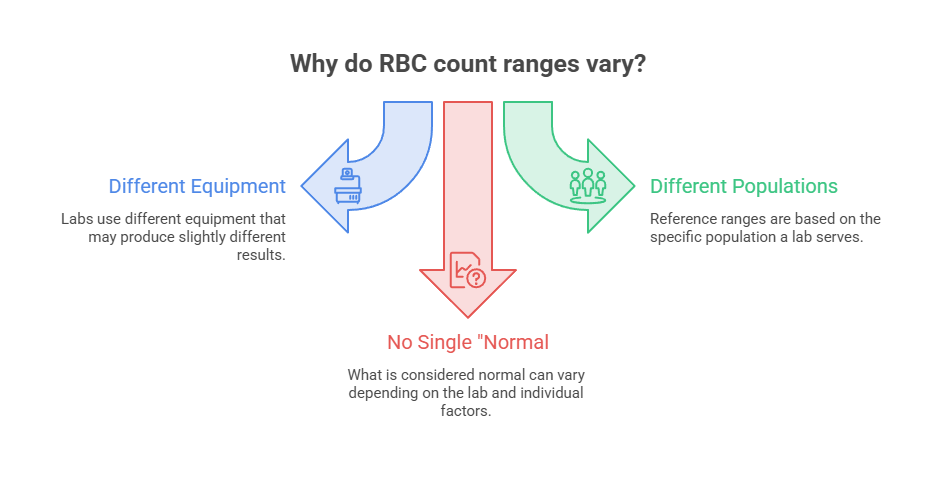
Reference ranges are tied to the specific equipment and population a lab uses to set them. The Cleveland Clinic states plainly that what counts as normal can vary depending on where you’re tested.
Different Analyzers, Different Intervals
Each analyzer model is calibrated against its own validated reference group. A hospital running one brand of machine may publish a slightly different interval than a clinic running another.
This is why our medical reviewers always tell patients to compare a result against the range on that same report, not a number pulled from a random search result. The two values may not have been measured the same way, and mixing them creates needless worry.
Altitude, Hydration, and Population Factors
Where you live matters more than most people expect. At higher altitudes, like Denver or Salt Lake City, there’s less oxygen in the air, so the body produces extra red blood cells to compensate. A healthy resident of the Mile High City may simply run higher than a healthy resident of Miami.
Hydration shifts the number too. Being low on fluids concentrates the blood and can push the count up temporarily, while differences in age, sex, and ancestry across a population also factor into how a lab draws its range.
The table below shows how the adult ranges compare across trusted US sources.
| Source | Men’s Range (million cells/µL) | Women’s Range (million cells/µL) |
| Mayo Clinic / WebMD | 4.5 to 5.9 | 4.1 to 5.1 |
| Healthline | 4.7 to 6.1 | 4.2 to 5.4 |
| StatPearls (NCBI) | 4.6 to 6.2 | 4.2 to 5.4 |
| Testing.com (general adult) | 4.0 to 6.0 | 4.0 to 6.0 |
| Cleveland Clinic | Varies by lab | Varies by lab |
A useful reality check: Mayo Clinic Proceedings reports that up to 5% of the general population without any disease will show lab values outside the statistically assigned normal range. A number sitting just past the edge is not automatically a diagnosis.
What a High RBC Count Means
A high red blood cell count, sometimes called erythrocytosis or polycythemia, means there are more red cells in your blood than expected. In cases reviewed by our medical team, the most common explanation is also the simplest: you were dehydrated on the day of the draw.
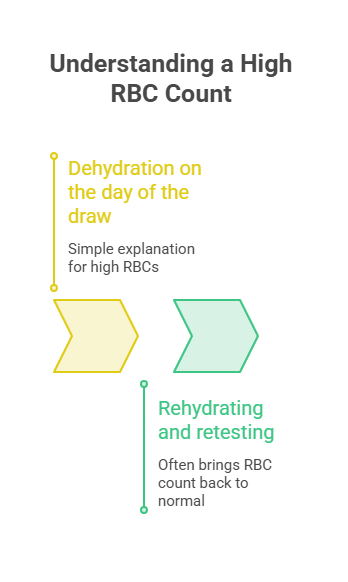
When you’re low on fluids, the liquid part of your blood shrinks, so the cells look more concentrated even though the actual number hasn’t changed. Picture a glass of juice left out overnight; as water evaporates, the same amount of concentrate looks denser. Rehydrating and retesting often brings the value right back into range.
Common Benign Causes
Several everyday factors can raise the count without signaling disease. These include dehydration, living at high altitude, smoking, and intense or prolonged physical training.
Even a long sauna session or a stomach bug with vomiting and diarrhea can shift hydration enough to nudge the number upward. Causes like these are usually temporary and fade once the trigger passes.
Medical Causes
Sometimes a high count points to something that needs treatment. The Cleveland Clinic lists heart failure, congenital heart disease, and lung conditions among the causes, because chronically low blood oxygen prompts the body to make extra red cells.
Polycythemia vera, a rare bone marrow disorder, raises the count on its own without an oxygen trigger. Certain medications, including anabolic steroids and erythropoietin (EPO), can do the same, which is why providers ask what you take.
Symptoms to Watch
A mildly high count often causes no symptoms at all. When symptoms do show up, they can include headaches, dizziness, blurred vision, fatigue, and itchy skin, sometimes worse after a warm shower.
Shortness of breath and chest pain are more serious signals, especially in someone with existing heart or lung problems. Any of these alongside a high count deserves a prompt conversation with a provider rather than a wait-and-see approach.
What a Low RBC Count Means
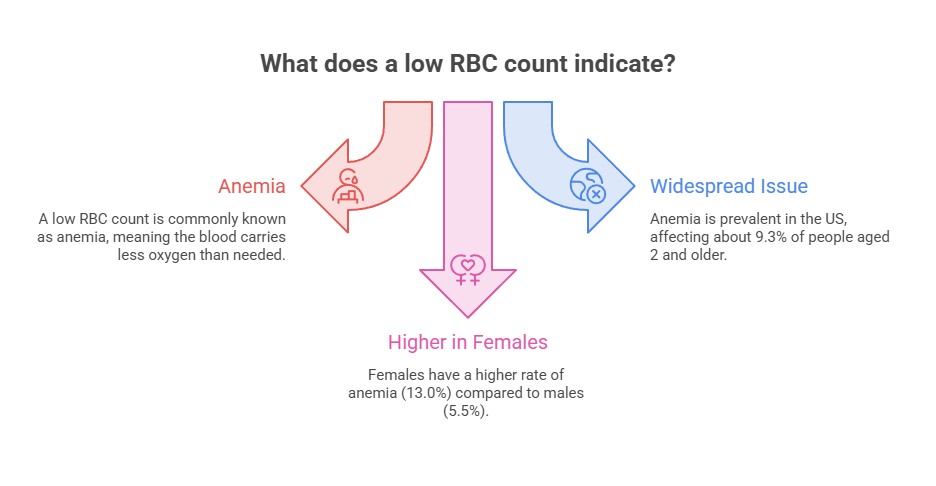
A low red blood cell count is the more common abnormal result, and it carries a familiar name: anemia. It means your blood is moving less oxygen than your body would prefer, which is why fatigue is often the first clue.
Anemia is widespread in the United States. Recent CDC data shows that about 9.3% of people age 2 and older had anemia in 2021 to 2023, with the rate notably higher in females (13.0%) than males (5.5%).
Anemia and Its Main Types
Iron-deficiency anemia is the most common form, usually caused by too little dietary iron or by chronic blood loss. Without enough iron, the marrow can’t assemble red cells fast enough to keep pace.
Vitamin B12 and folate deficiencies drive other types. MedlinePlus explains that different anemias affect the size, shape, and quality of red blood cells differently, which is exactly why doctors examine the red-cell indices alongside the raw count.
Blood Loss, Marrow, and Chronic Disease Causes
A low count comes from one of two situations: losing red cells faster than you make them, or making too few to begin with. Heavy menstrual periods, ulcers, and internal bleeding all drain the supply quietly.
Chronic conditions like kidney disease reduce the hormone signal that tells marrow to produce cells. In rarer cases, the marrow itself slows or stops, a situation that calls for specialist care rather than home remedies.
Symptoms to Watch
Low RBC symptoms build gradually and are easy to dismiss as a busy life catching up with you. Fatigue, weakness, pale skin, shortness of breath, cold hands and feet, and a racing heartbeat are the classic signs.
The CDC notes anemia climbs with age, reaching 12.5% in adults 60 and older. Across the patients we serve, persistent unexplained tiredness is the symptom that most often prompts the CBC that finally finds it.
RBC vs Hemoglobin vs Hematocrit (Reading the Whole Picture)
Three numbers on your report measure oxygen-carrying capacity, and they’re easy to mix up. Reading them together is how you actually understand a red-cell result instead of guessing.
RBC counts the cells themselves. Hemoglobin measures the oxygen-carrying protein packed inside them. Hematocrit measures the percentage of your blood made up of red cells. The quick contrast below makes the distinction clear.
| Measure | What It Counts | Typical Adult Range |
| RBC | Number of red cells per µL | Men 4.7 to 6.1; women 4.2 to 5.4 (million/µL) |
| Hemoglobin | Oxygen-carrying protein inside cells | Men 14 to 17.5; women 12.3 to 15.3 (g/dL) |
| Hematocrit | Percent of blood that is red cells | Men 41.5% to 50.4%; women 35.9% to 44.6% |
How the Three Relate
When red cell production rises or falls, all three usually move in the same direction. The hemoglobin and hematocrit figures above come from WebMD, which uses widely cited US laboratory values.
Reading all three together paints a fuller picture than any single number can. A provider rarely acts on the RBC count in isolation.
When RBC Is Normal but Hemoglobin Isn’t
This is where the indices earn their keep. You can have a normal RBC count yet low hemoglobin if your cells are smaller than usual or each carries less hemoglobin than it should.
That pattern shows up in iron-deficiency anemia, where cells are present in decent numbers but undersized and pale. Our lab partners report that this exact mismatch is why the red-cell indices (MCV, MCH, and MCHC) exist, since they catch problems the raw count alone would miss.
The Red-Cell Indices: MCV, MCH, MCHC, and RDW
Your report carries a few more red-cell numbers that describe the size and quality of your cells, not just how many there are. They are the detective work behind an anemia diagnosis.
MCV (mean corpuscular volume) measures average cell size, sorting anemias into small-cell, normal-cell, and large-cell types. MCH and MCHC describe how much hemoglobin each cell holds and how concentrated it is inside the cell.
RDW (red cell distribution width) measures how much your cell sizes vary from one to the next. A high RDW can be an early clue to a developing anemia, sometimes before the RBC count itself slips out of range.
RBC in Pregnancy
Pregnancy changes the math in a way that catches many expecting mothers off guard. The RBC count often falls during the second trimester, and that drop is usually expected rather than a warning sign.
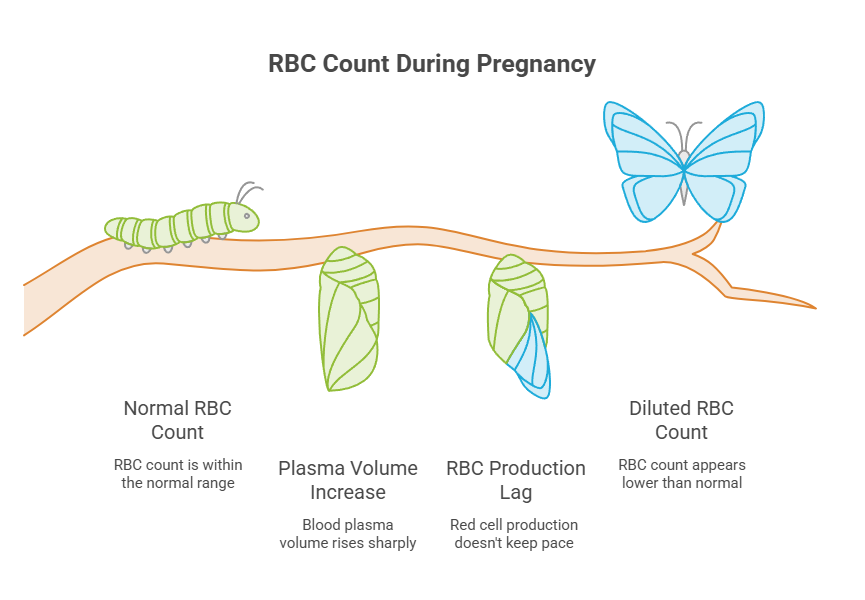
The reason is dilution. Blood plasma volume rises sharply in pregnancy, faster than red cell production ramps up, so the count reads lower even when red cell mass is perfectly adequate for the body’s needs.
Plasma-Volume Dilution and Trimester Shifts
This effect is sometimes called physiologic anemia of pregnancy. It typically appears mid-pregnancy and represents a normal adaptation to support the growing baby, not a true deficiency.
Expecting patients we work with often see a lower mid-pregnancy RBC and assume something has gone wrong. In most cases, the body is simply carrying more fluid, and the numbers recover after delivery as plasma volume normalizes.
Gestational Anemia Screening
True anemia in pregnancy still happens and still matters, which is why prenatal care includes regular blood testing throughout each trimester. Iron and folate needs climb substantially while carrying a baby.
If a count drops below the expected pregnancy range, a provider can check iron and folate status and recommend supplements. Catching gestational anemia early protects both mother and baby, and it’s far easier to correct when found promptly.
What to Do About an Abnormal RBC Result
A flagged result is a prompt for a conversation, not a diagnosis on its own. Use the table below as a quick reference for what different results may mean and the sensible next step for each.
| Your Result | What It May Mean | Recommended Next Step |
| Slightly high | Often dehydration, altitude, or smoking | Rehydrate, then retest; mention lifestyle factors to your provider |
| Markedly high | Possible polycythemia, heart, or lung issue | See your provider promptly for further testing |
| Slightly low | Mild anemia or normal variation | Discuss iron, B12, and folate; recheck as advised |
| Markedly low | Anemia needing a cause identified | Get a full workup; do not self-treat with iron alone |
| Normal but symptomatic | Possible index mismatch or another cause | Review hemoglobin, hematocrit, and indices with your provider |
Questions to Ask Your Provider
Walking in prepared turns a rushed visit into a useful one. Ask what your specific number was, how far outside the range it sits, and whether it changed from any earlier test.
It also helps to ask whether your hemoglobin and hematocrit agree with the RBC result, and whether the flag warrants a repeat test or a deeper look. Good questions often save a second appointment.
When to Retest
A single odd result is frequently just noise, especially if you were dehydrated, fighting an illness, or recently exercised hard. Many borderline values quietly normalize on a second draw.
Your provider will usually suggest a recheck after a set interval or after addressing an obvious cause. Trends across several tests reveal far more than any single reading ever could.
How to Support Healthy Red Blood Cells
For most people, healthy red cell production comes down to giving your marrow the raw materials it depends on. Iron, vitamin B12, folate, and steady hydration do most of the work.
Iron-rich foods include lean red meat, poultry, beans, lentils, spinach, and fortified breakfast cereals. Pairing plant iron with a source of vitamin C, like a squeeze of lemon or a side of bell peppers, helps your body absorb it better.
B12, Folate, and Everyday Habits
Vitamin B12 comes mainly from animal products and fortified foods, while folate is plentiful in leafy greens, citrus, and legumes. People following a strict plant-based diet sometimes need a B12 supplement, since plants don’t reliably supply it.
Staying hydrated keeps your plasma volume steady, which keeps your count readable rather than artificially high. Routine testing through a service like HealthCareOnTime makes it easy to track these values over time instead of guessing.
When Food Isn’t Enough
Diet alone can’t fix every low count, and it’s important to be honest about that. If a deficiency or an underlying condition is driving the problem, food won’t resolve it on its own.
This is where testing and medical guidance matter most. A provider can confirm the cause, recommend the right supplement or treatment, and recheck your levels to confirm they’re responding the way they should.
The Bottom Line on Your RBC Count
A red blood cell count is one of the most useful numbers on a routine blood test, and reading it well means looking past the H or L flag. Sex, age, altitude, hydration, and your lab’s own equipment all shape what normal looks like for you.
Most results that land slightly outside the range turn out to be harmless or easily explained. When a result is markedly off or comes with symptoms, that’s the signal to follow up, ideally with the full picture of hemoglobin, hematocrit, and the red-cell indices in hand.
Frequently Asked Questions
What is a normal RBC count?
A normal RBC count for adults generally falls between 4.2 and 6.1 million cells per microliter, depending on sex. Men sit higher, women lower, and children and infants have their own ranges. Always check the reference range printed on your own lab report, since values vary by equipment.
What is the normal RBC range for women?
For adult women who are not pregnant, the normal RBC range is roughly 4.2 to 5.4 million cells per microliter, though some labs list 4.1 to 5.1. Menstruation and hormones keep women’s counts slightly below men’s. Pregnancy lowers the range further because of plasma dilution.
What is the normal RBC range for men?
Adult men typically range from about 4.7 to 6.1 million cells per microliter, with some labs using 4.5 or 4.6 as the low end. Testosterone drives higher red cell production in men. A result modestly above the top is often dehydration rather than disease.
Does RBC normal range change with age?
Yes. Newborns have the highest counts, which fall over the first weeks, then rise through childhood. Teens approach adult values, and the male and female ranges separate by late adolescence. Counts can drift lower in older adults, which is partly why anemia becomes more common after 60.
Is an RBC count of 5.5 normal?
For an adult man, 5.5 million cells per microliter sits comfortably within the normal range. For an adult woman, 5.5 is at or just above the typical upper limit and may warrant a closer look. Context, hydration, and your lab’s exact range determine whether it’s a concern.
What does a high RBC count mean?
A high count means more red cells than expected. The most common cause is dehydration, which concentrates the blood. Other causes include high altitude, smoking, and lung or heart conditions, with polycythemia vera being a rarer one. Mild elevations often cause no symptoms and may resolve after rehydrating.
What is a dangerously low RBC count?
There’s no single universal cutoff, since symptoms depend on how fast the count dropped and your overall health. Generally, the further below the normal range and the more severe the symptoms (severe fatigue, breathlessness, chest pain), the more urgent it is. A markedly low count needs prompt medical evaluation.
Can dehydration raise my RBC count?
Yes. Dehydration reduces the plasma portion of your blood, so the red cells become more concentrated and the count reads higher even though the actual cell number hasn’t changed. Rehydrating before a follow-up test often returns the value to its true normal.
What’s the difference between RBC and hemoglobin?
RBC counts the number of red blood cells, while hemoglobin measures the oxygen-carrying protein inside those cells. You can have a normal cell count but low hemoglobin if the cells are small or pale, as in iron-deficiency anemia. Reading both together gives a clearer picture.
What is a normal RBC count during pregnancy?
Pregnancy lowers the count due to increased plasma volume, a normal effect sometimes called physiologic anemia of pregnancy. A rough range is around 3.8 to 5.0 million cells per microliter, often dipping mid-pregnancy. Prenatal blood tests track this to separate normal dilution from true gestational anemia.
Why is my RBC high but I feel fine?
Many people with a mildly high count have no symptoms, and the cause is often harmless, such as dehydration, altitude, or smoking. About 5% of healthy adults fall just outside the normal range. Your provider may simply recommend rehydrating and repeating the test to confirm.
How can I raise a low RBC count naturally?
Focus on iron, vitamin B12, and folate from foods like lean meats, beans, lentils, leafy greens, and fortified cereals, plus good hydration. Diet helps, but it won’t fix a count driven by an underlying condition. Testing and medical guidance are the safest way to identify and treat the real cause.
Medical Disclaimer: This article is for general informational purposes only and is not a substitute for professional medical advice, diagnosis, or treatment. Reference ranges vary by laboratory, so always interpret your results using the range printed on your own report and consult a qualified healthcare provider about any abnormal result or symptoms.
References
- Cleveland Clinic: Complete Blood Count (CBC)
- Cleveland Clinic: Function of Red Blood Cells
- Cleveland Clinic: High Red Blood Cell Count
- MedlinePlus: Red Blood Cell (RBC) Indices
- WebMD: Complete Blood Count (CBC) Test
- Mayo Clinic Laboratories: CBC with Differential
- Mayo Clinic Proceedings: Interpreting an Abnormal CBC in Adults
- StatPearls (NCBI): Normal and Abnormal Complete Blood Count With Differential
- CDC NCHS Data Brief: Anemia Prevalence, United States, 2021 to 2023
- Healthline: Red Blood Cell (RBC) Count