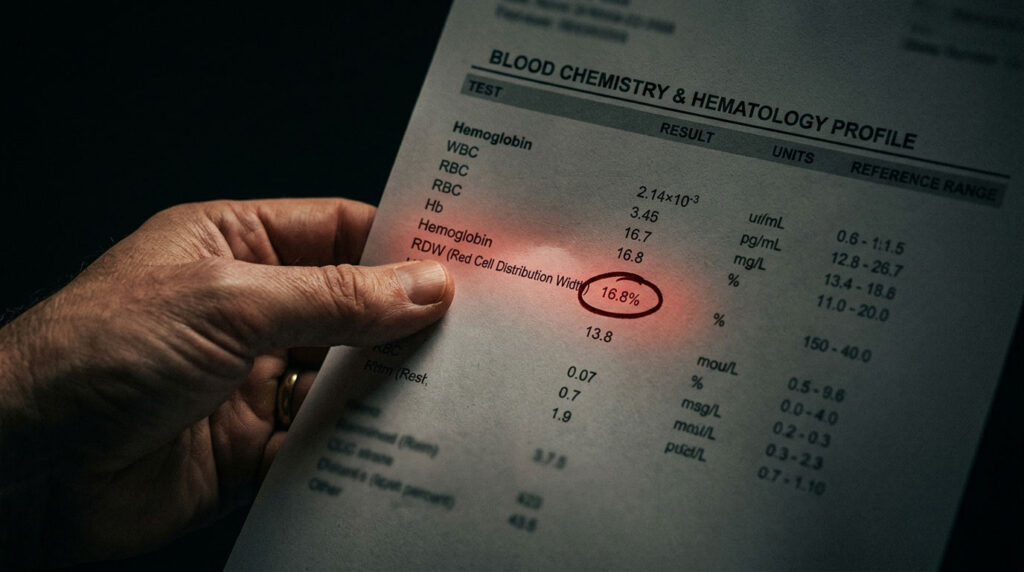
Most people skim a blood test for the values they recognize, like hemoglobin, cholesterol, and glucose, then slide right past a quiet three-letter entry: RDW. That habit can cost you. RDW often shifts weeks before you feel tired, look pale, or notice your heart working harder, which makes it one of the earliest clues your body leaves on a routine lab report.
Table of Contents
Quick Answer: RDW (red cell distribution width) is a standard part of a complete blood count that measures how much your red blood cells vary in size. A normal RDW-CV runs about 11.5% to 14.5%. A high RDW means your cells differ widely in size, often an early sign of iron, vitamin B12, or folate deficiency. A low RDW is usually harmless and rarely needs treatment.
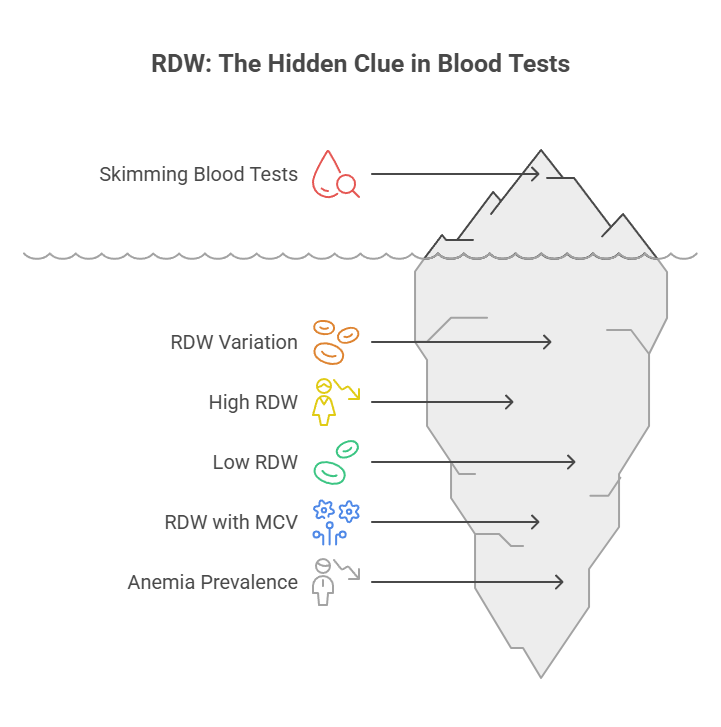
At a Glance
- RDW measures variation in red blood cell size, a feature doctors call anisocytosis.
- The normal RDW-CV range is roughly 11.5% to 14.5%; RDW-SD runs about 39 to 46 femtoliters.
- A high RDW most often points to iron, B12, or folate deficiency, sometimes before anemia appears.
- A low RDW means your cells are uniform in size and is rarely a concern.
- RDW becomes far more useful when read together with MCV (average cell size) and hemoglobin.
- About 9.3% of Americans age 2 and older have anemia, and women are affected more than twice as often as men.
What Is RDW on a Blood Test?
RDW stands for red cell distribution width. It tells your doctor how much your red blood cells differ in size from one another, reported as a single number on your complete blood count (CBC).
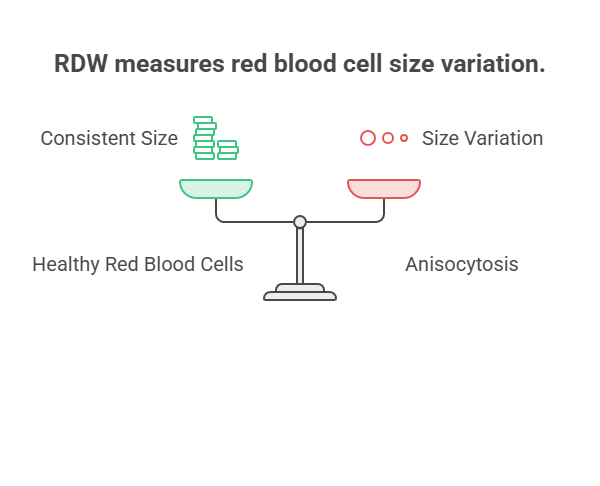
Healthy red blood cells are strikingly consistent. Most measure between 6.2 and 8.2 micrometers across, so a healthy sample is full of cells that are nearly the same size.
Size matters here for a practical reason. Red cells deliver oxygen from your lungs to the rest of your body, and a sudden mix of oversized and undersized cells can hint that production has gone off track.
When that consistency breaks down, some cells turn out larger or smaller than the rest. The medical term for this scatter is anisocytosis, and RDW is the number that captures it.
Across the complete blood count panels processed through our lab network, RDW appears on nearly every report, yet it draws less attention than hemoglobin. That is a missed opportunity, because the value can move early and quietly.
How Labs Measure RDW
Automated analyzers count thousands of red blood cells and plot their sizes on a graph called a histogram. If the cells cluster tightly together, the spread is narrow and RDW is low.
If the cells scatter across a wide range of sizes, the spread widens and RDW rises. A high number means your red cells form a mixed population, with some noticeably bigger or smaller than the others.
An elevated RDW can flag a sample that deserves a manual look under the microscope. It tells the lab that something is changing the way your bone marrow builds red cells.
RDW-CV vs RDW-SD: Two Ways Labs Report It
Your report may show RDW as a percentage or as a value in femtoliters, and the two are not interchangeable. Knowing which one you are looking at prevents needless confusion.
RDW-CV (coefficient of variation) is the percentage form. Analyzers calculate it by dividing the standard deviation of red cell volume by the MCV, then multiplying by 100. A normal RDW-CV sits around 11.5% to 14.5%.
RDW-SD (standard deviation) is the absolute form, measured in femtoliters, with a typical range near 39 to 46 fL. Because RDW-SD is not influenced by average cell size, it stays useful even when MCV is unusually high or low.
So if your result shows a percent sign, it is RDW-CV; if it shows fL, it is RDW-SD. US labs such as LabCorp and Quest most often report the percentage form on a routine CBC.
When Is an RDW Test Ordered?
You rarely ask for RDW by name. It comes bundled inside a complete blood count, which is one of the most frequently ordered lab panels in American medicine.
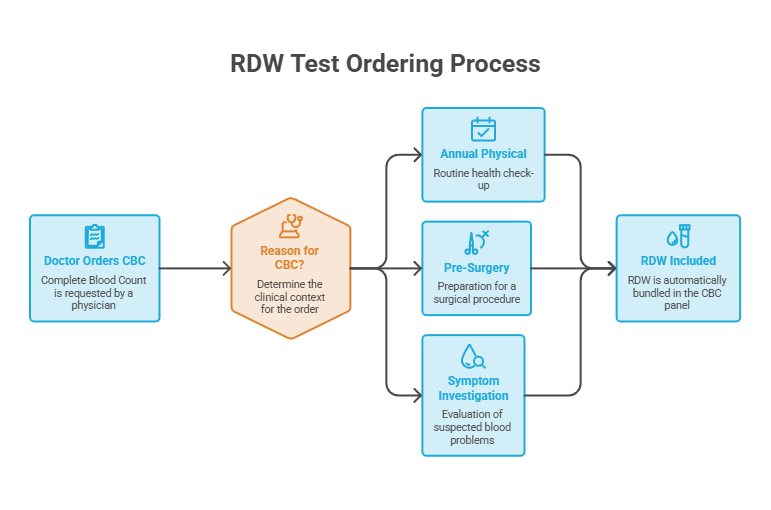
Doctors commonly order a CBC during an annual physical, before surgery, or when symptoms suggest a blood problem. RDW rides along automatically with that panel, no separate draw required.
The test becomes especially relevant when you report fatigue, weakness, pale skin, dizziness, or shortness of breath. Those are classic signs of anemia, and RDW helps sort out which type might be present.
Patients scheduling a CBC with us sometimes assume RDW is an add-on. It is not. It belongs to the standard red blood cell indices, alongside MCV, MCH, and MCHC, that every CBC reports together.
A family history of blood disorders such as thalassemia is another reason your provider may pay close attention to RDW. The value helps separate inherited conditions from nutritional ones.
What to Expect During the Test
There is no special preparation for RDW itself, since it travels with the CBC. A technician draws a small blood sample from a vein in your arm, usually in under a minute.
Risks are minimal. You might feel a quick pinch and notice slight bruising or tenderness at the needle site, which typically fades within a day or two. Results are usually ready within a day at most US labs.
What Is a Normal RDW Range?
A normal RDW-CV result generally falls between 11.5% and 14.5%, though Cleveland Clinic notes some labs use a range closer to 12% to 15%. For the standard-deviation form, a normal RDW-SD runs about 39 to 46 fL.
These cutoffs are not universal. Reference ranges shift slightly with the analyzer model, the lab’s calibration, and sometimes patient age, so always read your result against the range printed on your own report.
A normal RDW means your red cells are reasonably uniform in size. It does not, on its own, rule out every blood condition, since some anemias keep cells the same size while still lowering their number.
That nuance trips people up. You can have a perfectly normal RDW and still have a form of anemia that other red cell indices reveal, which is why doctors never read RDW alone.
The table below shows how different RDW values are usually interpreted. Treat it as a guide, not a diagnosis, because your doctor weighs RDW against the rest of your CBC.
| RDW-CV (%) | RDW-SD (fL) | What It Means | Common Associations | Typical Urgency |
| Under 11.5 | Under 39 | Low; cells unusually uniform | Usually benign; occasionally thalassemia trait | Routine |
| 11.5 to 14.5 | 39 to 46 | Normal | Balanced red cell production | None on its own |
| 14.6 to 16.5 | 47 to 52 | Mildly elevated | Early iron, B12, or folate shortfall; recovery | Recheck with iron studies |
| 16.6 to 20 | Above 52 | Elevated | Iron-deficiency, B12/folate, or mixed anemia | Doctor follow-up advised |
| Above 20 | Markedly above 52 | Markedly elevated | Combined deficiency, marrow disorder, fragmentation | Prompt evaluation |
What Does a High RDW Mean?
A high RDW means your red blood cells vary in size more than they should. Some are larger, some smaller, and that mix usually signals your marrow is responding to a problem somewhere.
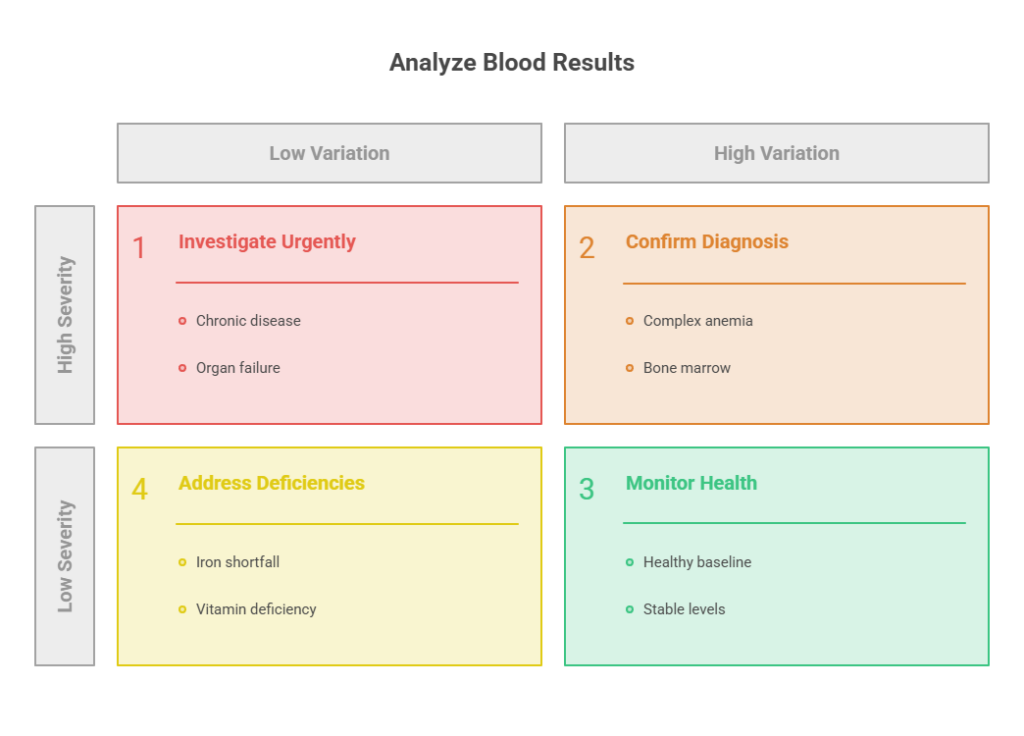
A high reading is rarely an emergency by itself, but it should not be brushed off either. It is a clue that points your doctor toward a likely cause, which is then confirmed with targeted follow-up tests.
Think of a high RDW as a prompt rather than a diagnosis. The same number can arise from a simple iron shortfall or from a more complex mix, so the next move is always to read it in context, not to jump to the worst case.
Iron Deficiency, the Most Common Cause
Iron deficiency is the leading reason for a high RDW. As iron stores run low, the marrow begins releasing smaller cells alongside the normal-sized ones, which widens the size spread.
This is one reason RDW is such a useful early marker. The size variation often appears before hemoglobin drops, sometimes giving you a head start on treatment well before full anemia sets in.
Patients booking an iron panel with us often ask why their RDW climbed while their hemoglobin still looked fine. The answer is timing: cell-size variation is an earlier signal than a fall in cell count.
Vitamin B12 or Folate Deficiency
Deficiencies of vitamin B12 or folate push the marrow to produce abnormally large red cells. When these big cells circulate beside normal ones, the size variation widens and RDW rises.
These shortfalls also raise MCV, your average cell size. That is why a high RDW paired with a high MCV often points toward a B12 or folate problem rather than iron, a distinction your doctor uses to choose the next test.
Chronic Disease, Liver, or Kidney Conditions
A high RDW can also reflect chronic inflammation, liver disease, or kidney disease. In these settings, red cell production becomes uneven for reasons that go beyond simple nutrition.
This is part of why an elevated RDW carries weight in broader health assessments. It tends to climb when the body is under sustained physiological stress, even when the immediate cause is not obvious.
After Blood Loss, Transfusion, or Recovery
Recent bleeding, a blood transfusion, or recovery from anemia can all widen RDW temporarily. After blood loss, the marrow floods the bloodstream with fresh young cells of varying sizes.
A recent transfusion mixes donor cells with your own, which also increases the size variation. In these cases, a high RDW reflects a process in motion rather than a hidden disease, and it often settles as recovery completes.
High RDW With Normal Hemoglobin: The Early Warning Pattern
Among the results our team helps people interpret, a high RDW with a normal hemoglobin is one of the most common sources of worry. It frequently means an early deficiency that has not yet become full anemia.
Iron stores can fall and red cell size can scatter while hemoglobin still reads in range. Catching this stage matters, because early iron or B12 shortfalls are far easier to correct before anemia takes hold.
A one-time mildly high RDW measured during or just after an illness usually means little on its own. Acute stress, infection, or surgery can nudge the value upward briefly, then it returns to baseline.
What Does a Low RDW Mean?
A low RDW means your red blood cells are very similar in size, even more uniform than the reference range expects. On its own, this is almost always a benign finding.
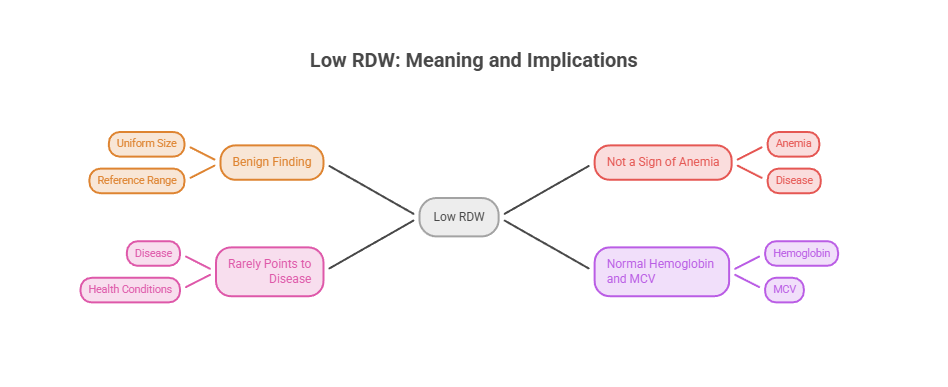
A low RDW is not a sign of anemia and rarely points to any disease. If your hemoglobin and MCV are both normal, a low RDW alone is not something you need to act on.
When Low RDW Pairs With Low MCV
The one pattern worth a closer look is a normal or low RDW combined with a low MCV and low hemoglobin. This can suggest thalassemia trait, an inherited condition in which red cells are uniformly small.
That contrast matters for diagnosis. Iron-deficiency anemia usually raises RDW, while thalassemia trait tends to keep it normal, so the RDW value helps separate the two before more specialized testing such as hemoglobin electrophoresis.
Reading RDW Alongside MCV and Other Indices
RDW rarely tells the full story by itself. Its real value shows up when your doctor reads it next to MCV, hemoglobin, and the other red blood cell indices on your CBC.
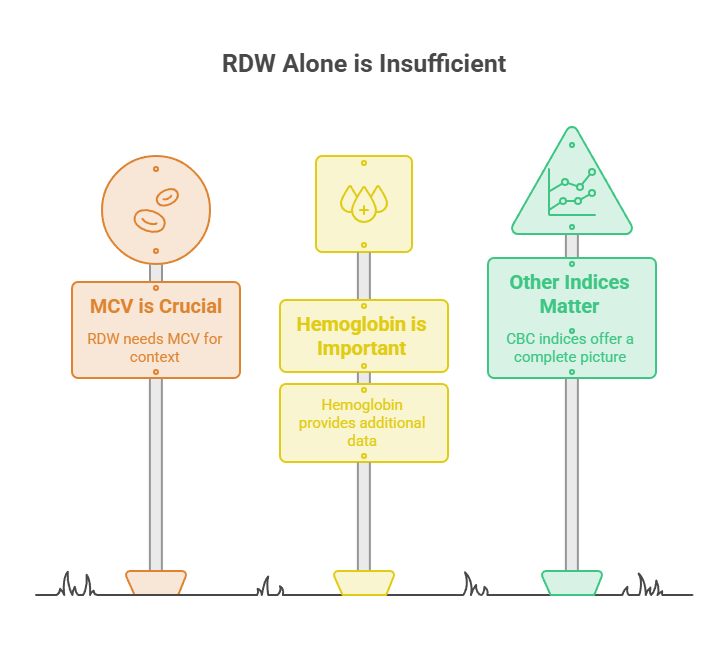
MCV measures the average size of your red cells, while RDW measures how much those sizes vary. Combine the two and you get a fast, practical map of which kind of anemia might be present.
A low MCV with a high RDW commonly points to iron deficiency. A high MCV with a high RDW leans toward B12 or folate deficiency. A low MCV with a normal RDW raises the possibility of thalassemia trait.
Our medical reviewers note that this pairing is where RDW earns its place on the panel. Read in isolation, the number is vague; read with MCV, it becomes a useful starting point for diagnosis.
Hemoglobin adds the final layer. It tells your doctor whether the size variation is happening alongside true anemia or showing up early, before your cell count has dropped at all.
The table below turns these patterns into next steps. Match your own results to the closest row, then use it to frame the conversation with your doctor.
| Your Pattern (RDW + MCV + Hemoglobin) | Likely Cause | Recommended Next Step |
| High RDW, low MCV, low hemoglobin | Iron-deficiency anemia | Ferritin and iron studies; look for a source of blood loss |
| High RDW, high MCV, low hemoglobin | Vitamin B12 or folate deficiency | B12, folate, and reticulocyte testing |
| High RDW, normal MCV, normal hemoglobin | Early deficiency before anemia | Recheck CBC plus ferritin in 4 to 8 weeks |
| Normal RDW, low MCV, low hemoglobin | Thalassemia trait | Hemoglobin electrophoresis |
| High RDW, normal MCV, low hemoglobin | Mixed deficiency or chronic disease | Iron, B12, folate, kidney, and inflammation labs |
| High RDW with abnormal white cells or platelets | Possible bone marrow disorder | Hematology referral and blood smear review |
Factors That Can Affect Your RDW Result
A few everyday situations can nudge RDW without signaling disease, and knowing them prevents unnecessary alarm. Context shapes how a single number should be read.
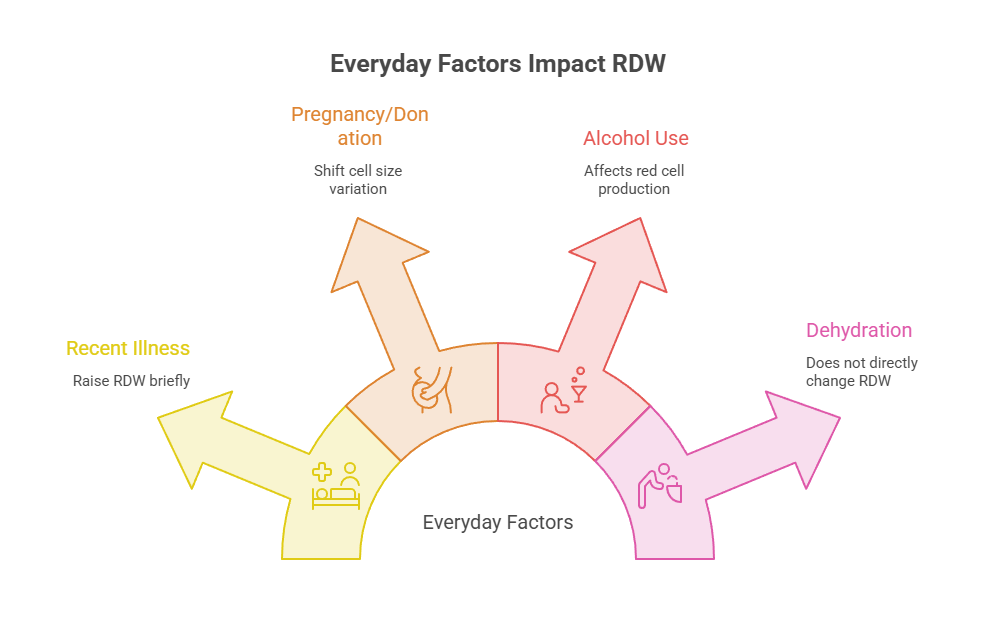
Recent illness, surgery, or infection can raise RDW briefly through acute physiological stress. A value measured right after one of these events deserves a recheck once you have recovered.
Pregnancy, recent blood donation, and a recent transfusion can all shift the relationship between cell size and variation. So can heavy alcohol use, which affects red cell production over time.
Dehydration is a common worry, but it does not directly change RDW-CV. It can make hemoglobin look slightly elevated, yet the size-variation measurement itself stays steady.
A useful rule is to trust the trend over any single reading. One borderline RDW means far less than a value that keeps climbing across repeat tests, which is why doctors often retest before drawing conclusions.
RDW in Pregnancy, Older Adults, and Children
RDW does not mean the same thing for everyone, and a few groups deserve extra context. Reading the number against a person’s life stage avoids both false alarms and missed problems.
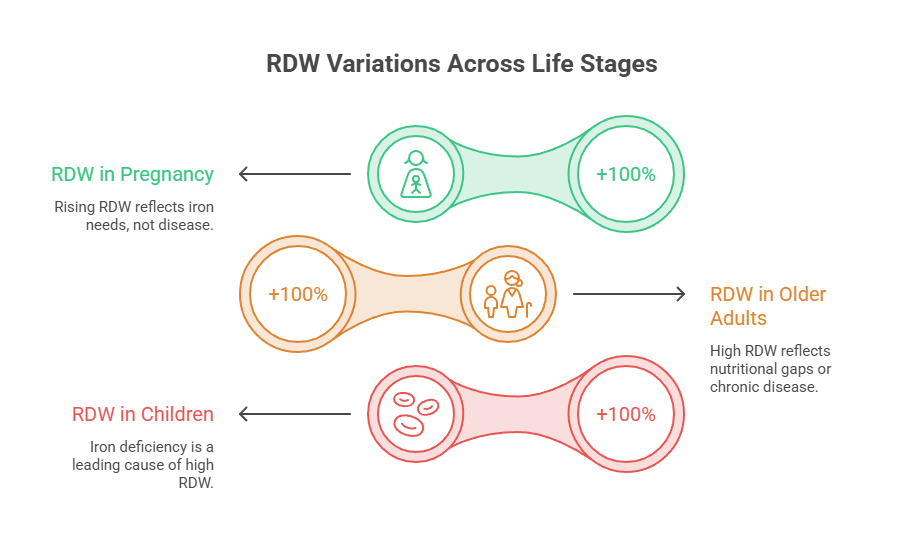
During pregnancy, blood volume expands and iron demand climbs sharply, so a rising RDW is common and often reflects iron needs rather than disease. Prenatal care routinely tracks iron status for this reason.
Older adults show anemia more often, and a high RDW in this group can reflect nutritional gaps, chronic disease, or both at once. In patients we serve, age rarely explains an abnormal value on its own, so it still warrants a look.
In children, iron deficiency is a leading cause of a high RDW, especially in toddlers and teenage girls. Pediatricians use age-specific reference ranges, so a child’s result should always be read against pediatric norms rather than adult cutoffs.
How Common Are Abnormal RDW Results in the US?
Abnormal RDW results usually trace back to anemia, and anemia is far from rare in the United States. According to the CDC’s National Center for Health Statistics, about 9.3% of people age 2 and older had anemia in the 2021 to 2023 NHANES survey.
The burden is not spread evenly. Anemia prevalence reached 13.0% in females versus 5.5% in males, and rates were especially high among adolescent girls and women of reproductive age.
Iron deficiency, the most common driver of a high RDW, is widespread among American women. Federal data tied to Healthy People 2030 objectives put iron deficiency at about 22.6% of women ages 12 to 49.
Lab partners we work with see this pattern reflected daily. Iron-related changes are among the most frequent reasons RDW drifts above range on an otherwise routine CBC.
These numbers put your own result in perspective. A high RDW tied to iron deficiency is common, treatable, and far more likely than any rare or frightening cause.
| US Group | Prevalence | Source |
| Overall (age 2+) anemia | 9.3% | CDC NCHS, NHANES 2021 to 2023 |
| Females (age 2+) anemia | 13.0% | CDC NCHS, NHANES 2021 to 2023 |
| Males (age 2+) anemia | 5.5% | CDC NCHS, NHANES 2021 to 2023 |
| Adolescent girls 12 to 19, anemia | 17.4% | CDC NCHS, NHANES 2021 to 2023 |
| Women 20 to 59, anemia | 14.0% | CDC NCHS, NHANES 2021 to 2023 |
| Adults 60 and older, anemia | 12.5% | CDC NCHS, NHANES 2021 to 2023 |
| Women 12 to 49, iron deficiency | 22.6% | CDC, Healthy People 2030 / NHANES |
RDW as an Early Warning and Prognostic Marker
For years, RDW was treated as a minor footnote on the CBC. Recent research has reshaped that view, showing the value carries information well beyond anemia.
Why RDW Rises Before Anemia Shows
The marrow adjusts red cell production quickly when nutrients run short or the body is stressed. That adjustment scatters cell sizes, so RDW often moves before hemoglobin or MCV change at all.
This early-mover quality is the practical reason RDW matters. A rising RDW on an otherwise normal CBC can be the first measurable sign that something deserves a closer look.
RDW and Heart, Kidney, and Metabolic Risk
A growing body of US and international research links a higher RDW to worse health outcomes across several conditions. In a real-world cardiovascular cohort, the highest RDW group carried more than double the risk of all-cause death, with an adjusted hazard ratio of 2.73 compared with the lowest group.
The pattern repeats in people with diabetes, where a high RDW independently predicted higher all-cause and cardiovascular mortality. Large analyses also tie elevated RDW to stroke, heart failure, atrial fibrillation, and chronic kidney disease.
The size of these associations is striking, but the interpretation calls for care. Across multiple studies, the highest RDW groups consistently showed two to nearly four times the mortality risk of the lowest, even after adjusting for other factors.
A key point keeps the science honest. Researchers suspect RDW is a marker of underlying systemic stress, not a direct cause of these problems, so a high value flags that something deserves attention without explaining what.
Our medical reviewers stress that this is exactly how to read it. An elevated RDW is a reason to look closer at the whole picture, never a standalone verdict about your future health.
What to Do If Your RDW Is High or Low
Seeing an abnormal RDW on your report can feel unsettling, but the right response is steady rather than panicked. RDW is a clue that tells your doctor to investigate, not a diagnosis you act on alone.
A low RDW with otherwise normal results usually needs nothing more than routine follow-up. A high RDW is where a structured next step genuinely pays off.
Questions to Ask Your Doctor
Bring focused questions so the visit moves quickly. Ask what your MCV and hemoglobin show alongside the RDW, and whether the overall pattern points toward iron, B12, or folate.
Ask whether your result could reflect a recent illness, blood loss, or a chronic condition you already manage. These questions help your doctor connect the number to your real situation rather than treating it in a vacuum.
Follow-Up Tests You May Need
Depending on the pattern, your doctor may order iron studies and ferritin, vitamin B12 and folate levels, a reticulocyte count, and sometimes thyroid or kidney tests. Each one helps pinpoint the cause behind the size variation.
In cases reviewed across our diagnostic network, the most useful next step is rarely a supplement and almost always a full iron panel. Treating the correct deficiency beats guessing at it and starting over later.
Red-Flag Symptoms That Need Urgent Care
A high RDW itself causes no symptoms; any symptoms come from the underlying condition. Seek prompt medical care if you have black or bloody stools, chest pain, fainting, or severe shortness of breath.
These signs can point to significant bleeding or severe anemia and deserve same-day attention rather than a routine recheck. When in doubt, err toward being seen sooner.
Why You Should Not Self-Treat With Supplements
It is tempting to start iron the moment RDW reads high, but that can backfire. Taking iron you do not need can be harmful, and it can mask the real reason your RDW rose.
Wait for lab confirmation before supplementing. If the cause turns out to be B12, folate, or a chronic condition, iron will not fix it and may delay the treatment that actually works.
Frequently Asked Questions
What is a normal RDW level?
A normal RDW-CV is about 11.5% to 14.5%, and a normal RDW-SD is roughly 39 to 46 femtoliters. Ranges vary slightly by lab and analyzer, so compare your result against the reference range printed on your own report rather than a generic figure online.
What does a high RDW mean?
A high RDW means your red blood cells vary in size more than normal, a state called anisocytosis. It most often signals iron, vitamin B12, or folate deficiency, but can also reflect chronic disease, liver or kidney issues, recent blood loss, or recovery from anemia.
Is a high RDW dangerous?
A high RDW is not dangerous by itself and is usually not an emergency. It is a marker that prompts further testing. That said, research links persistently elevated RDW to higher health risks, so it should be evaluated rather than ignored, especially when symptoms are present.
What causes a high RDW?
The most common cause is iron deficiency. Other causes include vitamin B12 or folate deficiency, mixed anemias, chronic inflammation, liver or kidney disease, recent blood loss or transfusion, and recovery after anemia. Rarely, a high RDW reflects a bone marrow disorder that needs specialist evaluation.
Can you have high RDW with normal hemoglobin?
Yes, and it is common. A high RDW with normal hemoglobin often signals an early nutritional deficiency before anemia develops, or recovery from a recent one. Your doctor will usually check iron studies, B12, and folate, then often repeat the CBC in a few weeks.
What is the difference between RDW-CV and RDW-SD?
RDW-CV is reported as a percentage and reflects size variation relative to average cell size. RDW-SD is measured in femtoliters and gives the absolute spread of cell sizes. RDW-SD is not affected by MCV, which makes it helpful when your average cell size is abnormal.
What does a low RDW mean?
A low RDW means your red blood cells are very uniform in size. It is not a sign of anemia and is rarely a concern on its own. In most cases, a low RDW with normal hemoglobin and MCV needs no specific treatment or follow-up at all.
Can dehydration affect RDW?
Dehydration does not directly change RDW-CV, which measures size variation rather than concentration. It can affect other CBC values, such as making hemoglobin look slightly elevated. A single mildly high RDW during an illness, which often involves dehydration, is usually not significant on its own.
How do you lower a high RDW?
You lower RDW by treating its cause, not the number itself. If iron, B12, or folate deficiency is confirmed, correcting it through diet or supplements under medical guidance usually helps. RDW takes time to normalize as new, healthy cells gradually replace older ones, often over several weeks.
What does high RDW with high MCV mean?
A high RDW with a high MCV suggests your red cells are both larger than normal and varied in size. This pattern commonly points to vitamin B12 or folate deficiency, and sometimes liver disease or alcohol use. Your doctor will likely test B12 and folate levels as the next step.
Does a high RDW mean cancer or leukemia?
Usually not. The large majority of high RDW results trace to common, treatable causes like nutritional deficiency. In rare cases, a high RDW with abnormal white cell or platelet counts can prompt evaluation for a bone marrow disorder, which a doctor confirms with further testing.
How long does it take for RDW to return to normal?
RDW changes slowly because red blood cells live about three to four months. Once the underlying cause is treated, RDW typically improves over several weeks to a few months as older, varied cells are replaced by uniform, healthy ones. Repeat testing tracks the trend over time.
Medical Disclaimer: This article is for general educational purposes and does not replace professional medical advice, diagnosis, or treatment. RDW results must be interpreted by a qualified healthcare provider alongside your full blood count, symptoms, and history. Always talk with your doctor before making decisions about testing, supplements, or treatment.
References
- MedlinePlus, RDW (Red Cell Distribution Width) Medical Test
- Cleveland Clinic, RDW Blood Test: What It Is, Procedure & Results
- CDC NCHS, Anemia Prevalence: United States, August 2021-August 2023
- CDC FastStats, Anemia or Iron Deficiency
- NCBI StatPearls, Normal and Abnormal Complete Blood Count With Differential
- NIH Clinical Methods, Red Cell Indices
- Medscape, Red Cell Distribution Width (RDW) Test
- Red Cell Distribution Width and Patient Outcome in Cardiovascular Disease (PMC)
- Red Cell Distribution Width and Mortality in Patients With Diabetes (PMC)