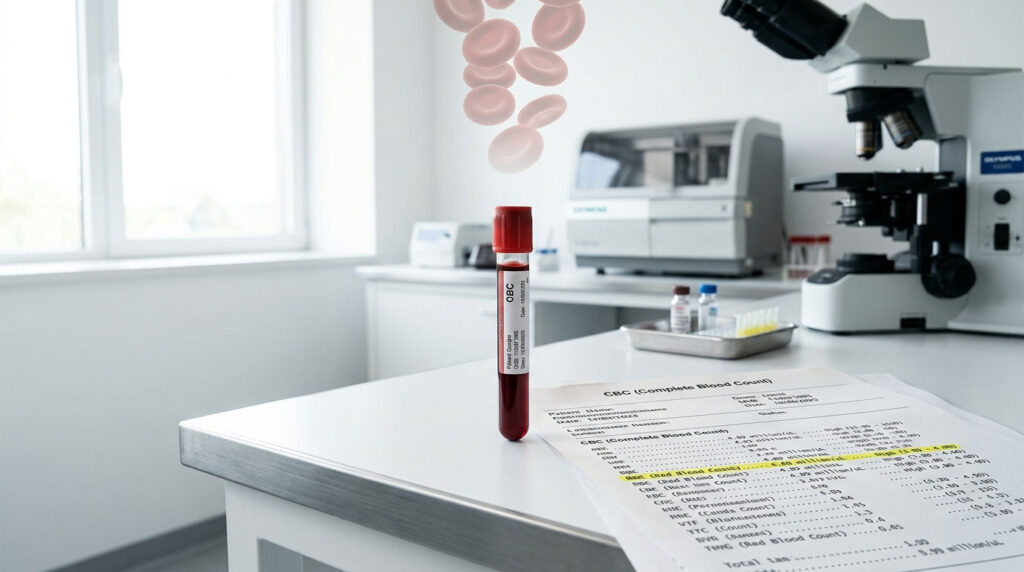
Your body builds roughly 2 million new red blood cells every second and clears out old ones at nearly the same pace. An RBC blood test freezes that round-the-clock turnover into a single number. When that number drifts too high or too low, your energy, your breathing, and your organ function often feel it long before you ever see the lab report.
Table of Contents
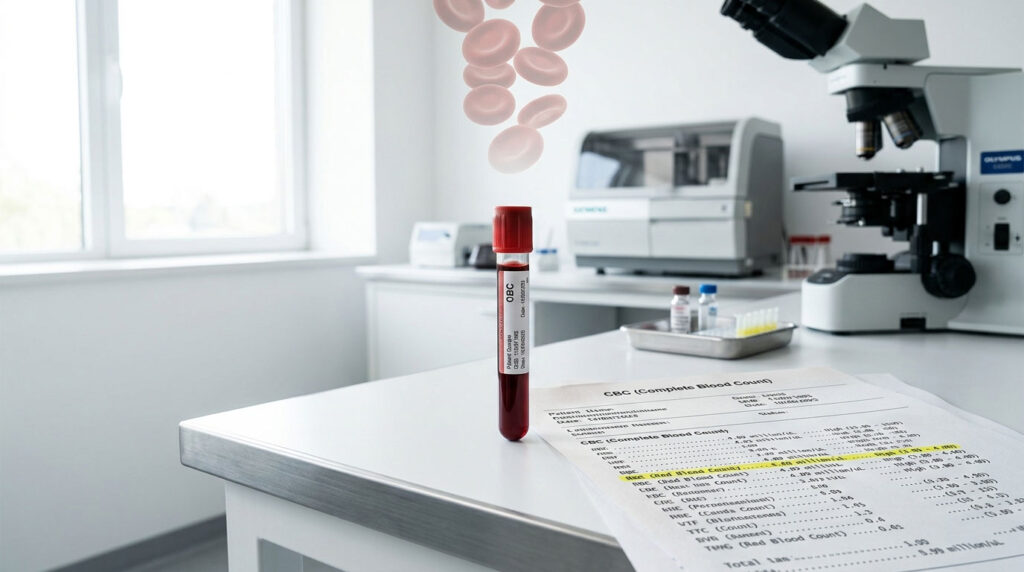
Quick Answer: An RBC blood test (red blood cell count, also called an erythrocyte count) measures how many red blood cells sit in a set volume of your blood, reported in millions of cells per microliter. It’s almost always run inside a complete blood count (CBC). A low result usually points to anemia, while a high result can signal dehydration or a condition called polycythemia.
At a Glance
- The RBC blood test counts your oxygen-carrying red cells, not how well each one works on its own.
- Typical adult ranges run about 4.7 to 6.1 million cells/uL for men and 4.2 to 5.4 million for women.
- A low count most often ties to iron deficiency anemia; a high count to dehydration, smoking, or altitude.
- Doctors read the count alongside hemoglobin, hematocrit, and red cell indices (MCV, MCH, MCHC, RDW).
- No fasting is needed, and a basic CBC often costs around $29 at major US labs.
- One out-of-range number rarely tells the whole story, so context and follow-up testing matter.
What Is an RBC Blood Test?
An RBC blood test counts the red blood cells packed into a measured amount of your blood. The result appears in millions of cells per microliter (million/uL), sometimes shown as a value times 10^6/uL on your report.
Red blood cells, or erythrocytes, are the most plentiful cell in your bloodstream. They make up roughly 40 to 45 percent of total blood volume in healthy adults, which is why their numbers carry such weight in how you feel day to day.
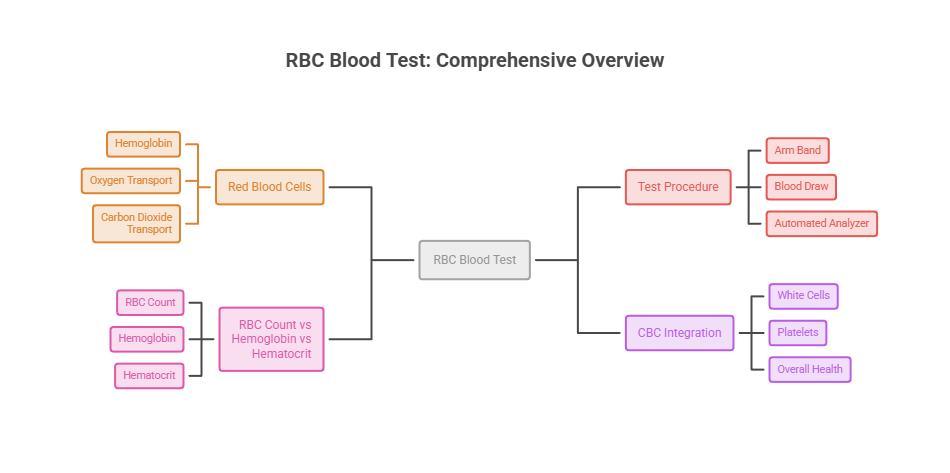
Patients booking routine panels with HealthCareOnTime often picture the RBC count as a standalone order. In practice it travels as one line inside a larger CBC, alongside white cells, platelets, hemoglobin, and hematocrit.
What Your Red Blood Cells Actually Do
Each red blood cell is essentially a delivery vehicle for oxygen. Inside every cell sits hemoglobin, an iron-rich protein that grabs oxygen in your lungs and drops it off in your tissues.
On the return trip, those same cells haul carbon dioxide back to your lungs so you can breathe it out. The oxygen reaching your muscles, brain, and organs depends on how many working red cells you have and how much hemoglobin each one carries.
Your bone marrow runs this factory without pause, leaning on adequate iron, vitamin B12, folate, and protein to keep output steady. When any of those raw materials run short, the number or the quality of your red cells can slip.
What to Expect During the Test
The RBC blood test itself is quick and routine. A technician wraps a band around your upper arm, cleans the site, and draws blood from a vein, usually at the inside of your elbow.
Most people feel only a brief prick or stinging, with maybe slight throbbing or a small bruise afterward that fades fast. The sample then runs through an automated analyzer that reports your count within minutes of processing.
There’s little risk involved. In cases reviewed by our medical team, the most common complaint is mild soreness, and serious reactions to a simple blood draw are rare.
RBC Count vs Hemoglobin vs Hematocrit
These three numbers sit side by side on your report and often move together, yet they measure different things. Mixing them up is one of the most frequent errors our medical reviewers see in patient questions.
The RBC count is the actual number of cells. Hemoglobin measures the concentration of the oxygen-carrying protein, in grams per deciliter. Hematocrit is the percentage of your blood made up of red cells.
Picture a crowded train. The RBC count is how many passengers are aboard, hemoglobin is how much cargo they carry between them, and hematocrit is how much of the train car those passengers physically fill.
Where the RBC Count Fits Inside a CBC
Almost no one orders an RBC blood test by itself. It’s nearly always part of a complete blood count, which measures red cells, white cells, platelets, hemoglobin, and hematocrit together.
That bundling is deliberate. A single CBC gives your doctor a wide read on overall health, screens for infection and clotting problems, and flags red cell disorders at once. The Mayo Clinic lists the CBC among the most commonly ordered blood tests in routine care.
Why Doctors Order an RBC Blood Test
There are two broad reasons your provider checks your red blood cell count: you have symptoms that need explaining, or it’s simply time for a routine look. Both are equally valid.
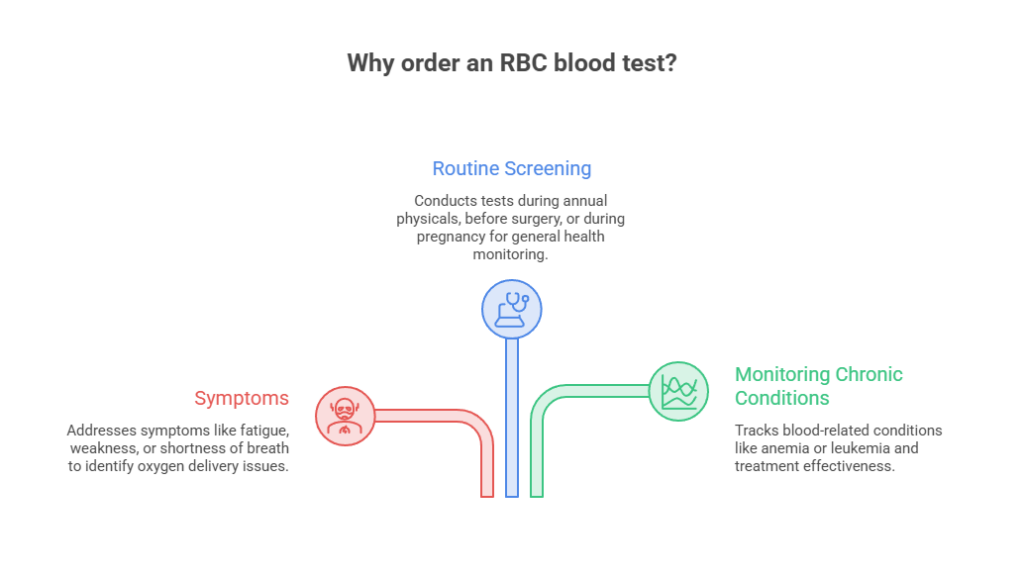
The RBC blood test answers a basic but important question. Are your tissues getting enough oxygen, and is your bone marrow producing red cells at a healthy clip?
Symptoms That Prompt the Test
When patients describe certain symptoms, a CBC with an RBC count is often one of the first orders written. Low oxygen delivery tends to announce itself.
Common red flags include lasting fatigue, weakness, pale skin, shortness of breath, dizziness, cold hands and feet, and frequent headaches. Bluish skin, confusion, and irregular breathing can point to a more serious oxygen shortfall.
On the high side, symptoms can include headaches, blurry vision, itchy skin (often after a warm shower), joint pain, and nosebleeds. In cases reviewed by our medical team, a striking share of high counts surface with no symptoms at all.
Routine Screening and Monitoring
Plenty of RBC tests happen when you feel fine. A CBC is standard during annual physicals, before surgery, and throughout pregnancy.
If you already live with a blood-related condition, the test becomes a tracking tool. Doctors use repeat CBCs to monitor chronic kidney disease, follow cancers like leukemia, and watch how treatments such as chemotherapy or iron therapy are working.
Red blood cell trouble is far from rare in the United States. The CDC’s National Center for Health Statistics records about 2.8 million physician office visits with anemia as the primary diagnosis, part of why this test is ordered so often. Patients we serve frequently arrive with a CBC already in hand, simply wanting to understand the RBC line.
RBC Normal Range by Age and Sex
Your RBC result only means something against a reference range, and that range shifts with age and sex. Most US laboratories print their own slightly different intervals, so always read your number against the range listed on your report.
Men generally run higher counts than women. Newborns start high, the count falls through infancy, and it tends to ease downward again in older age.
The table below shows widely used adult and pediatric reference ranges, drawn from NIH StatPearls and major US labs, with what results outside those ranges may suggest.
| Group | Typical Normal Range (million cells/uL) | Below Range May Suggest | Above Range May Suggest | Notes |
| Adult men | 4.7 to 6.1 | Anemia, blood loss | Polycythemia, dehydration | Testosterone raises baseline |
| Adult women | 4.2 to 5.4 | Anemia, heavy periods | Dehydration, smoking | Drops during pregnancy |
| Children (school age) | 4.0 to 5.5 | Iron or nutrient shortfall | Dehydration | Varies sharply by exact age |
| Newborns | 4.8 to 7.1 | Hemolytic disease | Dehydration | Naturally high at birth |
| Pregnant women | 3.9 to 5.0 (often lower) | Dilutional anemia | Rare | Plasma volume expands |
Why Men and Women Differ
The gap between men and women is mostly hormonal. Testosterone stimulates erythropoietin and directly boosts red cell production in the bone marrow, keeping male counts consistently higher.
Differences in average blood volume widen the gap. This is normal physiology, not a problem, so a healthy man and a healthy woman are graded against different yardsticks.
Menstruation also pulls female counts down over time. Regular blood loss, especially with heavy periods, helps explain why iron deficiency runs higher in women of reproductive age.
How Altitude, Pregnancy, and Age Shift Your Range
Where you live can nudge your number. People living above 5,000 feet routinely show RBC counts 5 to 10 percent higher than sea-level residents, because thinner air pushes the body to make more red cells. A reading of 6.3 million in Denver may be perfectly normal.
Pregnancy runs the opposite way. Plasma volume expands by roughly 50 percent, diluting red cells and lowering the count even when production is healthy.
Dehydration is the great trickster. Even mild fluid loss concentrates your blood and can inflate the count artificially, which is why our lab partners often suggest rechecking a borderline-high result after proper hydration.
How to Read Your RBC Results
A single RBC number is only a starting point. The real story lives in how that count interacts with hemoglobin, hematocrit, and a set of calculated values called red blood cell indices.
This is where the top search results tend to fall short, leaving readers with a number and no plain-English way to interpret it. The indices turn “your count is low” into “your count is low because your cells are small and iron-starved.”
RBC Indices Decoded
Red cell indices describe the size, hemoglobin content, and uniformity of your red blood cells. They were first defined by Wintrobe in 1929 and still anchor how labs classify anemia today.
Your analyzer calculates them automatically from your RBC count, hemoglobin, and hematocrit. Read together, they narrow down a cause without guesswork. The reference values below are commonly used, though labs vary slightly.
| Index | What It Measures | Common Reference Range | Low May Mean | High May Mean |
| MCV | Average cell size | 80 to 100 fL | Iron deficiency, thalassemia | B12/folate deficiency, liver disease |
| MCH | Hemoglobin per cell | 27 to 31 pg | Iron deficiency | Macrocytic anemia |
| MCHC | Hemoglobin concentration | 32 to 36 g/dL | Iron deficiency, chronic disease | Spherocytosis (rare) |
| RDW | Variation in cell size | 11.5 to 14.5% | Usually not significant | Mixed cell sizes, early deficiency |
MCV (Cell Size)
Mean corpuscular volume measures the average size of your red blood cells, normally around 80 to 100 femtoliters. It’s the single most useful index for sorting anemia.
Below 80 fL, cells are microcytic (too small), which classically points to iron deficiency or thalassemia. Above 100 fL, cells are macrocytic (too large), often from vitamin B12 or folate deficiency, liver disease, or heavy alcohol use.
MCH and MCHC (Hemoglobin Content)
Mean corpuscular hemoglobin (MCH) reflects the average hemoglobin per cell, normally about 27 to 31 picograms. Mean corpuscular hemoglobin concentration (MCHC) measures how densely that hemoglobin is packed.
A low MCHC means each cell carries less hemoglobin than it should, called hypochromic, leaning toward iron deficiency or chronic disease. Modern analyzers treat MCV and RDW as the more decisive indices, with MCH and MCHC playing a supporting role.
RDW (Size Variation)
Red cell distribution width measures how much your red cells vary in size, a property called anisocytosis. A high RDW means small and large cells are mixed together in the same sample.
This one value does heavy lifting. If MCH is low but RDW is high, iron deficiency is likely; if MCV is high alongside high RDW, it suggests B12 or folate deficiency. A low MCV with a normal RDW instead hints at thalassemia trait rather than iron loss.
Reading RBC Alongside Hemoglobin and Hematocrit
The numbers only tell a clear story as a set. A normal RBC count paired with low hemoglobin, for example, can flag thalassemia trait, where you have enough cells but each carries too little hemoglobin.
That’s why our medical reviewers caution against reacting to one line in isolation. A slightly out-of-range count with normal hemoglobin and a normal smear usually means far less than the same count surrounded by abnormal indices.
US red blood cell health varies widely across the population, which shapes how often abnormal results appear. The CDC’s December 2024 data brief maps anemia prevalence across groups, summarized below.
| Group (age 2 and older) | Anemia Prevalence | Source |
| Overall US population | 9.3% | CDC NCHS, NHANES 2021 to 2023 |
| Women | 13.0% | CDC NCHS, NHANES 2021 to 2023 |
| Men | 5.5% | CDC NCHS, NHANES 2021 to 2023 |
| Adults 60 and older | 12.5% | CDC NCHS, NHANES 2021 to 2023 |
| Adolescent girls 12 to 19 | 17.4% | CDC NCHS, NHANES 2021 to 2023 |
| Black non-Hispanic females | 31.4% | CDC NCHS, NHANES 2021 to 2023 |
What a Low RBC Count Means
A low red blood cell count is the medical definition of anemia, the most common red cell problem worldwide. With too few cells, your tissues run short on oxygen, and fatigue is usually the first thing you notice.
Anemia ranges from mild and easily corrected to serious enough to strain the heart. The cause matters far more than the number itself.
Common Causes of a Low RBC Count
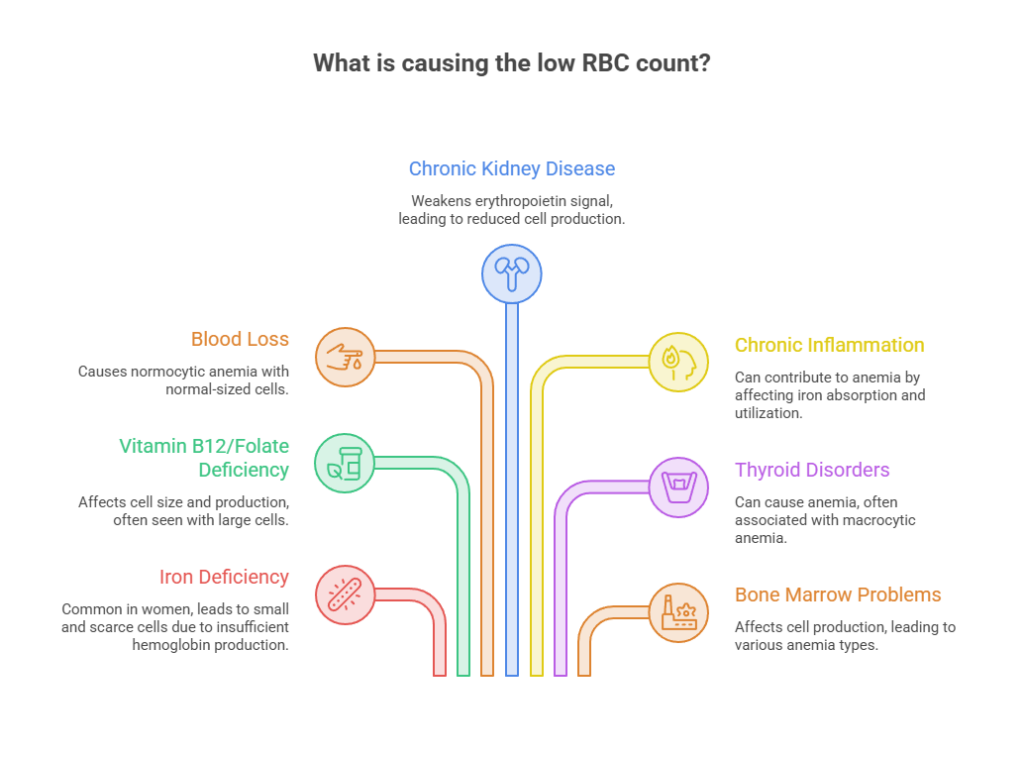
Iron deficiency tops the list by a wide margin. Without enough iron, your bone marrow can’t build healthy hemoglobin, so cells come out small and scarce.
Other frequent drivers include vitamin B12 and folate deficiency, ongoing blood loss (heavy periods or slow gastrointestinal bleeding), and chronic kidney disease, which weakens the erythropoietin signal that tells marrow to produce. Chronic inflammation, thyroid disorders, and bone marrow problems round out the list.
Iron shortfall is strikingly common in American women. The CDC reports that about 22.6 percent of females aged 12 to 49 have iron deficiency based on inflammation-adjusted ferritin, and female anemia has trended upward over the past two decades. Patients commonly ask us whether tiredness alone justifies testing, and given those numbers, it often does.
Symptoms to Watch For
Mild anemia can be silent or feel like ordinary tiredness. As it deepens, the signs sharpen.
Watch for persistent fatigue, pale or sallow skin, breathlessness during light activity, lightheadedness, cold extremities, brittle nails, and a racing or pounding heartbeat. Some people crave ice or non-food items, a clue specific to iron deficiency.
Severe anemia deserves prompt attention. Chest pain, fainting, or breathlessness at rest are signals to seek urgent care rather than wait for a routine appointment.
Anemia Types by Red Cell Size
Clinicians sort anemia by what the indices reveal, which guides treatment better than the RBC count alone. The three main shapes are microcytic, normocytic, and macrocytic.
Microcytic anemia (small cells, low MCV) usually means iron deficiency or thalassemia. Normocytic anemia (normal-sized cells) shows up with sudden blood loss, kidney failure, or chronic disease.
Macrocytic anemia (large cells, high MCV) points toward B12 or folate deficiency, liver disease, or hypothyroidism. Matching the type to the cause lets your doctor treat the real problem instead of just nudging a number upward.
What a High RBC Count Means
A high red blood cell count, called erythrocytosis or polycythemia, means you have more red cells than expected. Thicker, more crowded blood moves more sluggishly, raising clot risk when counts climb high.
A high count doesn’t automatically mean disease. The most frequent explanations are benign or temporary.
Common Causes of a High RBC Count
Dehydration is the leading false alarm, since concentrated blood reads as a high count that normalizes once you rehydrate. Smoking and chronic low oxygen come next, because the body compensates by making more red cells.
Cleveland Clinic notes that lung disease, heart disease, sleep apnea, and life at high altitude all push counts up. Testosterone therapy and, less often, kidney tumors that overproduce erythropoietin can do the same.
Then there’s the true marrow disorder. Polycythemia vera is driven by a genetic change, with the JAK2 mutation found in roughly 95 percent of cases, and it makes the marrow overproduce red cells on its own.
When a High Count Needs a Specialist
Most mildly elevated counts get explained by hydration, smoking, or altitude. Persistent or marked elevation is a different matter.
A useful threshold: if your count stays above 6.1 million (men) or 5.4 million (women) and your hematocrit runs above 49 percent (men) or 48 percent (women), your doctor should investigate further. That work-up often includes a hematology referral.
In cases seen across our diagnostic network, the trend matters more than a one-time spike. A single high reading on a hot day rarely carries the weight of a count that stays elevated across repeat tests.
RBC Blood Test Cost and Where to Get It
The RBC count rides along with a CBC, so what you pay is essentially the CBC price. For US patients, this is one of the cheapest tests on the menu.
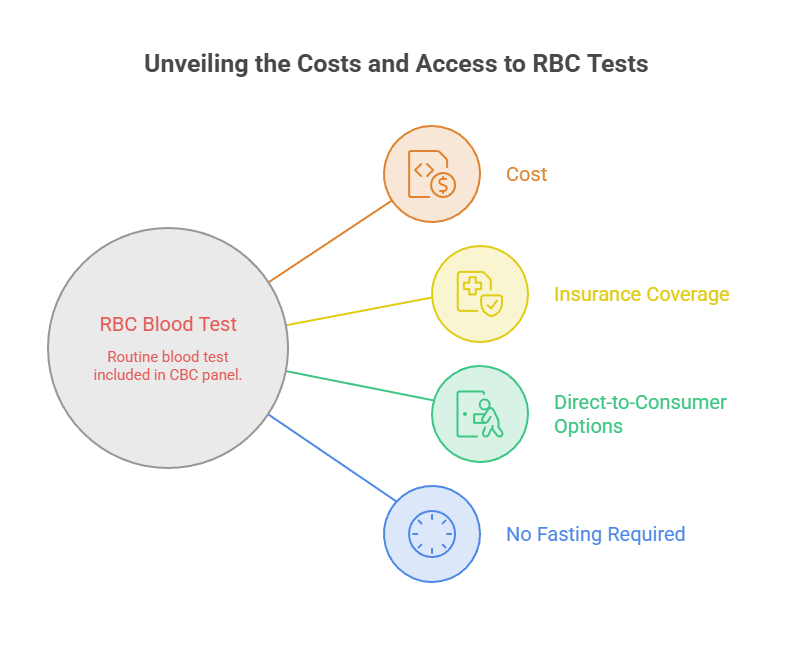
What you actually pay swings dramatically based on where your blood is drawn. The same panel can cost ten dollars at one site and several hundred at another.
Cost With and Without Insurance
With most insurance, a CBC ordered as preventive care is often covered fully or close to it. Diagnostic orders may apply to your deductible.
Without insurance, prices vary by setting. A CBC runs about $5 to $50 at retail labs but $50 to $400 or more at hospitals, and hospital chargemaster rates can top $1,000. At the big national labs, the cash price stays modest: a CBC costs around $29 at Labcorp and Quest Diagnostics.
Cost matters more than ever, since 27.5 million Americans were uninsured in 2024 and average individual deductibles now exceed $1,700. Asking for the self-pay or cash-discount price is a simple way to dodge the worst markups.
Direct-to-Consumer and Retail Lab Options
You no longer always need a doctor’s order. More than 37 states have direct access testing laws that let you order routine labs like a CBC yourself.
Direct-to-consumer and retail diagnostic chains tend to publish flat, low cash prices and run samples through the same certified labs hospitals use. For a routine RBC blood test, they’re usually the most affordable route.
One practical note our medical reviewers stress: no fasting is required for a CBC or RBC count. You can walk in at any time of day without skipping meals or water.
What to Do After Abnormal Results
An out-of-range RBC count is information, not a diagnosis. The right next step depends entirely on how far off the number is, what your indices show, and whether you have symptoms.
The table below maps common scenarios to sensible actions. Treat it as a guide for the conversation with your provider, not a replacement for one.
| Scenario | What It May Mean | Recommended Action |
| Slightly low RBC, no symptoms | Mild or early anemia | Recheck CBC, add iron and ferritin testing |
| Low RBC with fatigue and pale skin | Iron deficiency anemia likely | See your doctor; evaluate diet and blood loss |
| Slightly high RBC after a hot day | Probable dehydration | Rehydrate, repeat the test in a week |
| Persistently high RBC and hematocrit | Possible polycythemia | Request hematology referral and further work-up |
| Normal RBC but low hemoglobin | Possible thalassemia trait | Ask about hemoglobin electrophoresis |
| Chest pain or breathlessness at rest | Severe anemia or clotting risk | Seek urgent medical care now |
Questions to Ask Your Doctor
A short list of focused questions turns a confusing report into a clear plan. Bring them to your appointment.
Ask which way your count is off and by how much, what your MCV and RDW suggest about the cause, and whether the result fits your symptoms. Then ask what follow-up tests make sense and when to recheck.
It’s also fair to ask whether any medication, supplement, or recent illness could have skewed the result. Patients we serve often find that one honest conversation clears up weeks of online worry.
Diet, Hydration, and Follow-Up Testing
For mildly low counts tied to iron, diet adjustments under your doctor’s guidance often help. Iron-rich foods, paired with vitamin C to aid absorption, are a reasonable starting point alongside any prescribed treatment.
Hydration is the easiest variable to control before a recheck, especially for borderline-high results. Steady water intake helps your next sample reflect your true count.
Follow-up testing closes the loop. A repeat CBC, plus targeted tests like ferritin, B12, or a peripheral smear, confirms whether a one-time result was a blip or a pattern worth treating.
Frequently Asked Questions
What is a normal RBC count?
For adult men, the normal RBC count is about 4.7 to 6.1 million cells per microliter, and for adult women roughly 4.2 to 5.4 million. Children and newborns have their own ranges. Your lab prints its own reference interval, so compare your result to the range listed on your report.
What does a high RBC count mean?
A high RBC count, called polycythemia or erythrocytosis, means you have more red cells than expected. The most common causes are dehydration, smoking, high altitude, and chronic low oxygen. Less often it reflects a bone marrow disorder like polycythemia vera, which needs specialist evaluation.
What does a low RBC count indicate?
A low RBC count is the definition of anemia, meaning your blood carries fewer oxygen-delivering cells than it should. Iron deficiency leads the causes, followed by B12 or folate shortfalls, blood loss, and chronic kidney disease. Symptoms often include fatigue, pale skin, and shortness of breath.
Do I need to fast before an RBC blood test?
No. An RBC blood test and the CBC it belongs to require no fasting and no special preparation. You can have blood drawn at any time of day, with food and water beforehand. If your doctor bundles it with glucose or a lipid panel, those other tests may need fasting.
How much does an RBC blood test cost without insurance?
Because the RBC count is part of a CBC, you pay the CBC price. That’s roughly $29 at major labs like Labcorp and Quest, though retail prices range from about $5 to $50 and hospitals can charge far more. Asking for the cash or self-pay rate usually lowers the bill.
Is the RBC count the same as hemoglobin?
No. The RBC count is the number of red cells, while hemoglobin measures the oxygen-carrying protein inside those cells. They often move together, but not always. A normal count with low hemoglobin can flag conditions like thalassemia trait, which is why doctors read both numbers as a pair.
Can dehydration affect my RBC count?
Yes, significantly. Even mild dehydration concentrates your blood and can inflate the RBC count, producing a falsely high reading. This is one of the most common reasons for a borderline-high result. Rehydrating and repeating the test usually brings a dehydration-driven number back into range.
What RBC level is considered dangerous?
There’s no single universal danger number, since it depends on hemoglobin, hematocrit, symptoms, and your baseline. Counts well below or far above the reference range, especially with chest pain, fainting, or breathlessness, warrant prompt medical attention. Your doctor interprets the full picture, not one isolated value.
How long do RBC test results take?
A CBC is among the fastest lab tests. Automated analyzers process the sample within minutes, and many labs post results the same day or by the next morning. Turnaround can stretch slightly if the lab is busy or your doctor orders a manual blood smear review.
Can I check my RBC count at home?
True at-home RBC counting is limited, but more than 37 states allow direct access testing, so you can order a CBC yourself and visit a lab for the draw. Some mail-in kits collect a sample at home and process it in a certified lab. For accuracy, lab-run testing remains the standard.
Does a high RBC count always mean cancer?
No, and that fear is usually unfounded. Most high counts trace back to dehydration, smoking, altitude, or lung and heart conditions, not cancer. Polycythemia vera, a marrow disorder, is one serious cause, but it’s relatively uncommon and diagnosed through specialist testing, not the RBC count alone.
What should I do if my RBC count is abnormal?
Don’t panic over one number. Talk with your doctor about your indices (MCV and RDW), your symptoms, and whether anything could have skewed the result. Expect a recheck and possibly targeted tests like ferritin or B12. The cause, once identified, guides treatment far more than the count.
Medical Disclaimer: This article is for general educational purposes and does not replace professional medical advice, diagnosis, or treatment. Reference ranges vary between laboratories, and only a qualified healthcare provider can interpret your results in the context of your health. Always consult your doctor about any abnormal RBC count or symptoms, and seek urgent care for chest pain, fainting, or breathlessness at rest.
References
- CDC, National Center for Health Statistics: Anemia FastStats
- CDC NCHS Data Brief No. 519: Anemia Prevalence in the United States, August 2021 to August 2023
- NIH StatPearls: Normal and Abnormal Complete Blood Count With Differential
- NIH Clinical Methods: Red Cell Indices
- Mayo Clinic: Complete Blood Count (CBC)
- Cleveland Clinic: High Red Blood Cell Count