Most vaginal estrogen side effects are local and mild: more discharge, some itching or burning, light spotting, and now and then a headache or sore breasts. Large long-term studies of women using low-dose vaginal estrogen have not found higher rates of breast cancer, blood clots or stroke, even though many product labels still list those risks.
Table of Contents
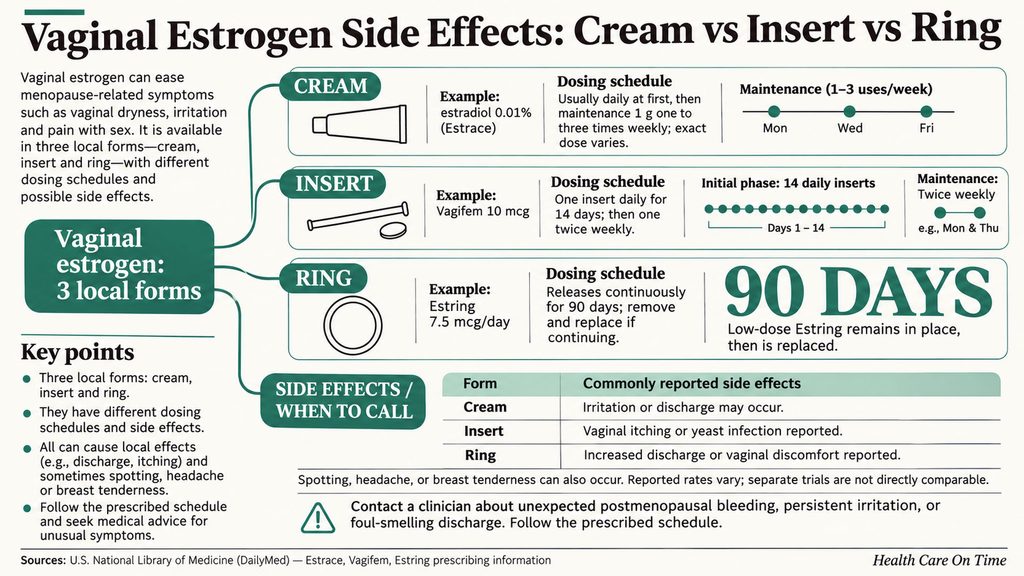
Quick answer: The most common vaginal estrogen side effects are increased discharge, vaginal itching or irritation, yeast infections, light spotting, headache and breast tenderness. In FDA label trials these showed up in roughly 1% to 16% of users, depending on the product and the symptom. Low-dose inserts and the Estring ring keep blood estradiol close to normal postmenopausal levels. Any bleeding after menopause still needs a doctor’s check.
What you’re actually using: cream, insert or ring
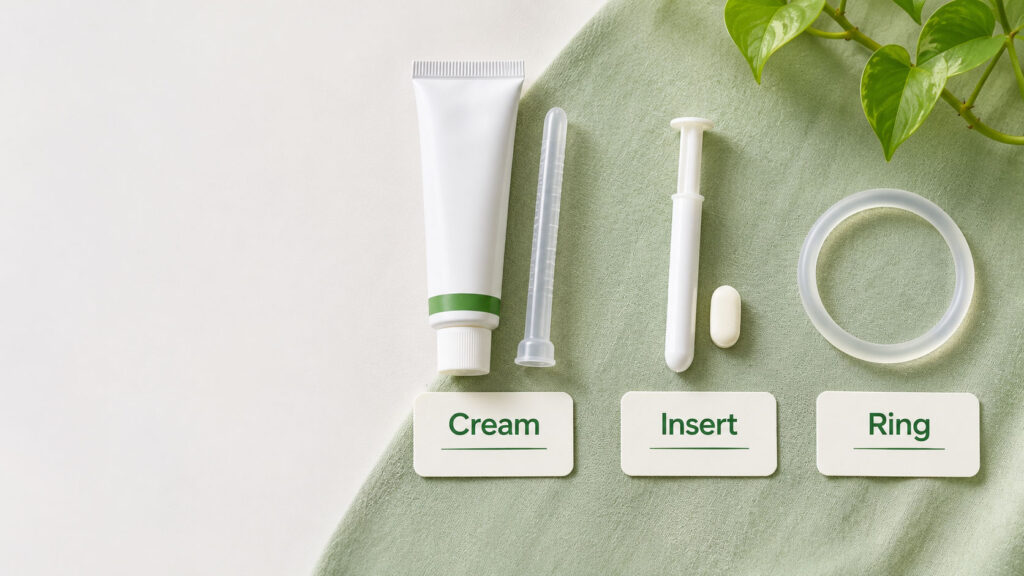
Vaginal estrogen treats genitourinary syndrome of menopause, the dryness, burning, painful sex and urinary symptoms that come from low estrogen in the vaginal and bladder tissue. In the U.S. it comes in three basic forms, and the form matters because each one delivers a different dose in a different way.
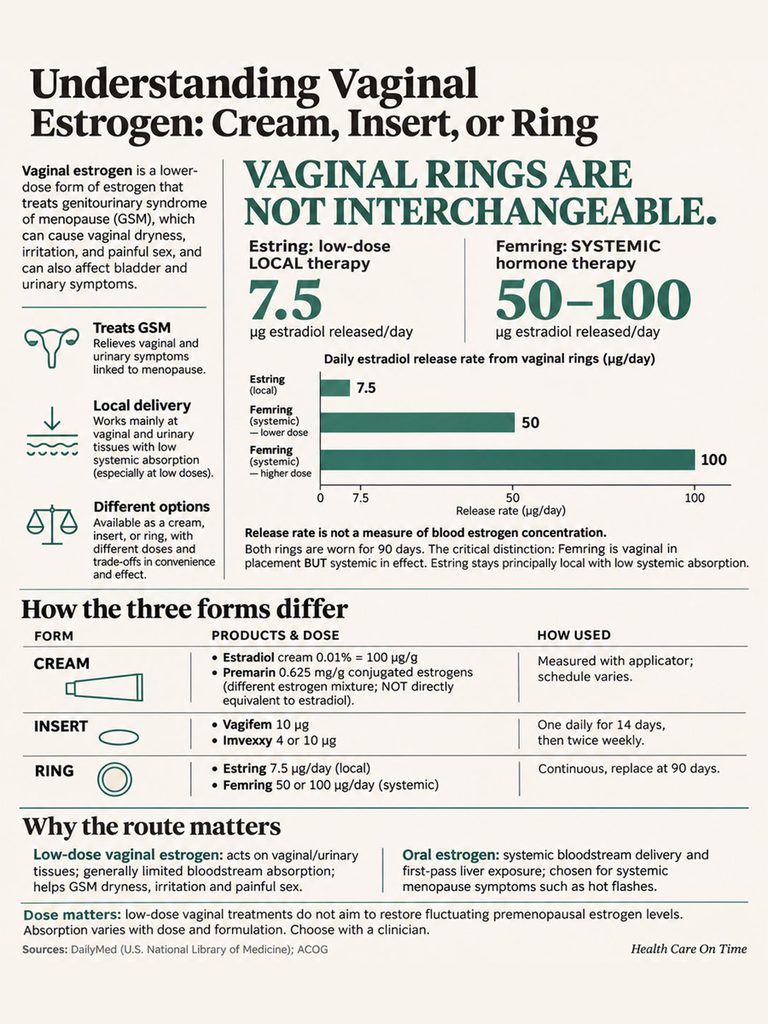
Creams are the oldest option. Estradiol cream 0.01% (Estrace and its generics) contains 0.1 mg of estradiol per gram, and conjugated estrogens cream (Premarin vaginal cream) is the other common choice. A typical start is 0.5 to 1 gram a day for two weeks, then the same amount one to three times a week, measured with a reusable applicator. You can also rub a little cream onto the vulva, which some women find soothing.
Inserts are small fixed doses. Vagifem and its generic Yuvafem contain 10 mcg of estradiol and come preloaded in a disposable applicator; the current label calls them “vaginal inserts,” although many people still say “tablets.” Imvexxy is a softgel insert in 4 mcg or 10 mcg strengths that you place about two inches inside with a finger. Both start daily for two weeks and then drop to twice a week.
The ring is Estring, a soft silicone ring with a 2 mg estradiol reservoir that releases about 7.5 mcg a day for 90 days. You put it in, leave it alone for three months and then replace it.
Femring confuses many people. It’s also a vaginal ring, but it delivers a systemic dose meant to treat hot flashes, so it behaves like regular hormone therapy and carries the same considerations about the uterus. Everything below is about the low-dose products: the creams at usual doses, the inserts and Estring.
Dose is what matters most. Before menopause, the ovaries put out roughly 70 to 500 mcg of estradiol a day, depending on the point in the cycle. A 10 mcg insert used twice a week is a tiny fraction of that, and estrogen absorbed through the vaginal wall skips the first pass through the liver that swallowed pills go through. If you’re also weighing pills or patches for hot flashes, the trade-offs are different, and the patch vs pill comparison for women with high blood pressure shows how much the route can change risk.
Side effects you’re most likely to notice
The common vaginal estrogen side effects fall into two groups: changes right where you apply it, and a handful of mild whole-body effects such as headache or breast tenderness. Rates below come from the trials behind the FDA labels.
More discharge, or a wetter feeling
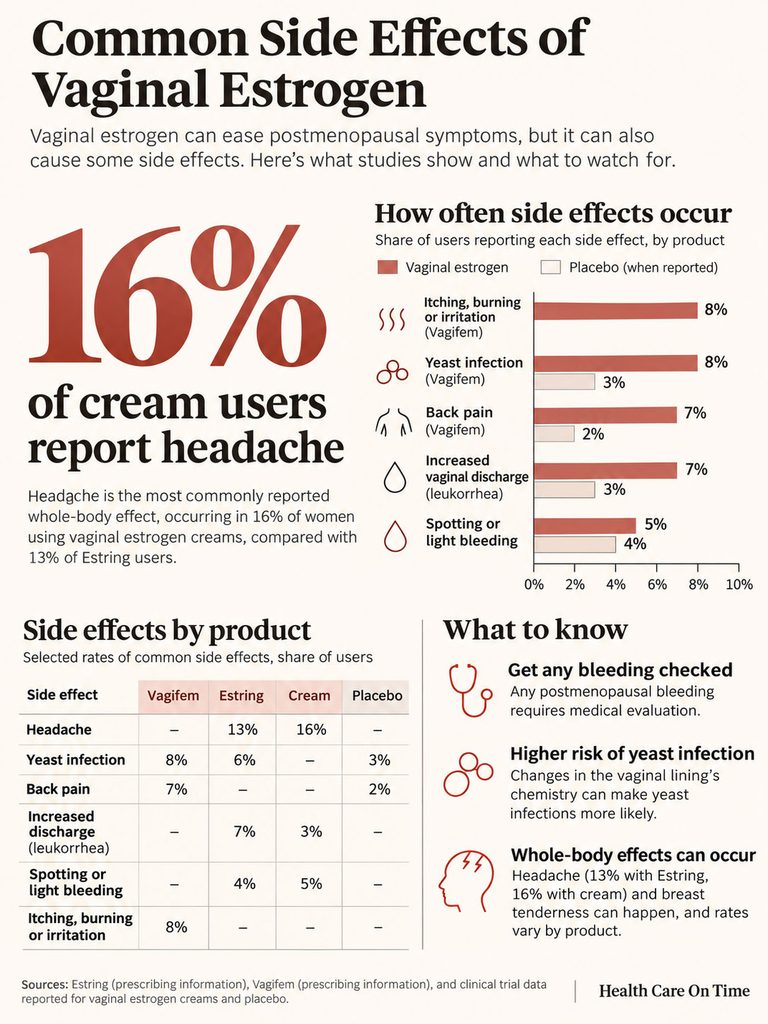
Increased vaginal discharge is the side effect Estring users report most often. In the ring’s pivotal trials, 7% of women on Estring had leukorrhea (a white or clear discharge) compared with 3% of women using conjugated estrogen cream. The ring’s patient leaflet describes these secretions as similar to the ones many women had before menopause and treats them as a sign the medicine is working. Discharge with a bad smell, itching or soreness is a different matter and points to infection.
Creams add their own wetness simply because the base has to go somewhere, and some women find them messy for that reason alone. Imvexxy’s label lists vaginal discharge among the effects reported after the product went on sale.
Itching, burning or irritation
Some irritation is common early on, and it can come from three directions: the medicine, the vehicle it’s carried in, or the original problem that hasn’t healed yet. In a 12-month placebo-controlled trial of Vagifem 10 mcg, vulvovaginal itching occurred in 8% of women on the insert versus 2% on placebo. Patient drug sheets for estradiol cream list irritation at the application site among the effects that usually don’t need medical attention unless they persist.
Creams can bother women who are sensitive to their base ingredients, and the Menopause Society’s 2020 position statement on genitourinary syndrome of menopause mentions that some users react to the vehicle itself. Switching forms often solves that. And because the thin, dry tissue of menopause is itself easily irritated, a little burning in the first week or two may just mean the treatment hasn’t caught up with the symptoms yet.
Spotting or bleeding
Light bleeding was uncommon in the trials: 4% of Estring users and 5% of cream users had vaginal bleeding over 12 weeks. With creams, bleeding, breast pain and nausea seem to track with dose, which suggests that some women absorbed enough estrogen to have whole-body effects.
Bleeding after menopause always needs a medical check, whatever you think caused it. Thin postmenopausal tissue can bleed from minor friction, but uterine bleeding can also signal a thickened lining, and the standard workup may include a transvaginal ultrasound, an endometrial biopsy or both.
Yeast infections
Estrogen changes the vaginal lining and its chemistry. Yeast sometimes takes advantage. Vulvovaginal yeast infections affected 8% of women on Vagifem 10 mcg versus 3% on placebo. In the Estring trials, genital yeast infections showed up in 6% of ring users and 7% of cream users. Vaginal yeast infection also appears in drug references as a less common effect that should prompt a call to your doctor.
Headache, breast tenderness, nausea and back pain
These effects sound like whole-body ones, but the trial numbers don’t always back that up. Headache was the most frequent adverse event in the Estring trials, at 13% for the ring and 16% for the cream, but those trials had no placebo group, so it’s hard to know how many headaches the drug caused. In Imvexxy’s placebo-controlled trial, headache occurred in 3.7% of women on the 4 mcg insert, 2.6% on 10 mcg and 3.1% on placebo, which is about the same with or without the hormone.
Breast pain looked very different by form. It affected 1% of Estring users and 7% of women using conjugated estrogen cream. Back pain was 7% with Vagifem against 2% with placebo, and diarrhea was 5% against none. Weight gain shows up on reference lists of more common effects too, though without a frequency.
Cream vs insert vs ring: side effects side by side
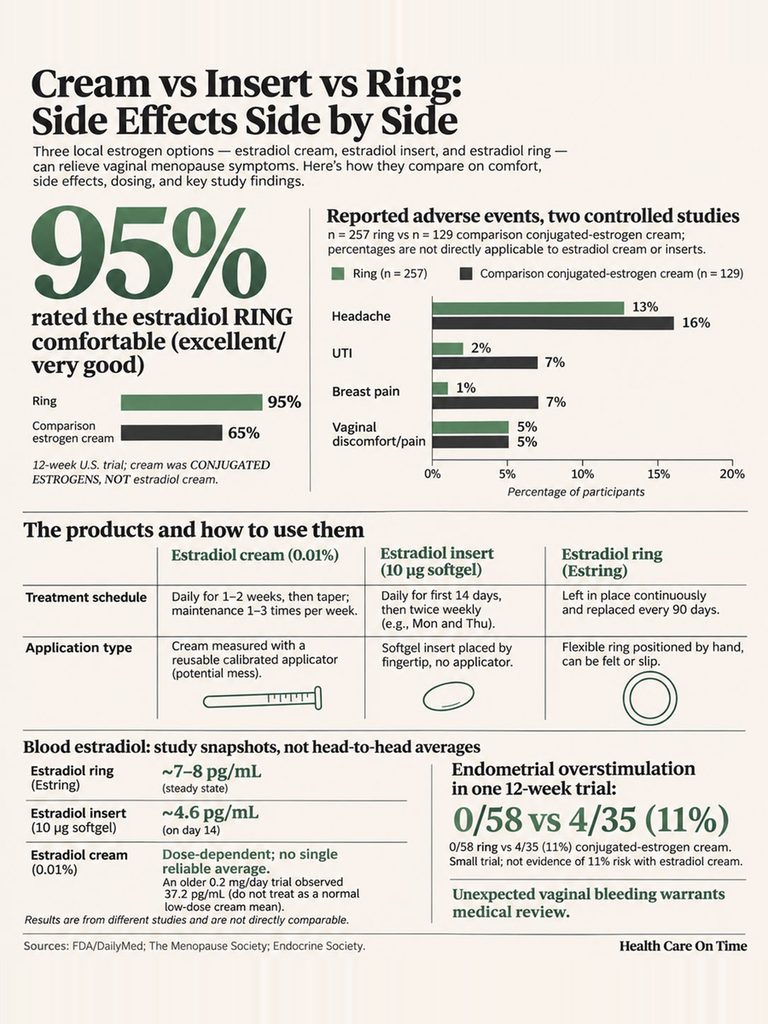
Trials of different products used different comparison groups, so the percentages below can’t be lined up as a strict ranking. They do show a pattern: the fixed low-dose products (inserts and the ring) produce small, steady blood levels, while creams vary with how much you use.
| Form | U.S. products and usual schedule | Side effects in label trials | Problems specific to this form | Average blood estradiol in studies |
| Estradiol cream 0.01% | Estrace and generics; 0.5 to 1 g daily for 2 weeks, then 1 to 3 times a week | Label lists burning and irritation, itching, spotting and breast tenderness; no placebo table | Dose depends on how full you fill the applicator; may weaken latex condoms | Variable; one older study with a 0.2 mg daily dose saw levels rise from 16.6 to 37.2 pg/mL |
| Conjugated estrogens cream | Premarin vaginal cream; same starting pattern | As the comparison arm in Estring trials: headache 16%, breast pain 7%, UTI 7%, bleeding 5% | 4 of 35 women (11%) had endometrial overstimulation in a 12-week U.S. study | Variable; hard to measure because the product mixes several estrogens |
| Estradiol insert 10 mcg | Vagifem, Yuvafem; daily for 2 weeks, then twice weekly | Itching 8% (placebo 2%), yeast 8% (3%), back pain 7% (2%), diarrhea 5% (0%) | Applicator can scrape very thin tissue | 5.5 pg/mL after 12 weeks |
| Estradiol softgel insert 4 or 10 mcg | Imvexxy; daily for 2 weeks, then twice weekly | Headache 3.7% (4 mcg) and 2.6% (10 mcg) vs 3.1% on placebo | No applicator; placed by finger | 3.6 and 4.6 pg/mL vs 4.3 on placebo |
| Estradiol ring 7.5 mcg/day | Estring; one ring every 90 days | Headache 13%, discharge 7%, back pain 6%, yeast 6%, vaginitis 5%, discomfort 5% | Slipping or falling out, rare sticking to the vaginal wall, erosion, toxic shock syndrome | 7.0 to 8.1 pg/mL over 48 weeks |
The ring caused less breast pain and fewer urinary tract infections than the cream it was tested against (2% versus 7% for UTIs), and none of the 58 women with a uterus who used Estring in the U.S. study showed overstimulation of the uterine lining, compared with 11% of the cream group. In the same study, 95% of women who finished 12 weeks rated the ring’s comfort as excellent or very good, against 65% for the cream.
Inserts give a precise dose without the mess. The trade-off with Vagifem is the plastic applicator, which the label links to a few cases of scraping, mostly in women with severely thinned tissue. Imvexxy avoids that because you place it with a finger.
How long the side effects last
None of the U.S. labels give a timeline for side effects, so the best guide is how the drug behaves in the body. Drug references say many of the minor effects may go away during treatment as your body adjusts.
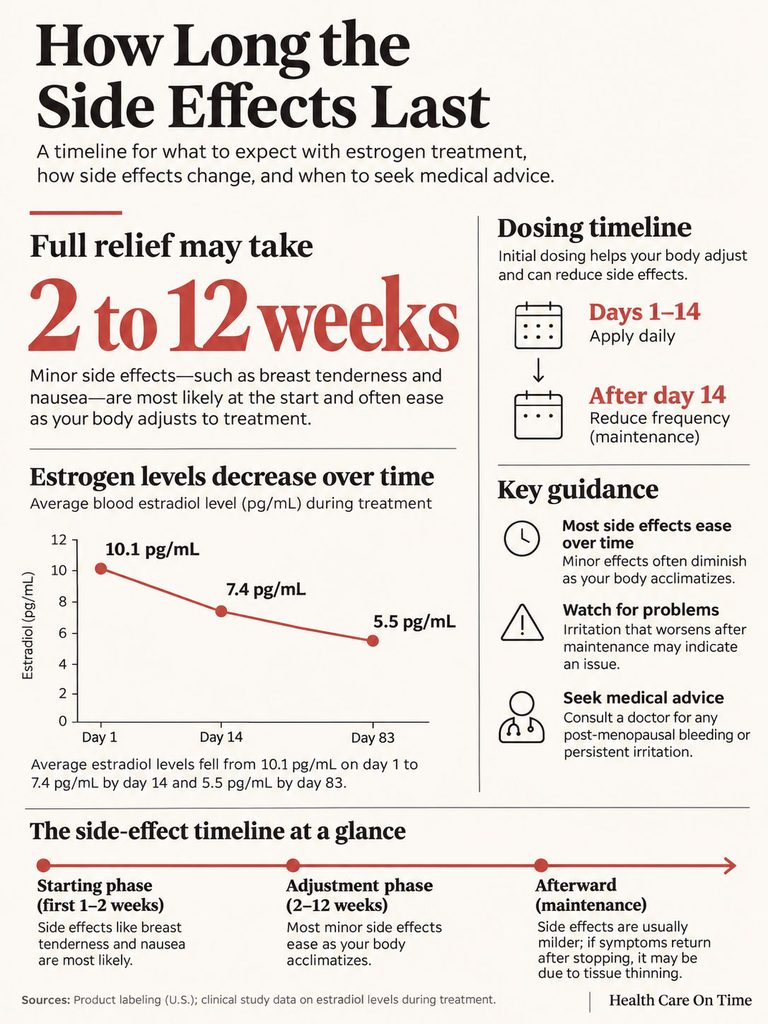
That fits the physiology: thin, atrophic vaginal tissue absorbs more estrogen at first, and absorption drops as the lining thickens. In Vagifem’s pharmacokinetic study, average blood estradiol was about 10.1 pg/mL on the first day, 7.4 pg/mL by day 14 and 5.5 pg/mL by day 83. Estring shows the same thing in a different way: when women inserted a second ring three months later, the brief early spike in blood estradiol was about 38% lower, because the treated lining let less through.
The dosing schedule follows the same logic. Creams and inserts are used daily for the first two weeks and then cut back to twice a week, or one to three times a week for creams. Effects that depend on how much estrogen reaches the bloodstream, such as breast tenderness, nausea and spotting, are most likely during that starting phase. With creams, they also tend to show up when the dose is higher than it needs to be, which is one reason doctors look for the lowest dose and frequency that still controls symptoms.
Relief takes longer to arrive. Estring’s leaflet estimates two to three weeks for the vaginal and urinary tissue to recover enough to feel the full effect, and the Menopause Society expects improvement within a few weeks but says maximum benefit may take 12 weeks. So irritation in week one doesn’t tell you much. Irritation that’s getting worse after you’ve moved to the maintenance schedule, or still bothering you at the 12-week mark, is worth a call, because it may point to sensitivity to the cream base, an infection, or a skin condition that looks like atrophy. Keep a simple log. Note when each symptom started and whether it eased after the switch to the maintenance schedule, since that record makes a follow-up visit far more useful.
With the ring in particular, a modest increase in secretions can continue for as long as you use it, and that’s expected.
Call your doctor about any spotting or bleeding after menopause, even in the first week.
And if you stop treatment, the original symptoms usually come back, because the tissue thins again without estrogen. The Menopause Society recommends continuing therapy, with follow-up, for as long as bothersome symptoms are present.
How much reaches the rest of your body
This is what most women want to know before starting. The evidence is reassuring, though product labels and medical guidelines have said different things for years.
Blood levels in plain numbers
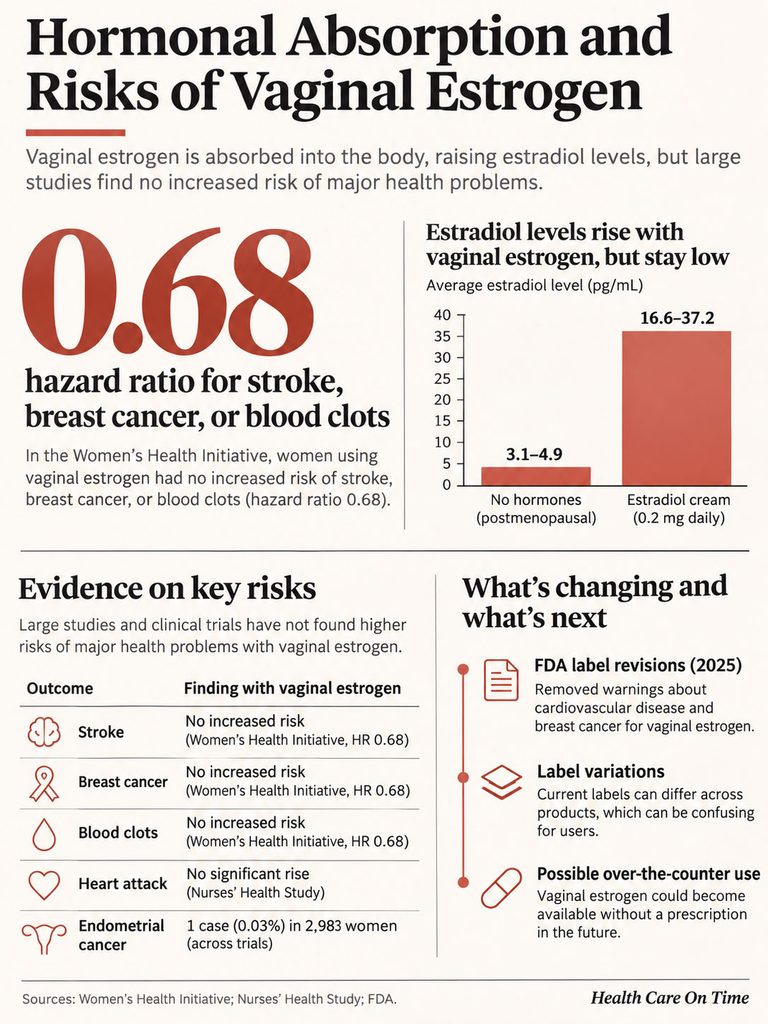
Women after menopause who use no hormones have estradiol levels of about 3.1 to 4.9 pg/mL when measured with the most sensitive lab methods. With the low-dose products, blood levels stay close to that range:
- Estring: about 7 to 8 pg/mL at weeks 12 through 48, with roughly 8% of the daily release absorbed unchanged.
- Vagifem 10 mcg: 5.5 pg/mL after 12 weeks.
- Imvexxy: 3.6 pg/mL (4 mcg) and 4.6 pg/mL (10 mcg) after two weeks of daily use, versus 4.3 pg/mL on placebo; by week 12 levels were no different from baseline.
- Creams: harder to pin down, because the dose depends on how much you use and most absorption data are old.
One older study of estradiol cream at 0.2 mg a day, which equals 2 grams of the 0.01% product and is twice the usual 1-gram dose, found blood estradiol climbing from 16.6 to 37.2 pg/mL after three weeks. Another study of conjugated estrogens cream at 0.3 mg three times a week for six months found no change in blood estradiol. Taken together, they suggest absorption from cream depends heavily on dose.
Breast cancer, clots and stroke: what long-term studies found
The two largest U.S. studies of vaginal estrogen both followed women for years. In the Women’s Health Initiative Observational Study, 45,663 women aged 50 to 79 who weren’t using systemic hormones were followed for a median of 7.2 years. Among women with a uterus, vaginal estrogen users had no higher risk of stroke, invasive breast cancer, colorectal cancer, endometrial cancer or blood clots than nonusers, and their combined risk of major events was actually lower (hazard ratio 0.68). Among women who’d had a hysterectomy, the risks didn’t differ either way.
The Nurses’ Health Study compared 896 vaginal estrogen users with 52,901 nonusers over 18 years, with an average of 37.5 months of use. None of the outcomes rose significantly: the hazard ratios were 0.73 for heart attack, 0.85 for stroke, 1.06 for blood clots in the legs or lungs and 1.05 for all cancers combined.
Both are observational studies built on women reporting their own use, so they can’t prove that vaginal estrogen is risk-free, and neither recorded much about specific products or doses. But they’re large and long, and their results match what the blood levels predict. A 2019 pooled analysis of 58 observational studies, cited in the Menopause Society’s position statement, also found no link between vaginal estrogen and breast cancer.
| Finding | Number | Who was studied | Source |
| Women after menopause with genitourinary symptoms | 27% to 84% | Postmenopausal women across several studies | Menopause Society 2020 position statement |
| U.S. women with symptoms who had never used any treatment | 50% | 1,858 U.S. postmenopausal women (EMPOWER survey) | Menopause Society 2020 position statement |
| U.S. women aged 45 to 64 vs those prescribed hormone therapy | About 41 million vs about 2 million (2020) | U.S. population | FDA, February 2026 |
| Combined risk of major events, vaginal estrogen users with a uterus | Hazard ratio 0.68 | 45,663 women, median 7.2 years | Women’s Health Initiative Observational Study |
| Risk of all cancers with vaginal estrogen | Hazard ratio 1.05 (not significant) | 896 users vs 52,901 nonusers, 18 years | Nurses’ Health Study |
| Endometrial cancer and hyperplasia in trials | 1 cancer (0.03%), 12 hyperplasia (0.4%) | 2,983 women in 20 randomized trials, up to 1 year | Menopause Society 2020 position statement |
The uterus question
Estrogen alone can thicken the lining of the uterus, which is why women with a uterus who take systemic estrogen usually add a progestogen. The numbers here are small. Across 20 randomized trials covering 2,983 women treated for up to a year, there was one case of endometrial cancer (0.03%) and 12 cases of endometrial hyperplasia (0.4%), which is similar to the background rate. In the Women’s Health Initiative Observational Study, endometrial cancer occurred at 1.3 cases per 1,000 woman-years in users versus 1 in nonusers, a difference that wasn’t statistically significant.
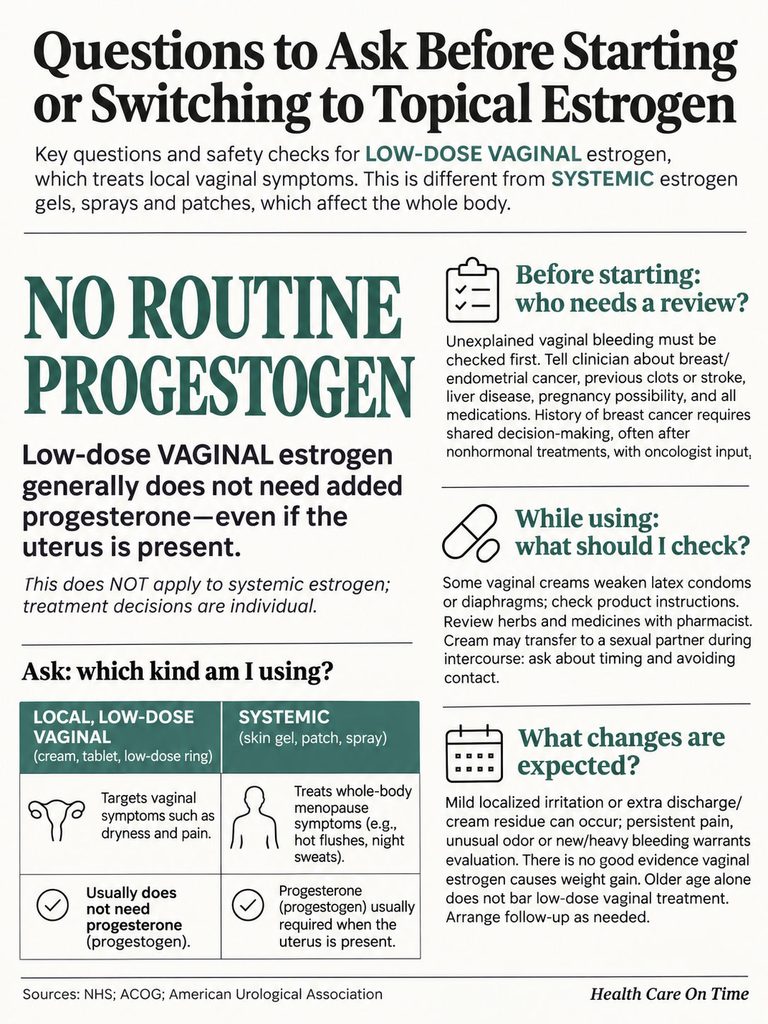
The guidelines and the labels don’t agree on what to do about it. The Menopause Society doesn’t recommend a progestogen or routine endometrial checks for low-risk women on low-dose vaginal estrogen, while some product leaflets, including Vagifem’s, still tell women with a uterus that adding a progestogen is generally recommended. Women at higher risk of endometrial cancer, such as those with obesity or diabetes, may warrant monitoring, and clinical trial data on the endometrium don’t go beyond one year. If your doctor does suggest a progestogen, it helps to know how progesterone and progestins work in the body and how they differ.
What changed on the FDA label
For more than two decades, every estrogen product, including low-dose vaginal ones, carried the same boxed warning about endometrial cancer, heart disease, stroke, blood clots, breast cancer and probable dementia. Those warnings came from the Women’s Health Initiative trials of daily oral hormone pills, not from vaginal products.
In November 2025, the FDA started removing the statements about cardiovascular disease, breast cancer and probable dementia from the boxed warnings on menopausal hormone therapy. On February 12, 2026, it approved the first six revised labels, and Estring was the vaginal product in that group. Estring’s revised label has no boxed warning about those risks; endometrial cancer and abnormal bleeding remain in its regular warnings section, and it still lists the risks seen with systemic estrogen while stating that their relevance to the ring isn’t known.
The rollout isn’t finished: by late October 2026, the FDA’s list of products with updated prescribing information still showed Estring as the only vaginal estrogen, although 29 companies had submitted proposed changes. The Vagifem and Imvexxy labels available today, both revised in February 2024, still carry the full boxed warning. So two women using equally low doses may read very different warnings depending on the product and when the package was printed. The FDA is also exploring whether vaginal estrogen could be sold over the counter, which would require a separate approval. Age changes the picture far more with pills and patches, as hormone therapy risks for women over 60 show.
Problems specific to the ring and the applicator
The ring has more device problems than other forms, though most are rare. Estring can slide down or come out during a bowel movement, straining or heavy coughing. Rinse it in lukewarm water and put it back. No new ring is needed. It may not suit women with a narrow, short or scarred vagina, or with prolapse, because those conditions make irritation and sores more likely.
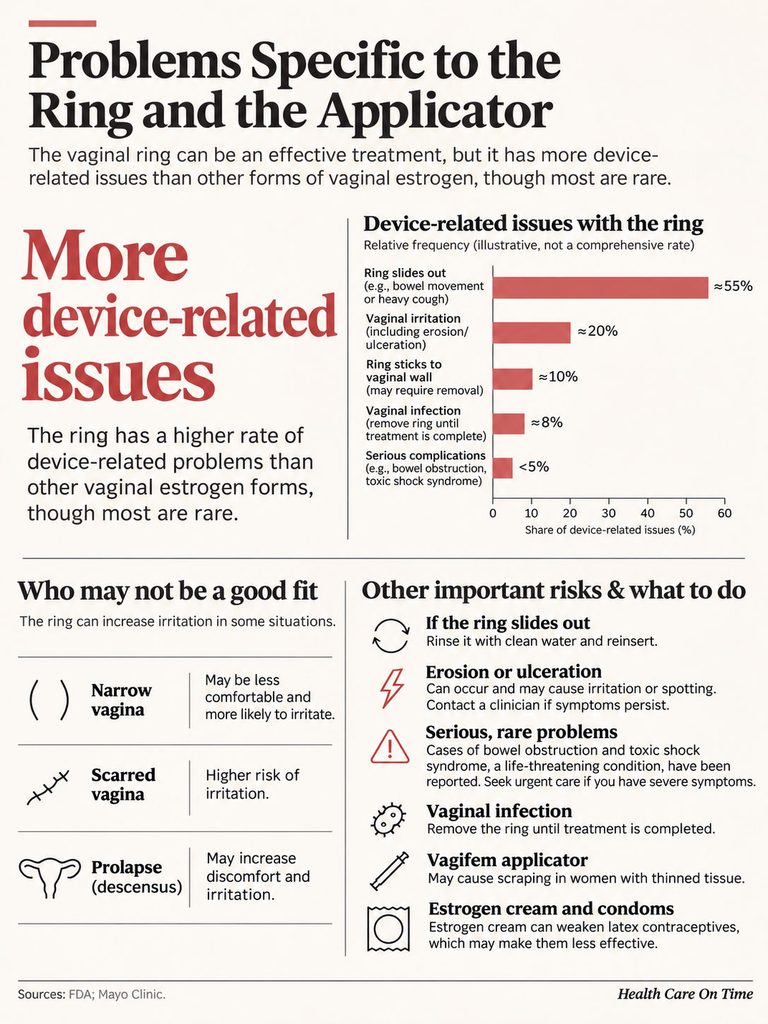
Less often, there are more serious problems. The label describes cases where the ring stuck to the vaginal wall, and some of those needed surgical removal. Erosion or ulceration of the vaginal lining has also occurred, sometimes showing up only as irritation, redness or spotting. Cases of bowel obstruction have been reported with vaginal rings. Toxic shock syndrome, a rare but life-threatening bacterial illness, has been seen with vaginal rings too; its warning signs are fever, nausea, vomiting, diarrhea, muscle pain, dizziness, fainting or a sunburn-like rash. If any of those appear, remove the ring if you can and get medical care right away.
If a vaginal infection develops while you’re using the ring, the label advises taking it out and putting it back only after the infection has been treated.
Inserts and creams have their own smaller issues. The Vagifem applicator has caused a few cases of scraping, mostly in women with severely thinned tissue, and estrogen cream may weaken latex condoms and diaphragms enough to make them unreliable. Whether a male partner absorbs a meaningful amount of estrogen from cream is unknown.
Who shouldn’t use vaginal estrogen, or needs a closer look
The labels for the ring and the inserts list the same core contraindications:
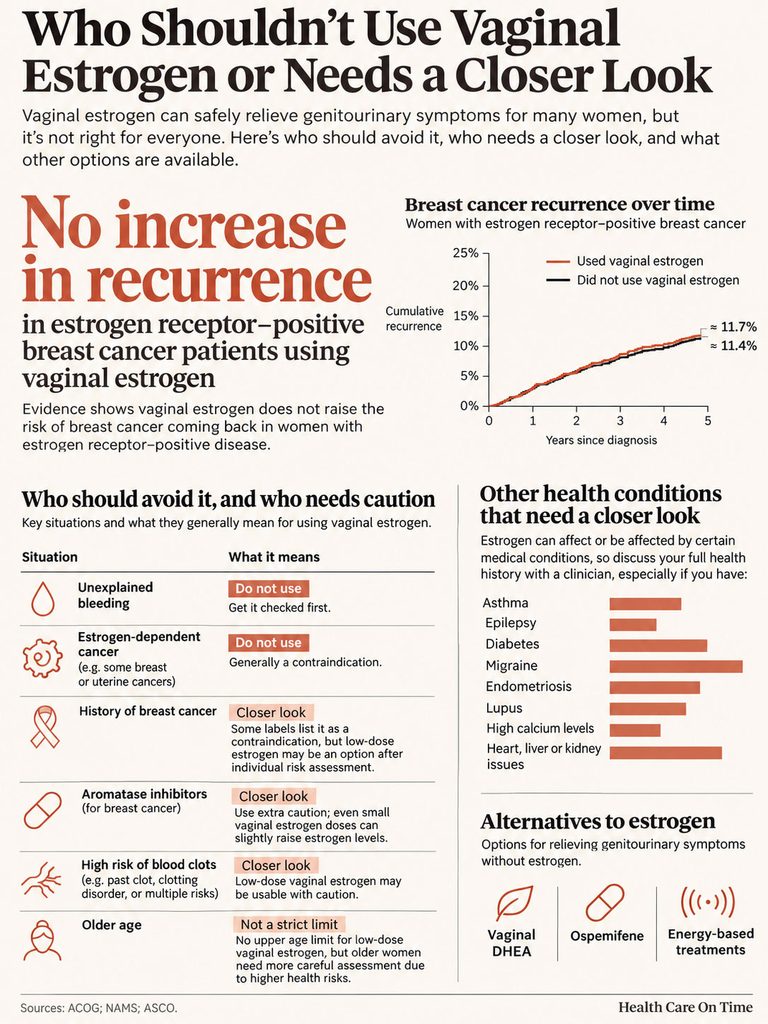
- Vaginal bleeding that hasn’t been explained
- Known or suspected estrogen-dependent cancer, and on the Vagifem and Imvexxy labels, any history of breast cancer
- A current or past blood clot in the legs or lungs
- A past stroke or heart attack
- Liver disease
- Protein C, protein S or antithrombin deficiency, or another inherited clotting disorder
- A previous allergic reaction or angioedema with the product
- Pregnancy
Expert guidance is looser. The Menopause Society’s position is that most women with genitourinary syndrome of menopause are candidates for low-dose vaginal estrogen; unexplained bleeding is a true contraindication, while estrogen-dependent cancer calls for caution. It hasn’t been studied in women at high risk of clots, but the society considers it usable with caution in that group because so little reaches the bloodstream and it doesn’t pass through the liver first.
Some other conditions call for a conversation first, because estrogen can make them worse: asthma, epilepsy, diabetes, migraine, endometriosis, lupus, hereditary angioedema, high calcium levels, and heart, liver, thyroid or kidney problems. If you take levothyroxine, your doctor may want to recheck your thyroid levels, since estrogen raises a protein that binds thyroid hormone. Women with migraine, especially with aura, face their own estrogen questions, and hormone replacement with migraine aura need a separate look.
After breast cancer
Labels and specialists disagree most here. The labels for Vagifem and Imvexxy list a history of breast cancer as a contraindication. The American College of Obstetricians and Gynecologists’ 2021 clinical consensus recommends nonhormonal treatments first, then allows low-dose vaginal estrogen after a discussion of risks and benefits, including for women taking tamoxifen. For women taking an aromatase inhibitor such as anastrozole or letrozole, ACOG says it can be used after shared decision-making among the patient, her gynecologist and her oncologist.
Aromatase inhibitors get extra caution because they work by pushing estrogen levels as low as possible, so even a small amount from the vagina could matter more than it would with tamoxifen, which blocks estrogen at the tumor instead. In a Danish national cohort of 8,461 women treated for early estrogen receptor-positive breast cancer, the 1,957 who used vaginal estrogen had no overall increase in recurrence (relative risk 1.08) and lower overall mortality (hazard ratio 0.78). In the subgroup taking aromatase inhibitors, though, the recurrence risk was higher (relative risk 1.39), without a rise in deaths.
Some consumer drug sheets go further and list aromatase inhibitors as drugs not to combine with vaginal estrogen at all.
When estrogen isn’t an option, other routes exist, including vaginal DHEA and the oral drug ospemifene, and energy-based treatments have been studied too, though the evidence for vaginal laser treatment is still limited.
Older women
The guidelines set no upper age limit for low-dose vaginal estrogen, so age alone isn’t a reason to stop. Drug monographs report no problems specific to older women in studies so far, while pointing out that older patients are more likely to have breast cancer, stroke or dementia, which calls for caution. Many women in their 70s and 80s use it for a practical reason. The American Urological Association’s guideline on recurrent urinary tract infections recommends vaginal estrogen for women around and after menopause who keep getting UTIs, defined as two or more in six months or three or more in a year. In the Estring trials, 2% of ring users had a UTI over 12 weeks.
Matching your situation to a next step
Most side effects can wait for your next visit, but a few can’t, and the table below shows which is which.
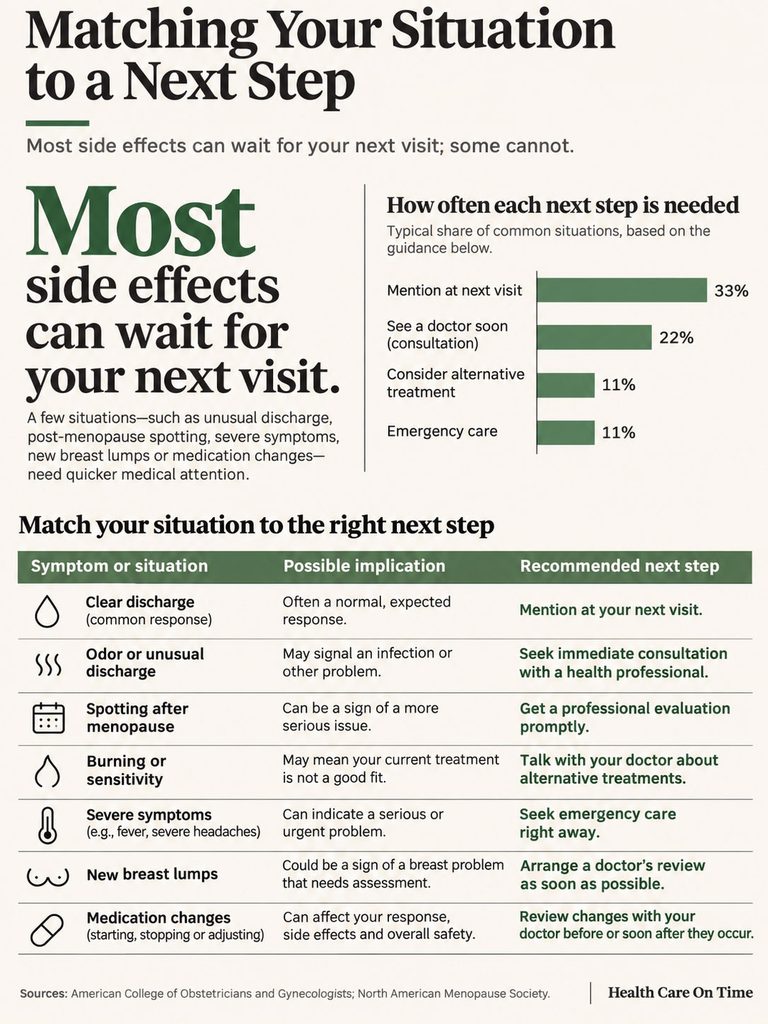
| What you notice | What it may mean | What to do |
| More clear or white discharge, no smell, in the first weeks | Common response as the lining recovers | Keep using it; mention it at your next visit |
| Discharge with odor, cottage-cheese texture, or new itching | Possible yeast or other infection | Call your doctor; with the ring, remove it until the infection is treated |
| Any spotting or bleeding after menopause | Could be fragile tissue, or a change in the uterine lining | Call your doctor; you may need an ultrasound or biopsy |
| Burning that gets worse after switching to twice-weekly use | Sensitivity to the cream base, applicator scraping, or another skin condition | Ask about switching to a different form |
| Breast tenderness or nausea with cream | Possibly more estrogen absorbed than needed | Ask whether a lower dose or a fixed-dose insert makes sense |
| Fever, vomiting, diarrhea, dizziness or a sunburn-like rash while using the ring | Possible toxic shock syndrome | Remove the ring if you can and get emergency care |
| Leg pain or swelling, chest pain, sudden shortness of breath, one-sided weakness, sudden severe headache | Possible blood clot or stroke | Call 911 |
| New breast lump, or you’re starting an aromatase inhibitor | Needs review of whether estrogen is still appropriate | See your doctor; involve your oncologist |
Questions to ask before you start or switch
Bring these to the appointment, in your own words:
- Is an insert or the ring a better fit than cream for someone who gets irritated easily?
- Which side effects in the first two weeks are normal, and which ones mean a phone call?
- With a uterus still in place, is any monitoring or a progestogen needed at this dose?
- Does this product’s label still have the old boxed warning, and does that change anything in this case?
- With a family history of blood clots, is low-dose vaginal estrogen still reasonable?
- Can this be used alongside tamoxifen or an aromatase inhibitor, and should the oncologist sign off first?
- How long should it take before the dryness and pain improve?
- If a yeast infection starts, should treatment pause or continue?
Frequently Asked Questions
Who should not use topical estrogen?
Women with unexplained vaginal bleeding, a known or suspected estrogen-dependent cancer, a past blood clot, stroke or heart attack, liver disease, or an inherited clotting disorder are listed on product labels as people who shouldn’t use it. Pregnancy and a past allergic reaction to the product rule it out too. Breast cancer survivors fall into a gray area: the labels say no, but ACOG allows low-dose vaginal estrogen after nonhormonal options fail and a careful discussion with the oncology team.
What should you avoid while using estrogen cream?
Avoid relying on latex condoms or a diaphragm, since the cream may weaken them. Don’t use more cream than prescribed, because dose-related effects like breast tenderness and spotting rise with higher amounts. Ask your doctor about grapefruit, St. John’s wort and other drugs that change how estrogen is broken down.
Should a 70-year-old woman use estrogen cream?
She can, if symptoms bother her and she has no contraindications. Guidelines set no upper age limit for low-dose vaginal estrogen, and urology guidelines recommend it for women who keep getting urinary tract infections after menopause. Older women do have higher baseline rates of breast cancer, stroke and dementia, so the decision deserves a review of her personal history, and a fixed low-dose insert or the ring may be preferred over cream.
Does topical estradiol have side effects?
Yes, mostly mild and local: discharge, itching, irritation, yeast infections and light spotting, plus occasional headache, breast tenderness or nausea.
Can vaginal estrogen cause weight gain?
Weight gain is listed among the more common side effects of vaginal estradiol in drug references, but no frequency is given, and blood estrogen levels with low-dose products stay near the postmenopausal range. Bloating or fluid retention is a more likely explanation for a quick change on the scale.
Do you need progesterone with vaginal estrogen?
Usually not with low-dose products. The Menopause Society doesn’t recommend a progestogen for low-risk women using low-dose vaginal estrogen, because trials found endometrial cancer and hyperplasia at rates similar to the general population. Some labels still suggest discussing one if you have a uterus, and women with obesity or diabetes may need monitoring. Any bleeding should be checked.
Can a partner absorb estrogen from vaginal cream?
It isn’t known. The Menopause Society lists the effect of partner absorption as unknown. Applying cream at bedtime after sex, or using an insert or the ring instead, sidesteps the question.
Is it normal to have more discharge on vaginal estrogen?
Yes. Increased discharge is the most frequently reported effect with the Estring ring, and it often resembles the discharge many women had before menopause. In the ring trials, 7% of users had it, compared with 3% on cream. Discharge with a bad smell, itching, burning or a cottage-cheese texture isn’t part of that normal change, and it should be checked for a yeast or bacterial infection, especially if you use the ring.
Medical disclaimer: This article is for general information and doesn’t replace advice from your own doctor, pharmacist or other qualified clinician. Don’t start, stop or change a prescription medicine based on this page. If you have heavy bleeding, chest pain, sudden shortness of breath, signs of stroke or symptoms of toxic shock syndrome, call 911 or go to the nearest emergency room.
References
- U.S. Food and Drug Administration. FDA Approves Labeling Changes to Menopausal Hormone Therapy Products. February 12, 2026.
- U.S. Food and Drug Administration. Menopausal Hormone Therapies with Updated Prescribing Information. Content current as of October 30, 2026.
- Pfizer. ESTRING (estradiol vaginal system) prescribing information and patient information. Revised February 2026.
- Novo Nordisk. Vagifem (estradiol vaginal inserts) prescribing information. Revised February 2024.
- TherapeuticsMD. IMVEXXY (estradiol vaginal inserts) prescribing information. Revised February 2024.
- The North American Menopause Society (now The Menopause Society). The 2020 genitourinary syndrome of menopause position statement. Menopause. 2020;27(9):976-992.
- Crandall CJ, et al. Breast cancer, endometrial cancer, and cardiovascular events in participants who used vaginal estrogen in the Women’s Health Initiative Observational Study. Menopause. 2018;25(1):11-20.
- Pinkerton JV. Is vaginal estrogen used for GSM associated with a higher risk of CVD or cancer? OBG Management. 2019;31(2). Review of Bhupathiraju SN, et al., Nurses’ Health Study, Menopause 2019.
- Cold S, et al. Systemic or Vaginal Hormone Therapy After Early Breast Cancer: A Danish Observational Cohort Study. J Natl Cancer Inst. 2022;114(10):1347-1354.
- American College of Obstetricians and Gynecologists. Treatment of Urogenital Symptoms in Individuals With a History of Estrogen-dependent Breast Cancer: Clinical Consensus No. 2. Obstet Gynecol. 2021;138(6):950-960.
- American Urological Association. Joint Clinical Guideline for Recurrent Urinary Tract Infections in Women. April 2019.
- MedlinePlus, National Library of Medicine. Estrogen Vaginal. Revised June 15, 2026.
- Mayo Clinic. Estradiol (vaginal route). Updated November 1, 2026.
- Cleveland Clinic. Estradiol Vaginal Cream.
- Contemporary OB/GYN. FDA removes boxed warnings from 3 more menopausal hormone therapy products. October 30, 2026.