Broccoli has spent decades wearing a reputation it never quite earned. Ask most Americans to name an iron-rich vegetable and broccoli lands near the top of the list, right beside spinach. The numbers tell a different story, and the gap between what people believe and what the USDA database actually shows is worth a few minutes of your attention.
Table of Contents
Quick Answer
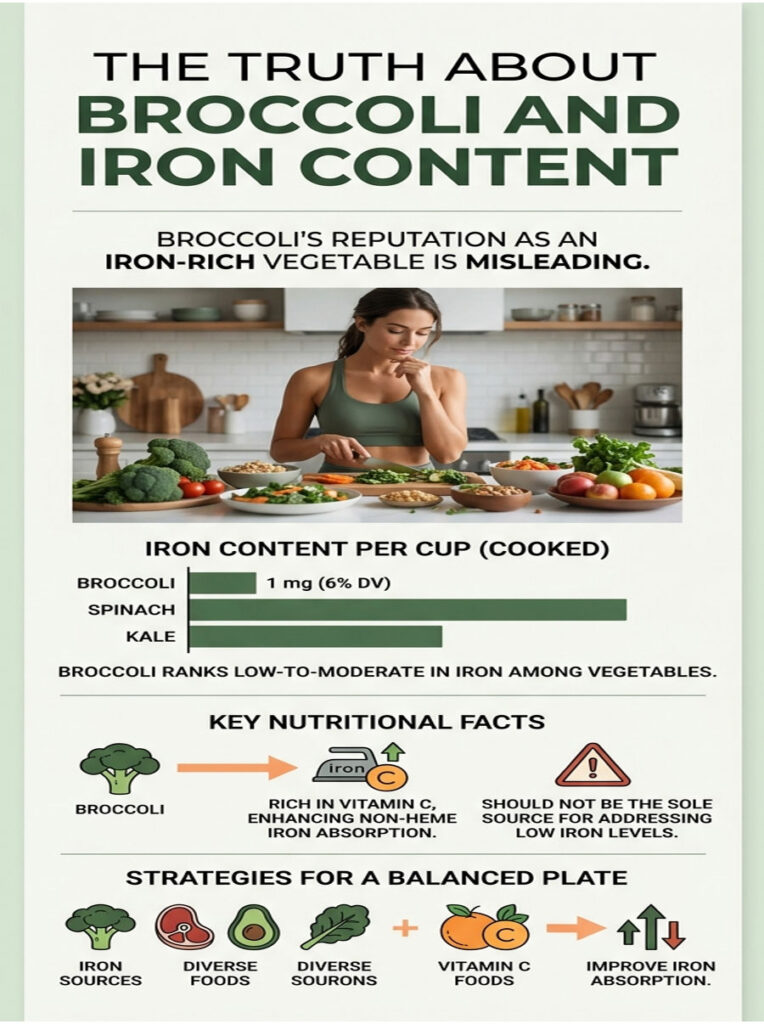
Broccoli is not high in iron. One cup of cooked broccoli contains roughly 1 mg of iron, about 6 percent of the daily value. That places it in the low-to-moderate range among vegetables. Its real strength is an exceptionally high vitamin C content, which sharply boosts your body’s absorption of non-heme iron from broccoli itself and from other foods on the same plate.
At a Glance
- Cooked broccoli holds about 1 mg of iron per cup, near 6 percent of the daily value.
- Cooked spinach has far more iron on paper, roughly 6 mg per cup.
- Cooked kale sits close to broccoli, around 1 mg per cup.
- All three contain non-heme iron, the plant form that absorbs less readily.
- Broccoli’s advantage is vitamin C, a proven booster of iron absorption.
- How you pair and cook these greens matters more than raw iron numbers.
Here is the broccoli iron content verdict in one glance, against the two greens it is most often compared with:
- Spinach leads on total iron, around 6 mg per cooked cup, but its iron is less efficiently absorbed.
- Broccoli holds about 1 mg per cooked cup, low in iron but high in absorption-boosting vitamin C.
- Kale sits near broccoli at about 1 mg per cooked cup, low in oxalate and reasonably absorbable.
If you have been eating broccoli specifically to fix a low iron reading, this guide explains what the vegetable can and cannot do, how it stacks up against spinach and kale, and how to build a plate that actually moves iron into your bloodstream.
Is Broccoli High in Iron? The Straight Answer
The honest answer disappoints a lot of people. Broccoli is a genuinely healthy vegetable, but iron is not its headline nutrient.
How Much Iron Is Actually in Broccoli
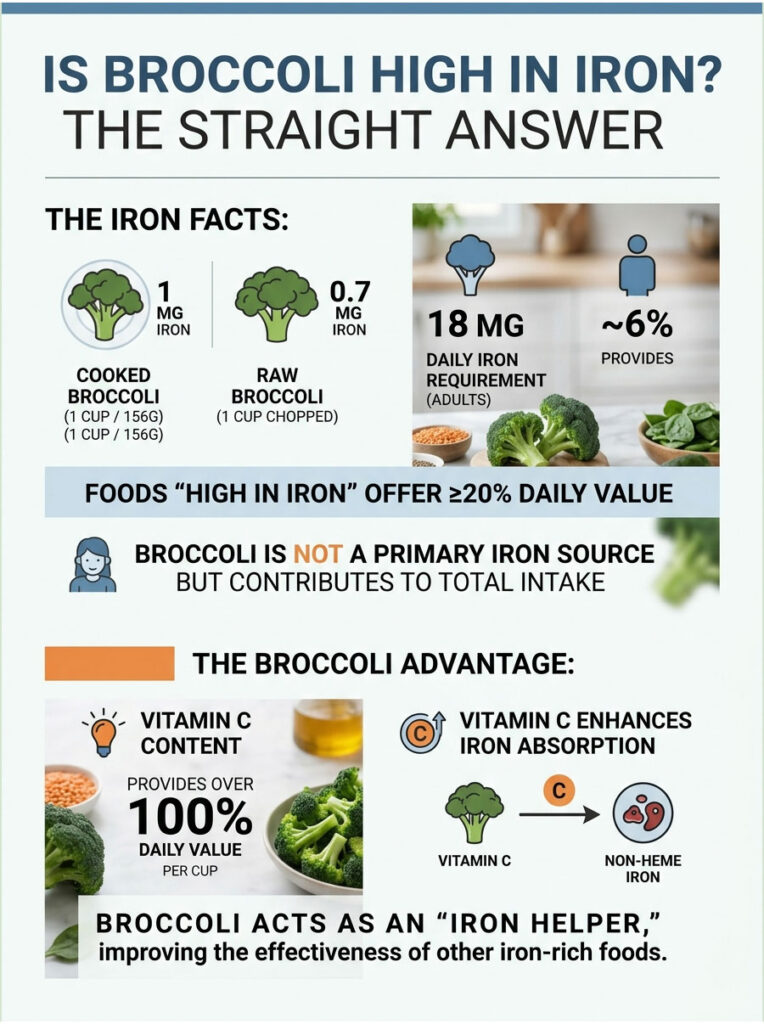
According to USDA nutrient data, a one-cup serving of cooked broccoli, about 156 grams, contains roughly 1 mg of iron. Raw chopped broccoli holds even less, closer to 0.7 mg per cup.
Cooking changes the picture slightly, and not always in the direction people expect. Some water-soluble nutrients leak out during boiling, while the concentration per cup can shift as the vegetable softens and packs down.
The practical takeaway is simple. Whether raw or cooked, a serving of broccoli delivers around 1 mg of iron, give or take. That is a modest contribution, not a powerhouse dose.
What “High in Iron” Really Means
Context is everything here. The daily value for iron used on US nutrition labels is 18 mg. The NIH sets the recommended dietary allowance at 18 mg for women aged 19 to 50 and 8 mg for adult men.
Against an 18 mg target, broccoli’s 1 mg covers about 6 percent. A food usually earns the “high” label when a serving provides 20 percent or more of the daily value.
Broccoli does not clear that bar. It is a contributor, the kind of food that adds up across a day, not a single-serving solution for someone with a real iron gap. Our medical reviewers see this misunderstanding often, when a patient assumes a daily side of broccoli will correct a low ferritin result.
Why Broccoli Still Earns a Spot in an Iron-Smart Diet
Here is where broccoli quietly redeems itself. A single cup supplies well over 100 percent of the daily value for vitamin C.
Vitamin C is one of the most reliable enhancers of non-heme iron absorption. When you eat broccoli alongside other iron sources, the vitamin C helps your body pull more iron out of the entire meal.
So broccoli is less of an iron source and more of an iron helper. Patients commonly ask us whether broccoli is “good for iron,” and the accurate answer is yes, but as a teammate rather than a star. It makes the iron in your lentils, beans, and fortified cereal work harder.
Broccoli vs Spinach vs Kale: The Iron Comparison
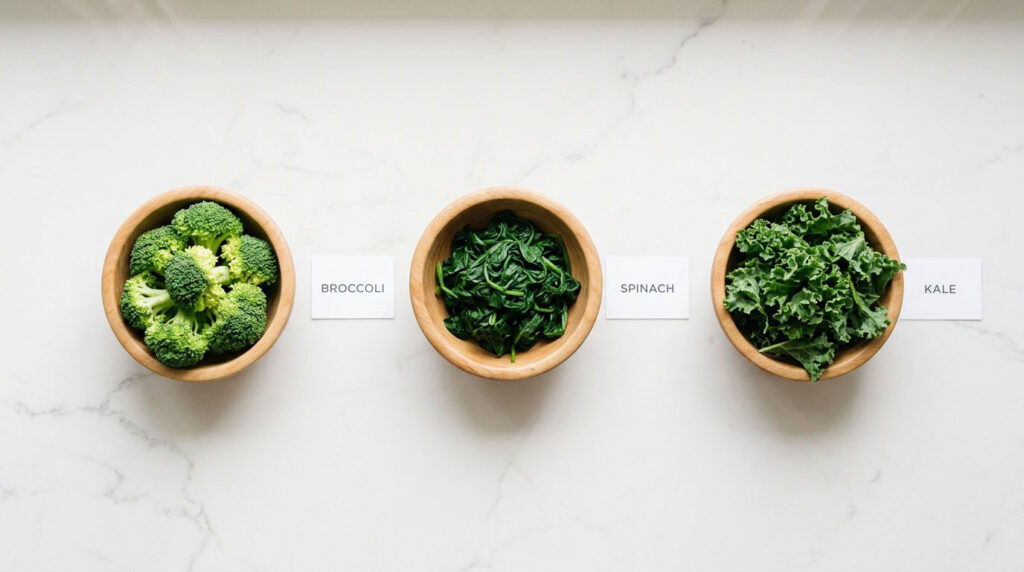
The user question pits broccoli against the two greens it is most often confused with. Putting real numbers side by side clears up years of grocery-aisle folklore.
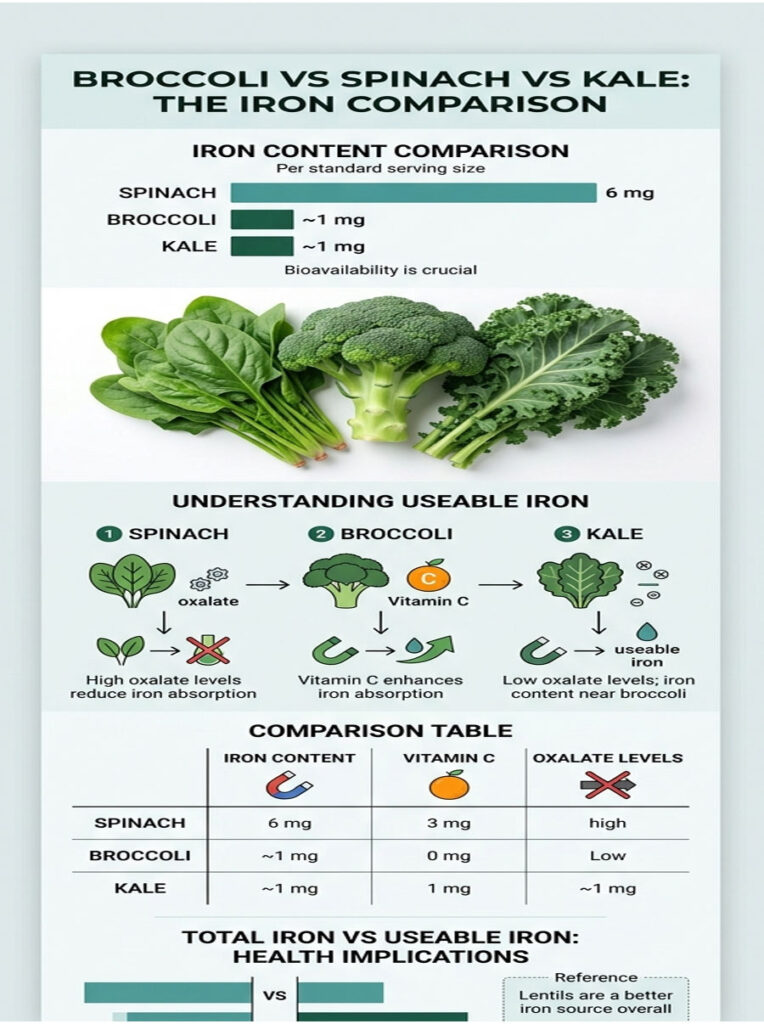
Iron Content Side by Side
On raw iron content, spinach is the clear leader. A cup of cooked spinach delivers far more iron than a cup of cooked broccoli, often cited near 6 mg, several times broccoli’s amount.
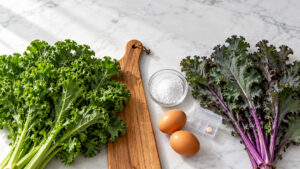
Kale surprises people. Despite its superfood image, cooked kale sits close to broccoli at roughly 1 mg of iron per cooked cup. It is not the iron giant its reputation suggests.
So on the scoreboard alone, the order is spinach first by a wide margin, then broccoli and kale running close together near the bottom.
Why the Raw Numbers Can Mislead You
Iron content on a label is only half the story. The number that matters for your blood is how much iron your body actually absorbs.
Plant foods contain non-heme iron, which is more sensitive to other compounds in the meal. Spinach holds a lot of iron, but it also carries compounds that can blunt absorption, so the usable iron is lower than the label implies.
This is the central trap of iron nutrition. A food can look impressive on a chart and still hand your body less iron than a humbler option. Our lab partners describe it as the difference between iron on the plate and iron in the bloodstream.
The Bioavailability Twist
Broccoli and kale share two quiet advantages. Both are low in oxalates, the compounds most associated with binding minerals, and broccoli in particular is rich in vitamin C.
Spinach, by contrast, is very high in oxalates and other absorption-modifying compounds. Its iron looks generous on paper but tends to be among the harder plant irons for the body to use.
The result is a more even contest than the numbers first suggest. Spinach still wins on total iron, but broccoli closes much of the real-world gap through better absorbability and built-in vitamin C.
Table 1: Iron and Absorption Profile of Common Greens and References
| Food (1 cup, cooked) | Iron Content | Iron, Raw (per cup) | Vitamin C | Oxalate Level | Notes |
| Broccoli | About 1 mg (~6% DV) | About 0.7 mg | Over 100% DV | Low (~2 mg/cup) | Low iron, strong vitamin C, highly usable |
| Spinach | About 6 mg (~33% DV) | About 0.8 mg raw | Moderate | Very high | High iron on paper, lower real-world absorption |
| Kale | About 1 mg (~6% DV) | About 1 mg | Over 100% DV | Low (~2 mg/cup) | Iron similar to broccoli, very low oxalate |
| Brussels sprouts | Almost 2 mg (~11% DV) | About 1.2 mg | High | Low | A stronger cruciferous iron option |
| Lentils | About 6.6 mg (~37% DV) | Not eaten raw | Low | Low-moderate | A true high-iron plant food for comparison |
The table makes the verdict visual. Among the greens, spinach leads on quantity, broccoli and kale trail, and a serving of lentils outperforms all three vegetables combined.
Heme vs Non-Heme Iron and Why Absorption Matters
To understand why broccoli’s iron behaves the way it does, you need to know that not all dietary iron is the same. The form matters as much as the amount.
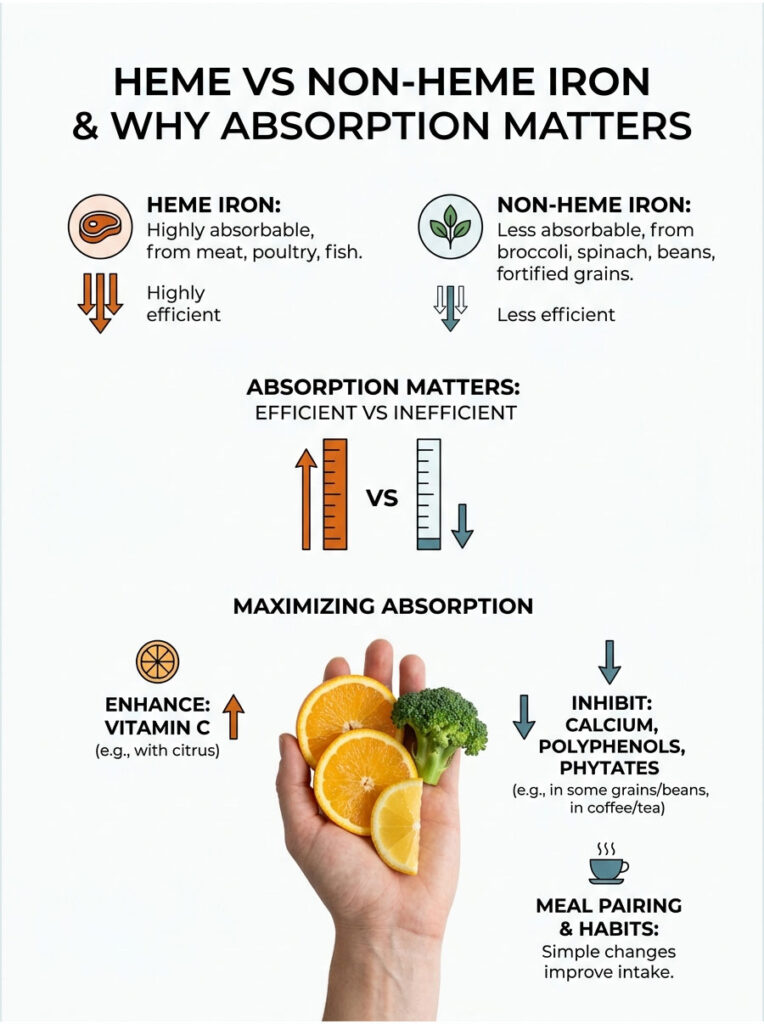
The Two Types of Dietary Iron
Iron in food comes in two varieties. Heme iron is found in animal foods such as meat, poultry, and fish, and the body absorbs it efficiently and consistently.
Non-heme iron is the plant form, found in broccoli, spinach, kale, beans, and fortified grains. It is also the iron added to most supplements and cereals.
Non-heme iron is more temperamental. Its absorption can swing widely depending on what else you eat in the same meal, which is both its weakness and, with the right pairings, an opportunity.
What Helps Non-Heme Iron Absorption
Vitamin C is the standout enhancer. According to the NIH Office of Dietary Supplements, vitamin C can substantially increase the absorption of non-heme iron when the two are eaten together.
This is broccoli’s genuine claim to fame. Its heavy vitamin C load means that even the modest iron it contains is comparatively well absorbed, and it lifts iron uptake from companion foods too.
Certain organic acids and the simple presence of meat, poultry, or fish in a meal can also raise non-heme iron absorption. The pattern is clear: pairing is a tool you control.
What Hinders Non-Heme Iron Absorption
Several common foods and compounds pull in the other direction. Calcium can compete with iron for absorption, so a large glass of milk is not the ideal partner for an iron-focused meal.
Polyphenols in coffee and tea, and phytates in some whole grains and legumes, can also reduce how much non-heme iron the body takes up. Timing helps here, since spacing coffee away from your iron-rich meals limits the effect.
In cases reviewed by our medical team, simple habit changes, like moving the afternoon coffee away from the iron-heavy lunch, often matter more than swapping one vegetable for another.
The Spinach Oxalate Myth, Explained
Few nutrition beliefs are as sticky as the idea that spinach iron is useless because of oxalates. The real science is more interesting and more nuanced than the myth.
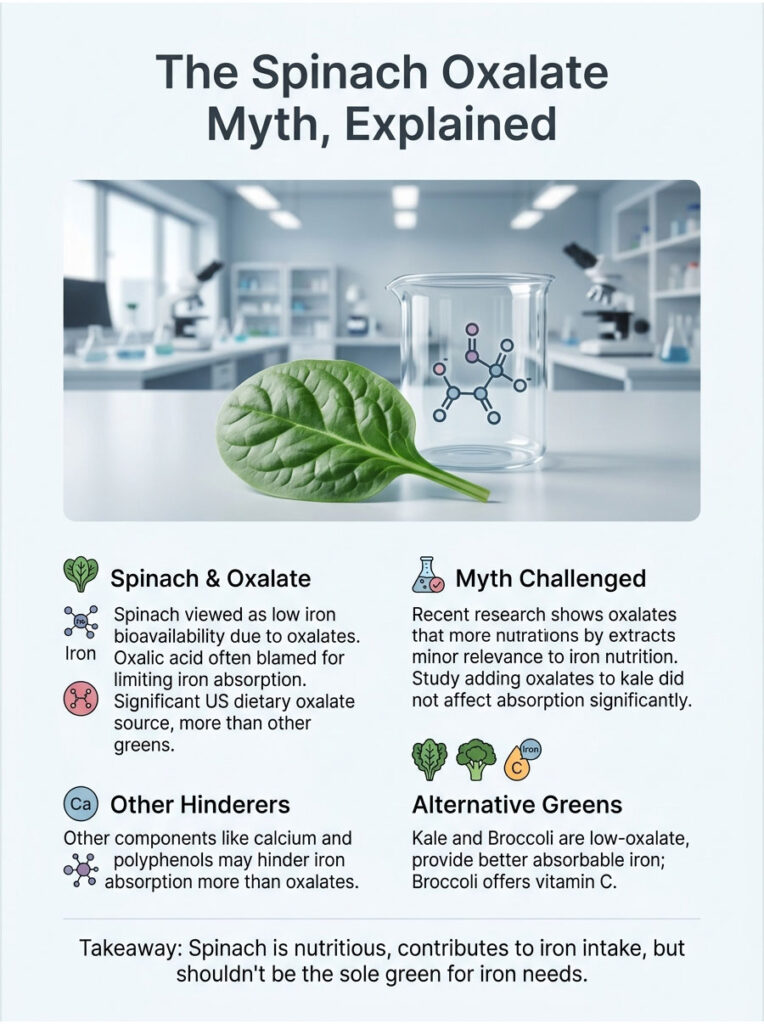
Why Spinach Iron Is Famously “Locked Up”
For decades, spinach has been described as an iron food whose iron you cannot reach. The blame usually falls on oxalic acid, a compound spinach contains in large amounts.
Spinach genuinely is an oxalate outlier. Harvard nutrition data and other sources note that spinach may account for a large share of total dietary oxalate intake in the United States, far more than greens like kale.
Oxalates can bind minerals in the gut, and that is the basis of the lore. The popular version says the oxalates in spinach simply trap its iron.
What Recent Research Actually Shows
The picture is less tidy than the myth. A controlled study published in the European Journal of Clinical Nutrition compared iron absorption from kale and spinach meals.
Researchers found that adding oxalate to a kale meal did not meaningfully change iron absorption. Their conclusion was that oxalic acid in fruits and vegetables is of minor relevance to iron nutrition.
So why is spinach iron still less absorbable? The same line of research points to other components of spinach, such as its calcium and polyphenol content, as more likely contributors. The headline oxalate explanation is, at best, incomplete.
Where Kale and Broccoli Win on Absorbability
Whatever the precise mechanism, the practical outcome holds. Iron from spinach tends to be absorbed less efficiently than iron from kale.
Kale and broccoli are both low-oxalate, and broccoli adds its vitamin C bonus on top. For someone who wants iron they can actually use, these two greens punch above what their small numbers suggest.
The lesson our medical reviewers draw is not “avoid spinach.” Spinach remains nutritious and still contributes iron. The lesson is to stop treating any single green as a complete iron strategy.
How to Get the Most Iron From Broccoli and Greens
If broccoli is a helper rather than a hero, the smart move is to use it strategically. A few habits turn modest vegetable iron into meaningful absorbed iron.
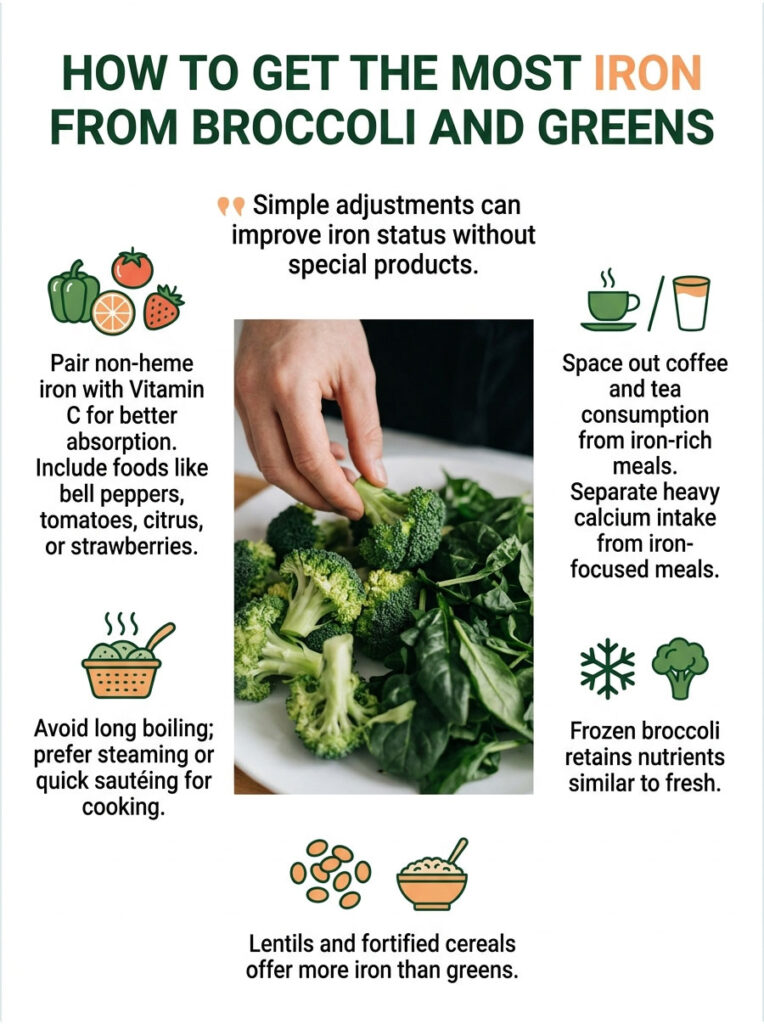
Pair Non-Heme Iron With Vitamin C
This is the single highest-value habit. Eating vitamin C alongside a non-heme iron source increases how much iron your body captures.
Broccoli does this work automatically because it carries both. But you can extend the trick: add bell peppers, tomatoes, citrus, or strawberries to a meal built around lentils, beans, tofu, or fortified cereal.
A squeeze of lemon over a lentil bowl is not a garnish, it is a functional choice. Patients commonly ask us for one easy rule, and this is it: never eat plant iron alone if you can pair it with vitamin C.
Cooking Methods That Protect Iron and Nutrients
How you cook matters, mostly for the vitamin C that makes the iron work. Vitamin C is sensitive to heat and water, so long boiling in lots of water leaches it away.
Steaming or quick sauteing protects more of broccoli’s vitamin C than a long boil. The shorter the heat exposure, the more of the absorption-boosting nutrient survives.
Frozen broccoli is a legitimate option here. It retains nutrient levels close to fresh, which makes it a practical year-round choice rather than a compromise.
What to Keep Away From Your Iron-Rich Meals
Timing protects your effort. Coffee and tea contain polyphenols that suppress non-heme iron absorption, so it helps to drink them between meals rather than with them.
A heavy calcium load, such as a large dairy serving or a calcium supplement, is also better separated from your most iron-focused meal. You do not need to avoid these foods, only to space them out.
These adjustments cost nothing and require no special products. Across patients our diagnostic network serves, this kind of meal-timing tweak is one of the most underused tools for improving iron status.
Table 2: Iron Content of Common Plant Foods (USDA-Based)
| Food | Iron Per Serving | Percent Daily Value | Source |
| Cooked broccoli (1 cup) | About 1 mg | About 6% | USDA FoodData Central |
| Cooked spinach (1 cup) | About 6 mg | About 33% | USDA FoodData Central |
| Cooked kale (1 cup) | About 1 mg | About 6% | USDA FoodData Central |
| Cooked lentils (1 cup) | About 6.6 mg | About 37% | USDA FoodData Central / NIH |
| Fortified breakfast cereal (1 serving) | Often around 10 mg | About 50% or more | NIH Office of Dietary Supplements |
The contrast is instructive. If your goal is raw iron quantity, lentils and fortified cereal do far more heavy lifting than any single green, broccoli included.
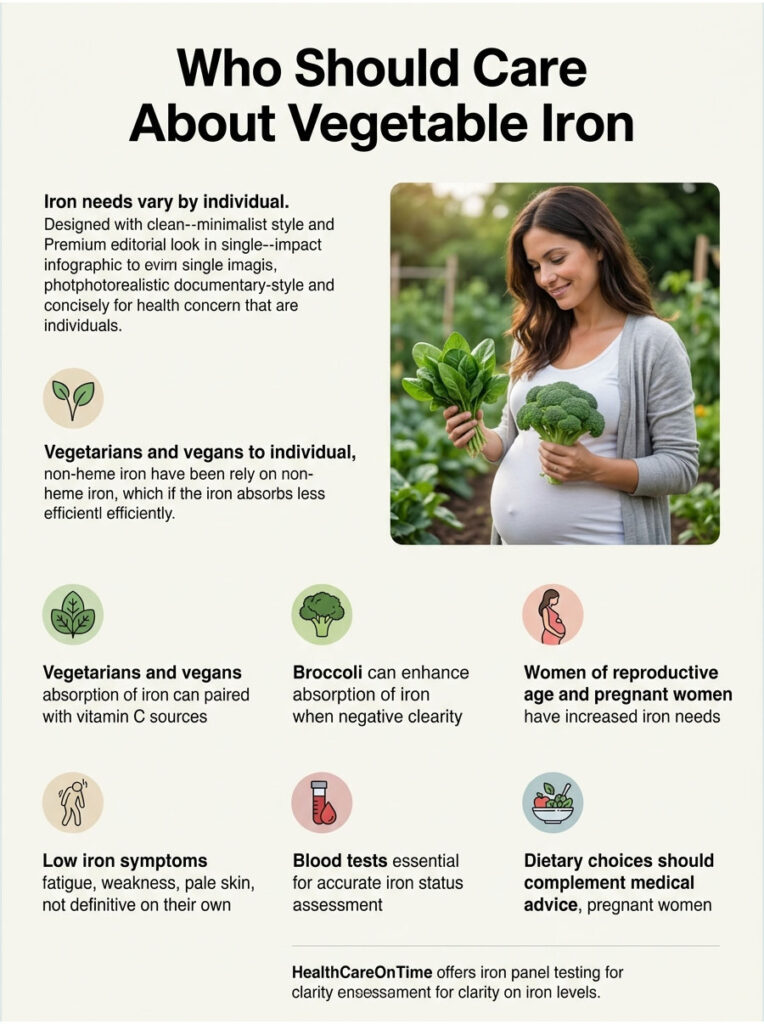
Who Should Care About Vegetable Iron
Iron needs are not uniform. For some people, vegetable iron is a minor detail, while for others it deserves real attention.
Vegetarians and Vegans
People who avoid meat rely entirely on non-heme iron, the form that absorbs less efficiently. The NIH notes that iron needs are effectively higher for those eating no meat, since plant iron is used less readily.
For this group, broccoli’s role makes more sense. It will not supply large amounts of iron, but its vitamin C improves absorption across an entire plant-based plate.
A plant-based eater is better served by building meals around lentils, beans, tofu, and fortified grains, then using broccoli, kale, peppers, and citrus as the vitamin C layer that lifts the whole meal.
Women of Reproductive Age and Pregnancy
Iron needs rise sharply for women who menstruate and rise further during pregnancy. This is the group most likely to run low.
For a woman with a known iron gap, a side of broccoli is not a treatment. It is a supportive habit that should sit alongside iron-dense foods and, where a provider advises it, supplementation.
Our medical reviewers stress that pregnancy iron needs in particular should be guided by a clinician, not self-managed through vegetable choices alone.
Signs of Low Iron and When Testing Makes Sense
Low iron can show up as persistent fatigue, weakness, pale skin, shortness of breath on light activity, cold hands and feet, or unusual cravings for ice. None of these is proof of a deficiency on its own.
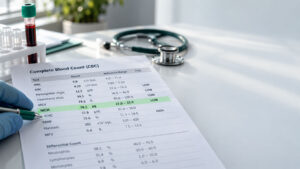
The only reliable way to know your iron status is a blood test. A provider can check markers such as hemoglobin and ferritin, the storage form of iron, to see the full picture.
If symptoms like these sound familiar, a simple iron panel through HealthCareOnTime can turn guesswork into a clear answer. Eating more broccoli is no substitute for knowing your actual numbers.
Building an Iron-Smart Plate
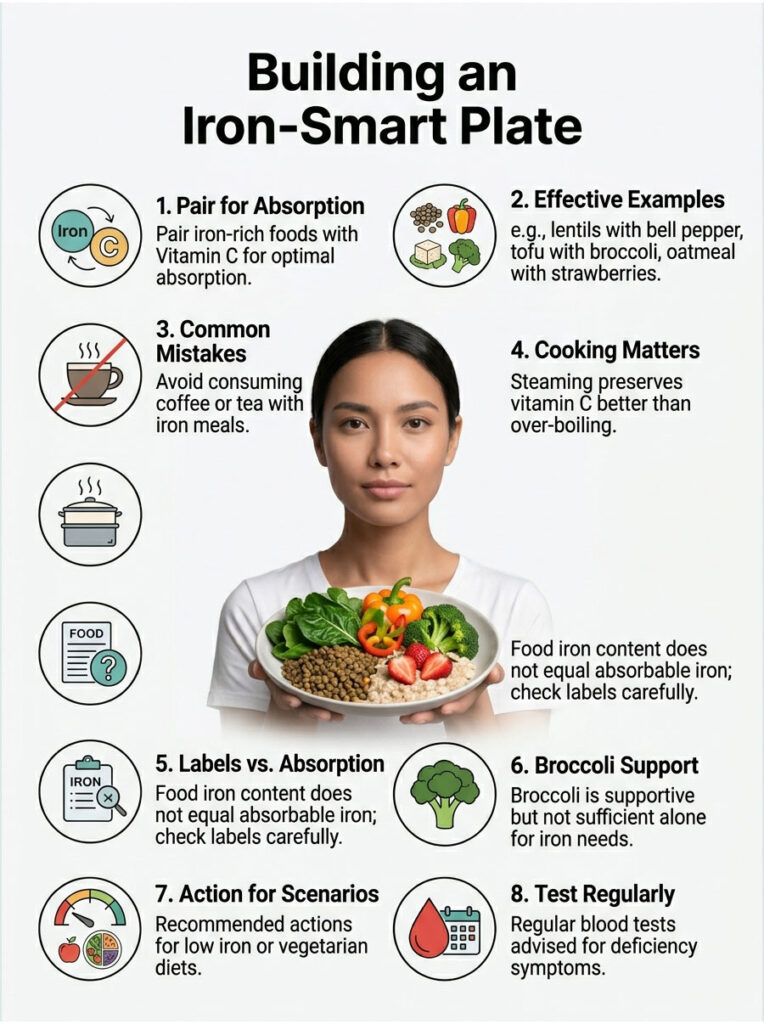
Knowing the science is one thing. Turning it into dinner is another. The good news is that an iron-smart plate is straightforward once a few principles click.
Sample Pairings That Work
Think in combinations rather than single foods. A lentil and vegetable bowl with broccoli, bell pepper, and a squeeze of lemon stacks iron and vitamin C in one dish.
A tofu and broccoli stir-fry pairs a solid plant protein and iron source with broccoli’s vitamin C. Fortified oatmeal topped with strawberries pairs a high-iron base with a vitamin C fruit.
The pattern repeats: an iron-dense anchor, a vitamin C partner, and minimal absorption blockers at that meal. Broccoli slots naturally into the partner role again and again.
Common Mistakes That Waste Plant Iron
The biggest mistake is treating one vegetable as an iron plan. No single green, broccoli or otherwise, carries enough iron to fix a genuine shortfall.
A second mistake is washing an iron-rich meal down with coffee or tea, which quietly suppresses absorption. A third is over-boiling vegetables until much of the vitamin C is gone.
A fourth is assuming the food label number equals what you absorb. As the spinach case shows, the gap between content and usable iron can be large. Awareness of that gap is itself a tool.
Table 3: Iron Strategy Decision Guide
| Scenario | Likely Issue | Recommended Action |
| Eating broccoli daily to fix low iron | Broccoli is too low in iron to correct a deficit | Add lentils, beans, tofu, or fortified grains as the iron base |
| Plant-based diet, unsure about iron | Non-heme iron absorbs less efficiently | Pair every iron source with a vitamin C food at the same meal |
| Iron-rich meal with coffee or tea | Polyphenols suppress absorption | Move coffee and tea to between meals, not with them |
| Fatigue, pallor, or breathlessness | Possible iron deficiency | Get a blood test for hemoglobin and ferritin before self-treating |
| Boiling broccoli for a long time | Vitamin C and absorption benefit lost | Steam or quickly saute to protect vitamin C |
The throughline is consistent. Broccoli helps an iron-smart plate, but the plate needs an iron-dense anchor, a vitamin C partner, and a test result when symptoms appear.
Frequently Asked Questions
Is broccoli or spinach higher in iron?
Spinach is higher in iron. A cup of cooked spinach contains roughly 6 mg, while a cup of cooked broccoli holds about 1 mg. However, spinach iron is less efficiently absorbed, so the real-world gap is smaller than the raw numbers suggest.
How much iron is in a cup of broccoli?
One cup of cooked broccoli contains about 1 mg of iron, roughly 6 percent of the 18 mg daily value. Raw chopped broccoli has slightly less, closer to 0.7 mg per cup. Either way, broccoli is a modest iron contributor, not a high-iron food.
Does cooking broccoli reduce its iron?
Cooking has a limited effect on broccoli’s iron itself, though some nutrients leach into cooking water. The bigger concern is vitamin C, which is heat-sensitive. Long boiling reduces the vitamin C that boosts iron absorption, so steaming or quick sauteing is the better choice.
Is kale a good source of iron?
Kale is only a modest source of iron, holding about 1 mg per cooked cup, similar to broccoli. Its strength is low oxalate content and good overall absorbability, so the iron it does contain tends to be relatively usable, but the total amount remains small.
Can broccoli help with anemia?
Broccoli alone cannot treat anemia, since it contains too little iron to correct a true deficiency. It can support an iron-smart diet because its vitamin C improves absorption of iron from other foods. Anemia should be diagnosed and managed by a healthcare provider.
Why is spinach iron poorly absorbed?
Spinach iron is non-heme iron, which absorbs less efficiently in general. Spinach was long blamed on oxalates, but controlled research suggests oxalic acid plays only a minor role. Other components, such as calcium and polyphenols, are more likely reasons its iron is less available.
Which green has the most absorbable iron?
Among common greens, kale and broccoli offer relatively usable iron because they are low in oxalate, and broccoli adds vitamin C that boosts uptake. Spinach has more total iron, but a lower absorbed fraction. For absorbable iron, no single green beats pairing greens with iron-dense foods.
Is raw or cooked broccoli better for iron?
The iron difference between raw and cooked broccoli is small. What matters more is preserving vitamin C, which aids absorption. Light cooking such as steaming keeps more vitamin C than long boiling, while raw broccoli retains the most. Both forms are reasonable choices.
Does broccoli have enough iron for vegetarians?
Not on its own. Vegetarians rely on non-heme iron and have higher effective iron needs. Broccoli is a useful vitamin C partner, but the iron base of a vegetarian diet should come from lentils, beans, tofu, fortified grains, and similar iron-dense plant foods.
What vegetable is highest in iron?
Among everyday vegetables, cooked spinach ranks high for total iron. Legumes such as lentils, while technically not vegetables, far outperform leafy greens, with cooked lentils near 6.6 mg per cup. Broccoli is a low-to-moderate option by comparison.
Does vitamin C in broccoli really boost iron absorption?
Yes. Vitamin C is a well-documented enhancer of non-heme iron absorption, and broccoli supplies over 100 percent of the daily value per cup. Eaten with iron-rich foods, that vitamin C helps your body capture more iron from the whole meal.
Should you take an iron supplement instead of eating greens?
Not without guidance. Iron supplements help some people but can cause side effects and are unnecessary or even harmful for those who are not deficient. A blood test and a provider’s advice should come first. Food-based iron remains a sound everyday strategy.
Disclaimer
This article is for general informational purposes only and does not constitute medical or dietary advice. It is not a substitute for professional diagnosis or treatment. Iron needs vary by age, sex, life stage, and health status. Consult a qualified healthcare provider before making major dietary changes, starting an iron supplement, or self-treating suspected anemia, and ask about a blood test to confirm your iron status.
References
- Iron: Fact Sheet for Health Professionals — NIH Office of Dietary Supplements
- FoodData Central — U.S. Department of Agriculture
- Oxalic acid does not influence nonhaem iron absorption in humans: a comparison of kale and spinach meals — European Journal of Clinical Nutrition
- Iron — The Nutrition Source, Harvard T.H. Chan School of Public Health
- Iron-Deficiency Anemia — Mayo Clinic