Ounce for ounce, one green kiwi carries more vitamin C than a whole orange. Gold kiwi carries nearly three times as much. That single fact upends what most Americans assume about which fruit tops the vitamin C list.
Table of Contents
Quick Answer: Kiwi fruit is a nutrient-dense fruit rich in vitamin C, fiber, potassium, and antioxidants. Backed by human trials, its main health benefits include stronger immune defense, relief from constipation, better sleep quality, improved mood, and support for heart and digestive health. One medium green kiwi delivers about 64 mg of vitamin C for just 42 calories, making it one of the most nutrient-efficient fruits you can eat.
At a Glance
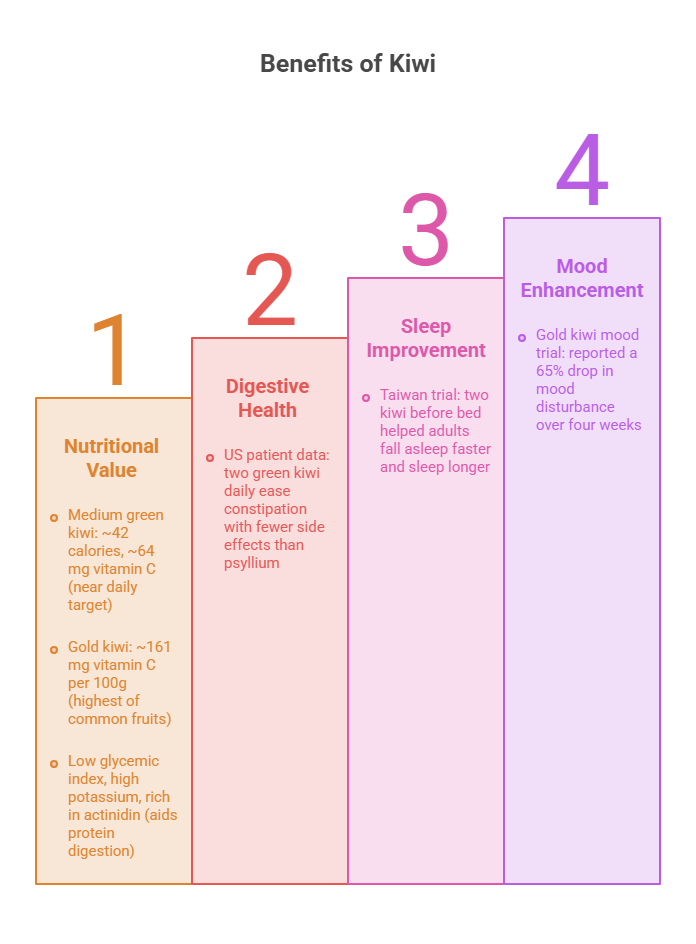
- One medium green kiwi holds roughly 42 calories and about 64 mg of vitamin C, close to a full day’s target.
- Gold kiwi carries around 161 mg of vitamin C per 100 grams, the highest of any common fruit.
- US patient data shows two green kiwi daily ease constipation with fewer side effects than psyllium.
- A Taiwan trial found two kiwi before bed helped adults fall asleep faster and sleep longer.
- A gold kiwi mood trial reported a 65% drop in mood disturbance over four weeks.
- Kiwi is low on the glycemic index, high in potassium, and rich in actinidin, an enzyme that aids protein digestion.
Kiwi fruit punches far above its size. This small, fuzzy fruit packs vitamins, minerals, fiber, and plant compounds that few other fruits can match, all for fewer than 65 calories per fruit.
Most fruit advice stops at “eat more of it.” This guide goes further. Below you’ll find the nine health benefits of kiwi that actually hold up in human research, the exact amounts used in those studies, and how to pick, store, and eat kiwi so none of that nutrition goes to waste.
What Makes Kiwi Fruit So Nutrient-Dense
Kiwi belongs to the genus Actinidia, native to the mountains of southwest China, where it grew as a wild vine once called the Chinese gooseberry. It reached New Zealand in 1904 and was later renamed after the country’s flightless bird.
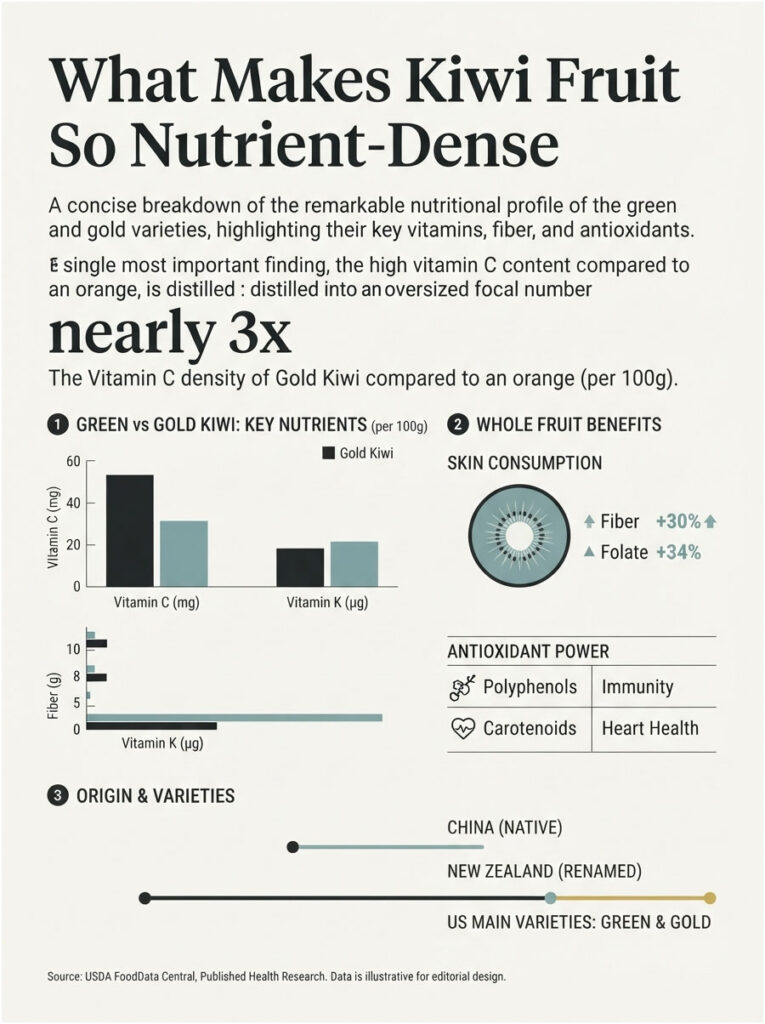
Two varieties dominate US produce aisles. Green kiwi (Actinidia deliciosa, the fuzzy Hayward type) has tart, emerald flesh and a bright, tangy flavor. Gold kiwi (Actinidia chinensis, sold as SunGold) has smoother bronze skin, sweeter yellow flesh, and even more vitamin C.
Both are low in calories yet dense in nutrients. Our nutrition team points out that few fruits deliver this much vitamin C, fiber, and potassium in one serving under 65 calories.
What sets kiwi apart is the combination. Plenty of fruits are high in one nutrient. Kiwi stacks vitamin C, fiber, potassium, vitamin K, folate, and vitamin E together, alongside enzymes and plant compounds that most fruits lack entirely.
Green Kiwi vs Gold Kiwi vs Orange
The comparison below uses data from USDA FoodData Central per 100 grams of edible fruit. The vitamin C gap between kiwi and orange is the headline most people get wrong.
Table 1. Nutrition Comparison Per 100 Grams
| Nutrient | Green Kiwi | Gold Kiwi (SunGold) | Navel Orange |
| Calories | 61 | 63 | 47 |
| Vitamin C (mg) | 93 | 161 | 59 |
| Fiber (g) | 3.0 | 1.4 | 2.4 |
| Potassium (mg) | 312 | 315 | 181 |
| Vitamin K (mcg) | 40 | 6 | 0 |
| Folate (mcg) | 25 | 31 | 30 |
| Vitamin E (mg) | 1.5 | 1.4 | 0.2 |
| Sugar (g) | 9 | 12 | 9 |
Green kiwi wins on fiber and vitamin K. Gold kiwi wins on vitamin C, holding almost three times the amount in an orange by weight. Both beat the orange handily on potassium and vitamin E.
A Word on Antioxidants
Kiwi’s benefits go beyond the vitamins on a label. It carries polyphenols like caffeic and chlorogenic acid, plus carotenoids and vitamin E, which together act as antioxidants that help neutralize cell-damaging free radicals.
Some research suggests kiwi’s total antioxidant capacity ranks higher than apples, pears, and grapefruit. That antioxidant load is part of why kiwi shows up in studies on immunity, mood, and heart health, not just digestion.
Can You Eat the Skin?
Yes, and it’s worth trying. Much of a kiwi’s fiber and folate sits in the skin. Eating whole SunGold kiwi, skin included, raises fiber, vitamin E, and folate by roughly 50%, 32%, and 34% according to a review in Nutrients.
Gold kiwi skin is thin and nearly hairless, so it’s easier to eat than the fuzzy green type. Just wash it under running water first. Patients booking tests with us often ask whether peeling wastes nutrients, and the honest answer is that it does.
The 9 Science-Backed Benefits of Kiwi Fruit
1. Exceptional Vitamin C for Immune Defense
Vitamin C supports both innate and adaptive immunity, helps the body absorb plant-based iron, and drives collagen production. The daily target in the US is 90 mg for men and 75 mg for women.
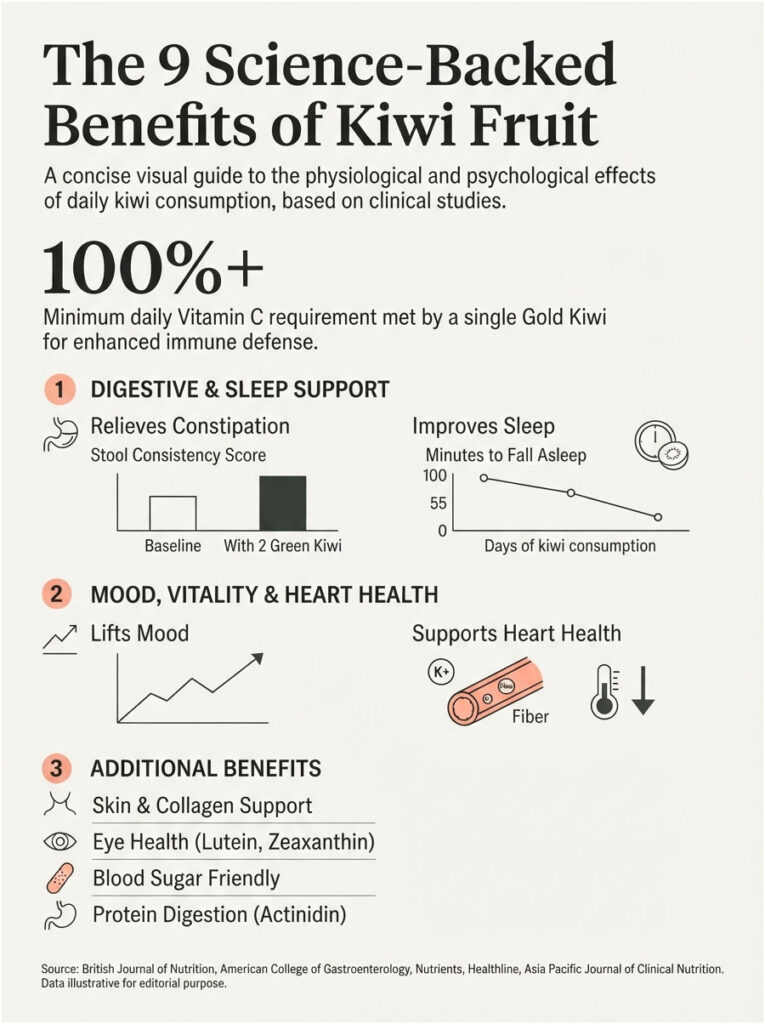
A single gold kiwi clears that bar on its own. Two green kiwi easily exceed it. That density matters because vitamin C is water-soluble and not stored, so daily intake counts far more than an occasional large dose.
In one trial, adults eating two kiwi daily raised plasma vitamin C to near-saturation levels. That is the point where the body’s tissues are effectively full, and it’s hard to reach with a typical diet.
Kiwi’s immune payoff shows up in trials too. When adults over 65 ate the equivalent of four gold kiwi daily for four weeks, they reported shorter, less severe head congestion and sore throat than when they ate bananas, alongside a rise in plasma vitamin C, per the British Journal of Nutrition. The fruit did not stop colds outright, but it eased the symptoms that make them miserable.
Our medical reviewers note that food-based vitamin C often performs as well as or better than isolated supplements, likely because it arrives alongside fiber, flavonoids, and other cofactors. A kiwi is a whole-food vitamin C source in a way a tablet is not.
2. Relieves Constipation Better Than You’d Expect
This is kiwi’s strongest evidence base, and part of it comes from US patients. In a trial at a US medical center, adults with chronic constipation ate two green kiwi, 100 g of prunes, or 12 g of psyllium daily for four weeks.
All three increased weekly bowel movements significantly. But kiwi improved stool consistency, reduced straining, and eased bloating, with the fewest side effects and the lowest dropout rate, per the American College of Gastroenterology.
An international multicenter trial published in the American Journal of Gastroenterology confirmed that two green kiwi daily improved constipation and abdominal comfort in patients across multiple countries.
Kiwi works through two mechanisms. Its fiber and water-holding compounds draw fluid into the small intestine and increase colonic volume, softening stool without speeding transit so aggressively that it causes cramping. That gentleness is why trial participants tolerated kiwi better than fiber supplements.
Across the cases our diagnostic network reviews, patients often abandon psyllium because of bloating and gas. A food they can eat as a snack, with results inside a month, is far easier to sustain.
3. May Improve Sleep Quality
The sleep link started with a Taiwan trial in adults who had sleep problems. Eating two kiwi about an hour before bed for four weeks helped participants fall asleep faster, sleep longer, and wake less during the night, reported by researchers in the Asia Pacific Journal of Clinical Nutrition.
Researchers point to kiwi’s serotonin and antioxidant content as possible drivers. A New Zealand study using digestive-tracking and metabolite analysis found kiwi shifted serotonin and melatonin markers tied to the sleep cycle, offering a plausible mechanism.
The picture is not unanimous. A 2024 pilot trial in young women showed only modest, mixed effects, and researchers stress that sample sizes so far are small.
Our medical reviewers note the evidence is promising but not settled, so treat kiwi as a low-risk sleep aid worth trying rather than a guaranteed fix. Since it carries no downside for most people, a two-kiwi evening snack is a reasonable experiment.
4. Supports Heart Health
Kiwi feeds the heart through several channels. Its potassium helps counter sodium and regulate blood pressure, while its soluble fiber helps lower LDL, the harmful cholesterol.
A review of 69 studies found that higher intake of carotenoids, vitamin C, and vitamin E, all present in kiwi, tracked with lower risk of heart disease, cancer, and death from all causes, as summarized by Healthline.
Some research also suggests kiwi can raise HDL, the protective cholesterol, and reduce blood clotting tendency thanks to its potassium and plant compounds. Those effects together ease strain on the circulatory system.
Across the cases our diagnostic network reviews, patients managing blood pressure often benefit from swapping processed, sodium-heavy snacks for potassium-rich fruit like kiwi. It’s a small change that nudges two heart risk factors at once.
5. Lifts Mood and Vitality
Kiwi’s effect on mood surprised even the researchers. In a crossover trial, adults with mild mood disturbance ate two SunGold kiwi daily for four weeks, then compared it to their usual diet.
Total mood disturbance dropped 65.2%, wellbeing rose 10.5%, and vitality climbed 17.3%, all statistically significant, per a study in Nutrients. Plasma vitamin C rose 27.5% over the same period.
Low vitamin C status is linked to fatigue and low mood, so restoring it may partly explain the lift. Vitamin C is also involved in making neurotransmitters like dopamine, which ties diet directly to mental energy.
This was a small, unblinded trial, so the effect deserves caution. Still, the size of the mood improvement is hard to ignore, and it lines up with the broader research on vitamin C and wellbeing.
6. Aids Protein Digestion With Actinidin
Green kiwi contains actinidin, a natural enzyme that breaks down protein. It works much like the enzymes in papaya and pineapple, splitting proteins into smaller pieces the body absorbs more easily.
In a study using digestive-tracking technology, adding Hayward kiwi to a high-protein steak meal supported protein breakdown and gastric comfort, reported in Nutrients. That may help people who feel heavy or bloated after protein-rich meals.
There’s a catch worth knowing. Gold SunGold kiwi has very little actinidin, so green kiwi is the better choice for digestion support.
A green kiwi after a big steak or protein-heavy dinner is a simple, food-first way to put that enzyme to work. Readers who consult HealthCareOnTime often ask for practical swaps like this, and this one costs nothing to try.
7. Skin and Collagen Support
Collagen gives skin its structure and helps wounds heal, and the body cannot make collagen without vitamin C. Kiwi’s high vitamin C content directly feeds that process.
Its antioxidants also help defend skin cells against oxidative stress from sun exposure and pollution, the same free-radical damage that accelerates visible aging. Gold kiwi’s carotenoids add pigment compounds tied to skin health.
Vitamin E, which kiwi supplies in higher amounts than most fruit, works alongside vitamin C to protect skin-cell membranes. The two antioxidants regenerate each other, making the pair more effective together.
None of this replaces sunscreen or a dermatologist’s care. But a vitamin C and E-rich diet is a genuine, evidence-based foundation for skin repair, and kiwi delivers both in one bite.
8. Eye Health From Lutein and Zeaxanthin
Kiwi supplies lutein and zeaxanthin, two carotenoids that concentrate in the retina and help filter harmful blue light. Diets rich in these compounds are associated with lower risk of age-related macular degeneration, a leading cause of vision loss in older Americans.
Gold kiwi, with its yellow pigment, is especially rich in these carotenoids. Because they are fat-soluble, pairing kiwi with a little healthy fat, like nuts or yogurt, improves how much your body absorbs.
Our medical reviewers note that no single fruit protects vision on its own. Kiwi fits into a broader pattern of colorful, plant-rich eating that research consistently links to healthier aging eyes.
9. Blood Sugar Friendly and Weight Conscious
Kiwi tastes sweet but sits low on the glycemic index, meaning it raises blood sugar slowly rather than spiking it. Its fiber slows sugar absorption, and its high water content adds volume without heavy calories.
At about 42 calories per medium fruit, kiwi fits most balanced eating plans, including those focused on weight management. Registered dietitians widely rank it as a smart fruit for blood sugar control.
For anyone watching glucose, pairing kiwi with protein or nuts flattens the blood sugar response even further. The combination slows digestion and keeps energy steadier between meals.
Whole fruit beats juice here every time. Juicing strips the fiber that makes kiwi blood-sugar friendly, leaving concentrated sugar behind. Eating the whole fruit keeps the benefit intact.
What the US Data Says About Digestive Health
Constipation is one of the most common digestive complaints in the country, and the burden is heavier than most people realize. The numbers below show why a food-first option like kiwi matters to so many households.
Table 2. US Constipation Burden and Kiwi Trial Outcomes
| Metric | Figure | Source |
| US adults with chronic idiopathic constipation | 9% to 20% (avg ~15%) | NIH / PMC |
| Annual direct cost per patient | $1,900 to $12,000 | NIH / PMC |
| US ambulatory and ER visits for constipation (2010) | 2.8 million | NIH / PMC |
| Weekly bowel movements, 3 gold kiwi/day vs baseline | 6.3 vs 3.3 | Br J Nutrition |
| Side-effect rate, kiwi vs psyllium and prunes | Lowest of the three | Am J Gastroenterol |
The pattern is consistent across trials. Kiwi matches proven treatments like psyllium and prunes for bowel frequency while causing fewer side effects and less dissatisfaction.
That difference matters over months, not just weeks. A remedy people actually enjoy eating gets used, while a supplement that causes bloating gets abandoned. In screenings arranged through HealthCareOnTime, patients frequently prefer a fruit-based option they can stick with long term.
There’s a cost angle too. With chronic constipation draining up to $12,000 per patient a year in direct medical costs, a produce-aisle fix that actually works is more than a wellness tip. It’s a practical, low-cost first step many people can try before escalating to prescription options.
How Much Kiwi Should You Eat, and When
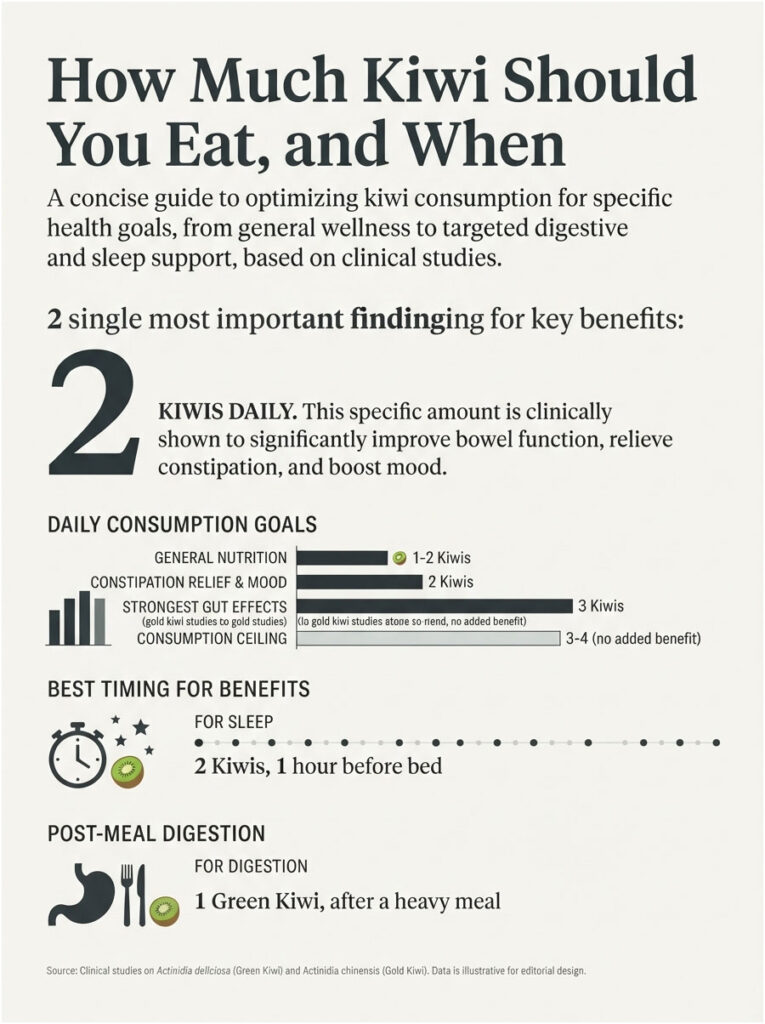
There’s no fixed prescription, but the research points to clear, goal-based amounts. Most benefits in trials came from two to three kiwi per day, which is also a reasonable ceiling for sugar and potassium in healthy adults.
Daily Amount by Goal
For general nutrition, one to two kiwi daily is plenty. For constipation relief or mood support, trials used two per day. For the strongest gut effects seen in gold kiwi studies, three per day was the dose.
Eating more than three or four kiwi daily offers little extra benefit and adds sugar and potassium you may not need. More is not automatically better here.
Best Time to Eat Kiwi
Timing depends on your aim. For sleep, eat two kiwi about an hour before bed. For digestion, a green kiwi after a heavy meal makes use of its actinidin enzyme.
For everything else, timing barely matters. A kiwi with breakfast, in a lunch salad, or as an afternoon snack all work. Consistency day to day counts more than the hour on the clock. The table below turns the evidence into quick decisions.
Table 3. Match Your Goal to the Right Kiwi Routine
| If your goal is… | Do this | Notes |
| Ease constipation | Eat 2 green kiwi daily, skin on if tolerated | Effects usually within 4 weeks; gentler than psyllium |
| Sleep better | Eat 2 green kiwi about 1 hour before bed | Evidence mixed but low-risk |
| Maximize vitamin C | Choose 1 gold kiwi | Exceeds a full day’s vitamin C need |
| Boost mood and energy | Eat 2 SunGold kiwi daily | Trial showed mood and vitality gains |
| Manage blood sugar | Pair kiwi with protein or nuts | Low glycemic; keep to 1 to 2 servings |
| Reduce cold severity | Eat 2 to 3 kiwi daily in cold season | May shorten sore throat and congestion |
How to Pick, Ripen, and Store Kiwi
Getting the benefits starts at the store. A rock-hard kiwi is underripe and sharply tart, while a ripe one is sweet and easy to digest.
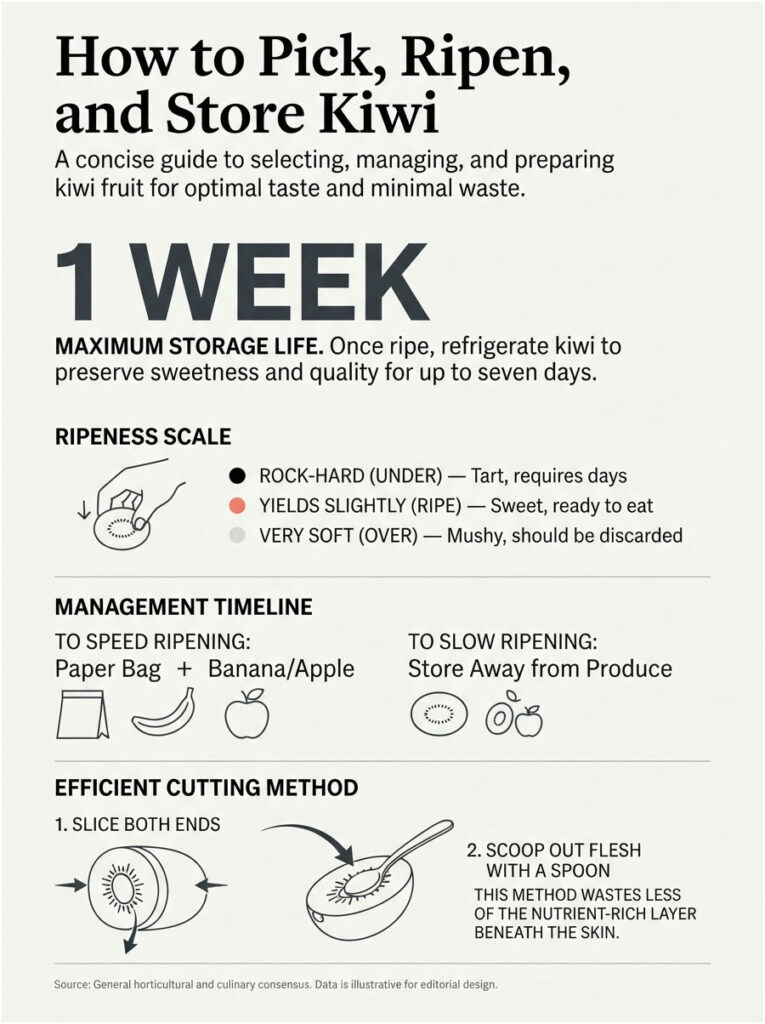
To check ripeness, hold the kiwi and press gently with your thumb. A ripe kiwi yields slightly, like a ripe peach, without feeling mushy or having soft spots.
Firm kiwi ripens at room temperature over a few days. To speed it up, place it in a paper bag with an apple or banana, which release ethylene gas that hastens ripening.
Once ripe, kiwi keeps in the refrigerator for up to a week, slowing further softening. Store unripe kiwi away from other produce if you want it to ripen slowly, since nearby fruit will accelerate it.
A quick tip on cutting. Slice off both ends, then run a spoon just under the skin and rotate to free the flesh in one piece. It’s faster than peeling and wastes less of the nutrient-rich layer just beneath the skin.
Easy Ways to Eat More Kiwi
Variety keeps a healthy habit alive. The simplest method is to cut a kiwi in half and scoop the flesh with a spoon, though eating it whole with the skin adds the most fiber.
Slice kiwi over oatmeal or yogurt for a vitamin C boost at breakfast. Toss it into fruit or green salads, where its tartness balances richer ingredients.
Blend it into smoothies with spinach and banana, or freeze slices for a cooling summer snack. Our nutrition team suggests pairing kiwi with a protein like Greek yogurt to steady blood sugar and add staying power.
One caution for recipes. Kiwi’s actinidin enzyme prevents gelatin from setting, so fresh kiwi will not firm up in a jello or panna cotta. Cooking the kiwi briefly first deactivates the enzyme and solves the problem.
Who Should Be Careful With Kiwi
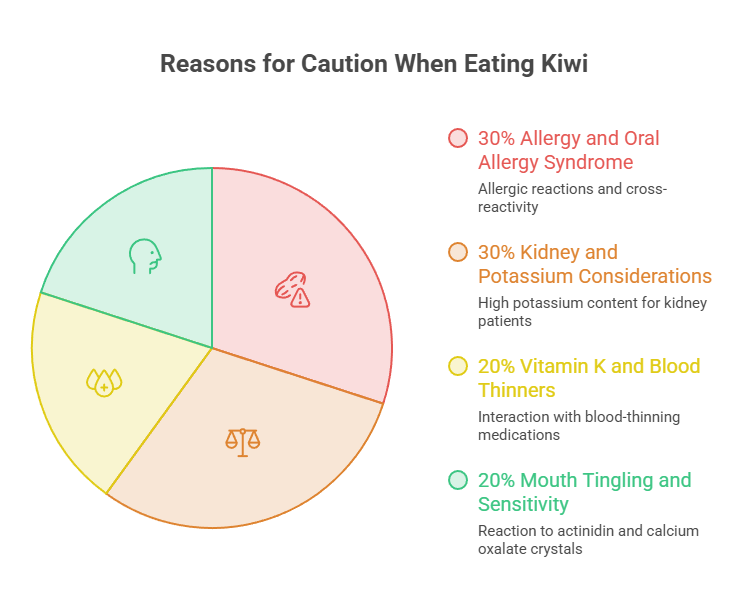
Kiwi is safe for most people, but a few groups should take care. Our medical reviewers note that even a healthy food is rarely one-size-fits-all.
Allergy and Oral Allergy Syndrome
Kiwi is a recognized allergen and can trigger reactions ranging from mouth itching to, rarely, severe anaphylaxis. People allergic to latex, birch pollen, avocado, or banana face higher risk through a phenomenon called cross-reactivity.
Children can be especially sensitive, and reactions sometimes appear on first known exposure. Anyone with a known kiwi allergy should avoid it entirely, and new or worsening reactions warrant a conversation with an allergist.
Kidney and Potassium Considerations
Kiwi is high in potassium, which is healthy for most people but a concern for those with advanced kidney disease or on potassium-restricted diets. If a clinician has told you to limit potassium, check before adding kiwi.
Its vitamin K content can also matter for people on blood thinners like warfarin. Vitamin K affects how those drugs work, so keeping intake steady, rather than avoiding it, is usually the goal. Confirm your approach with the prescribing doctor.
Why Kiwi Makes Your Mouth Tingle
That tingle comes from actinidin, the same enzyme that aids digestion, plus tiny needle-shaped calcium oxalate crystals in the flesh. For most people it’s harmless and fades quickly.
For sensitive individuals, it can be an early sign of allergy. If tingling escalates to lip or throat swelling or any trouble breathing, stop eating and seek care right away.
Frequently Asked Questions
Is it OK to eat kiwi every day?
Yes, for most people eating one to two kiwi daily is safe and beneficial. Daily kiwi supports vitamin C intake, digestion, and heart health. Only those with kiwi allergy, advanced kidney disease, or potassium restrictions should be cautious and check with a clinician first.
How many kiwis should you eat a day?
One to two kiwi covers general nutrition. Research on constipation, sleep, and mood used two per day, while the strongest gut-health studies used three gold kiwi daily. Staying within one to three per day keeps sugar and potassium in a reasonable range for healthy adults.
Does kiwi really help you sleep?
The evidence is promising but mixed. A Taiwan trial found two kiwi before bed helped adults fall asleep faster and sleep longer, likely due to serotonin and antioxidants. Later studies showed smaller effects. Kiwi is a low-risk option to try, but it is not a guaranteed sleep aid.
Is kiwi good for constipation?
Yes, and US trial data supports it. Two green kiwi daily improved bowel frequency, stool consistency, and straining, matching psyllium and prunes with fewer side effects. Kiwi draws water into the intestine and adds gentle fiber, easing constipation without the cramping some fiber supplements cause.
Can you eat kiwi skin?
Yes. Kiwi skin is edible and holds much of the fruit’s fiber and folate. Eating whole gold kiwi raises fiber, vitamin E, and folate meaningfully. Gold kiwi skin is thin and nearly hairless, so it is easier to eat than fuzzy green skin. Wash it well first.
Which has more vitamin C, kiwi or orange?
Kiwi, by a wide margin. Green kiwi holds about 93 mg of vitamin C per 100 grams versus roughly 59 mg in an orange. Gold kiwi reaches around 161 mg, nearly three times an orange. Ounce for ounce, kiwi is the richer vitamin C source.
Are gold kiwis healthier than green?
Neither is strictly healthier; they differ. Gold kiwi has more vitamin C and sweeter flesh, while green kiwi has more fiber, vitamin K, and the digestive enzyme actinidin. For gut and protein digestion, choose green. For maximum vitamin C, choose gold. Eating both gives the widest benefit.
Is kiwi high in sugar?
Not particularly. A medium green kiwi has about 6 to 9 grams of sugar and a low glycemic index, so it raises blood sugar slowly. Its fiber further slows sugar absorption. Whole kiwi is a smart choice even for people managing blood sugar, especially when paired with protein.
What is the best time to eat kiwi?
It depends on your goal. Eat two kiwi about an hour before bed for potential sleep benefits. Eat a green kiwi after a heavy or high-protein meal to use its actinidin enzyme for digestion. For general nutrition, any time of day works well.
Can kiwi help you lose weight?
Kiwi can support weight goals. At about 42 calories per medium fruit, it is low in calories but high in fiber and water, which help you feel full. It satisfies sweet cravings without heavy sugar. Kiwi alone will not cause weight loss, but it fits well in a balanced plan.
Why does kiwi make my tongue tingle?
The tingling comes from actinidin, a protein-digesting enzyme, along with tiny calcium oxalate crystals in the flesh. For most people this is harmless. For some, it signals a mild kiwi sensitivity. If tingling turns into swelling or trouble breathing, stop eating it and seek care.
Is kiwi safe during pregnancy?
Generally yes. Kiwi provides folate, vitamin C, and fiber, all valuable in pregnancy, and its low calorie count fits most prenatal diets. Unless you have a kiwi allergy or specific medical restriction, it is a nutritious choice. Pregnant readers should confirm their overall diet with their obstetrician.
Medical Disclaimer: This article is for general informational purposes and is not a substitute for professional medical advice, diagnosis, or treatment. Always consult a qualified healthcare provider before making significant changes to your diet, especially if you have a food allergy, kidney disease, diabetes, or take medications such as blood thinners. Individual results vary.
References
- USDA FoodData Central, nutrient data for green and gold kiwifruit
- The nutritional and health attributes of kiwifruit: a review, Nutrients (PMC)
- Comparative Effectiveness Trial of Green Kiwifruit, Psyllium, or Prunes in US Patients, PubMed
- Two green kiwifruits daily improves constipation and abdominal comfort, Am J Gastroenterol
- Effect of kiwifruit consumption on sleep quality in adults with sleep problems, APJCN
- Acute effects of green kiwifruit on sleep-related metabolites, Nutrients (PMC)
- SunGold Kiwifruit and Psychological Health (GoKiPH), Nutrients (PMC)
- A Pilot Trial on Kiwifruit, Actinidin, and Gastric Comfort, Nutrients (PMC)
- Effect of gold kiwifruit on gut health function, British Journal of Nutrition (PMC)
- Chronic Constipation in the United States, NIH (PMC)
- 6 Health Benefits of Kiwi, Cleveland Clinic
- Kiwi Benefits: Heart Health, Digestion, and More, Healthline