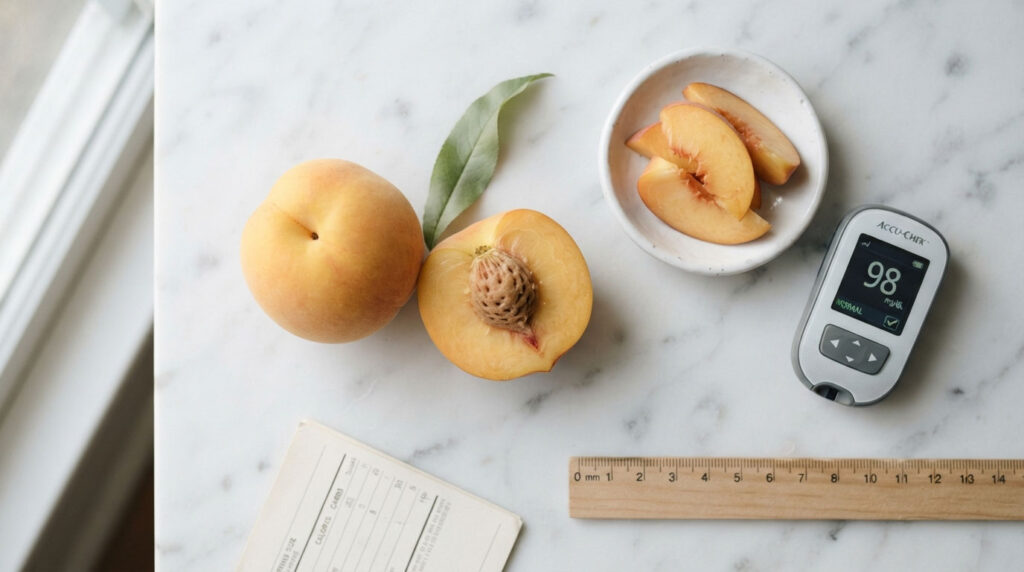
Look up the peach glycemic index today and you’ll find 28 on one health site and 57 on another. Both figures come from published laboratory data. Neither one is a typo.
Table of Contents
That gap is the most confusing thing about peaches and diabetes, and almost nobody explains it. Our medical reviewers field this exact question every July, when US peach season peaks and readers start comparing three apps that give three different answers.
Here’s the honest version, with the portion math you can use tonight.
Quick Answer
Yes, peaches are good for most people with diabetes. A medium fresh peach carries about 14 grams of carbohydrate, 2 grams of fiber, and a glycemic load of roughly 5, which is genuinely low. Published glycemic index values range from 28 to 57 depending on growing region and ripeness, averaging 42. Stick to one whole peach per sitting and skip anything canned in heavy syrup.
At a Glance
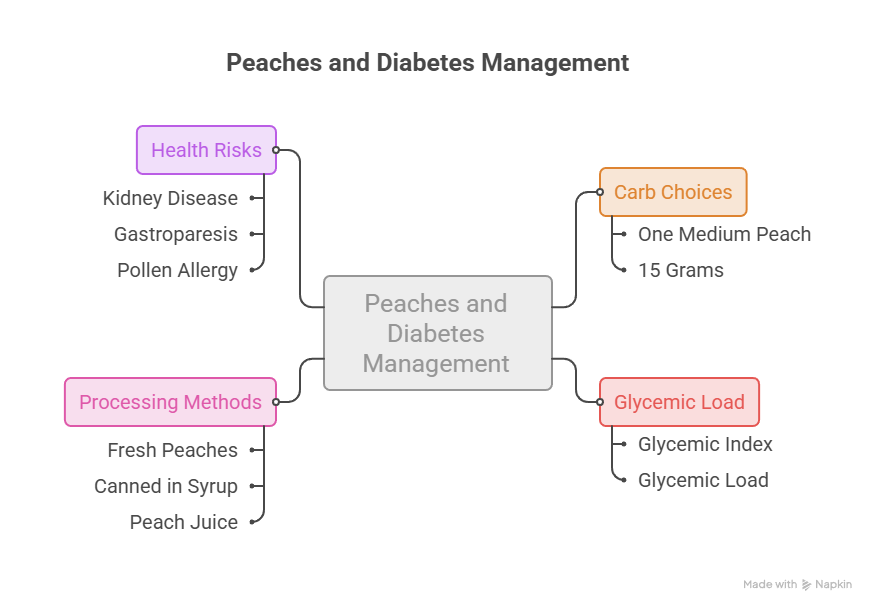
• One medium peach equals one carb choice, about 15 grams, in standard US diabetes meal planning.
• Glycemic load of 5 matters far more than the disputed glycemic index number.
• Canned in heavy syrup carries nearly double the carbohydrate of the same fruit fresh.
• Peach juice is the one form worth cutting outright.
• Large US cohort data does not show peaches lowering type 2 diabetes risk, despite what most articles imply.
• Kidney disease, gastroparesis, and pollen allergy each change the rules.
The Short Answer, and the Number Everyone Gets Wrong
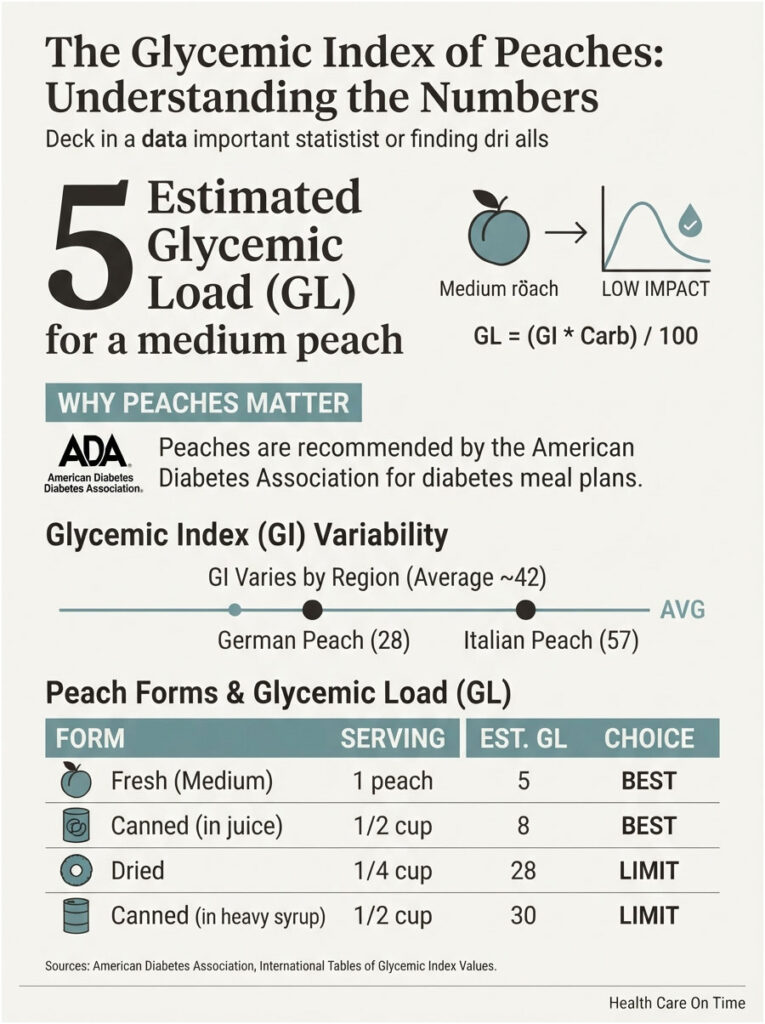
Peaches sit comfortably inside a diabetes meal plan. The American Diabetes Association lists peaches among common fruits people with diabetes can eat, and recommends fresh, frozen, or canned varieties without added sugars.
That’s the easy part. The confusing part is the number attached to them.
Why You See GI 28 in One Place and 57 in Another
The glycemic index is not a fixed property of a food. It’s an average produced by a small human test panel, and different laboratories tested different peaches.
The International Tables of Glycemic Index list a raw German peach at 28 and a raw Italian peach at 57 plus or minus 5. The mean across those studies puts the average peach at 42. Sunlight exposure during the growing season raises sugar concentration, which accounts for most of the spread.
So when one site tells you 28 and another says 42, both are quoting real data. They’re quoting different peaches.
Growing Region, Ripeness, and Test Panel Size
Three variables drive the variation. Growing region affects total sugar concentration, because more sun means sweeter fruit.
Ripeness converts stored carbohydrate into free sugars, so a soft peach tests measurably higher than a firm one from the same tree.
Panel size is the third. Glycemic index studies typically use 8 to 12 volunteers, and individual glucose responses vary widely even among healthy people. A different panel produces a different average.
What the Glycemic Index Cannot Tell You
Even a perfect glycemic index number has limits. It’s measured on a fixed 50-gram available-carbohydrate portion, which for peaches means eating roughly four medium fruits at once.
Nobody eats four peaches in a sitting. That’s the built-in flaw of using glycemic index alone for fruit.
The number also assumes an empty stomach and no accompanying food. Add protein or fat and the real-world response changes substantially.
Glycemic Load Is the Number That Actually Matters
Glycemic load fixes the portion problem by folding serving size into the calculation. A medium peach has an estimated glycemic load of about 5, which sits in the low range of 10 or below.
Watermelon makes the point clearly. Its glycemic index is around 76, well into high territory, but a cup of diced watermelon holds so little carbohydrate that the glycemic load lands at 8.
The lesson generalizes. For fruit, glycemic load beats glycemic index every time.
How to Run the Glycemic Load Math on Any Portion
The formula is glycemic index multiplied by available carbohydrate, divided by 100. Available carbohydrate means total carbs minus fiber.
For one medium peach: 42 times 12.1 grams, divided by 100, equals 5.1. Run that same calculation on a half cup of peaches in heavy syrup and the answer roughly triples.
Learning this one calculation lets you evaluate any fruit, any portion, without needing a chart. It takes ten seconds on a phone calculator.
| Peach Form and Serving | Total Carbs (g) | Fiber (g) | Sugars (g) | Glycemic Index | Glycemic Load | Verdict |
| Fresh whole, 1 medium (150g) | 14.3 | 2.2 | 12.6 | 42 (lab range 28 to 57) | 5 | Best choice |
| Fresh sliced, 1 cup (154g) | 14.7 | 2.3 | 12.9 | 42 (lab) | 5 | Best choice |
| Frozen unsweetened, 1 cup (155g) | 14.5 | 2.2 | 12.5 | 42 (assumed equal to fresh) | 5 | Equal to fresh |
| Canned in water, drained, 1/2 cup (122g) | 7.5 | 1.6 | 6.3 | Not lab tested | 3 (calculated) | Lowest load of all |
| Canned in 100% juice, drained, 1/2 cup (124g) | 14.3 | 1.6 | 11.7 | 45 (lab, plus or minus 6) | 6 | Acceptable |
| Canned in light syrup, drained, 1/2 cup (126g) | 16.0 | 1.0 | 11.0 | 52 (lab, Canadian sample) | 8 | Occasional only |
| Canned in heavy syrup, 1/2 cup (131g) | 26.1 | 1.7 | 24.2 | 58 to 64 (lab, two brands) | 15 | Skip |
| Dried halves, 1 oz (28g) | 17.1 | 2.3 | 11.8 | 35 (lab, plus or minus 5) | 5 | Measure strictly |
| Peach juice or nectar, 8 oz (250g) | 33.0 | 1.4 | 31.0 | Not lab tested | 15 (calculated) | Skip |
Nutrition values from USDA FoodData Central. Glycemic index values from the International Tables of Glycemic Index and the University of Sydney database, with each cell labeled as lab-tested, calculated, or assumed so you can weigh the evidence yourself. Figures rounded.
What Is Actually Inside a Peach
Marketing copy calls peaches “nature’s candy.” The USDA numbers tell a calmer story, and that’s good news for you.
Macros in One Medium Peach
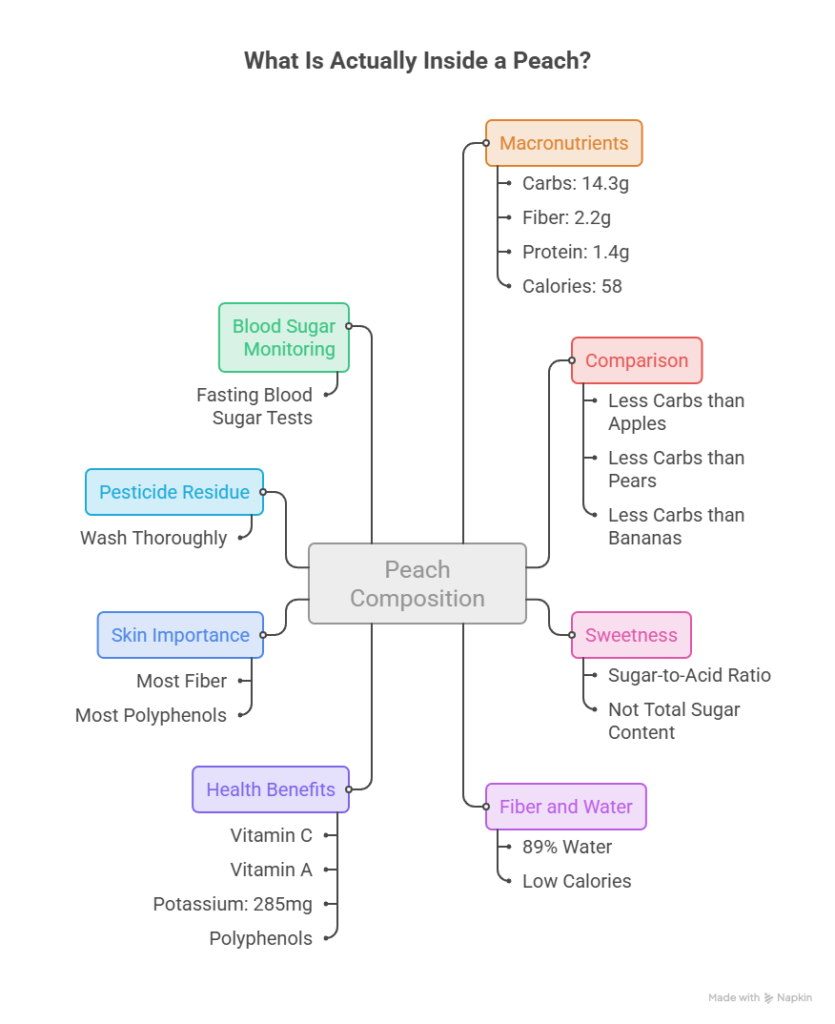
A medium 150-gram peach contains about 14.3 grams of carbohydrate, 2.2 grams of fiber, 1.4 grams of protein, and 58 calories. Net carbohydrate lands near 12 grams.
That is less carbohydrate than a medium apple at 25 grams, a medium pear at 27 grams, or a medium banana at 27 grams.
Peaches are one of the lighter fruits by carbohydrate count, not one of the heavier ones. Most people assume the opposite because peaches taste so sweet.
Why Sweetness Misleads You
Sweetness perception tracks the ratio of sugar to acid, not total sugar. Peaches are low in acid, so the same amount of sugar tastes sweeter than it would in an orange or a green apple.
A peach and an orange carry almost identical carbohydrate loads. The peach just tastes twice as indulgent.
The Fiber and Water Story
Peaches are roughly 89 percent water. That volume explains why a whole peach feels satisfying while delivering only 58 calories.
The 2.2 grams of fiber include pectin, a soluble fiber that forms a gel in the stomach and slows how quickly sugars reach your bloodstream. It’s a modest amount, but it does real work.
Eating a peach with the skin gets you noticeably more fiber than a peeled one. Patients commonly ask us whether peeling matters, and for blood sugar purposes it does.
Vitamin C, Vitamin A, Potassium, and Polyphenols
One medium peach delivers around 10 milligrams of vitamin C, roughly 11 percent of the Daily Value, plus beta-carotene that your body converts to vitamin A.
It also carries about 285 milligrams of potassium. For most readers that supports healthy blood pressure. For a smaller group it’s a caution flag, covered later in this article.
Peaches also contain chlorogenic acid, catechins, and in red-blushed varieties, anthocyanins. These are the compounds behind most of the antioxidant claims you’ll see.
Why the Skin Carries Most of the Benefit
Polyphenols concentrate in the skin and the layer directly beneath it. Peel a peach and you drop both the fiber and the majority of the polyphenol content.
Wash it well under running water and eat it whole. Peaches sit on the higher end of pesticide residue testing among US produce, so a thorough rinse is worth the ten seconds.
If you want to see how these numbers translate into your own readings, a fasting blood sugar test gives you the baseline to measure against.
How Peaches Behave in Real Blood Sugar Terms
Charts describe averages. Your body is not an average. This section covers the practical translation.
One Peach Equals One Carb Choice
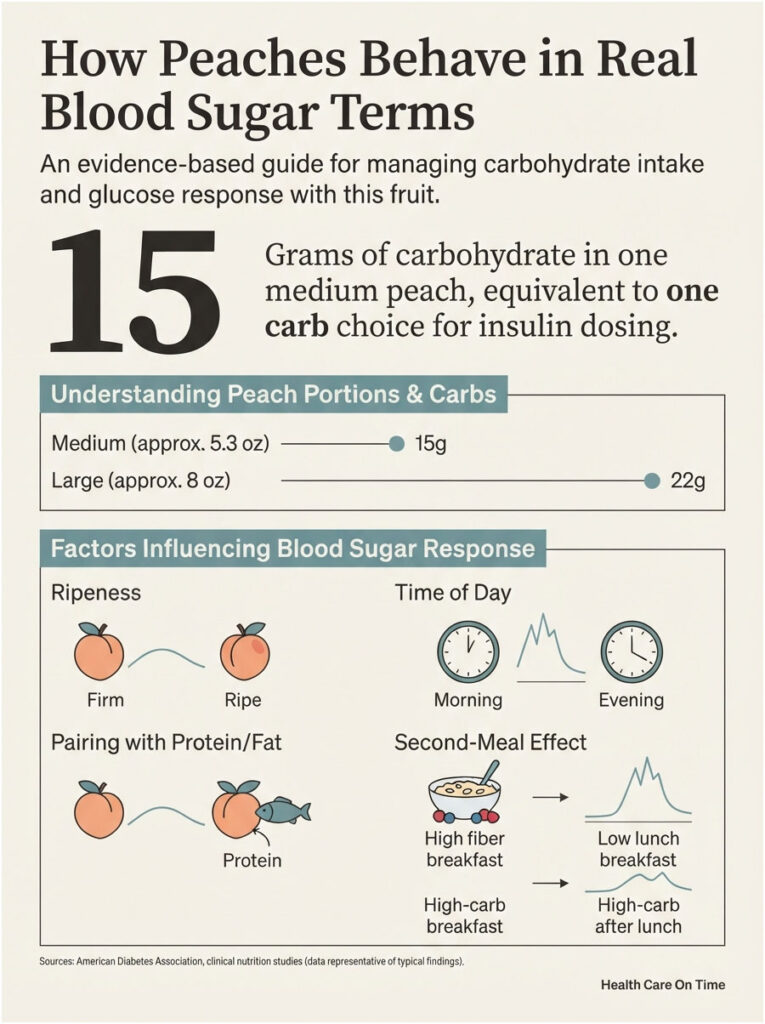
US diabetes meal planning uses a 15-gram carbohydrate unit called a carb choice, or a fruit exchange in older materials. One medium peach of about 6 ounces with the pit equals one standard fruit serving, providing roughly 15 grams of carbohydrate.
That’s the number to memorize. It makes peaches easy to slot into any plan without recalculating.
Two medium peaches equal two carb choices, or about 30 grams. On tighter meal plans that’s a full meal’s carbohydrate allowance, so spacing them out matters.
Sizing a Peach Without a Scale
Grocery peaches vary more than the charts suggest. A “medium” peach is roughly tennis-ball sized, about 2.5 inches across, and weighs close to 5.3 ounces with the pit.
Large peaches from a farmers market can hit 8 ounces and carry 22 grams of carbohydrate. Treat those as one and a half carb choices.
Type 1 and Type 2 Do Different Math
If you have type 2 diabetes and are not on mealtime insulin, your job is portion control and pairing. One peach, eaten with something containing protein or fat, rarely causes trouble.
If you have type 1 diabetes, the peach is a dosing decision rather than a permission question. The 15-gram figure gives you a clean input for your insulin-to-carbohydrate ratio.
Bolus Considerations for Insulin Users
Fruit sugars absorb faster than a mixed meal, so some insulin users find a slightly earlier pre-bolus works better for fruit eaten alone.
That’s an individual adjustment to work out with your endocrinologist or diabetes care and education specialist, not a rule to copy from an article.
Type 1 readers using a hybrid closed-loop pump often report the system handles a single peach without intervention. Announcing the carbohydrate still produces a flatter curve than letting the algorithm react after the fact.
The Pairing Rule That Flattens the Curve
A peach eaten alone on an empty stomach produces a sharper rise than the same peach eaten alongside protein or fat.
Pair it with a quarter cup of cottage cheese, a tablespoon of almond butter, or six almonds. The glucose curve flattens noticeably within the same two-hour window.
This is the highest-return habit change in this article, and it costs nothing. In cases reviewed by our medical team, pairing produces a bigger practical difference than switching fruit varieties ever does.
Ripeness, Timing, and Why Your CGM Disagrees With the Chart
As peaches ripen, stored carbohydrate converts to free sugar. A firm, barely-ripe peach produces a gentler rise than one that’s gone soft and syrupy on the counter.
Time of day matters too. Many people show stronger morning insulin resistance, so the same peach can read higher at 8 a.m. than at 3 p.m.
Patients booking A1C panels through HealthCareOnTime often tell us their continuous glucose monitor readings for fruit look nothing like the published averages. That’s expected, and it’s exactly why personal testing beats any chart.
The Second-Meal Effect
Eating a peach as part of a fiber-containing meal can slightly improve your response to the following meal. Researchers call this the second-meal effect.
The practical version: fruit eaten at lunch tends to behave better than fruit eaten alone at 4 p.m. on an empty stomach.
| Statistic | Figure | Period | Source |
| Americans with diabetes, diagnosed and undiagnosed | 40.1 million | 2023 data | CDC National Diabetes Statistics Report |
| Share of US population with diabetes | 12.0% | 2023 data | CDC |
| Adults with undiagnosed diabetes | 11.0 million, or 27.6% of adults with diabetes | 2023 data | CDC |
| US adults age 18 and older with prediabetes | Over 115 million | 2023 data | American Diabetes Association |
| New US diabetes diagnoses each year | About 1.5 million | Annual estimate | American Diabetes Association |
| Total cost of diagnosed diabetes in the US | $412.9 billion | 2022 | ADA Economic Costs of Diabetes |
| Type 2 share of adult diagnosed cases | 90 to 95% | Current | CDC |
| Americans age 65 and older with diabetes | 28.8% | 2023 data | American Diabetes Association |
| Adults with diabetes who also have chronic kidney disease | 39.2% | 2017 to 2020 | CDC |
Sources: CDC National Diabetes Statistics Report, American Diabetes Association, NIDDK.
Fresh vs Canned vs Dried vs Juice
The form you buy changes the answer more than the fruit itself does. This is where most people with diabetes go wrong without noticing.
Decoding the US Canned Aisle
American grocery shelves carry four standard pack types, and the label language is easy to misread when you’re moving fast down the aisle.
Heavy Syrup, Light Syrup, 100% Juice, and Water Pack
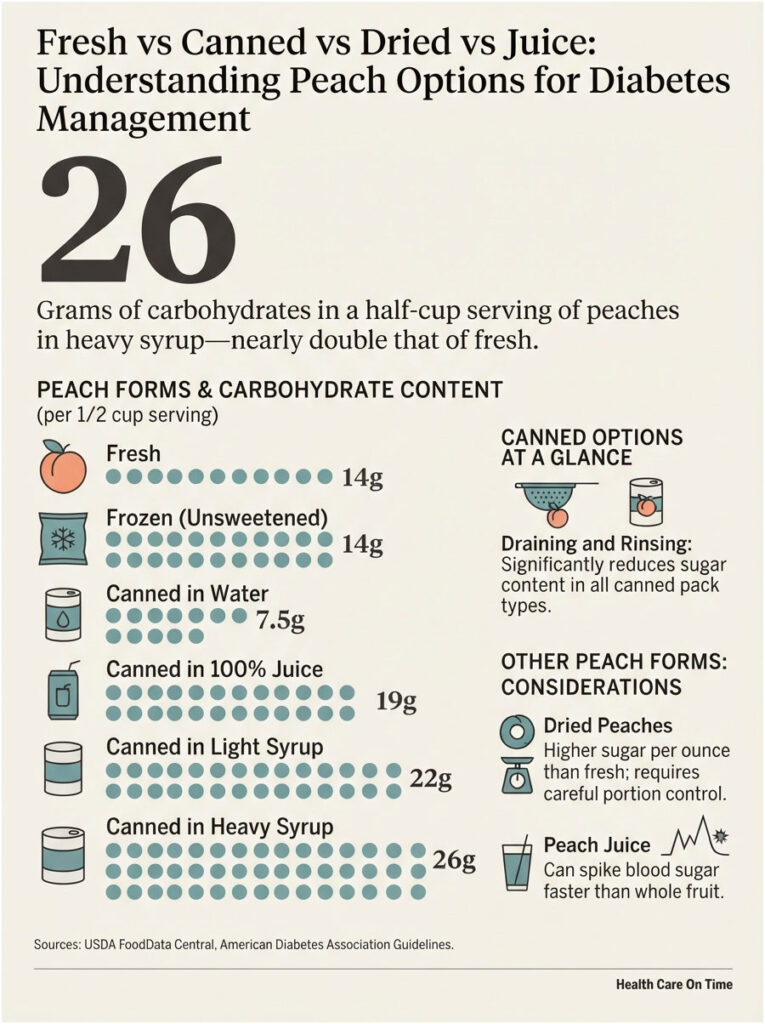
Heavy syrup is the problem. A half cup carries roughly 26 grams of carbohydrate and 24 grams of sugar, nearly double a fresh peach in a smaller portion.
Peaches canned in heavy syrup test at 58 plus or minus 11 or 64 plus or minus 3 depending on brand, while peaches canned in natural juice come in at 45 plus or minus 6.
Water pack is the quiet winner. A drained half cup runs about 7.5 grams of carbohydrate, less than any other form of peach you can buy.
One oddity worth knowing: peaches canned in reduced-sugar syrup from one tested brand came in at 62 plus or minus 9, higher than the same brand’s juice pack. “Reduced sugar” on the front of a can is not a guarantee of anything.
How to Read the Can in Ten Seconds
Ignore the front label entirely. Turn the can and find the ingredient list.
If the second ingredient is water, you’re fine. If it’s “peach juice concentrate” or “pear juice concentrate,” treat it as light syrup regardless of what the front says.
If you see “high fructose corn syrup” or “corn syrup,” put it back.
Does Draining and Rinsing Actually Help?
Yes, and more than people expect. Draining removes the syrup pooling between fruit pieces, and a quick rinse under cold water removes more.
Draining light syrup peaches cuts several grams of sugar per serving. It won’t turn heavy syrup into a good choice, but it improves a mediocre one meaningfully.
Our lab partners report that patients who switch from syrup-packed to juice-packed or water-packed canned fruit often see movement in their post-meal readings within a few weeks.
Frozen Peaches Deserve More Credit
Frozen unsweetened peach slices are nutritionally close to fresh, because commercial freezing happens shortly after harvest.
They’re often cheaper than fresh from October through April, and portion control is easier because you’re scooping from a measured bag rather than eyeballing whole fruit.
Check the bag for added sugar. Most plain frozen peaches have none, but sweetened varieties exist and the packaging looks nearly identical.
Dried Peaches and the Portion Trap
Dried peaches have a low glycemic index. UK dried peaches test around 35 plus or minus 5. That sounds reassuring until you look at volume.
One ounce of dried peach halves packs about 17 grams of carbohydrate, more than a whole fresh peach, in a portion that takes 30 seconds to eat.
Water removal is the issue. You lose the volume that made fresh fruit filling while keeping every gram of sugar. Measure them, cap at one ounce, and pair with nuts.
Peach Juice, Smoothies, and Why Blending Changes Everything
Juicing strips the fiber and concentrates the sugar. An 8-ounce peach nectar can hit 31 grams of sugar, more than two whole peaches.
The evidence here is unusually clear. Harvard researchers found that people consuming one or more servings of fruit juice daily raised their type 2 diabetes risk by as much as 21 percent, and that swapping three servings of juice per week for whole fruit was associated with lower risk.
Blending sits between the two. It keeps the fiber but ruptures the cell walls, which speeds absorption. A smoothie will raise blood sugar faster than the same fruit eaten whole.
What the Research Really Says
Here is the part most articles leave out, and it’s the part that separates honest health content from copy written to reassure you.
The Harvard Cohort Data on Stone Fruit
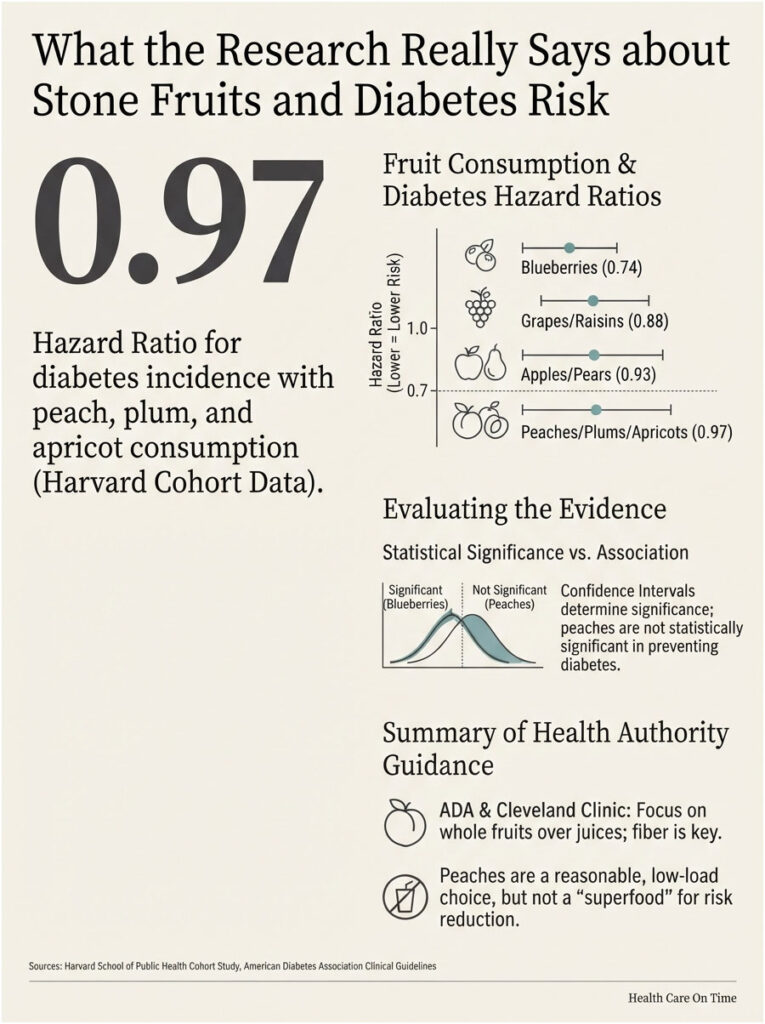
The largest US dataset on individual fruits and diabetes risk pooled three long-running cohorts covering more than 187,000 health professionals across several decades of follow-up.
The pooled hazard ratios per three servings per week were 0.74 for blueberries, 0.88 for grapes and raisins, 0.93 for apples and pears, and 0.97 with a 95 percent confidence interval of 0.92 to 1.02 for peaches, plums, and apricots.
Read that last one again. The confidence interval crosses 1.0.
Why a Confidence Interval Crossing 1.0 Matters
When a confidence interval includes 1.0, the study cannot rule out no effect at all. The peach result is not statistically significant.
Blueberries showed a clear protective association. Peaches did not. That does not mean peaches are harmful. It means the claim “peaches help prevent diabetes” is not supported by this dataset.
Across the readers we serve, people are often surprised that “low glycemic index” and “protects against diabetes” are two entirely separate claims. Peaches earn the first and not the second.
Why This Matters for How You Read Health Content
Any article telling you a specific fruit prevents diabetes should be showing you the effect size and the confidence interval. Most don’t, because most are summarizing other summaries.
The practical takeaway does not change much. Peaches remain a sound choice as a replacement for higher-load foods. They’re just not medicine.
Peach Polyphenols and Alpha-Glucosidase, Honestly Assessed
You’ll see claims that peach polyphenols inhibit alpha-glucosidase, the enzyme that breaks complex carbohydrates into simple sugars. Slowing that enzyme would slow glucose absorption.
The mechanism is real and has been demonstrated in laboratory work and in animal studies, including research on peach juice and metabolic markers in obese rats.
What does not exist yet is human trial evidence showing the effect is large enough to matter at normal eating portions. Treat it as an interesting bonus, not a reason to eat more peaches.
What ADA Guidance Actually Recommends
Current ADA nutrition guidance points toward whole fruits rather than juice as part of a healthy eating pattern for diabetes and prediabetes.
The Cleveland Clinic frames it the same way. Fruit belongs in the plan, fiber balances the natural sugars, and fresh or frozen beats processed.
Nothing in mainstream US guidance singles peaches out as either a superfood or a food to restrict. They’re a reasonable, low-load fruit choice, which is a perfectly good thing to be.
Who Should Be Careful With Peaches
For most readers, peaches are a straightforward yes. Four groups need a different rule, and you’ll rarely see these mentioned anywhere else.
Diabetic Kidney Disease and Potassium Load
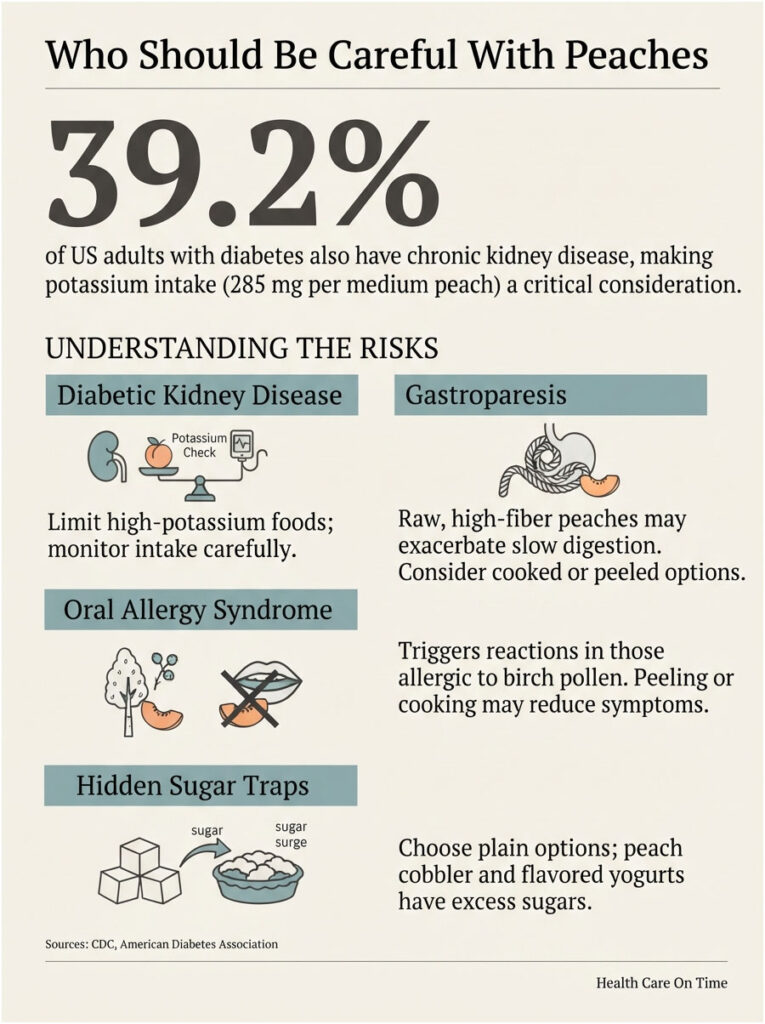
Among US adults with diagnosed diabetes, the estimated prevalence of chronic kidney disease was 39.2 percent during 2017 to 2020. That’s a large share of the readership for an article like this.
If your nephrologist has placed you on a potassium restriction, a medium peach’s 285 milligrams counts against your daily limit. Two peaches plus a banana adds up faster than most people expect.
This is not a reason to fear peaches. It’s a reason to ask your renal dietitian for your specific allowance before making them a daily habit. A kidney function panel tells you where you currently stand.
Gastroparesis and High-Fiber Fruit
Delayed gastric emptying is a recognized diabetes complication, and raw high-fiber fruit can worsen bloating, early fullness, and nausea.
If you have gastroparesis, peeled peaches, cooked peaches, or peaches canned in water are gentler than raw fruit with the skin on. You give up some fiber benefit and gain symptom control.
Gastroparesis also makes insulin timing unpredictable, because carbohydrate absorption slows and shifts later. That’s a conversation for your care team rather than a self-managed adjustment.
Oral Allergy Syndrome and Birch Pollen Cross-Reaction
Peaches are among the most common triggers of oral allergy syndrome in people sensitized to birch pollen. Symptoms include itchy mouth, tingling lips, and mild throat irritation within minutes of eating.
The reactive proteins concentrate in the skin, so peeling or lightly cooking often reduces symptoms. Any reaction beyond mild mouth itching needs an allergist, not a kitchen workaround.
Peach Cobbler, Peach Yogurt, and Other Hidden Sugar Traps
A single serving of peach cobbler can carry 45 to 60 grams of carbohydrate, most of it from flour, butter, and added sugar rather than the fruit.
Flavored peach yogurt often adds 15 to 20 grams of sugar on top of the natural dairy sugars. Plain Greek yogurt with fresh peach slices gets you the same flavor at a fraction of the load.
Peach-flavored iced tea, peach seltzer with added sugar, peach preserves, and peach pie filling belong in the same category. The word “peach” on a label tells you nothing about what’s inside.
A Note on Medication Interactions
Peaches do not interact meaningfully with metformin, sulfonylureas, GLP-1 receptor agonists, SGLT2 inhibitors, or insulin. There’s no known peach-specific drug interaction to worry about.
The only real consideration is carbohydrate accounting, which applies to any food. If a medication requires you to match intake to dosing, count the peach and move on.
Your Action Plan
Knowing the numbers is one thing. Here’s how to put them to work this week.
The Seven-Day Self-Test Protocol
Published averages cannot tell you your personal response. A structured week can.
- Days 1 and 2: Test blood glucose immediately before eating one medium peach on an empty stomach, then again at 60 and 120 minutes.
- Days 3 and 4: Repeat with the same peach size, paired with 1 ounce of almonds or a half cup of plain Greek yogurt.
- Days 5 and 6: Repeat with the peach eaten at the end of a mixed meal containing protein and vegetables.
- Day 7: Compare your three 120-minute readings and note which pattern kept you closest to target.
A rise of under 30 mg/dL at the two-hour mark generally indicates the food and portion are working for you. Bring the log to your next appointment rather than interpreting it alone.
Use the same peach size and the same ripeness across all three conditions, or the comparison tells you nothing.
Six Diabetes-Friendly Ways to Eat a Peach
- Sliced over plain Greek yogurt with cinnamon and chopped walnuts, roughly 20 grams of carbohydrate total
- Grilled halves as a dessert replacement, no sugar and no topping, about 15 grams
- Diced into a savory salsa with red onion, jalapeño, lime, and cilantro, served over grilled fish
- Added to a spinach salad with grilled chicken, feta, and a red wine vinaigrette
- Frozen slices blended with unsweetened almond milk and a scoop of protein powder, about 18 grams
- Half a peach with two tablespoons of cottage cheese as a mid-afternoon snack, about 9 grams
Shopping and Storage Notes for US Buyers
US peach season runs roughly May through September, with peak supply in July and August. California leads national production by volume, with South Carolina and Georgia as the major Southeastern growers.
Off-season, frozen unsweetened peaches are the closest match to fresh and usually cost less. Canned in water or 100% juice is the next best fallback.
Store unripe peaches at room temperature in a paper bag until they yield slightly to gentle pressure. Refrigerate only after they ripen, and eat within three days.
Freestone vs Clingstone, and What It Means for You
Clingstone peaches ripen earlier in the season and hold tight to the pit, which is why most canned peaches are clingstone.
Freestone varieties arrive later and separate cleanly from the pit, making them the standard for fresh market sales.
For blood sugar purposes the difference is negligible. Buy whichever is firm, fragrant at the stem end, and in season.
| If This Is You | Recommended Action | Portion Cap | Why It Works |
| Type 2, A1C under 7% | Eat a fresh whole peach with the skin, any time of day | 1 medium, about 15g carb | A glycemic load of 5 keeps the rise gradual |
| Type 2, A1C above 8% | Pair with protein or fat and test at the 2-hour mark | 1/2 medium per sitting | Halving the carbohydrate halves the rise while you tighten control |
| Type 1 on insulin | Count as 1 carb choice and bolus per your ratio | 1 medium, dosed | 15g is a clean, predictable number for carb-to-insulin math |
| Prediabetes | Swap juice, cookies, or dessert for a whole peach | 1 to 2 per day | Whole fruit substitution outperforms juice in cohort data |
| Post-workout | Peach with Greek yogurt or a small handful of almonds | 1 medium plus protein | Muscle glucose uptake is elevated and protein blunts the peak |
| Late-night craving | Fresh or frozen unsweetened slices, no syrup | 1/2 cup slices | Low load avoids an overnight rise before your fasting reading |
| Diabetic kidney disease on potassium restriction | Confirm your daily allowance with your renal dietitian first | Per your prescribed limit | One medium peach carries about 285mg potassium |
| Gastroparesis | Peeled, cooked, or canned in water rather than raw with skin | 1/2 cup, peeled | Less insoluble fiber reduces delayed-emptying symptoms |
| Only canned available | Choose water pack or 100% juice, then drain and rinse | 1/2 cup drained | Drops the load from 15 down to 3 or 6 |
Peaches Compared With Other Common US Fruits
Peaches hold up well against the fruits Americans actually buy. Only watermelon beats them on total carbohydrate per serving, and it loses badly on glycemic index.
| Fruit (1 medium or 1 cup) | Total Carbs (g) | Glycemic Index | Glycemic Load |
| Peach, 1 medium (150g) | 14.3 | 42 | 5 |
| Orange, 1 medium (131g) | 15.4 | 43 | 5 |
| Apple, 1 medium (182g) | 25.1 | 36 | 6 |
| Pear, 1 medium (178g) | 27.1 | 38 | 8 |
| Watermelon, 1 cup diced (152g) | 11.5 | 76 | 8 |
| Blueberries, 1 cup (148g) | 21.4 | 53 | 9 |
| Banana, 1 medium (118g) | 27.0 | 51 | 12 |
| Grapes, 1 cup (151g) | 27.3 | 53 | 13 |
Two patterns stand out. Peaches and oranges are the easiest fruits to fit into a tight carbohydrate budget, and grapes and bananas are the two most likely to push you over.
Note that apples score a lower glycemic index than peaches but a higher glycemic load, purely because a medium apple is a bigger portion. That’s the portion effect in a single line.
Across the readers we serve, swapping a daily banana for a daily peach is one of the simplest carbohydrate reductions available, cutting roughly 13 grams per day without changing anything else.
Frequently Asked Questions
How many peaches can a diabetic eat in a day?
Most people with well-controlled type 2 diabetes can eat one to two medium peaches daily, spread across separate eating occasions. Each counts as one 15-gram carb choice. If your A1C sits above 8 percent, start with half a peach and check your two-hour reading before increasing.
Do peaches raise blood sugar quickly?
Peaches raise blood sugar gradually rather than sharply. Their glycemic load of roughly 5 is low, and pectin fiber slows sugar absorption. Eaten alone on an empty stomach they rise faster than when paired with protein or fat, so pairing is the simplest available fix.
Is the peach glycemic index 28 or 42?
Both appear in published data. A raw German peach tested at 28, a raw Italian peach at 57, and the average across studies is 42. Growing region, sunlight exposure, and ripeness explain the spread. Use 42 as your working figure and glycemic load as your real guide.
Are canned peaches OK for diabetics?
Canned peaches in water or 100% juice work well, especially drained. A drained half cup of water-packed peaches carries about 7.5 grams of carbohydrate. Heavy syrup is the version to avoid, at roughly 26 grams of carbohydrate and 24 grams of sugar per half cup.
Is peach juice bad for diabetics?
Peach juice and nectar are the worst form for blood sugar. An 8-ounce serving can carry 31 grams of sugar with almost no fiber. Harvard cohort research linked daily fruit juice intake to a type 2 diabetes risk increase of as much as 21 percent. Choose whole fruit.
Are dried peaches safe with diabetes?
Dried peaches have a low glycemic index near 35, but they’re carbohydrate-dense. One ounce carries about 17 grams, more than a whole fresh peach, in a portion you can finish in seconds. Measure the serving, cap it at one ounce, and pair with nuts.
Can prediabetics eat peaches every day?
Yes. For the more than 115 million American adults with prediabetes, a daily peach is a sound swap for juice, cookies, or refined-carb snacks. Whole fruit substitution is one of the better-supported dietary moves in diabetes prevention research.
Which has less sugar, a peach or an apple?
A medium peach carries about 14 grams of carbohydrate versus 25 grams in a medium apple, largely because the apple is a bigger fruit. On glycemic load the two run close, at 5 for the peach and 6 for the apple. The peach wins per whole fruit.
Are white peaches lower in sugar than yellow peaches?
White peaches taste sweeter because they carry less acid, not more sugar. Total sugar content is broadly similar across white and yellow varieties. Treat them as interchangeable for carbohydrate counting and pick whichever flavor you prefer.
Is a nectarine better than a peach for diabetes?
Nectarines and peaches are near-identical nutritionally, differing mainly in skin texture. A medium nectarine carries about 15 grams of carbohydrate with comparable fiber and potassium. Either works, and both count as one carb choice in your plan.
Do peaches affect your A1C?
A single peach will not move your A1C, which reflects roughly three months of average glucose. Total carbohydrate intake across that window drives the number. Peaches can support a lower A1C when they replace higher-load foods like juice, cobbler, or syrup-packed fruit.
When is the best time of day to eat a peach with diabetes?
Afternoon or evening often produces a smaller rise than morning, because many people show stronger insulin resistance early in the day. Eating a peach after a meal rather than alone also lowers the peak. Test both patterns and follow what your own readings show.
Medical Disclaimer
This article is for general education and does not replace personalized medical advice. Individual blood sugar responses to food vary widely between people and even day to day. Talk with your physician, endocrinologist, or registered dietitian before changing your meal plan, carbohydrate targets, or insulin dosing. If you have kidney disease, gastroparesis, or a known pollen or food allergy, get specific guidance from your care team before adding peaches as a daily habit.
References
- CDC National Diabetes Statistics Report
- American Diabetes Association, Diabetes in America Statistics
- American Diabetes Association, Best Fruit Choices for Diabetes
- USDA FoodData Central
- Muraki et al., Fruit consumption and risk of type 2 diabetes, BMJ 2013
- Harvard T.H. Chan School of Public Health, whole fruit and type 2 diabetes risk
- NIDDK Diabetes Statistics
- Cleveland Clinic, Best Fruits for Diabetes
- CDC NCHS Data Brief 516, Prevalence of Diabetes in Adults
- GoodRx, Low Glycemic Fruits for People With Diabetes