A handful of berries will not turn you into a genius by lunch. Yet the science tying blueberries to a sharper, more resilient brain is real, repeatable, and more measurable than the claims behind nearly any other fruit on the shelf.
Table of Contents
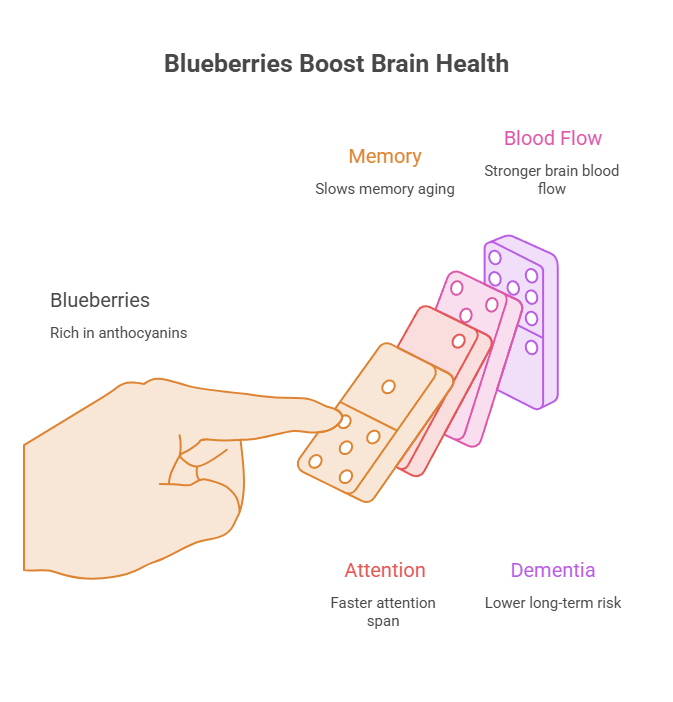
Quick Answer: Yes, blueberries are good for brain health. Research links their anthocyanin flavonoids to better memory, faster attention, stronger blood flow to the brain, and lower long-term dementia risk. The effects are modest and build with regular intake, roughly a daily cup or two-plus servings each week. They work best as one part of a brain-healthy diet, not as a quick fix.
At a Glance
- Older adults eating two or more weekly berry servings slowed memory aging by up to 2.5 years in Harvard research.
- The active compounds are anthocyanins, the deep-blue pigment flavonoids packed into each berry.
- One cup delivers about 242 mg of anthocyanins for only 84 calories.
- Frozen and wild blueberries often beat fresh on pigment per dollar.
- High flavonoid intake is tied to roughly 40% lower dementia risk across 20 years.
- Older adults and people with early cognitive concerns appear to gain the most.
Yes, and the Evidence Is Stronger Than Most “Superfood” Claims
Most foods crowned brain boosters fall apart under a hard look. Blueberries are one of the few that hold up across human studies, not just lab dishes and mouse experiments.
The reason is straightforward. Decades of population data, paired with a growing set of randomized trials, all point the same way: regular blueberry eaters tend to hold onto memory and thinking skills longer than people who skip them.
That does not mean berries reverse aging or cure disease. The honest version is that the benefits are small but consistent, and they accumulate over months and years rather than days.
The HealthCareOnTime medical desk sees the same theme in reader questions: the most reliable signal is how often someone eats berries over time, not the result of a single week. Steady habits are what move the numbers.
What “Brain Health” Actually Covers
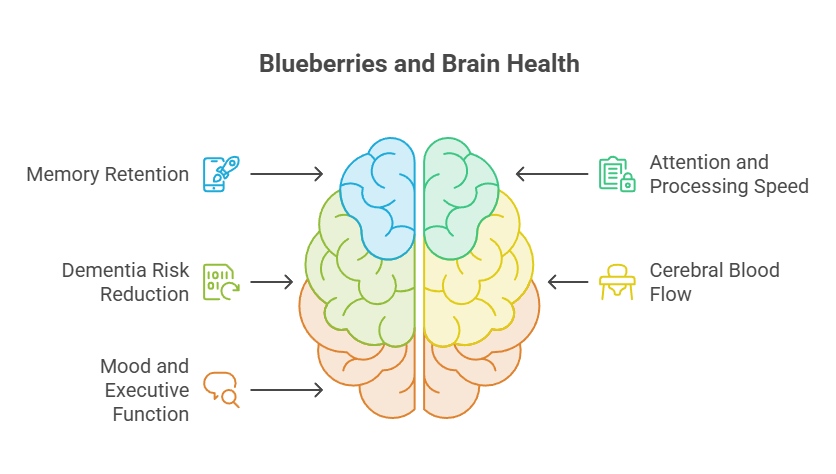
When scientists study blueberries and the brain, they measure specific outcomes, not a vague feeling of being sharp. The main targets are memory retention, attention and processing speed, mood and executive function, and long-term dementia risk.
Each outcome carries its own evidence base, and the strength varies from one to the next. The table below sorts what the research solidly supports from what is still early.
| Brain Function | What Research Shows | Typical Effect | Evidence Strength |
| Memory | Adults eating 2+ berry servings weekly showed slower decline | Up to 2.5 years delayed memory aging | Strong (large long-term cohort) |
| Attention & processing speed | Daily wild blueberry powder improved attention accuracy and reaction time | Faster, more accurate responses within 12 weeks | Moderate (controlled trials, small samples) |
| Dementia & Alzheimer’s risk | Highest flavonoid intake linked to fewer dementia diagnoses | About 40% lower risk over 20 years | Moderate (observational) |
| Cerebral blood flow | Blueberry intake raised brain blood flow and activity vs placebo | Measurable short-term increase | Emerging (small trials) |
| Mood & executive function | Flavonoids tied to better executive function and steadier cognition | Modest improvement | Emerging to moderate |
That memory figure traces to a landmark Harvard analysis. Researchers following thousands of older women found those eating the most strawberries and blueberries delayed memory decline by as much as two and a half years, according to the Harvard Gazette.
Two and a half years of preserved memory from a simple food swap is the kind of result that makes neurologists take note. It is also realistic for most people, no supplements or extreme diets required.
How Blueberries Actually Affect the Brain
The benefits are not mystical. They trace to specific compounds and the way those compounds change how blood, oxygen, and chemical signals move through the brain.
Once the mechanism clicks, the dose and form advice later in this guide makes far more sense. So it pays to understand what is happening under the hood.
Anthocyanins: The Pigment Behind the Benefits
Anthocyanins are the deep blue and purple pigments coloring the berry’s skin. They sit inside a larger family of plant compounds called flavonoids, and they are the main reason blueberries punch above their weight.
A single cup carries roughly 242 mg of anthocyanins based on USDA FoodData Central values. That ranks blueberries among the most concentrated whole-food sources of these compounds money can buy.
The riper and darker the berry, the more anthocyanins it holds. That is why wild blueberries, which are smaller and darker, tend to carry a heavier pigment load than the large cultivated kind.
Better Blood Flow and Lower Inflammation
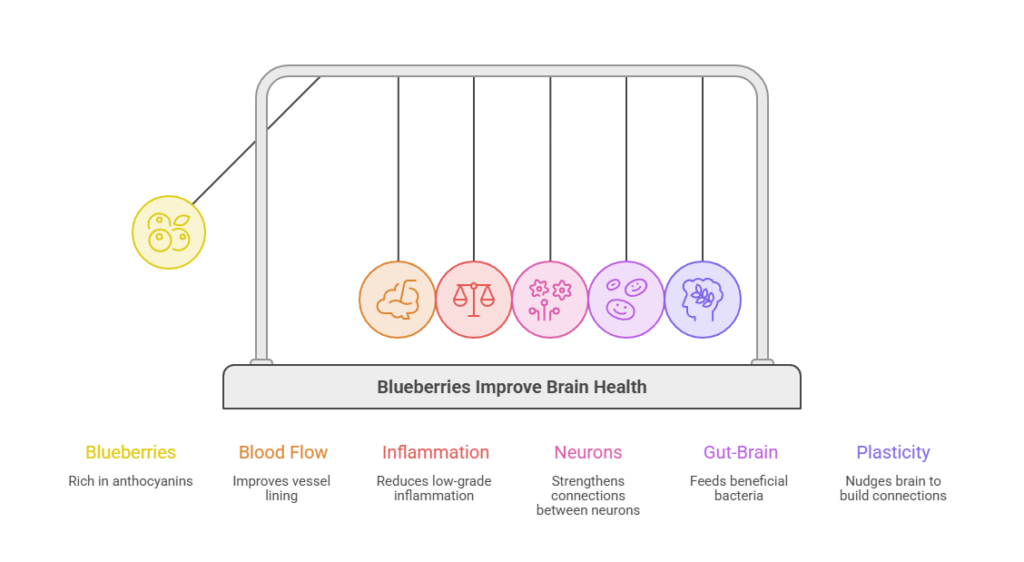
Anthocyanins do more than scavenge free radicals. Scientists now believe their biggest contribution is improving the lining of blood vessels, which raises blood flow to the brain.
A team at Ochsner Health cites trials in which older adults drinking concentrated blueberry juice daily showed greater brain activity, blood flow, and memory than a placebo group after only a few weeks.
Stronger circulation means more oxygen and glucose reach the regions that run memory and focus. At the same time, these compounds quiet the low-grade inflammation linked to faster cognitive decline.
This dual action, more blood flow plus less inflammation, is also why blueberries appear in heart-health research. As cardiologists often remind patients, the brain and the cardiovascular system tend to rise and fall together.
How Blueberry Compounds Reach Brain Tissue
For years, researchers assumed flavonoids worked only as antioxidants floating in the bloodstream. The newer picture is more interesting and more specific.
According to Scientific American, much of the cognitive payoff comes from flavonoids interacting directly with proteins built into brain-cell structure and signaling, not just from mopping up damage.
Smaller molecules from digested berries move into circulation and can cross the blood-brain barrier, settling into brain tissue. Once there, they appear to strengthen the connections between neurons that memory depends on.
The Gut-Brain Angle
There is a second pathway that gets less attention. Blueberry polyphenols are not fully absorbed in the small intestine, so a large share travels to the colon.
There they feed beneficial bacteria that produce short-chain fatty acids like butyrate, a compound tied to lower inflammation and healthier brain signaling. Researchers behind the King’s College trial proposed exactly this gut-driven route as one explanation for the cognitive gains.
This gut-brain connection is still an active research area, not settled science. But it helps explain why whole berries, with their fiber intact, may outperform isolated extracts that skip the gut entirely.
Flavonoids and Brain Plasticity
Beyond blood flow, lab and early human work suggests blueberry flavonoids may nudge the brain to build new connections. They appear to support signaling tied to brain-derived neurotrophic factor, a protein that helps neurons grow, adapt, and form memories.
That mechanism is still being mapped in people, so treat it as promising rather than proven. It does fit the pattern seen in trials, where steady intake supports learning and recall over time rather than delivering a one-time jolt.
What’s Inside a Cup of Blueberries
Nutrition labels tell only part of the story, because the headline nutrients in blueberries are modest. The real value sits in the plant compounds that labels rarely bother to list.
Here is what a standard one-cup serving delivers, with the brain angle spelled out line by line.
| Nutrient / Compound | Amount per Cup (148 g, USDA) | Why It Matters for the Brain |
| Anthocyanins | About 242 mg | Blue pigment flavonoids tied to memory and blood flow |
| Vitamin C | 14.4 mg | Antioxidant that shields neurons from oxidative stress |
| Vitamin K1 | About 29 mcg (24% DV) | Supports cell signaling and vascular health |
| Manganese | 0.5 mg (22% DV) | Cofactor in the body’s antioxidant enzymes |
| Fiber | 3.6 g | Feeds gut bacteria linked to the gut-brain connection |
| Calories | 84 | A low-calorie way to deliver a high polyphenol load |
The American Heart Association confirms that a cup carries about 84 calories and 3.6 grams of fiber, alongside generous vitamin K and manganese.
That fiber matters more than it looks. A healthier gut microbiome helps tamp down chronic inflammation, and the gut-brain axis ties those same bacteria to how well the brain functions.
Calories, Sugar, and the Blood-Sugar Question
One worry surfaces constantly: blueberries hold natural sugar, so will they spike blood sugar? For most people, not in any harmful way.
A cup holds about 15 grams of natural sugar, but the fiber and plant compounds soften the blood-sugar response compared with candy or juice. The berry’s bioactive content appears to blunt the spike.
Readers who order metabolic panels through HealthCareOnTime often ask whether fruit will wreck their glucose numbers. The practical answer: a cup of whole blueberries behaves nothing like a glass of fruit juice or a slice of pie.
What the Research Really Shows: Memory, Focus, and Dementia Risk
This is where blueberries break away from the hype. The evidence stretches from short controlled trials to studies that tracked people for two full decades.
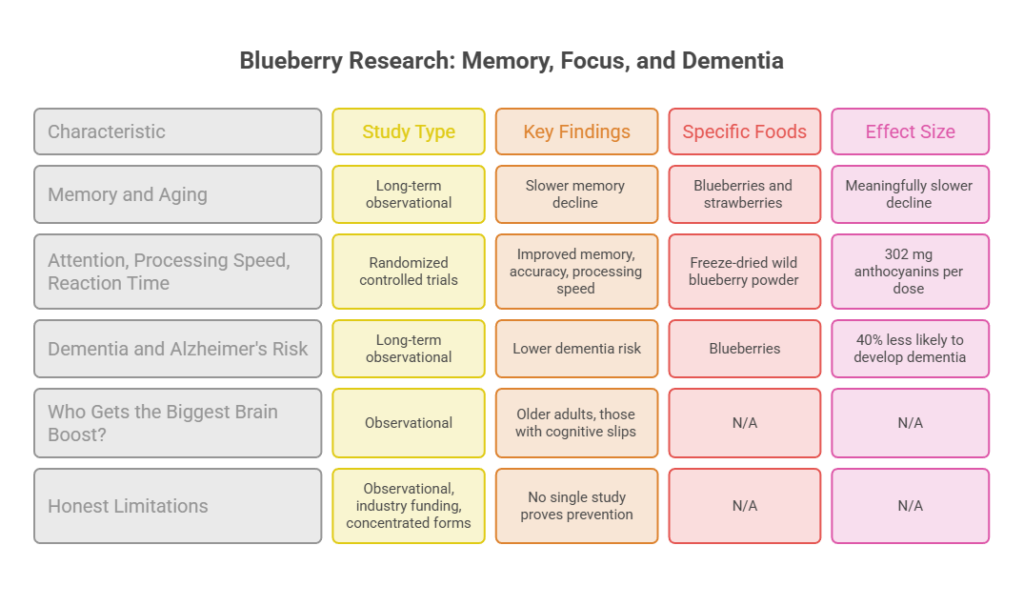
No single study proves berries alone prevent disease. Read together, though, they build a consistent case that flavonoid-rich fruit supports the aging brain.
Memory and Aging: The Long-Term Studies
The strongest data comes from large groups followed for many years. In the Harvard work above, women eating two or more weekly berry servings showed meaningfully slower memory decline.
A separate Harvard study published in Neurology tracked more than 77,000 adults for 20 years. People with the highest flavonoid intake were 19% less likely to report memory and thinking problems, as summarized by Harvard Health.
Blueberries and strawberries ranked among the specific foods most strongly tied to those benefits. That repeatability across independent studies is what gives the findings real weight.
These are observational studies, which show association rather than airtight cause and effect. Even so, the size and length of the data make the link genuinely hard to dismiss.
Attention, Processing Speed, and Reaction Time
Long-term cohorts capture the slow-burn benefits. Randomized trials show what shifts faster, and they carry more weight because participants are randomly assigned to berries or a placebo.
A standout trial from King’s College London, published in the American Journal of Clinical Nutrition, gave 61 adults aged 65 to 80 a daily drink made from freeze-dried wild blueberry powder for 12 weeks. The dose equaled about 178 grams of whole berries, per King’s College London.
Across those twelve weeks, the berry group showed better memory, improved accuracy on attention tasks, and lower blood pressure than placebo. Each daily dose held 302 mg of anthocyanins while the placebo had none, according to Medical News Today.
A separate clinical trial run through the University of North Carolina found that adults with cognitive concerns who ate freeze-dried wild blueberries daily for six months improved their brain’s processing speed, as reported by the UNC Nutrition Research Institute.
Dementia and Alzheimer’s Risk
The prevention question is what brings most older readers here. The data is encouraging, though it deserves honesty about its edges.
In a 20-year study of about 2,800 dementia-free adults averaging age 59, those with the highest flavonoid intake were roughly 40% less likely to develop dementia than those with the lowest, per Harvard Health.
Blueberries also hold a singular spot in the MIND diet, the eating pattern built specifically to protect the aging brain. It is the only fruit the diet names outright, alongside leafy greens, nuts, and fish.
Studies of the MIND diet, developed at Rush University, report that close adherence is associated with about a 53% lower Alzheimer’s risk, and even moderate adherence with roughly a 35% reduction. The pattern is reviewed by the Harvard T.H. Chan School of Public Health.
Who Gets the Biggest Brain Boost?
Not everyone benefits equally, and the research makes the pattern fairly clear. Older adults and people already noticing memory or processing slips tend to show the largest, fastest gains.
That fits the biology. There is simply more room for improvement when blood flow has dipped and inflammation has crept up with age, which is when the berry’s effects show up most sharply in trials.
Younger adults and children likely still benefit over the long haul, since flavonoids support memory and learning at any age. The effect is just harder to measure in a brain that is already running well, so the headline studies skew older. For a busy 30-year-old, the payoff is more about protecting the brain decades down the road than feeling sharper this afternoon.
The Honest Limitations
Among the readers our team serves, the most common error is treating one fruit as a cure. The research does not back that, and good guidance has to say so plainly.
Several caveats apply. Many of the strongest trials used concentrated freeze-dried powder or extracts, not the fresh berries on a grocery shelf, which vary in pigment by variety and ripeness.
A portion of the funding also comes from the blueberry industry through groups tied to the U.S. Department of Agriculture, as a recent evidence review noted in the NIH library. Industry money does not automatically void a finding, but it is a fair reason to read claims with care.
Finally, much of the human data is observational. People who eat lots of berries often exercise more and eat better overall, which muddies how much credit the berries alone deserve.
Fresh, Frozen, Wild, or Dried: Which Is Best for Your Brain?
If blueberries help the brain, the next fair question is which kind gives you the most for your money. The gaps are wider than most shoppers expect.
The table below compares the common forms on pigment, cost, and how well each holds its brain-relevant compounds.
| Form | Anthocyanins | Cost (US, approx.) | Brain-Benefit Verdict |
| Fresh cultivated | Good (about 240 mg/cup) | $3 to $5 per pint | Solid choice when in season |
| Frozen cultivated | Good (locked in by flash-freezing) | $2 to $4 per pound | Best everyday value |
| Wild (usually frozen) | Highest (about 33% more pigment) | $4 to $7 per pound | Top pick for pigment per dollar |
| Dried | Lower (some loss, often added sugar) | $6 to $10 per pound | Snackable, but read the label |
| Juice, jam, or baked | Lowest (cooking cuts pigment 20% to 40%) | Varies | Treat as a treat, not a brain food |
Why Frozen and Wild Often Win
Freezing carries an unfair stigma. Flash-freezing locks in the pigments at peak ripeness, so frozen berries often match or beat fresh ones that spent days in transit.
Wild blueberries are the quiet champion. Compared with cultivated berries, they carry about 33% more anthocyanins and roughly twice the antioxidant content, according to AARP.
Cooking is where the benefit leaks out. The American Heart Association notes that baking lowers anthocyanin levels, and that jams and jellies can run up to two-thirds sugar.
A bag of frozen wild blueberries is usually the smartest buy for brain benefits per dollar. It keeps for months and skips the sugar manufacturers add to most dried and baked versions.
How Many Blueberries Should You Eat for Brain Health?
There is no prescription-strength dose, but the research points to a workable range. The good news is the helpful amount is small and easy to reach.
The table below turns the evidence into plain action for common situations.
| Your Situation | Recommended Approach | Practical Tip |
| Want the most anthocyanins on a budget | Buy frozen wild blueberries | Cheaper per gram and often higher in pigment than fresh |
| Following the MIND diet | At least two berry servings weekly; blueberries count | Keep a freezer bag stocked for consistency |
| Watching blood sugar | Stick to half a cup to one cup, paired with protein | Add to Greek yogurt or eat with nuts to soften the spike |
| Don’t enjoy plain berries | Blend into smoothies or stir into oatmeal | Avoid jam and pastries as your main source |
| Older adult focused on memory | Aim for a daily serving, around one cup | Daily consistency beats occasional large portions |
A Simple Daily Approach
Even a modest amount appears to help. An Advances in Nutrition review concluded that a daily intake of about one-third cup of blueberries, supplying under 50 mg of anthocyanins, is associated with lower disease risk.
The MIND diet asks for only two servings of berries a week. The trials that improved memory leaned closer to a daily cup, so a target somewhere between those two points is sensible.
A clear pattern shows up in our reader questions: people who treat blueberries as a daily habit see the slow, steady support the studies describe. The occasional eaters tend not to.
Does the Time of Day Matter?
No study has pinned down a best time to eat blueberries for the brain, so the honest answer is that consistency beats clock-watching. A morning bowl is popular simply because it is easy to remember.
Some people report steadier focus when they pair berries with breakfast, likely from the gentle, fiber-buffered energy rather than any special timing effect. Eat them whenever you will actually eat them every single day.
Easy Ways to Eat More
The simplest route is to attach berries to a meal you already eat. Drop a handful into morning oatmeal, blend them into a smoothie, or spoon them over plain yogurt.
A cup runs roughly 65 to 75 berries, which sounds like a lot until you see it fit in a small bowl. Frozen berries also work straight from the bag, with no prep at all.
For an easy routine, portion frozen berries into a week of grab-and-go containers, or keep a bag right next to the cereal. Pairing them with a protein, like cottage cheese or a small handful of nuts, steadies energy and helps the habit stick.
Mistakes That Cancel Out the Brain Benefits
Plenty of people eat blueberries and still miss the upside, usually because of how they eat them. A few habits quietly erase the gains.
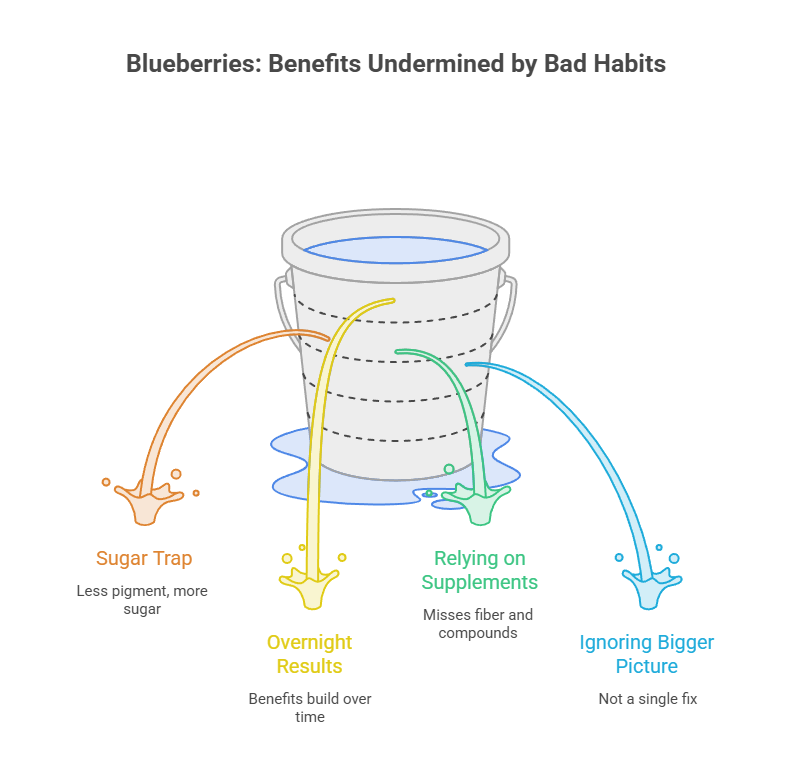
The first is the sugar trap. Blueberry muffins, pies, jams, and sweetened dried berries deliver far less pigment plus a load of added sugar, which pulls against brain health.
The second is expecting overnight results. These benefits build across weeks and months, so a single smoothie will not sharpen your recall by dinnertime.
The third is leaning on supplements instead of food. Pills and powders have their place, but whole berries bring fiber and a fuller mix of compounds that isolated extracts often miss.
The fourth is ignoring the bigger picture. Blueberries help most inside a brain-healthy pattern of leafy greens, fish, nuts, exercise, and sleep, not as a single fix bolted onto a poor diet.
The readers who benefit most pair a daily berry habit with those other basics. The berry is a strong supporting player, never the whole team.
The Bottom Line for Your Brain
So, are blueberries good for brain health? The evidence says yes, with realistic expectations attached.
They will not prevent every case of memory loss or guarantee a razor mind into your nineties. What they reliably offer is a small, repeatable edge: better memory retention, faster attention, improved blood flow, and lower long-term dementia risk when eaten regularly.
The smartest move is also the easiest. Keep frozen wild blueberries on hand, eat a serving most days, and fold them into an overall pattern that protects your brain.
For the price of a bag of berries, that is one of the better-supported bets in everyday nutrition. Our medical reviewers rank blueberries as a low-risk, evidence-backed habit well worth keeping.
Frequently Asked Questions
Are blueberries really good for your brain?
Yes. Human studies link regular blueberry intake to better memory, faster attention, improved blood flow to the brain, and lower long-term dementia risk. The effects are modest and build over time. They work best as part of an overall brain-healthy diet rather than as a standalone cure.
How many blueberries should you eat a day for brain health?
Aim for about one cup daily, roughly 65 to 75 berries. Research suggests even one-third of a cup carries benefit, while memory trials used closer to a full cup. The MIND diet asks for at least two berry servings weekly, so a daily habit clears that bar easily.
Are frozen blueberries as good as fresh for the brain?
Yes, and sometimes better. Flash-freezing locks in anthocyanins at peak ripeness, so frozen berries often match or beat fresh ones that traveled for days. Frozen wild blueberries are usually the best value, delivering high pigment content for a lower price per pound.
Do blueberries improve memory?
Evidence points that way. In Harvard research, older adults eating two or more berry servings weekly slowed memory decline by up to 2.5 years. Controlled trials using daily blueberry powder also improved memory and attention within 12 weeks. The benefits are real but gradual, not instant.
How long does it take for blueberries to help your brain?
Short-term trials showed measurable gains in memory and attention after about 12 weeks of daily intake, and some blood-flow effects within a few weeks. The long-term protective benefits, like lower dementia risk, build over years of regular eating. Consistency matters far more than any single serving.
Are wild blueberries better than regular ones for the brain?
Generally yes. Wild blueberries are smaller and darker, carrying about 33% more anthocyanins and roughly twice the antioxidants of cultivated berries. Most are sold frozen. For brain benefits per dollar, a bag of frozen wild blueberries is often the strongest choice on the shelf.
Can blueberries prevent dementia or Alzheimer’s?
They may lower the risk, but they cannot guarantee prevention. Adults with the highest flavonoid intake had about 40% lower dementia risk over 20 years. Blueberries are the only fruit named in the MIND diet, which is linked to reduced Alzheimer’s risk. They are protective, not curative.
Do blueberries help with focus and concentration?
Some research supports a focus benefit. Controlled trials found daily blueberry intake improved attention accuracy and reaction time, especially in older adults. The likely reason is better blood flow to the brain and reduced inflammation. The effect is moderate and clearest with consistent daily intake.
Are blueberry supplements as good as fresh berries?
Not quite. Many trials used freeze-dried powder, so concentrated forms can deliver standardized doses. Whole berries, though, also bring fiber and a fuller mix of plant compounds that isolated extracts often skip. For most people, eating fresh or frozen berries is the better and cheaper choice.
Can kids and young adults get brain benefits from blueberries?
Likely yes, though most strong studies focused on older adults. Some research suggests flavonoids support memory and learning across all ages. Blueberries are a low-sugar, nutrient-dense fruit with no real downside for children or young adults, so they fit easily into a brain-healthy diet at any age.
Is blueberry juice good for the brain?
Whole berries are better. A few small trials used blueberry juice and saw brain-blood-flow benefits, but juice loses fiber and often adds sugar. Cooking and processing also cut anthocyanin content. For consistent brain benefits, fresh or frozen whole blueberries beat juice in most cases.
Should you eat blueberries every day?
A daily serving is a reasonable, well-supported habit. The trials that improved memory used near-daily intake, and the helpful dose is small. For most people there is no downside to a cup a day beyond cost. Pair it with an overall brain-healthy pattern for the best results.
Medical Disclaimer: This article is for general educational purposes and does not replace professional medical advice, diagnosis, or treatment. Blueberries are a food, not a medicine, and individual needs vary. If you have concerns about memory, cognition, diabetes, or any health condition, consult a licensed healthcare provider before making dietary changes. Always seek guidance from a qualified clinician for personal medical questions.
References
- USDA FoodData Central, blueberry nutrient composition
- Harvard Gazette, berries and slower memory decline
- Harvard Health, flavonoids linked to sharper thinking and memory
- Harvard Health, berries, apples, and tea linked to lower dementia risk
- Harvard T.H. Chan School of Public Health, MIND diet review
- King’s College London, daily wild blueberries and brain function
- Medical News Today, blueberries and cognitive and cardiovascular health
- UNC Nutrition Research Institute, wild blueberries and processing speed
- American Heart Association, fresh or frozen, wild or cultivated blueberries
- Advances in Nutrition, health benefits of blueberries and anthocyanins
- NIH PMC, state of the science on blueberry health benefits
- Scientific American, your brain on blueberries
- Ochsner Health, ways blueberries improve brain health
- AARP, health benefits of blueberries for your brain