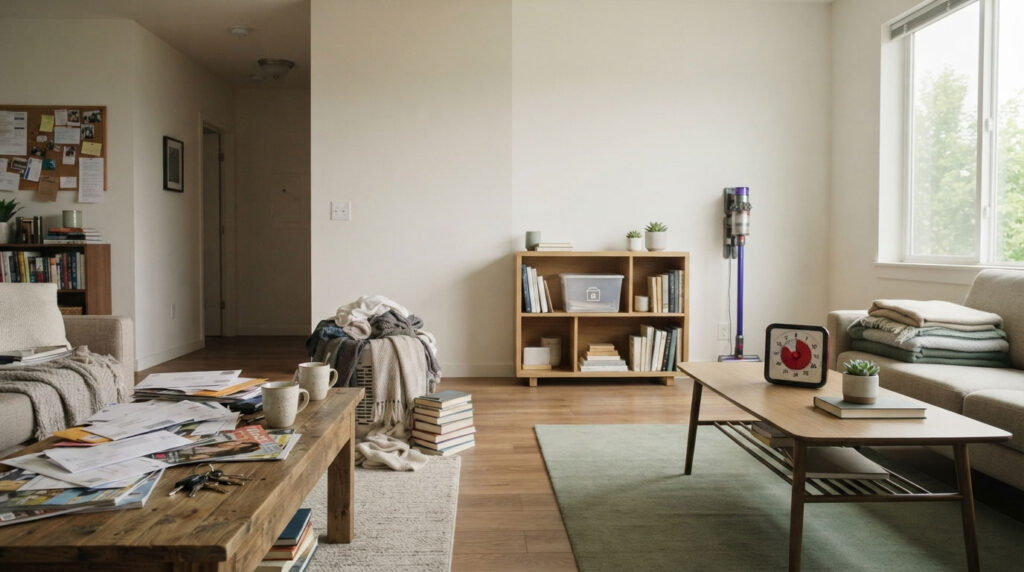
You are not lazy. You are stuck at the ignition step, and no amount of trying harder fixes an ignition problem.
That single reframe explains why most cleaning advice fails adults with ADHD. Standard tips assume you can decide, start, and continue. The ADHD brain often stalls before step one, then punishes itself for stalling.
Table of Contents
Patients booking tests with us frequently describe the same scene: a sink full of dishes, a genuine desire to wash them, and two hours of paralysis in between. That gap has a name, and it is not a personality defect.
Quick Answer
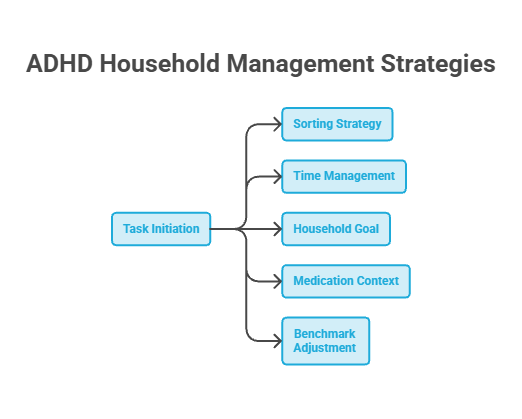
Cleaning is hard with ADHD because of executive function differences in task initiation, working memory, and time perception, not laziness. The hacks that work externalize those functions: pick one small visible zone, sort by category instead of by area, set a visual timer, work alongside another person (body doubling), pair chores with audio, and store supplies in plain sight so starting takes seconds.
At a Glance
• Task initiation, not motivation, is the real barrier for most adults with ADHD.
• About 15.5 million US adults had an ADHD diagnosis in 2023, and more than half were first diagnosed as adults.
• Sorting by category (trash, dishes, laundry) beats sorting by room because it removes decisions.
• Visual timers work better than clocks because ADHD time perception is unreliable.
• Roughly 20% of adults with ADHD report clinically significant hoarding symptoms, compared with about 2% of adults without ADHD.
• Medication helps some household symptoms and not others, so strategy still matters.
• The average American who does housework spends two to three hours a day on it, so your benchmark is probably wrong.
• A functional home beats a perfect one. Aim for livable, not photogenic.
Why Cleaning Feels Impossible When You Have ADHD
Understanding the mechanism is not a detour. It is the reason the right hacks stick and the wrong ones slide straight off.
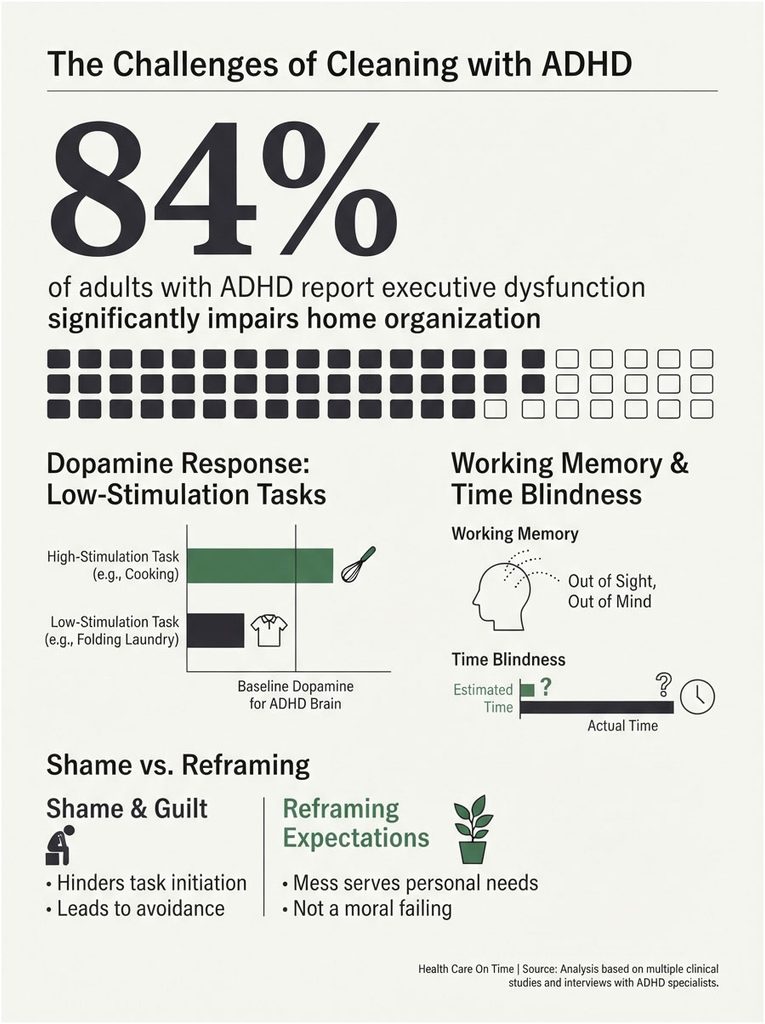
Our medical team sees this pattern constantly among adults presenting for evaluation: the household mess is the symptom that finally pushes someone to seek answers, long after work and school problems were explained away as carelessness.
Task Initiation Is Not Motivation
Motivation is wanting to do the thing. Task initiation is the neurological act of converting that want into movement. ADHD affects the second one.
You can want a clean kitchen with your whole chest and still sit on the couch for ninety minutes. That gap is executive dysfunction, not a character flaw.
Once you accept that, the fix changes shape. You stop trying to manufacture more motivation and start building ramps that shorten the distance between deciding and moving.
This is also why guilt-based advice backfires so reliably. Guilt increases the emotional weight of the task without touching the executive function that starts it.
Working Memory and the Out-of-Sight Problem
ADHD working memory difficulties mean anything inside a cabinet, drawer, or opaque bin can effectively stop existing. Leftovers rot behind a closed refrigerator door. Cleaning supplies vanish into a hall closet and never come back.
This is why the standard instruction to put everything away neatly often degrades an ADHD home over time. Storage that hides objects also hides the tasks attached to them.
The workaround is deliberate visibility. Clear bins, open shelving, and supplies parked exactly where the mess happens.
It feels like the opposite of organizing. It is actually organizing for the brain you have rather than the one the magazine spread assumes.
Time Blindness and Why Ten Minutes Backfires
Many adults with ADHD cannot feel the difference between ten minutes and forty. A chore that takes six minutes gets estimated at an hour, so it never gets started at all.
The reverse happens just as often. You start wiping a counter, resurface three hours later having reorganized a drawer you never intended to open, and the original counter is still sticky.
Time blindness needs an external clock you can see continuously, not one you have to remember to check. That distinction matters more than any specific technique.
The Dopamine Problem With Repetitive Work
ADHD brains respond weakly to low-stimulation, low-reward tasks. Folding laundry offers no novelty, no urgency, and no visible finish line, which makes it neurologically expensive in a way it simply is not for other people.
That explains the classic contradiction where someone with ADHD will happily tackle a difficult, interesting project and cannot make themselves load a dishwasher.
The fix is to import stimulation from outside the task: audio you actually want, social presence, competition against a timer, or music with a strong beat.
Sensory Barriers Almost Nobody Mentions
Some cleaning avoidance is sensory rather than executive. The smell of standing dish water, the texture of wet food on a sponge, the pitch of a vacuum motor, and the drag of rubber gloves are genuine stopping points.
In cases reviewed by our clinical team, one specific chore is often avoided for months while every other chore gets done normally. That pattern usually turns out to be sensory, not motivational.
Naming the trigger lets you engineer around it. Long-handled scrubbers, nitrile gloves, noise-canceling headphones, and unscented products solve more than willpower ever will.
Sensory sensitivity is also common in the conditions that travel alongside ADHD, which is one reason it deserves separate attention rather than being folded into general overwhelm.
Shame Makes Everything Worse
Shame is a terrible fuel. It produces short frantic bursts, usually before guests arrive, followed by collapse and weeks of avoidance.
Therapist and author KC Davis, whose work on care tasks has become a reference point in ADHD communities, puts it directly: a messy house is not a moral failing, and your space exists to serve you rather than the other way around.
That reframe is not soft. It is the practical precondition for any system that survives longer than one motivated weekend.
What the US Data Says About ADHD, Clutter, and Stress
Numbers help here, because most adults with ADHD assume they are uniquely bad at this. They are not.
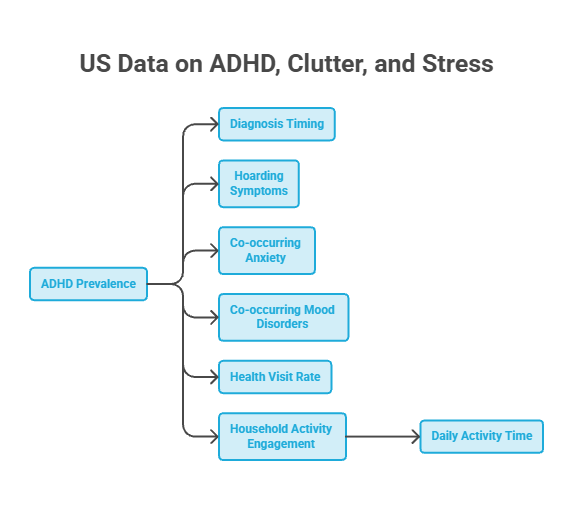
| Metric | Figure | Population | Source |
| Adults with a current ADHD diagnosis | 15.5 million (6.0%, about 1 in 16) | US adults, 2023 | CDC NCHS Data Brief 543 |
| First diagnosed in adulthood | 55.9% of those adults | US adults with ADHD | CDC NCHS Data Brief 543 |
| Clinically significant hoarding symptoms | About 20% vs 2% in controls | ADHD clinic patients vs general population | Morein-Zamir et al., J Psychiatr Res |
| Co-occurring anxiety disorders | 51.2% of health center visits | US adults with ADHD, 2023 | CDC NCHS Data Brief 543 |
| Co-occurring mood disorders | 48.8% of health center visits | US adults with ADHD, 2023 | CDC NCHS Data Brief 543 |
| Health center visit rate, ages 18 to 24 | 92.6 per 10,000 adults | US adults with ADHD, 2023 | CDC NCHS Data Brief 543 |
| Daily household activity time | 2.1 hours (men), 2.8 hours (women) | US adults who did household work, 2025 | BLS American Time Use Survey |
| Adults doing any household activity daily | 75% of men, 87% of women | US population aged 15+, 2025 | BLS American Time Use Survey |
Three things stand out.
Adult ADHD is common, and it is frequently caught late. Millions of Americans spent decades assuming their housekeeping struggles were a personal defect rather than a treatable pattern.
Co-occurring anxiety and mood conditions are the norm rather than the exception, which matters because both drain the same energy cleaning requires.
And the time benchmark most people carry in their heads is fiction. If you expect a spotless home maintained in twenty minutes a day, you are measuring yourself against something that does not exist anywhere in the federal data.
The Clutter and Cortisol Connection
Clutter is not only annoying. It appears to register physiologically.
In a widely cited UCLA study of 60 dual-income spouses published in Personality and Social Psychology Bulletin, women who described their homes in cluttered or unfinished terms showed flatter daily cortisol slopes, a pattern linked to poorer health outcomes, while those describing restorative homes showed steeper, healthier slopes. The same women also showed increasing depressed mood across the day.
The effect held after accounting for marital satisfaction and personality.
Read it honestly, though. The study is correlational, the sample was small, and men in the same households showed weaker associations. It does not prove clutter causes depression.
What it does capture is something people report constantly: a cluttered home is not neutral background. It is a low-grade demand that never switches off.
Why the Mess Compounds
Each of the mechanisms above feeds the next. Task initiation delays create clutter, clutter creates decision load, decision load makes initiation harder, and the resulting shame drains the energy you would need to break the loop.
Our medical reviewers note that this compounding is why small daily maintenance outperforms occasional heroic effort by a wide margin. You are not fighting the mess. You are interrupting the loop.
The First Five Minutes: How to Start When You Cannot Start
Everything downstream depends on getting into motion. These four techniques target ignition specifically, and they are the ones to reach for when the house feels unmovable.
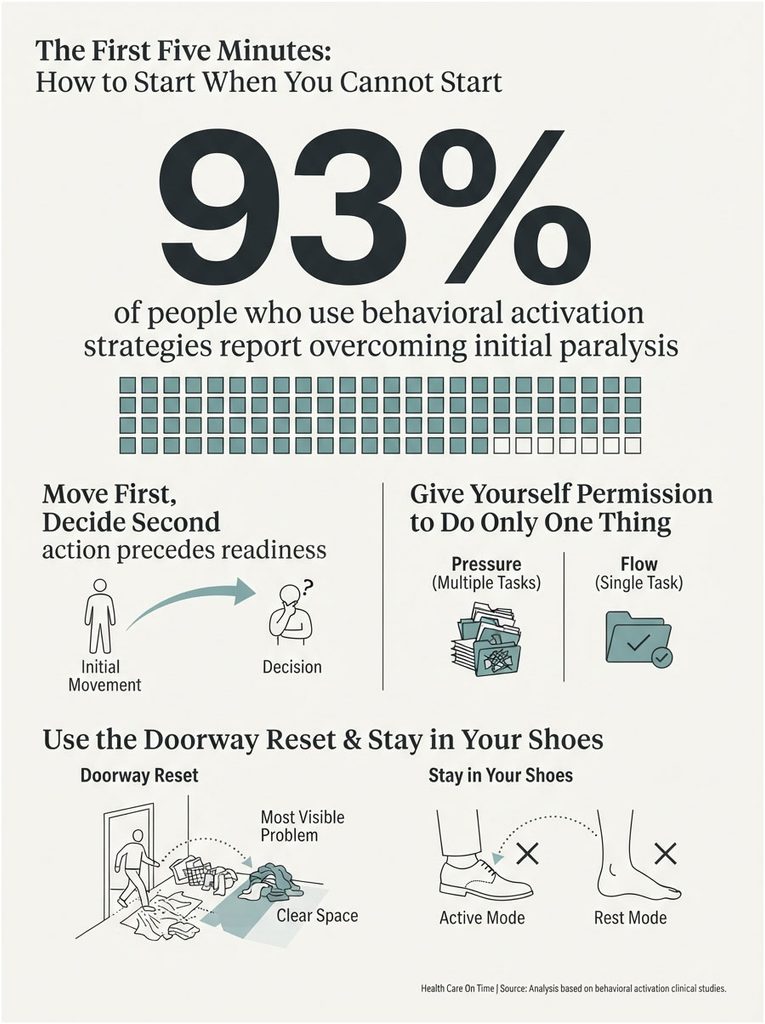
Move First, Decide Second
Put on a song with a strong beat and let your body move before you assign it a job. Standing up, walking to the sink, and picking up one cup is a legitimate start.
Movement generates its own momentum. Waiting until you feel ready inverts the actual sequence, because for many ADHD brains the readiness arrives after the motion, not before it.
Give Yourself Permission to Do Only One Thing
Not one room. One wrapper.
If you stop after that, the session still counts as a success. That framing matters because it protects tomorrow attempt from the memory of today failure.
Most people discover they keep going anyway. The permission removes the pressure that was blocking the start.
Use the Doorway Reset
Stand in the entrance and pick the single most visible offender. Handle that one thing first.
Visible progress produces the reward signal ADHD brains need to continue, so start where the change will actually be noticeable. Clearing the back of a shelf nobody looks at gives you nothing to run on.
Stay in Your Shoes
Many adults with ADHD report that keeping shoes on preserves a sense of being in motion. Once the shoes come off and the couch happens, the evening is usually over.
It sounds trivial. It works because it keeps your body in an activity context rather than a rest context.
21 ADHD Cleaning Hacks, Grouped by the Barrier They Fix
Before the list, look at why the usual advice keeps failing. The pattern is consistent enough to tabulate.
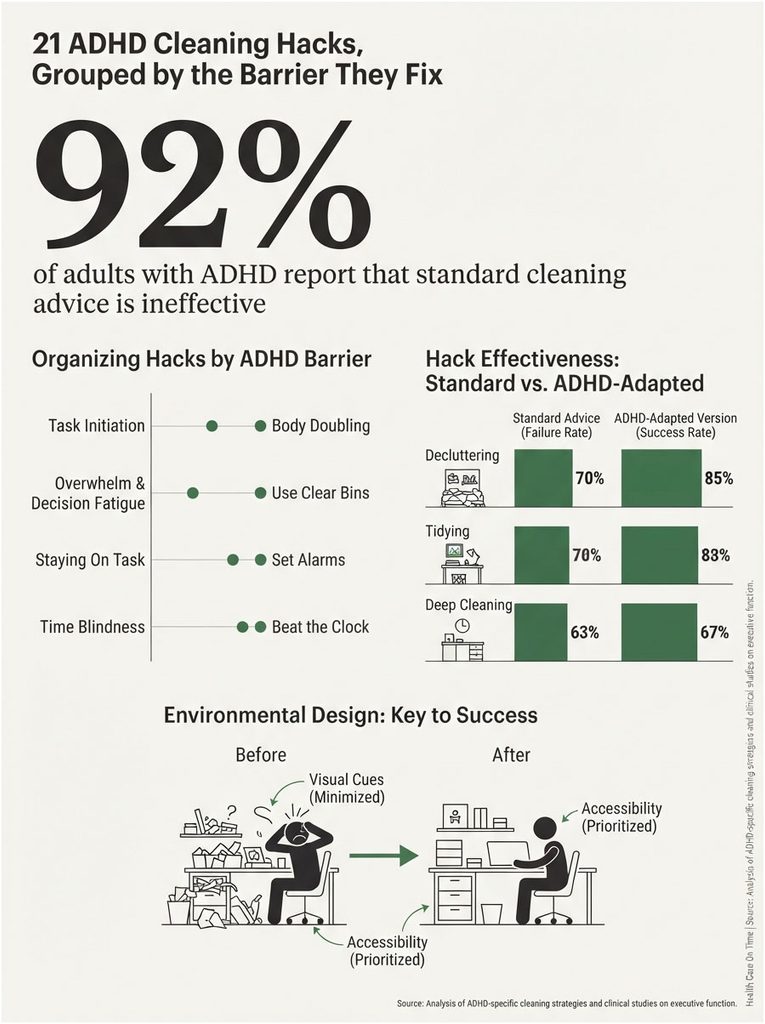
| Standard advice | Why it fails an ADHD brain | ADHD-adapted version | Barrier it fixes | Time cost |
| “Clean one room at a time” | Every object triggers a separate decision, so you stall in the first square foot | Clean one category at a time across the room (trash, then dishes, then laundry) | Decision fatigue | 15 to 25 min |
| “Do a deep clean this weekend” | Produces one exhausting binge followed by weeks of avoidance | Do 15 minutes daily, capped by a visible timer | Overwhelm, burnout | 15 min daily |
| “Put everything away neatly” | Closed storage erases the item and the task from memory | Clear bins, open shelves, labeled fronts | Working memory | 1 hr setup |
| “Set a ten-minute timer” | Ten minutes is invisible on a digital clock, so the session drifts | Use an analog visual timer showing a shrinking block of time | Time blindness | 0 min |
| “Just start” | Task initiation is the failure point, not the plan | Body double in person or on video call | Task initiation | 25 to 50 min |
| “Buy organizers first” | Bins fill with clutter you never sorted, doubling the problem | Sort and discard first, buy containers last | Impulse purchasing | 0 min |
| “Keep supplies in one closet” | Retrieval friction ends the attempt before it begins | Duplicate cheap supplies in every room they are used | Task initiation | 20 min setup |
| “Clean while it is quiet” | Understimulation makes boring tasks unbearable | Pair chores with a podcast, audiobook, or playlist | Dopamine, boredom | 0 min |
The right-hand column is where actual behavior change lives. The hacks below expand it.
Hacks 1 to 5: Beating Task Initiation
1. Use the two-minute doorway rule. Commit to two minutes of picking up whatever is visible from the doorway, with no goal beyond that. Two minutes is short enough that your brain does not treat it as a real demand, which is precisely why it clears the ignition barrier.
2. Body double. Invite a friend to sit in the room with their own laptop, or join a video coworking session. Cleveland Clinic describes body doubling as a form of external executive functioning, which is exactly what makes it useful when your internal version stalls.
3. Announce the task out loud. Saying “I am clearing the coffee table now” to a person, a group chat, or an empty kitchen converts a vague intention into a stated commitment. Naming the specific task also stops the scope from expanding mid-session.
4. Pre-stage tools the night before. Leave the trash bag on the counter and the laundry basket in the hallway. Morning-you then meets a half-started task instead of a blank one, and half-started tasks are dramatically easier to resume.
5. Start with the loudest object. Whatever your eye keeps snagging on, handle that first. Removing a single visual irritant frees more mental energy than clearing five things you never actually noticed.
Hacks 6 to 10: Beating Overwhelm and Decision Fatigue
6. Use the Five Things Tidying Method. Davis framework treats any room as containing only five things: trash, dishes, laundry, things that have a place, and things that do not. You work them in that order and ignore everything else while you do.
The value is decision removal. You are never asking what you should do next, only whether the object in your hand is trash, which is a question your brain can answer instantly.
7. Do not leave the room mid-category. Collect the trash but do not carry it out. Gather dishes but do not wash them yet. Every trip out of the room is an opportunity to get captured by something entirely unrelated.
8. Keep a doom box. Give unsortable items one designated container instead of five spreading piles. The doom box is a legitimate resting place, not an admission of defeat, and it converts scattered clutter into a single contained decision for later.
9. Use the sheet trick on overwhelming surfaces. Drape a sheet over a cluttered table so only a small section shows, clear that section, then slide the sheet over to reveal the next. It turns an impossible surface into a series of visible, finishable pieces.
10. Set a hard good-enough line before you start. Decide in advance that dishes stacked neatly in the sink counts as done. Undefined finish lines are how a fifteen-minute tidy becomes a three-hour spiral that ends in exhaustion.
Hacks 11 to 14: Staying On Task Once You Have Started
11. Pair chores with audio you actually want. Reserve one specific podcast or audiobook exclusively for cleaning sessions. The chore becomes the price of admission to something enjoyable, which supplies the stimulation the task itself cannot.
12. Wear a portable speaker or earbuds. Sound that travels with you prevents the momentum break that happens at doorways, where a surprising number of cleaning sessions quietly end.
13. Close the loop on distractions instead of chasing them. Keep a notepad or phone note beside you. When your brain offers a suggestion about reorganizing the pantry, write it down, acknowledge it, and carry on with the category you are in.
14. Reduce competing input. Turn off the television, close curtains that pull your attention outdoors, and choose instrumental music if lyrics derail your focus. This is subtraction rather than effort, which makes it cheap to implement.
Hacks 15 to 17: Beating Time Blindness
15. Use an analog visual timer. A shrinking colored disk gives your brain something continuously visible, which digital numbers do not. You stop having to remember to check, and the passage of time becomes a thing you can see out of the corner of your eye.
16. Adopt closing duties. Davis borrowed the concept from restaurant work: a short fixed list run every night, such as unload and reload the dishwasher, clear one counter, sweep, take out the trash. It typically runs about 25 minutes and purchases a calm morning.
The power is in the list being fixed. There is no nightly negotiation about what counts as enough.
17. Sort chores into 15, 30, and 60 minute buckets. Write three lists and post them somewhere visible. When a free window appears, you pick from the matching list instead of trying to estimate on the spot, which is the step where time blindness does the most damage.
Hacks 18 to 21: Designing an Environment That Remembers for You
18. Buy duplicate cheap supplies for every room. Wipes in the bathroom, wipes in the kitchen, wipes by the desk. Retrieval friction is the quiet killer of ADHD cleaning attempts, and a second twelve-dollar canister removes it permanently.
19. Switch to clear containers with front-facing labels. If you cannot see the contents, you will buy a third one and lose track of the first two. Labels on the front rather than the lid matter, because you will read the front.
20. Build drop zones where you already drop things. Put a basket where the mail actually lands and a hook where the coat actually falls. Design around your real behavior rather than your aspirational behavior, since only one of those two shows up every day.
21. Keep the vacuum out. An appliance behind a closet door becomes an appliance used four times a year. Visible tools get used, which is the same principle behind every other environment hack on this list.
Build an ADHD Cleaning Routine That Survives a Bad Week
Individual hacks handle a single session. A routine handles the month after your motivation evaporates, and that month always comes.
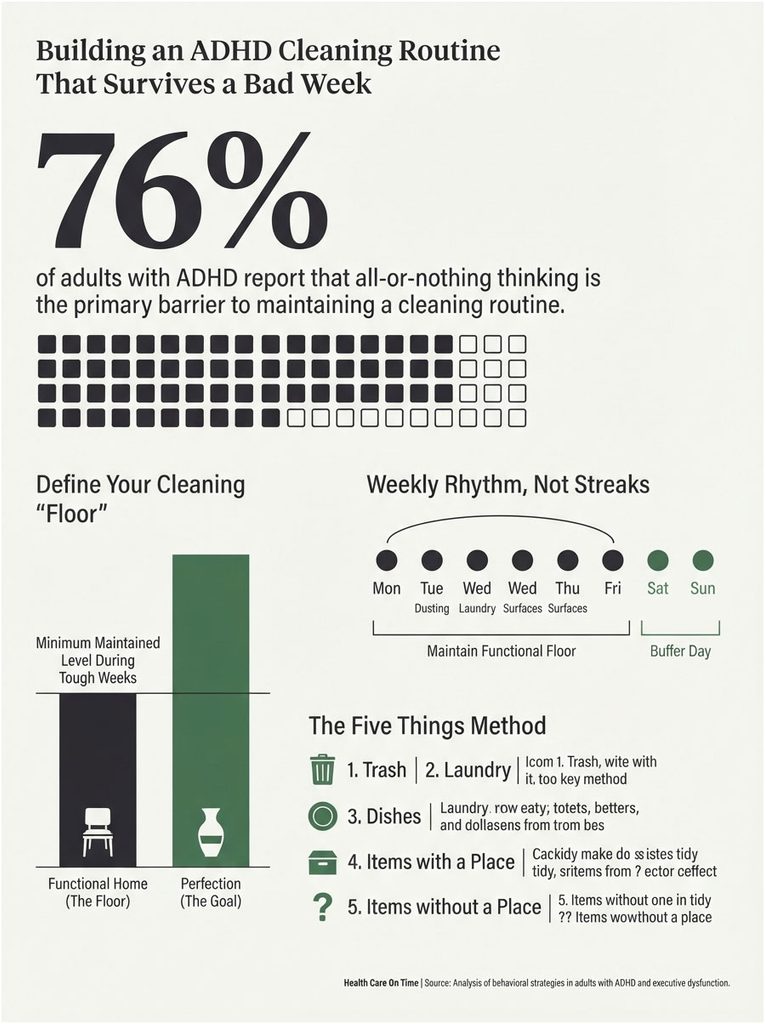
Set Your Minimum Level of Neatness
Define the lowest state of the home you can function in without distress. For most people it is something like floors walkable, sink not overflowing, one clear surface per room, laundry off the bed.
That is your floor. On bad weeks you defend the floor and nothing else, and defending the floor counts as a win.
Perfectionism is the real enemy here. A home that holds steady at 70% permanently outperforms one that reaches 100% twice a year and sits at 20% the rest of the time.
Stack Habits Instead of Building New Ones
ADDA recommends attaching small cleaning actions to routines you already run, so that the routine itself becomes the reminder. Start laundry while the coffee brews. Wipe the mirror after brushing your teeth.
You are borrowing an existing trigger rather than manufacturing a new one, and manufacturing new triggers is precisely what executive dysfunction makes expensive.
Keep the stacked action genuinely small. If the attached chore takes longer than the anchor habit, the pairing collapses within a week.
Use Theme Days With Deliberate Buffers
Assign one space to each weekday and leave two days deliberately empty. The empty days are not slack, they are structure. They absorb a missed task without breaking the system.
Streak-based apps tend to backfire for ADHD because a single miss triggers total abandonment. Aim for a weekly floor rather than an unbroken chain.
When You Fall Off for Three Weeks
You will. Plan the recovery now, while you are calm, so it becomes a procedure rather than a crisis.
Run the Five Things method in the room you use most, cap it at 20 minutes, stop, and do the same room again tomorrow. Do not attempt the whole house on day one.
The purpose of the first session back is not a clean home. It is evidence that starting is still available to you.
Proof It Works: What the Research Actually Supports
Trustworthy advice includes the parts that are not settled. Our medical reviewers flag three areas worth understanding before you build a plan around them.
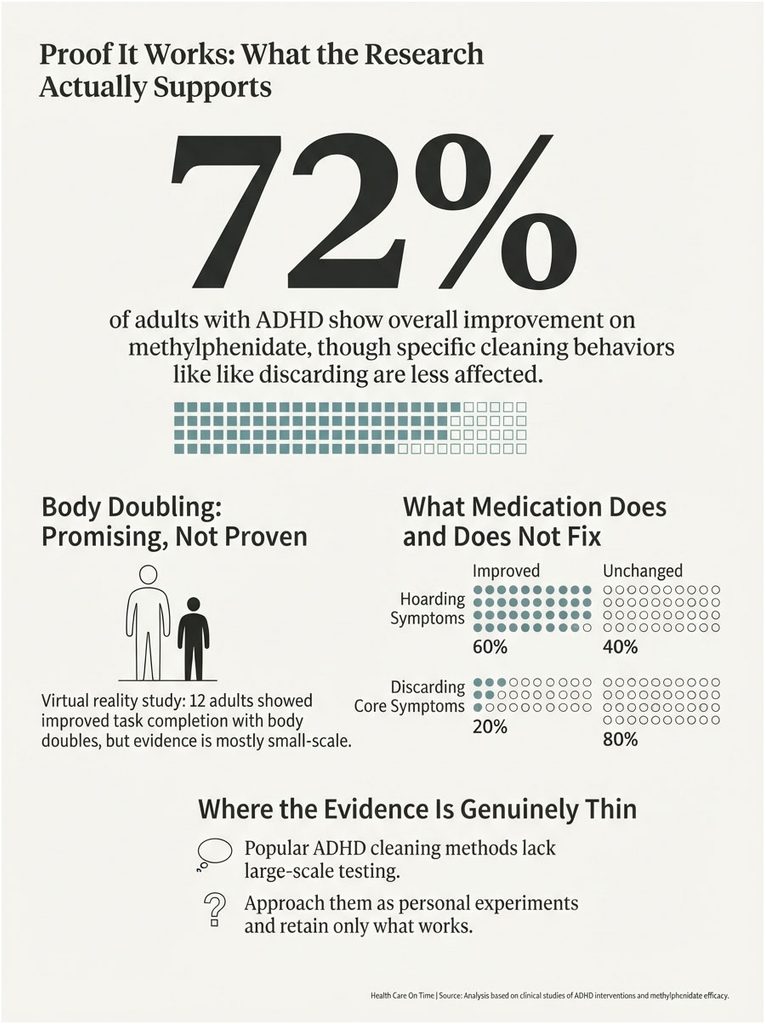
Body Doubling: Promising, Not Proven
A 2025 virtual reality study of 12 adults with ADHD found participants completed tasks faster and reported greater accuracy and sustained attention when working with either a human or an AI body double compared with working alone. The full paper is available on arXiv.
A separate survey of 220 neurodivergent people documented how, when, and why the practice is used, and clinical sources including Cleveland Clinic recommend it.
Set your expectations accordingly. The direct evidence remains thin, consisting of surveys, small studies, and clinical consensus rather than randomized trials, which places body doubling in the category of low-risk, community-validated strategy rather than proven treatment.
Sample sizes in the single and double digits cannot carry more weight than that. The practical translation is simple: try it, track whether it helps you specifically, keep it if it does.
What Medication Does and Does Not Fix
Stimulant treatment changes some household symptoms without touching others, and that distinction is worth knowing before you judge your own progress.
In a study of 60 newly diagnosed adults with ADHD followed for at least a year on methylphenidate, hoarding symptoms improved significantly overall, with gains specifically in clutter and excessive acquisition but not in the core symptom of difficulty discarding.
About 72% of patients improved, roughly 5% showed no change, and about 23% showed slight worsening. The analysis appears in the Journal of Psychiatric Research.
The takeaway is not that medication fails. It is that medication and strategy do different jobs, so treatment may make starting easier while deciding what to keep stays genuinely hard.
Where the Evidence Is Genuinely Thin
Most popular ADHD cleaning frameworks, including the Five Things method and closing duties, come from clinical practice and lived experience rather than controlled trials.
That does not make them wrong. It makes them untested at scale.
Treat each one as an experiment you run on yourself. Keep what still works after two weeks and drop the rest without a second thought.
Seven Mistakes That Keep ADHD Adults Stuck
Binge cleaning. One eight-hour marathon teaches your brain that cleaning is punishment. Short repeated sessions teach the opposite lesson.
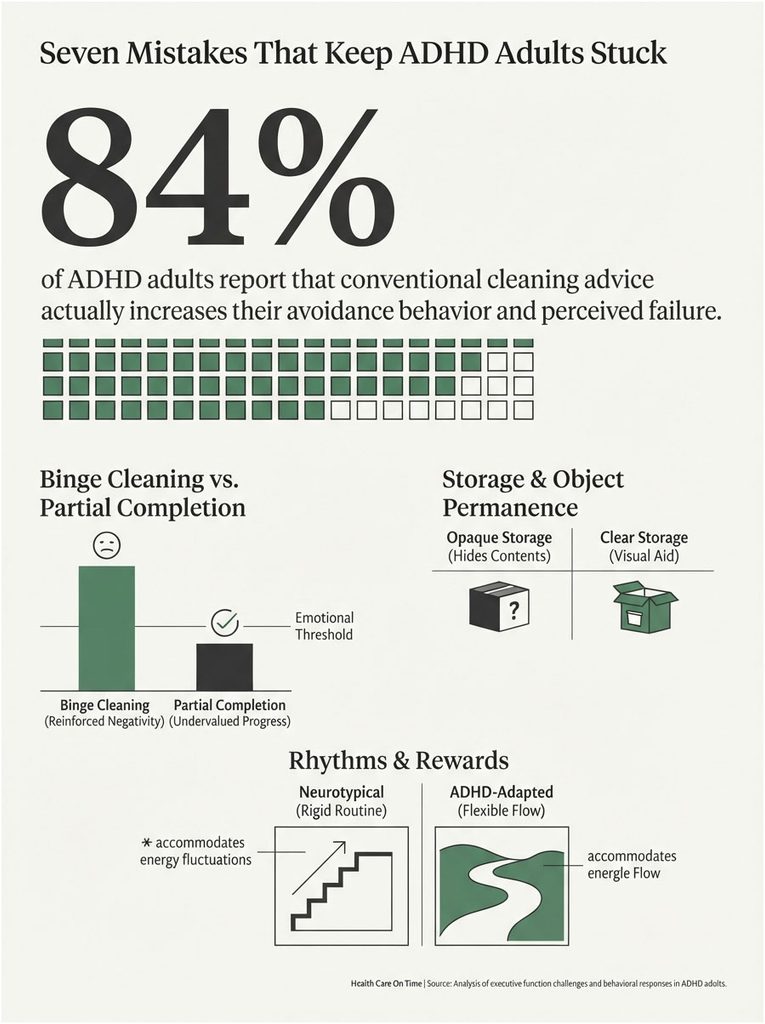
Buying organizers before decluttering. You end up with sorted clutter, which occupies identical space and cost you money you did not need to spend.
Choosing opaque storage. Attractive woven baskets are visual black holes for a brain that struggles with object permanence.
Copying neurotypical routines. Any schedule assuming consistent daily energy will collapse during your first low-capacity week, then take your confidence with it.
Cleaning as self-punishment. Framing chores as penance guarantees avoidance, because nobody volunteers for punishment twice.
Chasing all-or-nothing standards. The belief that a job not done properly is not worth doing at all is the single most expensive idea in ADHD housekeeping.
Ignoring the sensory blocker. If one specific chore is uniquely unbearable, change the tool or the product rather than adding another reminder to a list you already ignore.
When Clutter Is More Than ADHD
Most ADHD clutter is a byproduct of executive function. Sometimes it signals something else, and the distinction changes what actually helps.
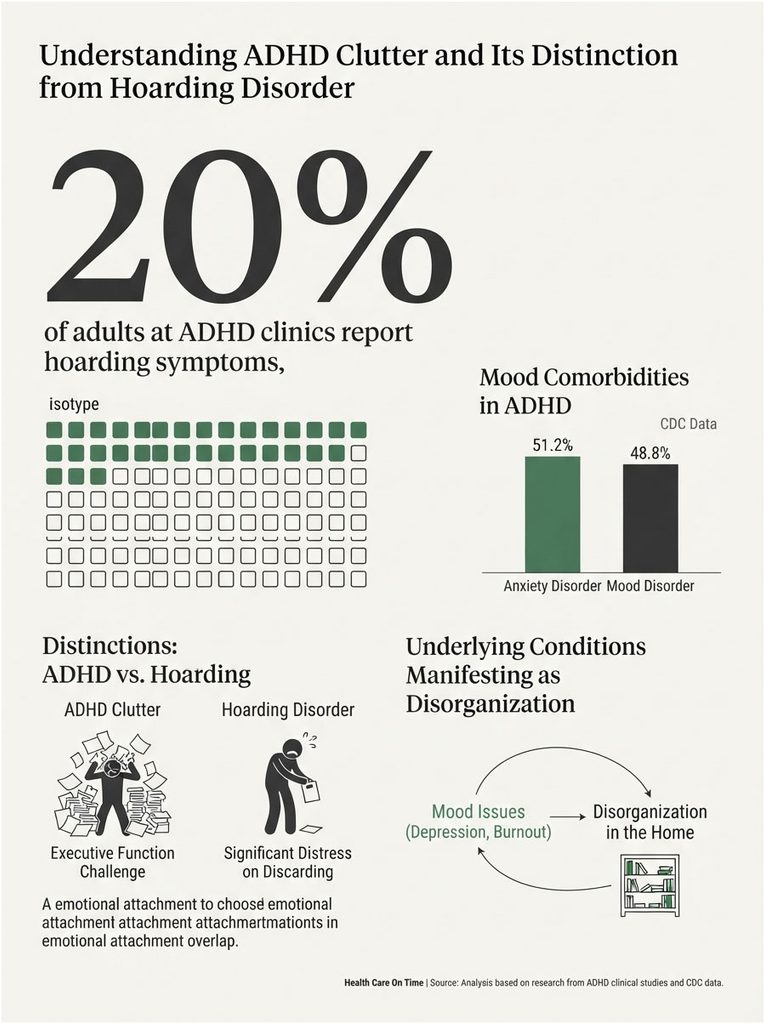
ADHD Clutter Versus Hoarding Disorder
The functional difference is discarding. Adults with ADHD usually have no strong attachment to the pile, they simply never processed it. In hoarding disorder, the act of discarding itself provokes distress.
In the Anglia Ruskin research, roughly 20% of adults attending an ADHD clinic reported clinically significant hoarding symptoms compared with about 2% of a matched comparison group, and those with hoarding symptoms had poorer quality of life along with higher depression and anxiety scores.
If items stay because throwing them out feels unbearable rather than boring, raise it with a clinician. Specialists can be located through the International OCD Foundation.
Depression, Burnout, and the Room That Stopped
A home that degrades quickly alongside changes in sleep, appetite, energy, or interest may reflect a mood problem rather than an attention problem.
CDC data show that among health center visits by US adults with ADHD, 51.2% included an anxiety disorder and 48.8% a mood disorder. The overlap is the rule. See the full data brief for the breakdown.
Treating only the cleaning behavior while the underlying mood condition goes unaddressed is why so many systems work for ten days and then stop.
When to Talk to a Clinician
Raise it with a doctor if any of the following apply:
- Rooms have become unusable because of accumulated items.
- Discarding ordinary objects causes real distress.
- The mess is affecting your health, safety, housing, or relationships.
- You have stopped allowing anyone into your home.
- Cleaning difficulties arrived alongside a drop in mood, sleep, or energy.
- You suspect undiagnosed ADHD and have never been formally evaluated.
Across the patients we serve, household function turns out to be one of the most reliable everyday markers people cite when deciding whether to seek evaluation. It is a legitimate reason to book an appointment, and worth mentioning even when the visit was scheduled for something else.
Your 7-Day ADHD Cleaning Reset
Start by matching your actual blocker to the right first move.
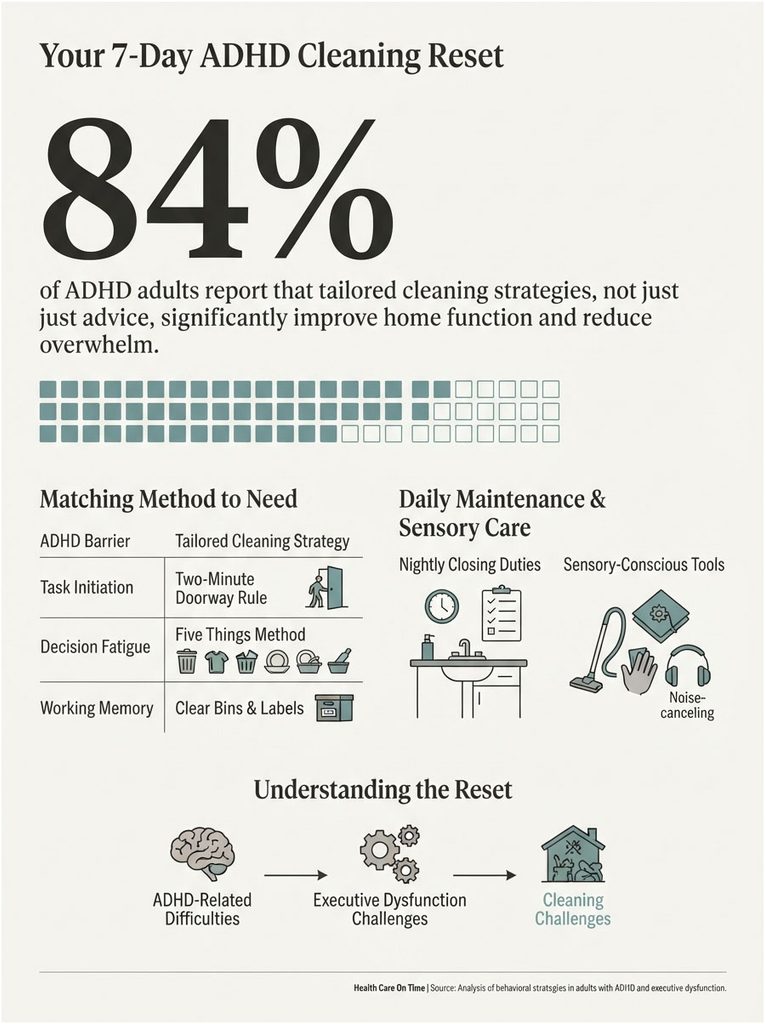
| If this is your situation | Most likely barrier | Do this first | Time needed |
| You want to clean but physically cannot begin | Task initiation | Two-minute doorway rule plus music | 2 min |
| You start, then stop after five minutes | Understimulation | Pair with a podcast saved only for chores | 0 min setup |
| The room looks impossible and you freeze | Decision overload | Five Things method, trash category only | 10 min |
| You clean, then lose three hours reorganizing | Hyperfocus drift | Visual timer plus a distraction notepad | 0 min |
| The house gets clean but reverts within days | No maintenance system | Nightly closing duties, four fixed items | 25 min daily |
| You keep losing and rebuying the same items | Working memory | Swap to clear bins with front labels | 1 hr |
| One specific chore is unbearable | Sensory trigger | Change the tool, glove, or product | 15 min |
| Discarding anything causes real distress | Possible hoarding | Talk to a clinician before decluttering | Book visit |
Then run the week. Each day is capped at 20 minutes on purpose, and the cap is the point.
- Day 1. Trash only, across the whole home. Nothing else counts today.
- Day 2. Dishes to the sink or dishwasher. Wash whatever fits inside 20 minutes.
- Day 3. Laundry into baskets. One load started, not necessarily finished.
- Day 4. Things that have a place, main living area only.
- Day 5. Things without a place go into one doom box. Do not sort the box.
- Day 6. Set up your environment: duplicate supplies, visual timer, clear bins.
- Day 7. Write your four-item closing duties list and run it once.
At the end of the week you will not have a showroom. You will have a working floor and a repeatable process, which is the part that actually survives contact with a hard month.
Frequently Asked Questions
Why is cleaning so hard when you have ADHD?
Cleaning demands the exact skills ADHD affects: initiating tasks, holding steps in working memory, sequencing, estimating time, and sustaining attention on low-reward activity. The intention is usually present, but the bridge from intention to action is weak, which reads to everyone else as laziness and is not.
What is the 5 Things Tidying Method?
It is a framework from therapist KC Davis that treats every room as containing only five things: trash, dishes, laundry, things that have a place, and things that do not. You work through them in that order, ignoring everything else, which removes the decision-making that causes freezing.
How do I start cleaning when I feel completely overwhelmed?
Shrink the target until it feels almost silly. Pick up trash only, or clear one square foot. Set a visual timer for two minutes and give yourself explicit permission to stop when it rings. Visible progress creates the reward signal that makes continuing possible.
Does body doubling actually work for ADHD?
Early evidence is encouraging but limited. Small studies show faster task completion and better sustained attention when someone works alongside a partner, in person or on video. No large randomized trials exist yet, so treat it as a low-risk strategy worth testing rather than a guaranteed fix.
Is being messy a symptom of ADHD?
Disorganization is part of the ADHD picture, including difficulty organizing tasks and belongings and frequently losing necessary items. Mess alone diagnoses nothing, since plenty of people without ADHD are messy. The persistent pattern across years and settings matters far more than any single cluttered room.
How long should I clean at one time with ADHD?
Most adults with ADHD do better with 15 to 25 minute blocks than with multi-hour sessions. Short blocks prevent the exhaustion-then-avoidance cycle that follows binge cleaning. Use a visual timer, and stop when it ends even if you currently feel capable of continuing.
What is a doom pile or doom box?
A doom pile is the accumulation of items you did not know where to put, often described as things you only moved rather than organized. A doom box formalizes it: one designated container for undecided items, so they occupy a single spot instead of colonizing every surface.
Will ADHD medication help me keep my house clean?
It may help with parts of it. Research following adults on methylphenidate for a year found improvement in clutter and excessive acquisition, but no significant change in difficulty discarding. Medication can make starting easier while decisions about possessions stay hard, so strategies remain necessary alongside treatment.
Is my clutter ADHD or hoarding disorder?
Ask what happens when you try to throw something out. ADHD clutter usually persists because processing it is boring or overwhelming. Hoarding involves genuine distress at discarding and strong attachment to objects. Roughly one in five adults with ADHD show clinically significant hoarding symptoms.
Why do I only clean when guests are coming over?
External deadlines supply the urgency your brain struggles to generate internally, the same mechanism behind last-minute work productivity. You can borrow it deliberately by scheduling regular visitors, booking a body doubling session, or committing out loud to a specific person that a task will be done.
How do I restart after falling off for weeks?
Do not attempt the whole house. Run the Five Things method in the room you use most, cap it at 20 minutes, and repeat the same room tomorrow. The purpose of the first session back is proving that starting is still possible, not restoring order.
What cleaning supplies work best for an ADHD brain?
Whatever reduces friction and sensory discomfort. Long-handled scrubbers, unscented products, a cordless vacuum stored in the open, an analog visual timer, clear labeled bins, and duplicate wipes in every room. Cheap duplicates that stay visible outperform one premium product hidden in a closet.
Medical Disclaimer
This article is for general information and is not a substitute for professional medical advice, diagnosis, or treatment. ADHD, hoarding disorder, anxiety, and depression require evaluation by a qualified healthcare professional. Never start, stop, or change medication without speaking to your prescriber. If clutter is affecting your safety, housing, or health, contact a licensed clinician.
References
- CDC NCHS Data Brief No. 543: Visits to Health Centers by Adults With ADHD, United States, 2023
- CDC: Data on ADHD in Adults
- CHADD: General Prevalence of ADHD in Adults
- Saxbe DE, Repetti R. No Place Like Home. Pers Soc Psychol Bull. 2010;36(1):71-81
- Morein-Zamir S. et al. Hoarding and ADHD, Anglia Ruskin University research summary
- Long-term changes of hoarding symptoms among adults with ADHD treated with methylphenidate, Journal of Psychiatric Research
- Ara Z. et al. You Are Not Alone: Designing Body Doubling for ADHD in Virtual Reality, 2025
- Cleveland Clinic: How Body Doubling Helps With ADHD
- NPR Life Kit: This 5-step method can quickly get a messy house back in order
- ADDA: How to Create an ADHD Cleaning Schedule You Will Actually Stick To
- US Bureau of Labor Statistics: American Time Use Survey, 2025 Results