Someone three years into Suboxone treatment can feel completely fine and still wonder what the medicine has been doing to their teeth, hormones or liver. Most of the early side effects fade within weeks, and the handful that can last, from constipation to tooth decay to a lower sex drive, can usually be managed without giving up treatment.
Table of Contents
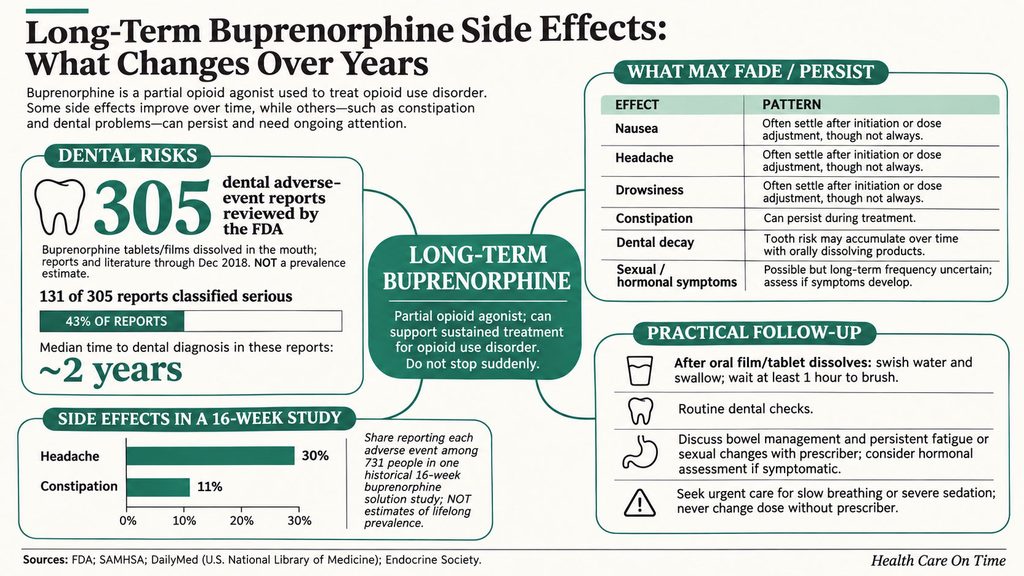
Quick answer: Long-term buprenorphine (Suboxone, Subutex, Zubsolv, Sublocade) is considered safe for most people, and the FDA label sets no maximum length of treatment. The effects most likely to stick around for years are constipation, sweating, tooth decay from films and tablets, low libido or low testosterone, and sleep-related breathing problems. Liver enzyme rises, adrenal insufficiency and heart rhythm changes are uncommon but worth checking for. Stopping abruptly carries more danger than staying on it.
Which Effects Fade and Which Tend to Stay
Buprenorphine is a partial opioid agonist. It sits on the same mu-opioid receptors that heroin, fentanyl and oxycodone use, but it only switches them partway on, and its effects level off at higher doses. That ceiling is a big part of why it calms cravings and withdrawal with a lower overdose risk than full opioids. Because the receptors stay occupied every day, the body gets used to some effects and never quite gets used to others. Nausea and headache usually belong to the first group. Constipation belongs to the second.
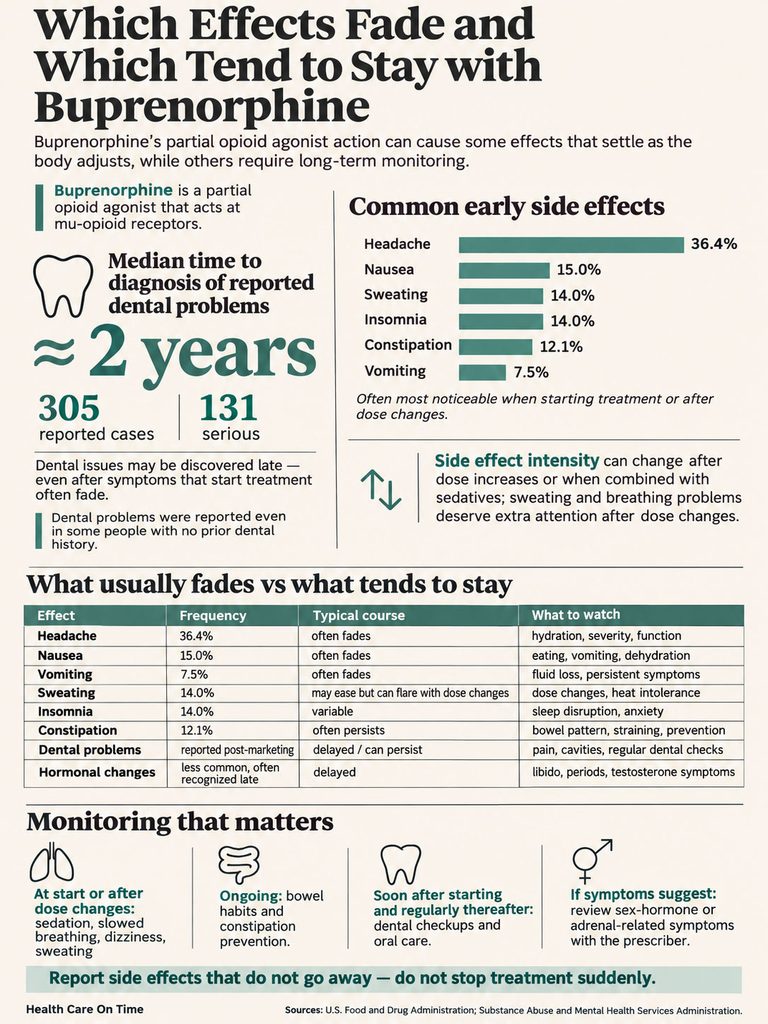
Everything in the table below assumes a steady dose, and the picture shifts when the dose changes, since sweating, sedation, constipation and nighttime breathing problems all tend to rise with it.
| Body system and effect | How often it shows up | Fades or lasts? | What to monitor | Call your prescriber when |
| Digestive: constipation | 12.1% on Suboxone vs 2.8% on placebo over 4 weeks; 9.4% on Sublocade 100 mg vs 0% on placebo | Often lasts; little tolerance develops | Bowel habits, straining, hard stools | Belly pain, swelling or vomiting with no bowel movement |
| Dental: cavities, broken teeth, tooth loss (films and tablets only) | 305 cases sent to the FDA through 2018; true rate unknown | Builds slowly; median about 2 years to diagnosis | Dental exam soon after starting, then regular checkups | Tooth pain, a cracked tooth, gum swelling |
| Skin: sweating | 14.0% vs 10.3% on placebo over 4 weeks; 12% over 16 weeks | Often lasts; likely dose-related | Night sweats, soaked clothing | Sweats with fever or weight loss, or sweats that disrupt work or sleep |
| Sleep: insomnia and night breathing | Insomnia 14.0% vs 15.9% on placebo over 4 weeks; 25% over 16 weeks | Insomnia often improves; breathing problems can grow with dose | Sleep quality, daytime sleepiness, snoring | Pauses in breathing seen by a partner, morning headaches |
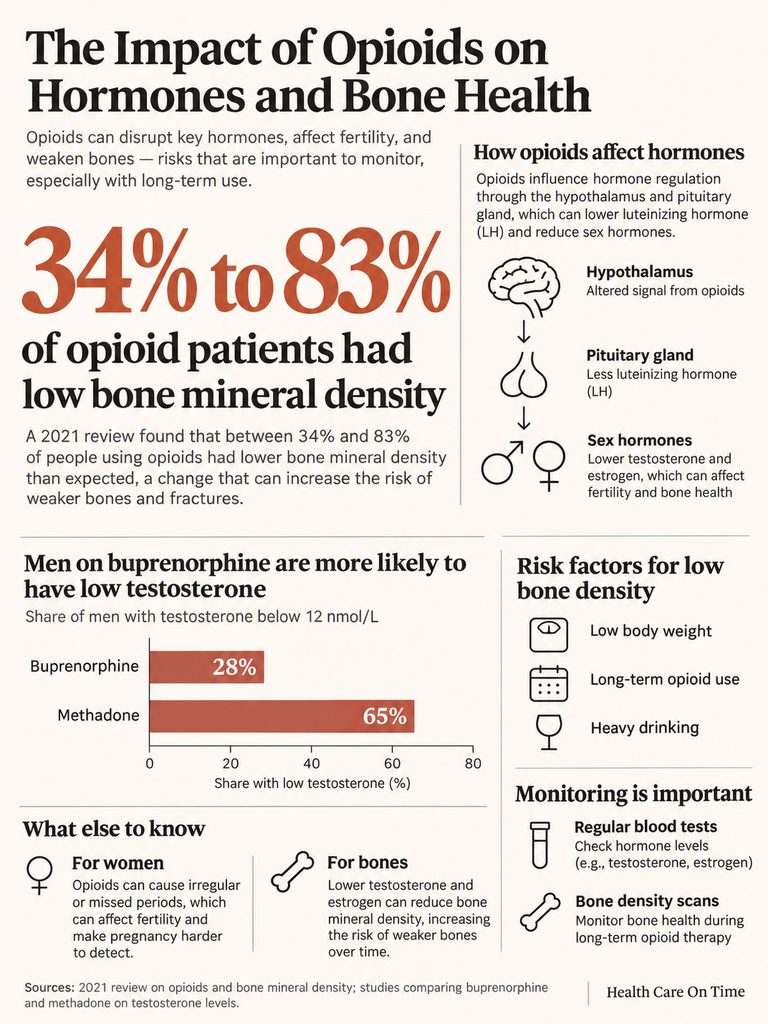
| Hormones: libido, testosterone, periods | Low testosterone in 28% of men on buprenorphine vs 65% on methadone in one study | Can last during treatment | Testosterone level if symptoms appear; cycle changes | Erection problems, missed periods, trouble conceiving |
| Liver: raised ALT and AST | ALT above 3 times normal in 5.4% on Sublocade 100 mg vs 4.0% on placebo | Usually mild; serious hepatitis is rare | Liver tests before starting and periodically | Yellow skin or eyes, dark urine, pale stools |
| Adrenal glands: adrenal insufficiency | Rare; seen more often after more than 1 month of opioid use | Can appear late | Testing only when symptoms suggest it | Nausea, fatigue, weakness, dizziness and low blood pressure together |
| Dependence and withdrawal | Expected with daily use | Lasts as long as treatment does | Missed doses, running out early | Before any dose change or plan to stop |
Teeth and hormones are the rows people tend to discover late, often only after a cracked molar or months of feeling flat.
The Early Effects That Usually Fade
Headache is the classic first-month complaint. In the four-week trial described in the Suboxone prescribing information, it affected 36.4% of people on the drug and 22.4% on placebo. Stomach trouble came next, with nausea in 15.0% versus 11.2%, vomiting in 7.5% versus 4.7%, and abdominal pain in 11.2% versus 6.5%.
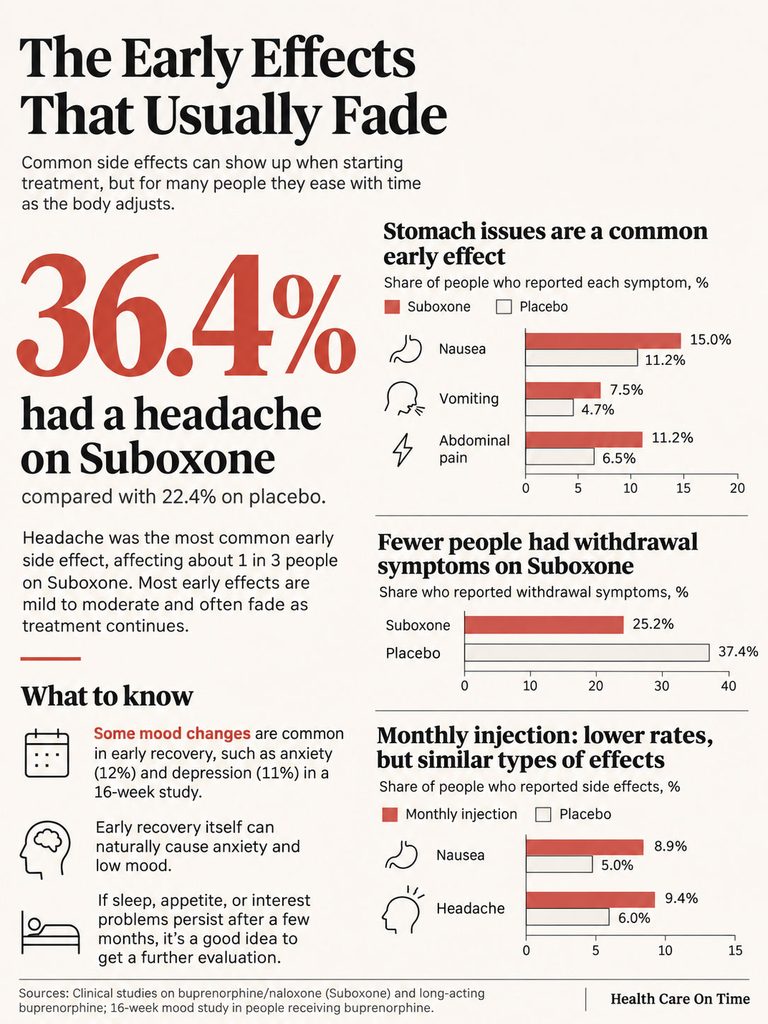
Withdrawal symptoms ran the other way, 25.2% on Suboxone and 37.4% on placebo, which makes sense, since the medicine was treating them. The monthly injection showed smaller gaps, with nausea at 8.9% versus 5% and headache at 9.4% versus 6%. Once the dose is steady, most of this settles.
Mood is murkier. Anxiety showed up in 12% of people and depression in 11% over a 16-week study, yet that study compared doses of buprenorphine with each other and had no placebo group, and early recovery brings plenty of anxiety and low mood on its own. So nobody can say how much of it belongs to the drug. If sleep, appetite or interest in daily life keeps slipping after the first few months, get it looked at as a problem in its own right.
Constipation That Doesn’t Adapt
The gut rarely adjusts. Opioid receptors line the intestines, and when they’re occupied, the muscles that move stool along slow down while the colon pulls more water out of what’s left, so stools get harder and come less often.
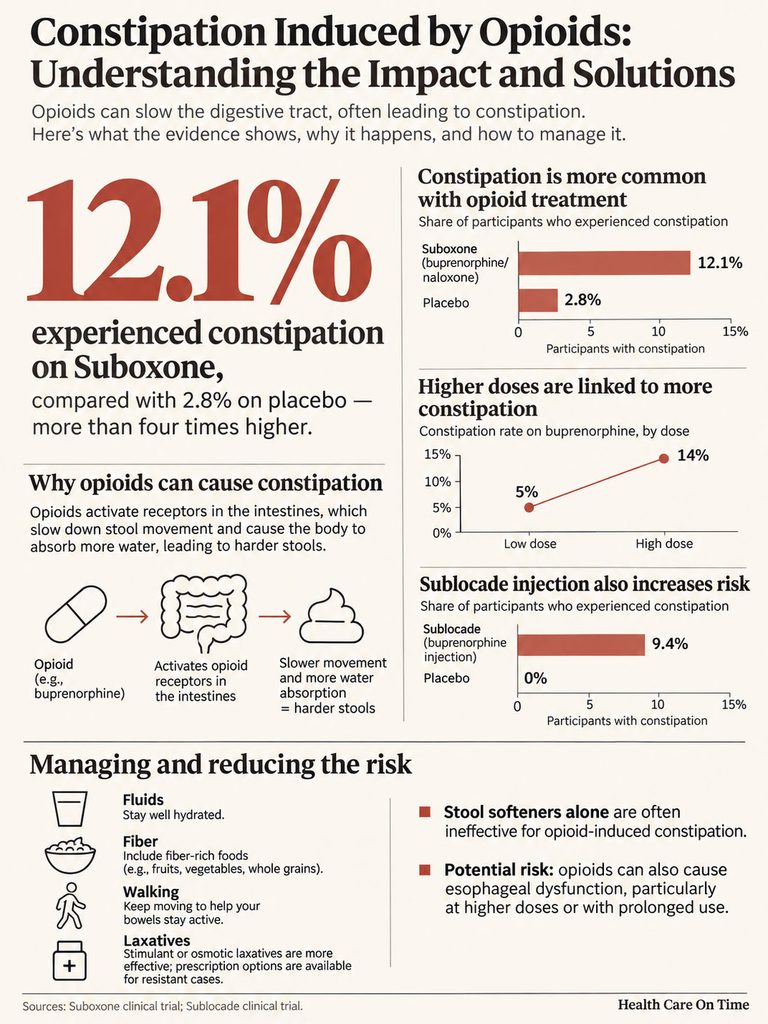
Constipation shows up with every form of the drug. It hit 12.1% of people in the four-week Suboxone trial against 2.8% on placebo, roughly four times as often, and in a 16-week study of a buprenorphine solution it climbed with the dose, from 5% in the very-low-dose group to 14% in the high-dose group. Even the monthly shot isn’t spared, since 9.4% of people on Sublocade 100 mg were constipated while nobody in the placebo group was.
Fluids, fiber, walking and an over-the-counter laxative picked with a pharmacist handle most cases. A stool softener by itself tends to be too gentle for opioid constipation, one reason Colace and similar softeners often fall short here. Stimulant or osmotic laxatives usually do more, and prescription drugs made for opioid-induced constipation exist for the cases that don’t budge.
A rarer problem higher up has turned up since Sublocade was approved: opioid-induced esophageal dysfunction, which makes swallowing hard and may be more likely at higher doses or with longer use. Food that seems to stick in your chest, or pain when you swallow, is worth a call.
Your Teeth and the FDA Dental Warning
Dental damage is the long-term effect most people taking Suboxone films never hear about until a tooth breaks. In January 2022, the FDA put out a Drug Safety Communication on dental problems with buprenorphine medicines that dissolve in the mouth, a group that includes Suboxone film, generic films and tablets, Subutex, Zubsolv and Belbuca.
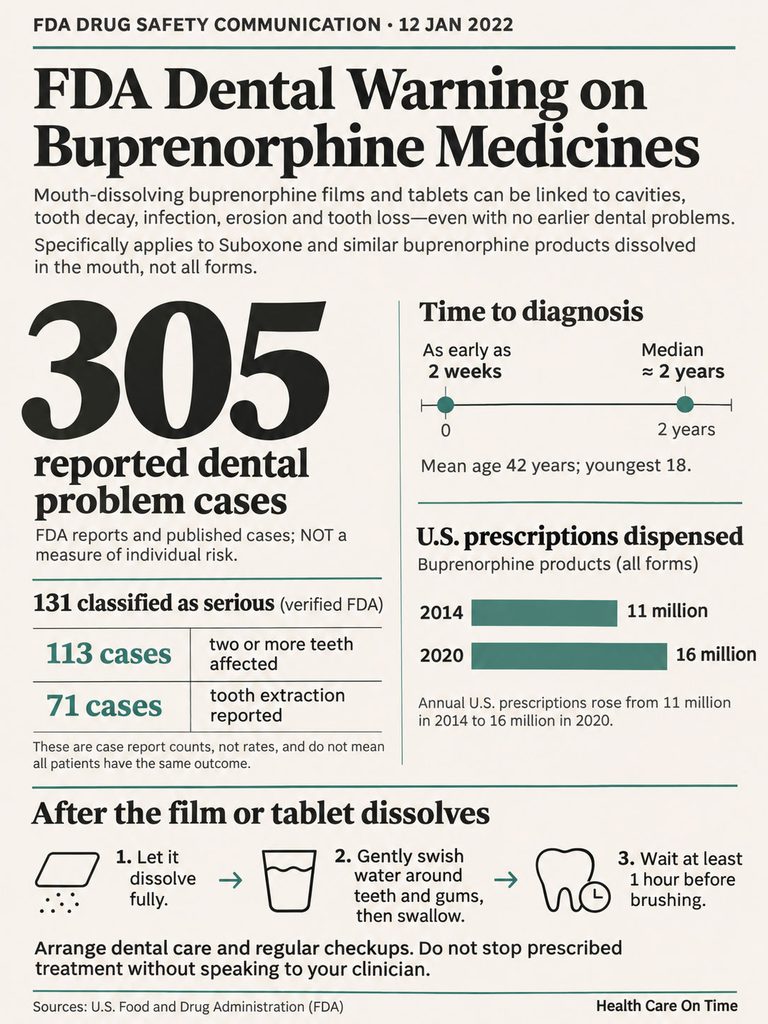
The agency had gathered 305 cases of tooth decay, cavities, abscesses, erosion or tooth loss, and 131 of them were serious. The damage usually surfaced slowly, with a median of about two years before diagnosis, though a few cases appeared as early as two weeks in, and the damage was often widespread: 113 cases involved two or more teeth, and pulling the tooth, done in 71 cases, was the most common fix. In 26 cases the person had no dental history at all. Patients averaged 42 years old and the youngest was 18. Twenty-eight of them were taking buprenorphine for pain instead of addiction.
None of that adds up to a rate. Case reports can’t show how many users never had a problem, and people with opioid use disorder tend to start out with more dental disease. Still, with yearly prescriptions for these products rising from about 11 million in 2014 to about 16 million in 2020, the FDA added a dental warning to every one of their labels, while making clear that the benefits of treatment outweigh the risk.
What the warning changed day to day
The routine is simple. Once the film or tablet has fully dissolved, take a big sip of water, swish it gently over your teeth and gums, and swallow. Then hold off at least one hour before brushing, because scrubbing right away can wear down enamel. Prescribers are now asked to send patients for a dental exam soon after starting, and dentists are asked to do a baseline exam, judge cavity risk and set up a prevention plan. If you’ve been on films or tablets for a year or more and your dentist has no idea, bring it up at the next visit.
Injections and patches weren’t tied to these problems, which makes switching forms an obvious thing to raise with the prescriber if your teeth keep breaking.
Hormones: Sex Drive, Testosterone, Periods and Bone
Opioids act on the hypothalamus and pituitary gland, the part of the brain that tells the testes and ovaries how much hormone to make. Over time, steady opioid use can lower luteinizing hormone and leave the body short on sex hormones, which shows up as low libido, erection problems, missed periods or infertility. How much of that comes from buprenorphine itself is still unclear. Stress, illness, weight and years of past drug use all push hormone levels around too, so research hasn’t been able to separate out the drug’s share, and blood work beats guessing.
Men
Buprenorphine seems to be gentler on testosterone than methadone. An Australian study of 103 men in treatment found total testosterone below 12 nmol/L in 28% of the men on buprenorphine and 65% of those on methadone, and at a stricter 8 nmol/L cutoff the split was 11% and 39%. With only 19 men in the buprenorphine group, the exact percentages are best read as rough.
Men who want children later should bring this up early, because the reduced fertility that can come with long-term opioid use may not fully reverse.
Low testosterone feels like low sex drive, weak erections, fatigue, flat mood and lost muscle. A morning blood test is the place to start. If the level really is low, the answer might be a dose change, treating sleep apnea or excess weight, or testosterone therapy, which brings risks of its own.
Women
In women the menstrual cycle is usually the first thing to shift, with periods turning irregular or stopping altogether. Long-term opioid use may also reduce fertility in both sexes, and whether that effect fully reverses is unknown. Lower fertility still leaves room for pregnancy, so anyone who doesn’t want to conceive needs birth control, and anyone who is trying and struggling should mention the medicine to the doctor helping them.
A missed period on buprenorphine can still hide a pregnancy, so a pregnancy test is the sensible first check when a period doesn’t come.
Bones
Low testosterone and low estrogen both thin bone over the years. A 2021 systematic review of people in opioid treatment found low bone mineral density in anywhere from 34% to 83% of patients, depending on the study, and linked it to male sex, low body weight, low testosterone, methadone or heroin use, and long stretches of heavy drinking. Nearly everyone in those studies was on methadone. Buprenorphine made up a small slice of just one, so its effect on bone is still an open question. With other risk factors on top, such as low weight, smoking or long-term steroid use, a bone density scan is worth asking about.
Sweating, Sleep and Breathing at Night
Drenching sweats are one of the most common complaints from people who have been stable for months. Sweating affected 14.0% of people on Suboxone in the four-week trial against 10.3% on placebo, and about 12% across all doses in the 16-week study. It tends to track with dose. Addiction psychiatrists writing in Frontiers in Psychiatry in 2024 put sweating, sedation and lower libido on their list of likely dose-related effects, at a time when many patients are started on 24 to 32 mg a day because of fentanyl and kept there indefinitely, and they suggest that once someone is stable, a trial of a lower dose may be worth considering. Some people need the higher dose to stay safe, so that trial is for the prescriber to weigh.
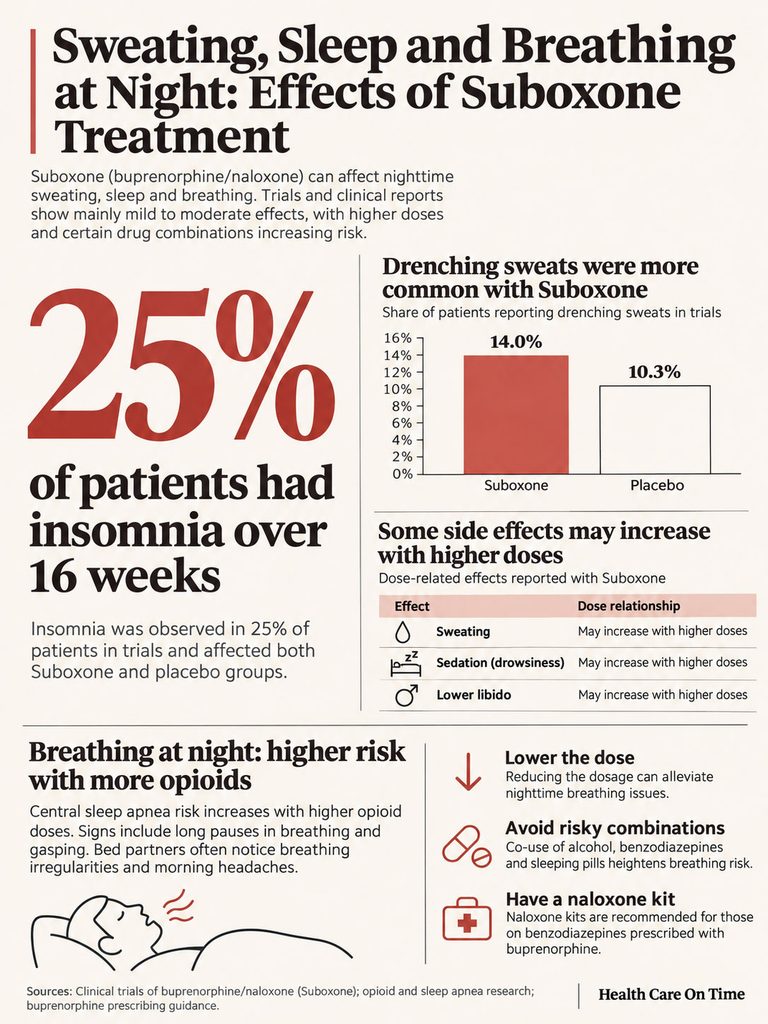
Insomnia is harder to pin on the drug. It showed up in 25% of people over 16 weeks, but in the short trial it was nearly as common on placebo as on Suboxone, which points toward withdrawal, stress and the upheaval of early recovery. Many people sleep better once life settles.
Breathing at night is the bigger worry. Opioids can cause central sleep apnea, in which the brain briefly stops telling the lungs to breathe, along with low oxygen during sleep, and the risk rises with dose. A bed partner usually notices first. Long pauses, gasping and loud, uneven breathing are the signs, along with morning headaches and heavy daytime sleepiness, and a sleep study settles the question. Lowering the dose sometimes fixes it.
Alcohol, benzodiazepines, sleeping pills and gabapentin all make nighttime breathing problems more dangerous. Someone on a benzodiazepine still shouldn’t be turned away from buprenorphine, since untreated opioid use disorder is the bigger threat, but the combination calls for a plan and a naloxone kit at home.
Liver Health: What the Blood Tests Show
Early reports of hepatitis in people taking buprenorphine are part of why the liver comes up so often, and the prescribing information still lists cases ranging from mild enzyme rises with no symptoms to rare liver failure. In most of those cases something else was in play, such as hepatitis B or C, another liver-toxic drug or ongoing injection drug use.
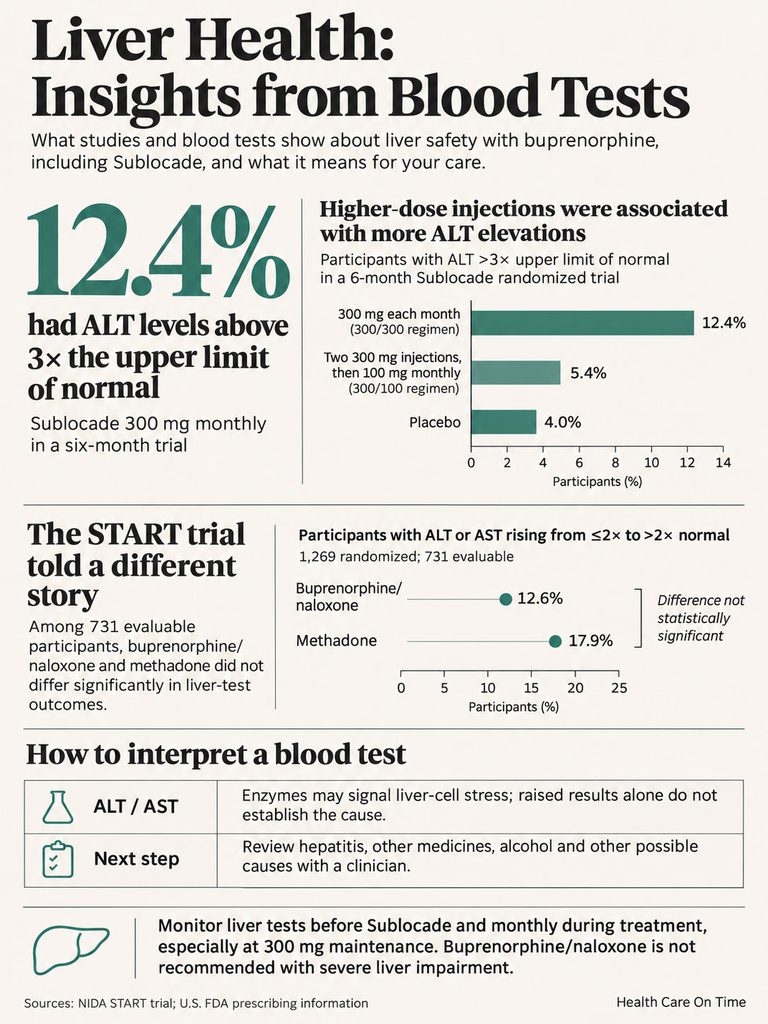
The cleanest answer came from the START trial, run by the National Institute on Drug Abuse’s Clinical Trials Network, which randomly assigned 1,269 people to buprenorphine-naloxone or methadone for 24 weeks and tracked their liver enzymes. Liver test changes came out the same on both drugs. Hepatitis B or C at the start was the only thing that predicted enzymes moving from normal to high, extreme jumps were rare (9 people on buprenorphine, 15 on methadone), and neither medicine showed signs of harming the liver over those first six months.
ALT and AST are enzymes that leak into the blood when liver cells are under stress, so a rise is a signal to look closer rather than proof of harm. Sublocade is a slightly different story, because the injection keeps blood levels steadier and higher. In the trials behind the Sublocade prescribing information, ALT rose above three times the upper limit of normal in 5.4% of people getting 300 mg followed by 100 mg monthly and in 12.4% of those getting 300 mg every month, compared with 4.0% on placebo. Nobody in those trials had serious liver injury blamed on the drug, but monthly liver tests are recommended, particularly at the 300 mg dose. For films and tablets, the schedule is a test before starting and periodic checks after that.
A high result can come from plenty of places besides buprenorphine, from alcohol to muscle injury, and the usual causes of a high AST are worth ruling out before blaming the medicine. People with severe liver impairment shouldn’t take the buprenorphine-naloxone combination, because a damaged liver lets naloxone build up.
Rarer Long-Term Problems Worth Knowing
Most people never run into the problems below, but each one can appear months into treatment, and their early signs are easy to mistake for something else.
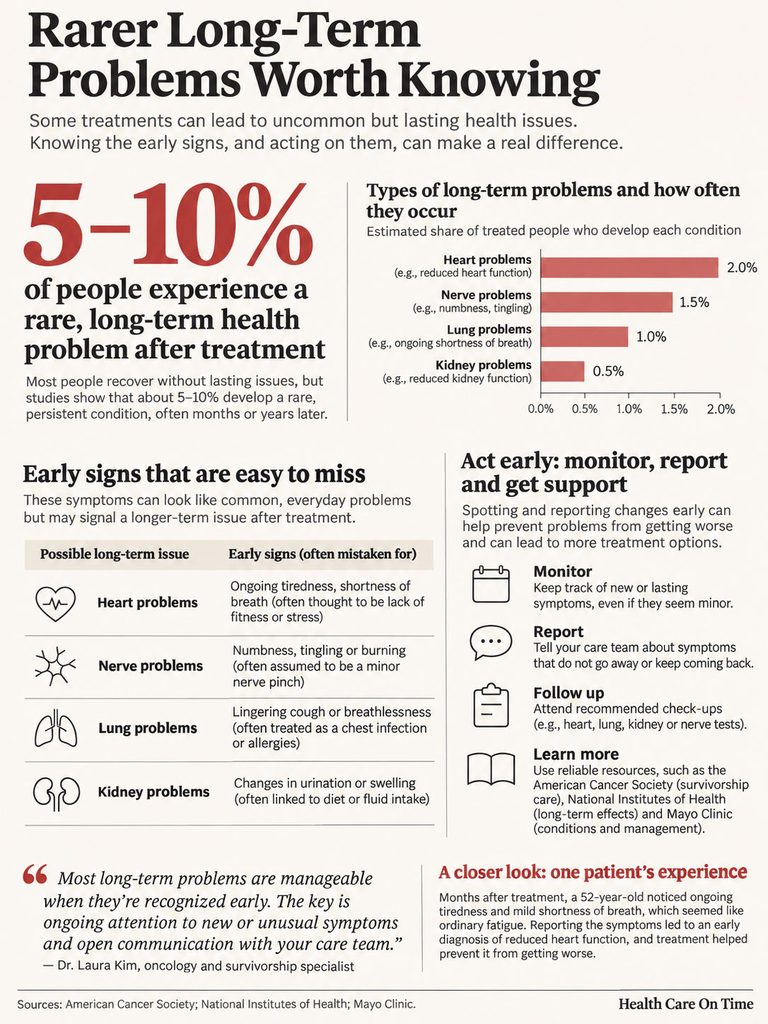
- Adrenal insufficiency. The adrenal glands make cortisol, and long-term opioid use can suppress them, more often after more than one month. The signs are vague: nausea, vomiting, poor appetite, fatigue, weakness, dizziness and low blood pressure. A blood test confirms it, and steroid replacement treats it.
- Heart rhythm changes. Buprenorphine lengthens the QT interval by 15 milliseconds or less, which on its own is unlikely to cause dangerous rhythms. Low potassium or magnesium, heart failure or other QT-prolonging drugs make it matter more.
- Swelling and mouth problems. Leg and foot swelling (peripheral edema), mouth sores, an inflamed tongue and numbness in the mouth have all turned up with the films.
- Low blood sugar. It has turned up mostly in people with diabetes or another risk factor, which makes regular glucose checks more important for anyone in that group.
- Serotonin syndrome. Rare but serious, it can happen when buprenorphine is combined with antidepressants or other serotonergic drugs, with agitation, fever, a fast heartbeat and muscle twitching as warning signs. Anyone also taking Zoloft (sertraline) or a similar antidepressant should make sure every prescriber knows about both.
Dependence Is Expected, and Stopping Carries the Risk
Physical dependence and addiction are two different things. Dependence just means the body has adjusted to a daily opioid, so stopping suddenly brings on withdrawal. With buprenorphine that withdrawal is usually milder than with full opioids and may start later, because it’s a partial agonist with a long half-life, 24 to 42 hours for the film. The monthly injection stretches this out much further: blood levels stay in the therapeutic range for two to five months after the last shot, and the drug can still be detected a year or more later. Missed doses and running out early can bring on the same withdrawal, which is one more reason to keep refills on schedule.
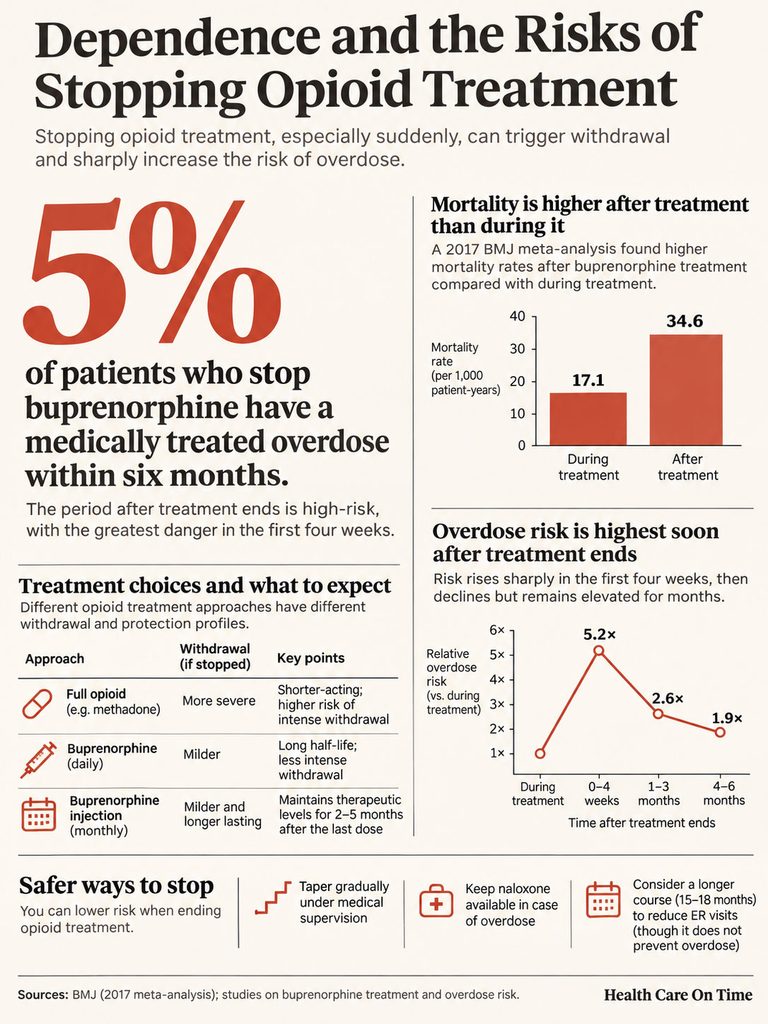
The real danger comes after treatment ends, when tolerance drops fast and an amount of fentanyl someone could have survived months earlier can kill. Across 15,831 people in a 2017 BMJ meta-analysis, deaths from any cause ran at 4.3 per 1,000 person-years during buprenorphine treatment and 9.5 after it, with overdose deaths at 1.4 versus 4.6, and the first four weeks off treatment were the worst stretch, at 32.0 per 1,000, before the rate eased to 10.9. In the US, researchers who followed 8,996 Medicaid patients who stopped after six to 18 months of treatment found that roughly 5% had a medically treated overdose within six months no matter how long they’d been on it, and between 42.1% and 49.9% ended up in an emergency room. Staying 15 to 18 months lowered the odds of ER visits, hospital stays and new opioid prescriptions compared with stopping at six to nine months, yet it didn’t protect anyone from overdose. Stopping is also common, and the same researchers estimate that 50% to 80% of patients who start buprenorphine stop within weeks or months.
So when a side effect is wearing you down, adjusting the treatment is almost always safer than quitting it. People who do decide with their prescriber to come off generally go slowly, under supervision, with a relapse plan and naloxone on hand. Some then move to monthly naltrexone, which blocks opioid receptors outright and can only start once buprenorphine has cleared the body.
Is It Safe to Stay on Buprenorphine for Years?
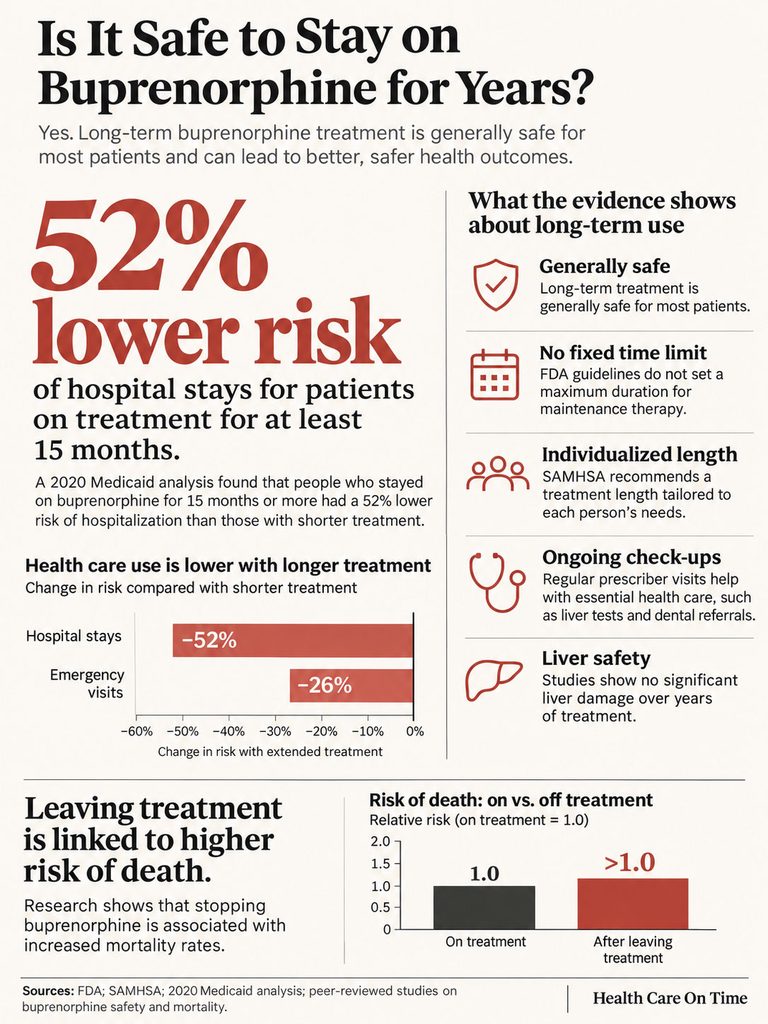
For most people, yes, and the evidence favors longer treatment over shorter. The FDA-approved labeling sets no maximum length for maintenance and allows that some patients may need it indefinitely, for as long as they benefit, and federal guidance from SAMHSA calls for tailoring the length to each person. In a second Medicaid analysis, published in Health Affairs in 2020, people who stayed on buprenorphine for at least 15 months had a 52% lower risk of hospital stays from any cause and a 26% lower risk of emergency visits than those who stopped at six to nine months, and the steepest drops were in overdoses and opioid-related hospital care. Staying in treatment also keeps people in regular contact with a prescriber, and those visits are when liver tests, dental referrals and hormone checks actually get done.
| Finding | Number | Source |
| US drug overdose deaths in 2025 | 69,973, down almost 14% from 81,313 in 2024 | CDC NCHS, May 2026 |
| Opioid-involved overdose deaths, 2024 to 2025 | 55,296 to 44,564 | CDC NCHS, May 2026 |
| US adults who needed opioid use disorder treatment (2022) | 3.7%, about 9,367,000 people | CDC MMWR, 2024 |
| Of those, share who received medication such as buprenorphine | 25.1%, about 2,353,000 people | CDC MMWR, 2024 |
| All-cause deaths per 1,000 person-years, in vs out of buprenorphine treatment | 4.3 vs 9.5 | Sordo et al., BMJ 2017 |
| Medically treated overdose within 6 months of stopping, after 6 to 18 months of treatment | About 5% | Williams et al., Am J Psychiatry 2020 |
| Liver tests that differed between buprenorphine and methadone over 24 weeks | None; 9 vs 15 extreme elevations | START trial, Saxon et al. 2013 |
Years on buprenorphine don’t appear to cause the slow, building organ damage many people fear. Liver tests hold steady in trials, the hormone and dental effects can be checked and treated, and leaving treatment raises the death rate, so for most people the balance favors staying on.
Film or Tablet vs the Monthly Shot
Switching forms changes which side effects you’re likely to deal with. Sublocade, given monthly under the skin of the abdomen, thigh, buttock or back of the upper arm, avoids the dental problem tied to films and tablets and removes the daily decision to dose. Its trade-off is the injection site. In trials, 16.5% of the 848 people who got it had pain, itching, redness or hardening where the shot went in, and even 9.0% of the placebo group in the main trial had a reaction, so some of it comes from the needle itself. A firm lump can linger for weeks. Rare abscesses, ulcers and tissue death have been reported since approval, which is why the shot has to go under the skin and never into a muscle or vein.
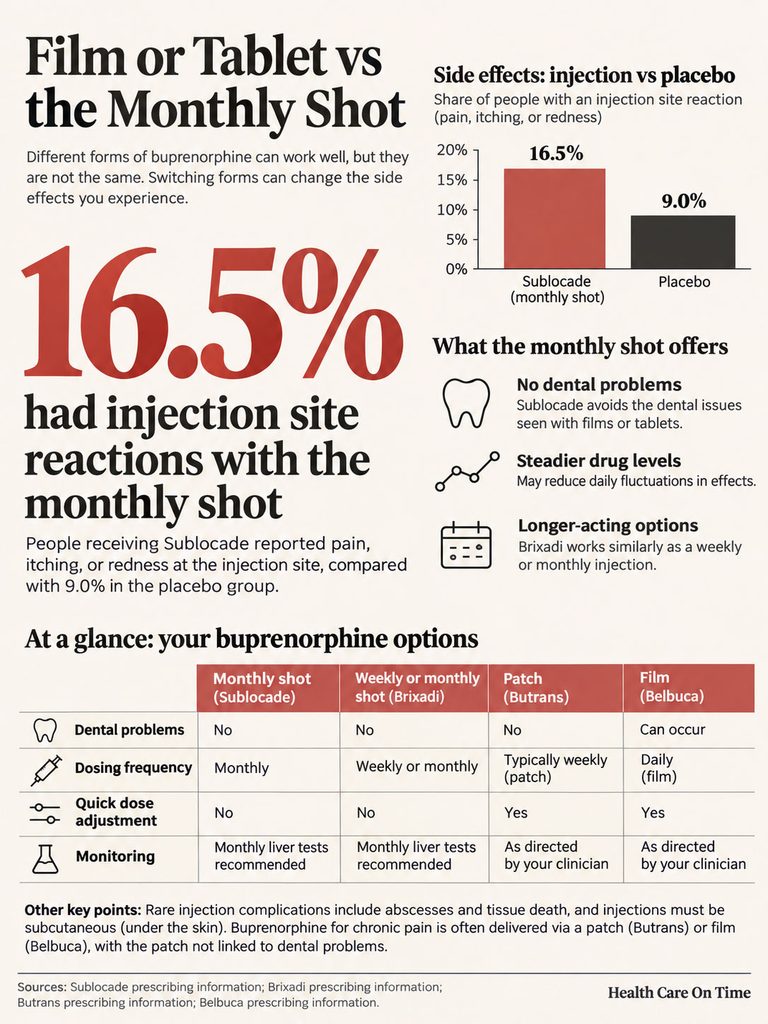
Steadier levels mean some people feel less up-and-down through the day. The downside is that the dose can’t be pulled back quickly if a side effect becomes a problem, and liver tests are recommended every month. Brixadi, a weekly or monthly shot, works the same way.
People using buprenorphine for chronic pain usually get it as a skin patch (Butrans) or a film pressed against the cheek (Belbuca). The patch wasn’t linked to dental problems. Belbuca dissolves in the mouth, so the same dental warning and the same rinse-and-wait routine apply.
Pregnancy and Breastfeeding
Buprenorphine and methadone are both first-choice treatments for opioid use disorder in pregnancy, and buprenorphine comes out ahead for the baby on several counts. In a 2022 New England Journal of Medicine study of Medicaid pregnancies, neonatal abstinence syndrome affected 52.0% of babies exposed to buprenorphine and 69.2% of those exposed to methadone. Preterm birth ran 14.4% versus 24.9%, and low birth weight 8.3% versus 14.9%. Outcomes for the mothers, such as cesarean delivery, were about the same.
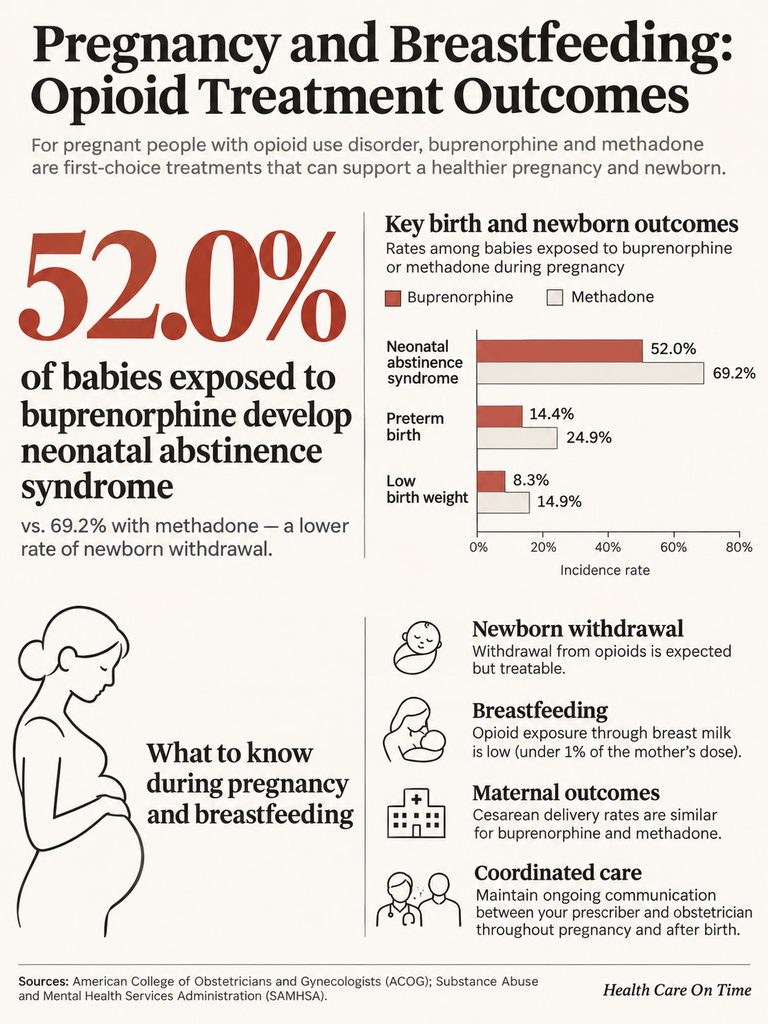
Some withdrawal in a newborn exposed to any opioid is expected and treatable. Exposure through breast milk is low, under 1% of the mother’s daily dose, and because doses sometimes need to rise during pregnancy, staying in close touch with both the prescriber and the obstetrician matters.
What to Do When a Side Effect Builds Up
A side effect that appears after a year on a steady dose usually has a cause worth tracking down, whether that’s a new medicine, a change in weight, a dental problem that started small, or a dose that’s now higher than needed.
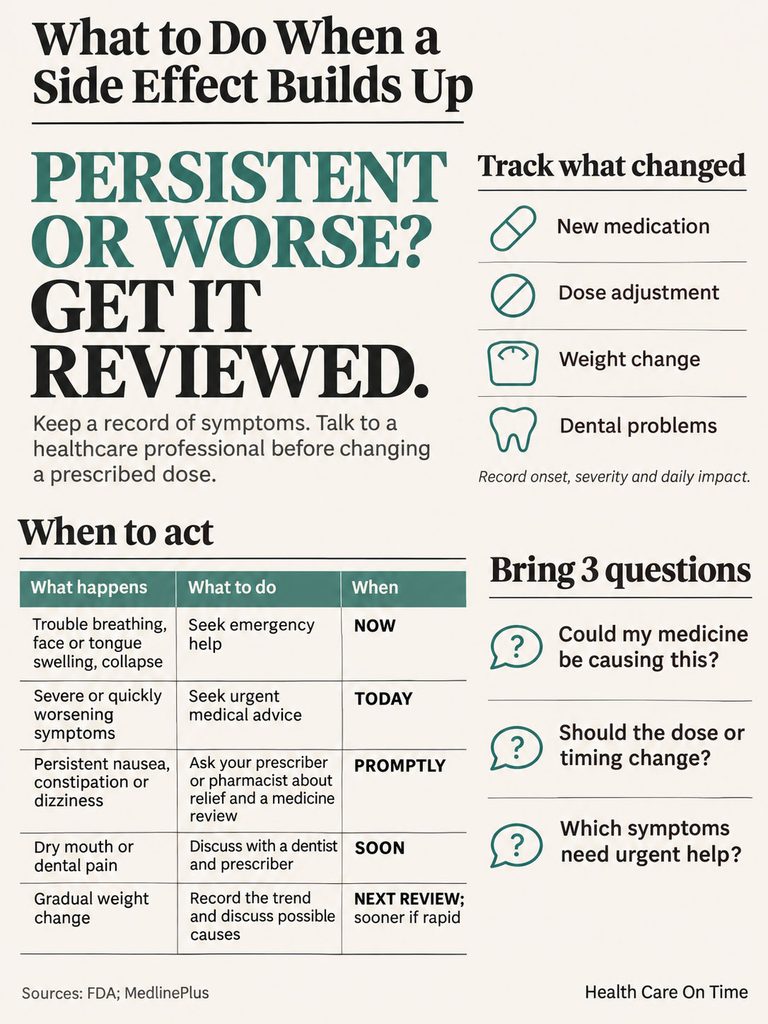
| Situation | What to do | How soon |
| Constipation every week despite fiber and fluids | Ask a pharmacist or prescriber about a stimulant or osmotic laxative, or a prescription option | At your next refill or visit |
| A tooth chips, aches or feels loose | See a dentist and say you take buprenorphine; ask about switching to an injection if damage keeps happening | Within days |
| Low sex drive, erection problems or missed periods for months | Ask for a morning testosterone test or hormone workup, and a pregnancy test if relevant | Within a few weeks |
| Soaking night sweats | Review your dose and other drugs with your prescriber; rule out infection or thyroid problems | At your next visit, sooner with fever |
| Partner sees pauses in your breathing at night | Ask for a sleep study and a dose review; avoid alcohol and sedatives | Within 1 to 2 weeks |
| Fatigue, nausea, dizziness and low blood pressure together | Ask about testing for adrenal insufficiency | Within days |
| Yellow eyes, dark urine or pale stools | Get liver tests urgently | Same day |
Going in with specific questions makes an appointment far more useful. A few worth asking:
- Could a lower dose take care of the sweating or the daytime sleepiness?
- When were the last liver tests, and when is the next one due?
- With a sex drive this low, is it time to check testosterone?
- Would the monthly shot be easier on the teeth than the film?
- Does anything else on the medication list, like an anxiety pill, a sleep aid or a painkiller, add to the breathing risk?
- If stopping is the goal someday, what would a safe plan look like?
When to Get Help Right Away
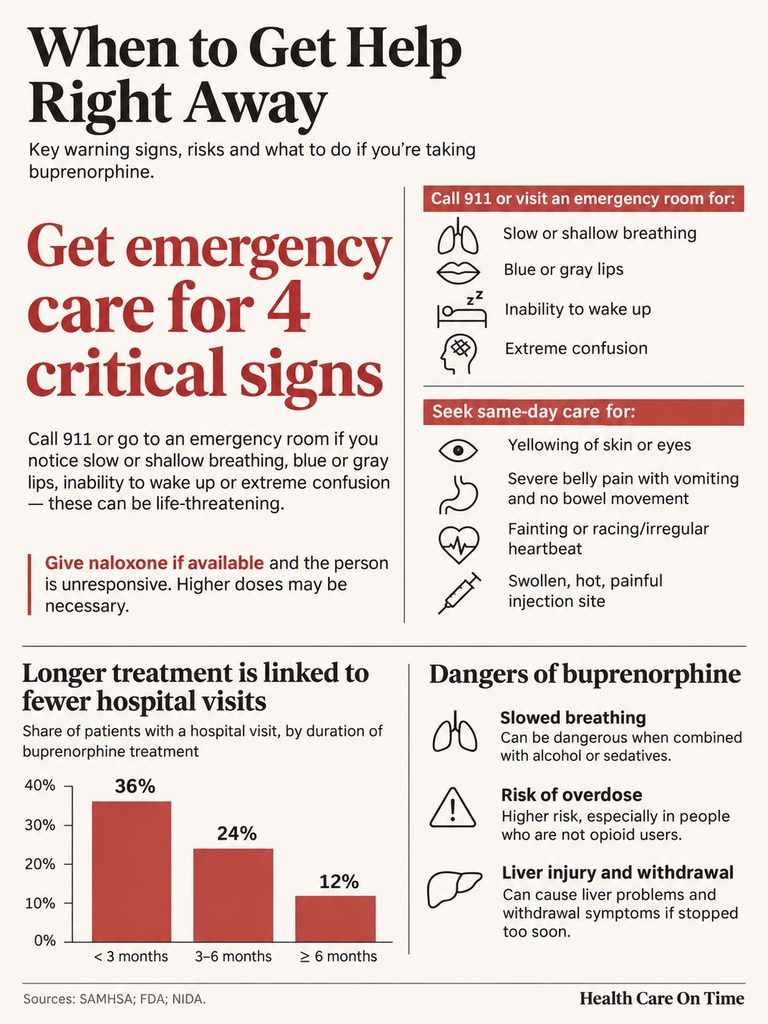
Call 911 or go to an emergency room if you or someone with you has slow or shallow breathing, blue or gray lips, can’t be woken up, or is extremely confused. Give naloxone if you have it and the person is not responding normally; higher or repeated doses may be needed because buprenorphine binds tightly to the receptors. Seek same-day care for yellowing of the skin or eyes, severe belly pain with vomiting and no bowel movement, fainting, a racing or irregular heartbeat, or a swollen, hot, painful injection site.
Frequently Asked Questions
What are the dangers of buprenorphine?
The serious risks are slowed breathing when it’s mixed with alcohol or sedatives, overdose in anyone who doesn’t take opioids (children above all), liver injury, adrenal insufficiency, dental damage from films and tablets, and withdrawal if it’s stopped suddenly. Leaving treatment is the most dangerous moment of all, with death rates in the first four weeks afterward far higher than during treatment. Keep doses locked up and out of reach of kids and visitors, and keep naloxone in the house.
How long should patients be on buprenorphine?
There’s no set end date. Treatment can continue indefinitely, and people who stay 15 months or more have fewer hospital stays and ER visits than those who stop at six to nine months. When to stop depends on how stable life is and what the person wants, and it’s a decision to make with the prescriber.
Is buprenorphine a weak or strong opioid?
Both, depending on what you measure. It grips opioid receptors very tightly, which is why it blocks other opioids and why naloxone sometimes needs repeat doses to reverse it. As a partial agonist, though, its effects flatten out at higher doses. For someone who doesn’t use opioids, even a 2 mg dose can be dangerous.
How do you feel after taking buprenorphine long term?
On a stable dose, most people feel normal: no high, no withdrawal, cravings mostly quiet. The first weeks can bring headache, nausea, sleepiness or restlessness. Years in, the usual leftovers are sweating, constipation and a lower sex drive. Feeling sedated or foggy months into treatment can mean the dose is higher than needed, which is worth raising.
Can Suboxone make your teeth fall out?
It can damage teeth, and some of the 305 cases the FDA reviewed ended in tooth loss. Those were reports, though, so they can’t show how common it is. Rinsing with water after the film dissolves, waiting an hour to brush and seeing a dentist regularly all lower the risk.
Does buprenorphine lower testosterone?
It can, though usually less than methadone. In one study, 28% of men on buprenorphine had low testosterone compared with 65% on methadone. A morning blood test sorts it out.
Can buprenorphine damage your liver?
Serious damage is rare. In a 24-week trial of 1,269 people, liver tests changed no more on buprenorphine than on methadone, and hepatitis B or C was the main reason enzymes rose. Expect liver tests at the start and periodically after that, and monthly on Sublocade.
Do buprenorphine side effects go away?
Many do. Nausea, headache and early sleepiness usually fade within weeks of reaching a steady dose. Constipation, sweating, low libido and dental risk tend to stick around as long as you take it, though each one can usually be eased.
Why does Suboxone cause so much sweating?
Sweating is one of the opioid effects the body often never adjusts to, and in many people it seems to rise with the dose. Placebo matters here too: in the four-week trial it affected 14.0% of people on Suboxone but also 10.3% on placebo, so not every drenched night shirt traces back to the medicine. That’s why a dose review makes a sensible first step, and why sweats that come with fever or weight loss need a separate check for infection or thyroid problems, since buprenorphine shouldn’t be blamed for everything. Light layers, breathable bedding and cutting back on caffeine and alcohol help some people while the cause gets sorted out.
Medical disclaimer: This article is for general information and is not medical advice. It does not replace care from a licensed clinician who knows your history. Do not change your buprenorphine dose or stop treatment without talking to your prescriber. If you think someone is overdosing, call 911 and give naloxone if you have it. For help finding treatment, call the SAMHSA National Helpline at 1-800-662-4357.
References
- Indivior Inc. SUBOXONE (buprenorphine and naloxone) sublingual film, prescribing information, revised 05/2025. U.S. Food and Drug Administration. https://www.accessdata.fda.gov/drugsatfda_docs/label/2025/022410s056lbl.pdf
- Indivior Inc. SUBLOCADE (buprenorphine extended-release) injection, prescribing information, revised 12/2025. https://www.sublocade.com/Content/pdf/prescribing-information.pdf
- U.S. Food and Drug Administration. FDA warns about dental problems with buprenorphine medicines dissolved in the mouth to treat opioid use disorder and pain. Drug Safety Communication, January 12, 2022. https://www.fda.gov/drugs/drug-safety-and-availability/fda-warns-about-dental-problems-buprenorphine-medicines-dissolved-mouth-treat-opioid-use-disorder
- Substance Abuse and Mental Health Services Administration. Buprenorphine. Updated April 2026. https://www.samhsa.gov/substance-use/treatment/options/buprenorphine
- Hallinan R, Byrne A, Agho K, et al. Hypogonadism in men receiving methadone and buprenorphine maintenance treatment. Int J Androl. 2009;32(2):131-139. https://researchers.westernsydney.edu.au/en/publications/hypogonadism-in-men-receiving-methadone-and-buprenorphine-mainten/
- Ramli FF, Syed Hashim SA, Mohd Effendy N. Factors associated with low bone density in opioid substitution therapy patients: a systematic review. Int J Med Sci. 2021;18(2):575-581. https://medsci.org/v18p0575.htm
- Jain L, Meeks TW, Blazes CK. Reconsidering the usefulness of long-term high-dose buprenorphine. Front Psychiatry. 2024;15:1401676. https://public-pages-files-2025.frontiersin.org/journals/psychiatry/articles/10.3389/fpsyt.2024.1401676/text
- Saxon AJ, Ling W, Hillhouse M, et al. Buprenorphine/naloxone and methadone effects on laboratory indices of liver health: a randomized trial. Drug Alcohol Depend. 2013;128(1-2):71-76. https://ctnlibrary.org/document/901/
- Sordo L, Barrio G, Bravo MJ, et al. Mortality risk during and after opioid substitution treatment: systematic review and meta-analysis of cohort studies. BMJ. 2017;357:j1550. https://pmc.ncbi.nlm.nih.gov/articles/PMC5421454/
- Williams AR, Samples H, Crystal S, Olfson M. Acute care, prescription opioid use, and overdose following discontinuation of long-term buprenorphine treatment for opioid use disorder. Am J Psychiatry. 2020;177(2):117-124. https://pmc.ncbi.nlm.nih.gov/articles/PMC7002204/
- Samples H, Williams AR, Crystal S, Olfson M. Impact of long-term buprenorphine treatment on adverse health care outcomes in Medicaid. Health Aff. 2020;39(5):747-755. https://ifh.rutgers.edu/?p=3503
- Dowell D, Brown S, Gyawali S, et al. Treatment for opioid use disorder: population estimates, United States, 2022. MMWR. 2024;73(25):567-574. https://pmc.ncbi.nlm.nih.gov/articles/PMC11254342/
- National Center for Health Statistics. U.S. overdose deaths decrease for third consecutive year in 2025. May 13, 2026. https://www.cdc.gov/nchs/pressroom/releases/20260513.html
- Suarez EA, Huybrechts KF, Straub L, et al. Buprenorphine versus methadone for opioid use disorder in pregnancy. N Engl J Med. 2022;387(22):2033-2044. https://escholarship.org/content/qt834912kt/qt834912kt.pdf